Tag: Kyrgyzstan

  • Kazakhstan and Kyrgyzstan Sign Memorandum to Boost AI and Digital Development

    Kazakhstan and Kyrgyzstan Sign Memorandum to Boost AI and Digital Development

    The Ministry of Artificial Intelligence and Digital Development of Kazakhstan and the Ministry of Digital Development of Kyrgyzstan have signed a memorandum of cooperation aimed at advancing digital technologies and strengthening bilateral collaboration in IT and artificial intelligence.

    The agreement focuses on experience sharing, the introduction of innovative solutions, and the development of the digital economy in both countries. The partnership is expected to enhance digital services, foster integration in the field of tech startups, and improve infrastructure to create more efficient and secure solutions in IT and AI.

    Officials emphasized that strengthening this strategic partnership opens up new opportunities for the implementation of digital technologies across Central Asia, contributing to long-term regional growth and innovation.

  • Kyrgyzstan Boosts Mineral Output in Early 2025 Amid Sector Consolidation

    Kyrgyzstan Boosts Mineral Output in Early 2025 Amid Sector Consolidation

    Kyrgyzstan recorded significant growth in gold, silver, coal, and natural gas production during the first half of 2025, according to data from the Kyrgyz Geological Service. Despite the increase, the number of active companies in the sector fell, reflecting a wave of license revocations and industry consolidation.

    Compared to the same period in 2024, the country produced an additional 700 kg of gold and 1.1 million cubic meters of natural gas. Silver production surged from 198 kg to 3.8 tons, while coal output rose from 3.1 million to 4.4 million tons.

    The state resource balance for January–June 2025 was as follows:

    • Regular gold: 5.8 tons

    • Placer gold: 57 kg (up from 28.3 kg)

    • Silver: 3.8 tons (up from 198 kg)

    • Coal: 4.4 million tons (up from 3.1 million tons)

    The sector also delivered stronger fiscal results, with tax and non-tax revenues climbing from 17.9 billion KGS ($205.2 million) in 2024 to 27.8 billion KGS ($318.5 million) in 2025. Industrial production reached 30.7 billion KGS ($352 million), an increase of nearly 3 billion KGS ($34.4 million).

    At the same time, licensing activity slowed. Authorities revoked 199 production licenses in the first half of 2025, citing inactivity, while only 15 new licenses were issued, compared with 26 during the same period last year. Expired permits were reallocated to other operators.

    Officials welcomed the rise in output as a positive contribution to GDP and a sign of improved efficiency. However, the report warned of risks to construction resources such as marble, sand, and gravel, which are being rapidly depleted due to high demand from the building sector.

    Experts caution that while the surge in mining strengthens revenues and energy security, long-term sustainability will require careful planning to prevent overexploitation of finite resources.

  • Kyrgyzstan Launches Underground Gold Mining at Kumtor, Prioritizing Sustainability and State Control

    Kyrgyzstan Launches Underground Gold Mining at Kumtor, Prioritizing Sustainability and State Control

    BISHKEK, Kyrgyzstan — President Sadyr Zhaparov officially launched an underground gold mining project at the Kumtor Gold Company during a working visit to the Issyk-Kul region on Wednesday, marking a significant shift in the country’s mining strategy and environmental approach.

    The project, which builds on over 1,600 meters of developed tunnels, is set to tap into high-grade ore deposits containing over 5 grams of gold per ton. The underground operation is expected to last 17 years and has added 147 tonnes of gold to Kyrgyzstan’s state reserve balance.

    President Zhaparov hailed the move as both an economic and environmental milestone.

    “This marks a new chapter for Kumtor — one that aligns with our goals of sustainable development and environmental protection, especially in preserving our glaciers,” he said.

    The president underscored the importance of the Kumtor deposit’s return to state ownership, calling it a historic achievement. Under domestic management since May 2021, Kumtor has generated $3.45 billion in revenue, of which $891.6 million has gone to the state budget. Over 54 tonnes of gold have been produced in that time, with $441 million in dividends transferred to the state — a dramatic increase compared to just $100 million during the previous 28 years of foreign operation.

    The project is being executed entirely by local specialists, with underground mining chosen for its lower environmental impact compared to open-pit methods. While open-pit operations will continue, the strategic focus will increasingly shift underground.

    Zhaparov also revealed plans to process gold-rich tailings and develop new sites, including the Togolok deposit and the Jangart exploration area, as part of Kyrgyzstan’s broader efforts to maximize national resource benefits.

  • Kyrgyzaltyn Strengthens Ties with Tajik Mining Giants Through Strategic Co-Op Agreements

    Kyrgyzaltyn Strengthens Ties with Tajik Mining Giants Through Strategic Co-Op Agreements

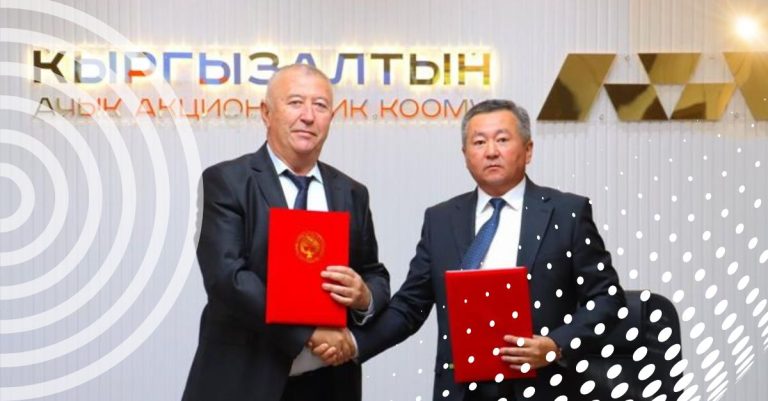
    Kyrgyzaltyn, Kyrgyzstan’s state-owned mining company, has entered on 27 August 2025 into significant co-operation agreements with three of Tajikistan’s premier mining firms: Talco Gold, Tajik-China Mining Company, and Pakrut. The memorandums of understanding were officially signed during a high-level visit by Tajikistan’s First Deputy Prime Minister, Hokim Kholikzoda, and a large business delegation.

    The agreements, which were announced by Kyrgyzaltyn, are intended to bolster the development of the mining sector across both nations. The focus will be on the implementation of advanced technologies, improving production efficiency, and creating new job opportunities.

    In a further sign of burgeoning economic ties, a separate memorandum was also signed between the Tajik delegation and the wheel processing and restoration plant belonging to Kumtor Gold Company, a subsidiary of Kyrgyzaltyn.

    As part of their visit, the Tajik delegation toured several key Kyrgyz enterprises, including the wheel processing and restoration factory and Kyrgyzaltyn’s main facilities.

    Kyrgyzaltyn, which holds a crucial position as the sole domestic producer of refined gold and gold bars in Kyrgyzstan, stated that the newly signed agreements will lay the groundwork for strengthened good-neighbourly relations and foster long-term, mutually beneficial collaboration between the two countries.

  • Kyrgyzaltyn Confident in Kumtor’s 2025 Gold Production Target

    Kyrgyzaltyn Confident in Kumtor’s 2025 Gold Production Target

    Bishkek, Kyrgyzstan – Kyrgyzaltyn OJSC, the sole shareholder of Kumtor Gold Company (KGC), has declared that Kumtor’s gold production plan for 2025 is “realistic and fully achievable.” This assertion comes from Kubat Abdraimov, Chairman of the Board of Kyrgyzaltyn, following a recent visit to the Kumtor mine.

    Abdraimov’s confidence stems from KGC’s strong production performance in 2024. Kumtor Gold Company’s 2024 revenue from gold sales reached $989.1 million, significantly exceeding the planned $739.3 million. The mine produced 12,552 kilograms of gold, surpassing its target of 12,509 kilograms.

    During his visit, Abdraimov thoroughly inspected various operations at the mine, including the progress of the underground gold mining project, the testing of recovered tires on dump trucks, the functioning of the gold processing plant, and the condition of the Central and Sary-Tor pits.


    Focus on Equipment and Efficiency

    Abdraimov paid particular attention to the heavy mining equipment repair workshop and the fueling complex. He emphasized the critical role of maintenance in Kumtor’s continuous operation. “The most modern special mining and auxiliary equipment is currently operating at the mine,” he noted. “Considering that the equipment operates in high-altitude and often in harsh weather conditions, and the mine itself does not stop for a minute, various breakdowns are inevitable. Much depends on the repairmen, whose high professionalism no one doubts.”

    He also highlighted the positive impact of the newly commissioned fueling complex, which has strengthened control over diesel fuel usage and resulted in “significant financial resources” being saved.

    Looking ahead, Abdraimov affirmed Kyrgyzaltyn’s commitment to continuous improvement and active promotion of digital transformation initiatives at the mine.

  • Kyrgyz Prime Minister Calls for Greater US Investment During Washington Visit

    Kyrgyz Prime Minister Calls for Greater US Investment During Washington Visit

    During his working visit to Washington, Prime Minister Adylbek Kasymaliev participated in a roundtable with members of the Kyrgyz-American Business Council, where he urged American companies to increase their investments in Kyrgyzstan’s economy, the Kyrgyz government reported.

    Kasymaliev emphasized that direct foreign investments from the United States serve as a significant driver of economic growth for the country. He assured that Kyrgyzstan is ready to offer favorable conditions for investors, including liberal tax policies, access to free economic zones, and markets with a combined population of over 500 million people.

    “Kyrgyzstan today is a country of new opportunities and prospects, with a dynamically developing economy and open policies. We are prepared to provide comprehensive support for investment projects at all stages of implementation and offer the necessary state assistance,” Kasymaliev stated.

    He highlighted priority sectors for investment, including:

    • The launch of Kambar-Ata Hydroelectric Power Plant-1;

    • Tourism development, supported by a visa-free regime and the country’s unique natural landscapes.

    “Mining and mineral processing are also priority sectors. Kyrgyzstan is ready to offer reliable and environmentally responsible partnerships in the exploration and processing of critical resources,” Kasymaliev added.

    The Prime Minister expressed confidence in expanding Kyrgyz-American economic cooperation and invited US entrepreneurs to visit Kyrgyzstan to assess investment opportunities firsthand.

  • Kyrgyzstan: Changes at the Kumtor Gold Mine

    Kyrgyzstan: Changes at the Kumtor Gold Mine

    Three years ago, Kyrgyzstan and the Canadian company Centerra Gold inked an agreement to settle mutual claims. This landmark decision saw full control of the Kumtor gold mine revert to the Official Bishkek.

    Background to the Kumtor Mine

    The Kumtor Gold Company (KGC), a significant contributor to Kyrgyzstan’s GDP (around 10 per cent), was nationalised several years prior. Tensions surrounding the KGC escalated in May 2021 when the Kyrgyz cabinet introduced temporary external management. Before this, the Kumtor mine was operated by Centerra Gold Inc., a Canadian firm established in 2004 following a restructuring of assets from Cameco, a major global uranium producer. It was with Cameco that the government of independent Kyrgyzstan signed the general agreement for the Kumtorzoloto project in December 1992. Commercial gold production at the site commenced in 1997.

    The path to nationalisation was long and debated. In April 2022, the settlement agreement with Centerra Gold Inc. was finally signed, resolving nearly three decades of periodic calls within Kyrgyzstan for the mine’s nationalisation. Notably, the current President Sadyr Japarov was a vocal advocate for this, having raised concerns about Kumtor’s privatisation as early as 2012 and leading a parliamentary commission to scrutinise the company, although the idea did not gain parliamentary support at the time.

    “Nationalisation of Kumtor Was Necessary”

    Gani Abdrasilov, a former advisor to the Kyrgyz Prime Minister, economic analyst, and member of the parliamentary commission on Kumtor, explained that in 2012, while preparing a report for the commission’s then-chairman, Sadyr Japarov, he analysed the economic activities of Cameco and Centerra Gold Inc., specifically examining financial flows and identifying alleged corruption schemes. According to him, international auditing firms were brought in, and they determined that the total lost profit at that point amounted to US$3.5 billion, encompassing both economic and environmental damages.

    Speaking to DW, Mr Abdrasilov asserted that the nationalisation of Kumtor was essential and non-negotiable, as it concerned a national asset and the country’s image. “This is our deposit, which ranks seventh in the world in terms of gold reserves. And why should we give it to someone or operate as a joint venture?” he questioned.

    Mr Abdrasilov believes the Kyrgyz authorities should again engage independent international auditors to recover the lost profits.

    Two Sides to Kumtor’s Operations

    In contrast, Ishimbay Chunuev, President of the Kyrgyz Society of Subsoil Experts and former Director of the State Agency for Geology and Mineral Resources, who worked at the gold mine for 17 years, sees two sides to the Kumtor issue. On one hand, it facilitated the training of local personnel, but on the other, the experience of dealing with the investor proved negative. He noted, however, “It’s easy to say now in hindsight. The finances there are huge – around US$800 million. About 450-500 million went into the construction of the road and the processing plant alone. We didn’t even have 100 million… The issue with investors is another matter, of course, but that involves politics and corruption.”

    Mr Chunuev believes that production at Kumtor has continued post-nationalisation thanks to the national specialists who have been trained over nearly 30 years. He estimates that the mine’s reserves allow for operation until approximately 2040. However, he stresses that for more accurate assessments in the mining sector, Kyrgyzstan should join CRIRSCO (Combined Reserves International Reporting Standards Committee), an international public organisation that includes countries like the USA, Canada, Australia, the UK, China, Russia, Kazakhstan, Mongolia, and Turkey. He points out that this would enable Bishkek to implement international reporting standards for exploration results, mineral resource and reserve estimates.

    Environmental Concerns Linger

    Kaliya Moldogazieva, an independent environmental and health expert and a member of interdepartmental and state commissions on Kumtor, stated that the environmental community was primarily concerned about the state of the environment following the KGC’s nationalisation. Over the years of the mine’s operation, environmental incidents such as a cyanide spill into the Barskoon River and the impact of waste storage on the Lysyi and Davydov glaciers have occurred.

    Ms Moldogazieva highlighted that gold extraction at the site continues to be via open-pit mining. “Around 17 tonnes of explosives are used daily. Even when the Canadians were here, experts and government bodies urged them to switch to underground mining, which is safer,” she recalled, adding, “Of course, now the profit from gold mining goes to the state, but what will be the environmental consequences?”

    Ms Moldogazieva emphasised the need to develop a programme to prevent negative environmental impacts. She believes the government needs clarity on two aspects: the reclamation process and the mine closure concept, which should be updated every three years to reflect changes such as remaining resources or accumulated waste. Furthermore, she called for greater transparency and dialogue with the public, potentially through meetings or site visits to Kumtor for interested parties.

    Changes in Kumtor’s Operations

    In January 2025, changes occurred in the management of Kumtor Gold Company CJSC, with Buzurman Subanov appointed as the new President and Chairman of the Board by the board of directors. Previously, he served as the Deputy Chairman of Kyrgyzaltyn OJSC, a state-owned enterprise specialising in gold deposit development, which is now the sole shareholder of KGC.

    DW reached out to KGC to inquire about the changes in the company’s operations since its transition to state ownership and the priorities of Mr Subanov in his new role.

    “My main task as the head of the company is to ensure the smooth operation of all structural divisions of our enterprise to achieve the set goals,” Mr Subanov responded. He stated that KGC currently employs around 3,600 people, with an additional 1,000 specialists involved through contracting organisations. “After the foreign partners left the project, the working conditions of the company’s employees have not fundamentally changed. We have not cut salaries, nor have we cancelled other payments due to our employees,” he affirmed.

    Regarding financial and production figures, KGC’s revenue from May 2021 to December 2024, since the introduction of external management and subsequent transfer of the Kumtor mine to state ownership, amounted to over US$3.4 billion, with a net profit exceeding US$1.2 billion. The company reported paying US$891.6 million to the state budget in taxes and other payments.

    On the environmental front, KGC mentioned the commencement of a project for underground mining of gold-bearing ore, with an initial phase targeting the extraction of approximately 115 tonnes of gold. Looking ahead, the company intends to undertake a project to extract gold from the processed ore stored in the mine’s tailings facilities.

    However, the management of KGC insists on a nuanced phrasing: “To say that the Kumtor mine was nationalised is fundamentally incorrect.” They clarify that it was not a nationalisation but a “return” of the Kumtor deposit to the ownership of the republic.

  • Kyrgyzstan and Russia Partner to Complete Min-Kush Uranium Site Cleanup by August

    Kyrgyzstan and Russia Partner to Complete Min-Kush Uranium Site Cleanup by August

    The reclamation efforts at the former uranium mining site in Min-Kush, located in Kyrgyzstan’s Naryn region, are on track for completion by August 2025. This updated timeline was announced during a meeting between Kyrgyzstan’s Minister of Emergency Situations, Boobek Azhikeev, and the Deputy Director General of Russia’s Rosatom State Corporation, Nikolai Spassky.

    According to a press release from the Ministry of Emergency Situations, the primary focus of the discussion was the finalization of the project aimed at rehabilitating the Min-Kush uranium site.

    Rosatom representatives informed Minister Azhikeev that all planned work at the location is scheduled to be finished in August. As a symbol of the region’s mining history and the strategic partnership between Kyrgyzstan and Russia, a memorial stele will be erected in Min-Kush.

    This significant environmental remediation project is being carried out under the framework of an interstate program dedicated to reclaiming territories impacted by uranium mining. It also aligns with an agreement established between the Cabinet of Ministers of Kyrgyzstan and the Government of Russia, which was signed in March 2024.

    During the meeting, the parties also discussed future steps concerning the rehabilitation of other sites in five additional settlements across Kyrgyzstan: Kadzhi-Sai, Kyzyl-Zhar No. 12, Kara-Tash (Too-Moyun), Sumsar, and Kan.

  • Kyrgyzstan Aims for 46% Gold Production Increase by 2030, Backed by Chinese Mining Venture

    Kyrgyzstan Aims for 46% Gold Production Increase by 2030, Backed by Chinese Mining Venture

    The Ministry of Natural Resources of the Kyrgyz Republic has announced plans to boost annual gold production to 38 tons by 2030, a 46% increase compared to the previous year. Minister Meder Mashiev attributed this growth to the industrial-scale operations of China’s Zhong Ji Mining Company at the Solton-Sary deposit’s Buchuk site.

    Located 355 km from Bishkek on the northern slope of the Kapka-Tash ridge, the Solton-Sary gold deposit will host a processing plant with an annual capacity of 600,000 tons of ore and approximately 1.8 tons of gold. In the long term, ZAO “Chaarat Zav” plans to develop the Chaarat deposit in the Chatkal district, which holds reserves exceeding 100 tons of gold.

    Despite these ambitions, Kyrgyzstan’s gold output dropped to 26 tons in 2024, down from an average of 30 tons annually. Meanwhile, Kazakhstan reported a 4.6% rise in refined gold production, surpassing 74.2 tons last year.

  • Rosatom to Aid Kyrgyzstan with Industrial Site Clean-up

    Rosatom to Aid Kyrgyzstan with Industrial Site Clean-up

    Russia’s state nuclear corporation Rosatom is set to assist Kyrgyzstan in addressing environmental contamination at a former industrial facility, officials announced today.

    The Federal Environmental Operator, a division of Rosatom, recently took part in high-level discussions in Bishkek where authorities approved immediate remediation work at the Crystal plant complex.

    Stanislav Zhabrikov, Director for Environmental Projects Implementation at the Federal Environmental Operator, highlighted the organisation’s credentials, noting: “Having amassed considerable expertise in managing environmental legacy issues within Russia, we are now expanding our role as a trusted partner to colleagues abroad.”

    The Crystal facility, established in 1989 in Tash-Kumyr, was formerly involved in polycrystalline silicon manufacture. The site currently harbours hazardous chemical residues requiring specialist treatment.

    The collaboration marks a significant step in addressing historical industrial pollution in the region, though specific details regarding the scope and timeline of the clean-up operation have yet to be disclosed.