Tag: Uzbekistan

  • Uzbekistan’s Technological Metals Complex: A Strategic Vision for Critical Raw Materials

    Uzbekistan’s Technological Metals Complex: A Strategic Vision for Critical Raw Materials

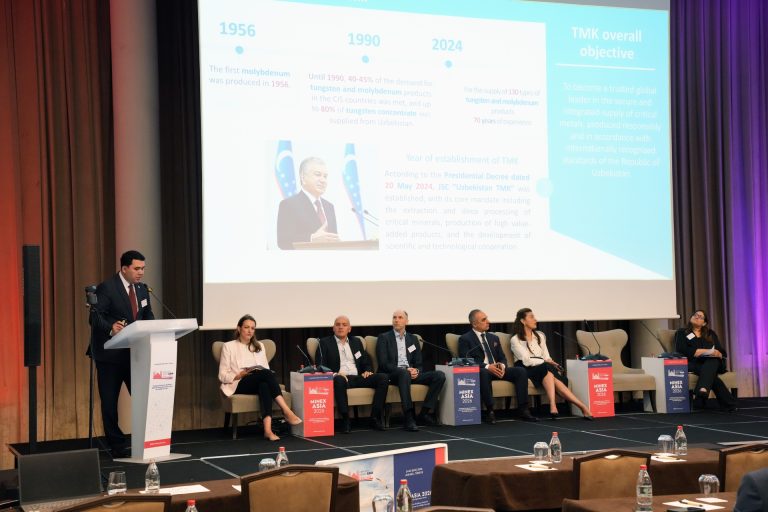
    In a recent presentation, Khikmatullaev introduced the Uzbekistan Technological Metals Complex (TMK), outlining a state-backed strategy aimed at unlocking the country’s potential in critical raw materials. He emphasised Uzbekistan’s advantageous geographic position, providing access to major global markets including the EU, the United States, and Asia. The country has experienced consistent economic growth of approximately 5–7% annually, driven by structural reforms that liberalise the economy and enhance the investment climate, making it an attractive destination for foreign capital. The mining sector plays a crucial role, contributing about 24% to the country’s industrial output, indicative of a robust natural resource base and significant industrial potential.

    Khikmatullaev highlighted the immense mineral resource base of Uzbekistan, estimated at around $3 trillion under the C2 category, supported by a national register of over 2,500 distinct deposits. This positions Uzbekistan among the top global holders of key reserves, including being the third-largest globally for one resource category and eighth for copper reserves. Notably, only about a third of the country’s territory has been geologically explored, suggesting substantial untapped discovery potential. The country also boasts significant reserves of uranium, lithium, tungsten, and molybdenum, reinforcing its strategic importance as a supplier of critical raw materials.

    The presentation detailed TMK’s institutional history and mandate, tracing its roots back to 1956 with a legacy in molybdenum production. Established as a modern corporate entity in 2024, TMK aims to integrate exploration and downstream processing to produce higher value-added products. The company’s strategic objective is to become a trusted global leader in the secure and responsible supply of critical raw materials, aligning with the standards demanded by Western buyers and financiers.

    Khikmatullaev elaborated on TMK’s resource bases and active projects, particularly focusing on tungsten, where Uzbekistan’s resource base includes 14 deposits with proven reserves of approximately 188,000 tons. Ongoing exploration is expected to increase total tungsten reserves significantly by 2030. TMK operates a fully integrated supply chain, encompassing geological exploration, refining, and processing, rather than merely functioning as an upstream extraction company.

    Looking ahead, TMK plans to implement over 70 distinct investment projects between 2026 and 2030, with an estimated investment of $1.6 to $2 billion, strongly supported by the Uzbek government. A critical aspect of this strategy is the development of a critical raw materials hub connecting mining projects to processing centres in Tashkent and Samarkand, aimed at transforming raw ore into high-purity metals. The government has announced incentives for investors who establish full-cycle operations, including a 10-year tax refund and additional benefits for projects located in special economic zones.

    Several flagship projects were highlighted, including a $151 million hydrometallurgical plant in the Samarkand region for processing tungsten concentrate, and plans for a molybdenum cluster with a $25 million investment. Other significant projects include the preparation of the Muskon copper deposit, the Nurkum lithium deposit, and the Tosin graphite deposit, with investments planned in the hundreds of millions. Collectively, these initiatives position TMK as a rapidly scaling industrial operator with a defined project pipeline, government-aligned incentives, and specific production targets across multiple critical minerals, establishing Uzbekistan as a leading opportunity in the global mining landscape.


  • Uzbekistan’s Strategic Shift: Opening Mining Sector to International Capital Markets

    Uzbekistan’s Strategic Shift: Opening Mining Sector to International Capital Markets

    Uzbekistan is taking significant steps to modernise its mining sector by moving state-owned companies like NMMC and AMMC towards international capital markets. This initiative aims to attract global investors and incorporate international management practices, thereby partially opening its ownership of strategically important mineral assets. This shift is more than just an initial public offering (IPO); it represents a fundamental revaluation of Uzbekistan’s resource strategy.

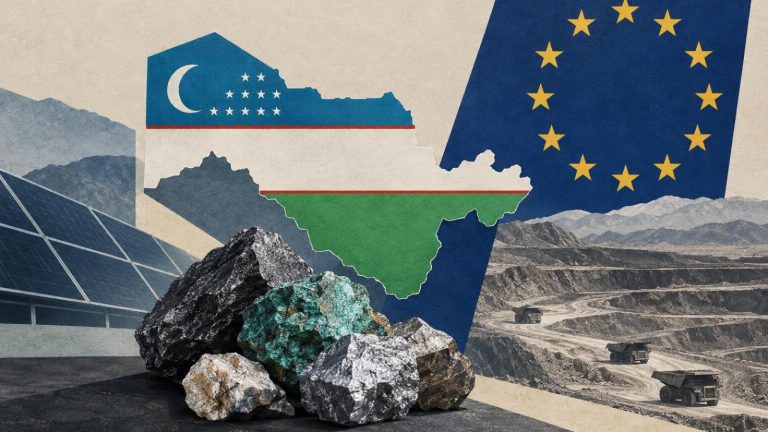
    The potential advantages of this move are substantial. Firstly, by exchanging equity for capital, Uzbekistan can secure the necessary funding to develop critical minerals such as copper, lithium, and tungsten. These projects require vast investments, and access to global capital markets could alleviate the country’s reliance on government borrowing, facilitating faster investment in mining operations, smelting facilities, and downstream processing.

    Secondly, the influx of international capital could bring advanced technology and management expertise to Uzbekistan’s mining sector. This collaboration could enable the country to transition from merely exporting raw minerals to establishing a more integrated mine-to-metal value chain, enhancing its economic prospects.

    Moreover, the involvement of international shareholders is likely to improve corporate governance within Uzbekistan’s state-owned mining companies. Public listings typically introduce stricter disclosure, auditing, and environmental, social, and governance (ESG) requirements, which can drive these companies towards greater efficiency and transparency.

    Additionally, establishing partnerships with Western investors could create a more secure supply chain for Uzbekistan’s critical minerals. As these investors gain significant stakes in local projects, their interests will become intertwined with the country’s long-term political and economic stability.

    However, this strategy is not without its risks. Sharing equity means relinquishing a portion of future resource revenues and potentially compromising strategic control over mineral assets. If the anticipated benefits of international investment do not materialise—specifically, if technology and market access remain elusive—Uzbekistan may find itself merely exchanging the export of raw materials for the export of ownership.

    The central question remains: who will ultimately dictate the pace of resource development, the allocation of profits, and the direction of downstream industrial investment? The key metric is not merely the amount of equity sold but whether Uzbekistan can leverage minority stakes to gain capital, technology, and a stronger position in global supply chains. If successful, this approach could pave the way for a new model for resource-rich nations seeking to overcome the traditional ‘resource curse.’


  • Digital Transformation in Central Asian Geology: Platforms, AI, and Workforce Challenges

    Digital Transformation in Central Asian Geology: Platforms, AI, and Workforce Challenges

    The mining industry is increasingly recognising the importance of digitalisation, particularly in the field of geology, which is one of the most knowledge-intensive sectors. However, the pace of digital transformation in Central Asia is lagging behind the demands of the business and global investment markets. This article explores how Kazakhstan and Uzbekistan are addressing this issue through strategic programmes aimed at expanding their mineral resource bases.

    In the competitive landscape of critical minerals, the integration of digital technologies is essential for success. From forecasting and assessing mineral reserves to product exportation, the mining industry must embrace digital solutions. Despite the existence of scientific literature and discussions at strategic business forums, the application of AI, big data, and machine learning remains limited to isolated practices. A systematic approach is needed to harness geological information effectively, and both Kazakhstan and Uzbekistan are developing their own transformation scenarios.

    Kazakhstan has made significant strides since the launch of a unified subsoil use platform in 2025. By August 2026, the country completed the digitisation of geological information, processing over 4.8 million archival materials, marking a revolutionary step that could serve as a model for other Central Asian nations. Meanwhile, Uzbekistan announced the creation of a National Geological Data Base, aiming to digitise 36,000 reports and establish a Centre for Technological Transformation, which is expected to double the quality and speed of geological data generation and modelling.

    Experts at the MINEX Kazakhstan 2026 forum highlighted that the digitalisation of geology is a matter of survival rather than prestige for Central Asian countries. Traditional methods are no longer sufficient to ensure growth or replenish mineral resources, especially as older deposits are depleted and ore quality declines. The key challenge is not just the quantity of reserves but the effective management of geological data and decision-making based on that data. Currently, only 21% of geologists in Kazakhstan have access to modern data transmission networks, significantly delaying project timelines.

    A critical barrier to digitalisation is the skills gap, particularly in the intersection of IT, big data, and geology, which are essential for quality predictive analysis. The reliance on foreign software and the lack of local intellectual resources hinder the rapid development of homegrown solutions. The competition for skilled professionals in IT and data science is fierce, with companies vying for talent by offering lucrative salaries.

    Another significant obstacle is the absence of unified standards for geological information, although Kazakhstan has made progress in this area. Without the integration of historical data, its value diminishes, and investors are less inclined to engage. To improve the situation, experts suggest a shift in focus towards innovative priorities within the industry.

    The Ministry of Industry and Infrastructure Development of Kazakhstan has begun practical steps to implement neural network models in geology, collaborating with the National Geological Service and Astana Hub. This initiative is supported by EPAM Kazakhstan and aims to address the skills shortage by training geologists in big data and machine learning techniques.

    The article also discusses various applications of AI in modelling mineral deposits and the use of digital tools in geophysical exploration across Kazakhstan and beyond. Companies are employing advanced methods such as 3D modelling and machine learning to enhance the accuracy of geological assessments and streamline operations. As Kazakhstan embarks on a state programme to study 20 areas for detailed geological surveys, the integration of IT tools will be crucial for achieving its resource potential.

    In conclusion, Central Asia is undergoing a significant transformation in its geological sector, which will ultimately determine the success of the entire mining industry in the region. The future of geology in Central Asia hinges on the successful implementation of digital technologies and the establishment of an open ecosystem for geological information, positioning countries like Kazakhstan and Uzbekistan as high-tech hubs in the Eurasian landscape.


  • Advancements in Geological Exploration and Risk Management in Central Asia

    Advancements in Geological Exploration and Risk Management in Central Asia

    The demand for critical minerals is reshaping the role of Central Asia, particularly Kazakhstan and Uzbekistan, in global supply chains, while highlighting the urgent need for verified geological information. Many raw materials in the region remain unexplored, and the extent of its mineral wealth is still largely speculative, based on historical data and limited new findings. Leaders from the five Central Asian countries agree on the necessity to explore, balance, and utilise natural resources efficiently and economically for national interests.

    Central Asia is not only rich in copper, uranium, tungsten, lithium, graphite, titanium, and rare earth elements but also holds over 38% of the world’s manganese ore reserves and significant quantities of other critical minerals. Uzbekistan alone boasts reserves of over 30 types of critical minerals, with plans for 76 projects worth $2.6 billion aimed at developing 28 rare minerals by 2030. In Kyrgyzstan, the Kyzyl-Ompol deposit holds an estimated 20 million tonnes of titanomagnetite, while the Kutessai-2 site contains approximately 60,000 tonnes of various critical minerals.

    Kazakhstan is actively mining and integrated into global raw material supply chains, with rare earth exports quadrupling by early 2025 compared to 2020. The country joined the Minerals Security Partnership in 2024 and plans to invest nearly $5.3 billion in the development of its rare metals and minerals sector by 2028, including geological research.

    Experts believe that with detailed geological exploration using new technological solutions, the overall reserves of critical minerals in Central Asia could increase significantly. Recent geological exploration at the Kuiraktykol deposit in Kazakhstan saw resource estimates rise from 20 million tonnes to 282 million tonnes, illustrating the potential for discovery through modern methods. The rapid global economic changes and the rise of green energy and high-tech industries have intensified the demand for strategic raw materials, making extensive geological surveys essential for development.

    At the MINEX Kazakhstan 2026 forum, discussions highlighted the need for innovative approaches in geological exploration, emphasising a shift from traditional methods to systematic targeting based on modern capabilities. The reliance on archival data for over 55% of geological information underscores the importance of verifying historical data to mitigate exploration risks. The forum also addressed the balance between speed and quality in geological surveys, advocating for investments in reliable data rather than merely land.

    The implementation of advanced technologies, such as geophysical methods and remote sensing, has transformed the landscape of geological exploration, enabling the identification of previously inaccessible mineral deposits. The integration of these technologies is crucial for enhancing the efficiency and accuracy of geological assessments, ultimately leading to more successful exploration outcomes. As Central Asia continues to evolve its approach to resource exploration, the MINEX forum serves as a vital platform for international dialogue on the future of the mining industry in the region.


  • NGMK’s Investment Projects: Boosting Gold Production and Modernisation

    NGMK’s Investment Projects: Boosting Gold Production and Modernisation

    The Navoi Mining and Metallurgy Combinat (NGMK) in Uzbekistan is making significant strides in gold production and modernisation, as highlighted during the MINEX Kazakhstan 2026 forum. The company has increased its gold output to 98.2 tonnes in the previous year, achieving a net profit of $3.5 billion, a 64% increase, largely due to favourable market conditions where the average price per ounce exceeded $3,400. NGMK plays a crucial role in Uzbekistan’s strategy for 2030, which aims to elevate the country’s gold production from 118 tonnes to 175 tonnes. This ambitious target positions NGMK as a leader in the region, which currently accounts for 7.5% of global gold production, with nearly half of that attributed to the NGMK.

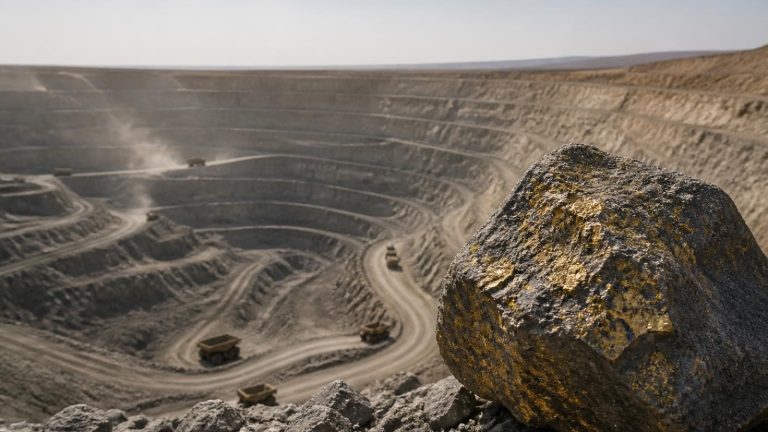
    To maintain its growth momentum, NGMK is leveraging various tools for sustainable development, including geological exploration, advanced technologies, and infrastructure improvements. The company has invested significantly in expanding the Muruntau mine, which has been recognised as a global leader in gold production. The mine’s dimensions have grown substantially since its inception in 1967, and recent investments have further enhanced its capacity.

    In addition to expanding existing operations, NGMK is also focusing on exploring new mineral deposits. The company has acquired licenses for new areas and is conducting geological exploration to confirm gold reserves in regions like Kokpatas and Daugiztau. The resource base of NGMK currently stands at approximately 140 million ounces of gold, with ongoing efforts to increase this through the processing of lower-grade ores.

    Investment in infrastructure is another key focus for NGMK, with over $1 billion allocated for 2025 alone. This includes modernising existing facilities and introducing new technologies to improve operational efficiency. The company has successfully implemented various projects aimed at enhancing its processing capabilities and expanding its mining fleet, which is crucial for meeting the growing demand for gold.

    Digital transformation is also a priority for NGMK, with a strategy in place to modernise operations by 2030. This includes the adoption of information technologies for geological exploration, automated inventory calculations, and real-time monitoring of production processes. The integration of artificial intelligence and machine learning is helping to optimise operations and reduce human error, thereby improving overall efficiency.

    As NGMK continues to evolve, its commitment to sustainable practices and technological advancement positions it well for future growth in the competitive global mining landscape. The company’s proactive approach to investment and innovation not only strengthens its market position but also contributes to Uzbekistan’s economic development and industrial sovereignty.


  • Azerbaijani Companies Expand Gold and Rare Earth Mining Ventures in Uzbekistan

    Azerbaijani Companies Expand Gold and Rare Earth Mining Ventures in Uzbekistan

    Uzbekistan is broadening its international partnerships in the mining sector, with recent agreements signed with Azerbaijani companies focusing on gold and rare earth metals (REMs), hydrocarbon exploration, and the processing of silver-containing ores, as reported by Gazeta.uz, citing the Ministry of Investments of the Republic.

    AzerGold, an Azerbaijani gold mining company, has gained access to the Akba deposit in the Kashkadarya region. According to Uzgeologiya, over 13 tonnes of extractable gold reserves were added to the state balance last year, with the site’s potential estimated at an additional 50 tonnes. Concurrently, AzerGold will conduct geological studies in promising areas of the Navoi region.

    In the Namangan region, a joint venture will be established for processing silver-containing ore, with processing facilities to be built based on the deposit in the Pap region. Sur Gold and Silver Project will be the partner in this initiative.

    Collaboration with NEQSOL Holding in the field of REMs will cover the Navoi, Tashkent, and Jizzakh regions. This partnership is a continuation of a broader agreement signed in June at the Tashkent Investment Forum, which involves the joint extraction of strategic minerals, including titanium.

    Additionally, the Azerbaijani state oil and gas company SOCAR will undertake exploratory works as part of the ‘Ustyurt’ project, which encompasses six blocks: Terengkuduk, Boyterak, Birkori, Kharoy, Kulboy, and Karakalpak, located in Karakalpakstan. This expansion of Azerbaijani companies into Uzbekistan’s mining sector signals a significant step towards enhancing regional cooperation and resource development.

  • Uzbekistan and China Set Ambitious $30 Billion Trade Target Amid Strengthening Economic Ties

    Uzbekistan and China Set Ambitious $30 Billion Trade Target Amid Strengthening Economic Ties

    Uzbekistan and China are moving to deepen cooperation across mining, mineral processing, and nuclear energy, as President Shavkat Mirziyoyev and Chinese President Xi Jinping discussed a broader economic partnership at the Shanghai Cooperation Organization summit in Bishkek. Alongside a shared ambition to raise bilateral trade from roughly $18 billion last year to $30 billion, the two leaders singled out mining and the extraction and processing of mineral resources as priority areas for expanded industrial cooperation.

    The resource-sector focus sits within a much larger investment relationship: an estimated $60 billion in ongoing joint investment projects and more than 6,000 joint ventures are already active in Uzbekistan. Metallurgy was named specifically among the priority industrial sectors, alongside energy, chemicals, and high technologies — a signal that Chinese capital and technical expertise are expected to flow further into Uzbekistan’s mining and metals value chain, from raw extraction through to processing and downstream materials.

    On the nuclear side, Uzbekistan reiterated its intent to attract Chinese companies into peaceful nuclear energy projects, positioning this alongside conventional and renewable power as part of a broader energy diversification strategy. This comes as Tashkent has been actively courting international partners for both large-scale and small modular reactor projects, and China’s inclusion in that mix points to growing competition among global nuclear vendors for a foothold in Central Asia’s emerging civil nuclear market.

    Supporting infrastructure for these ambitions is also advancing: the China-Kyrgyzstan-Uzbekistan railway, currently under construction, is expected to strengthen Eurasian transport connectivity under the Belt and Road Initiative — a corridor that would also serve as a logistics backbone for moving mined and processed materials to Chinese and regional markets.

    Taken together, the mining and nuclear commitments reflect a shift in the Uzbekistan-China relationship beyond trade volumes and consumer manufacturing (such as the BYD electric vehicle partnership) toward deeper integration in resource extraction, materials processing, and energy security — areas where China’s demand for critical minerals and Uzbekistan’s mineral wealth and nuclear ambitions increasingly align.


  • Azerbaijani Companies to Explore Gold and Rare Earth Deposits in Uzbekistan

    Azerbaijani Companies to Explore Gold and Rare Earth Deposits in Uzbekistan

    Azerbaijani companies are set to engage in the exploration and development of gold deposits in Uzbekistan, as reported by Gazeta.uz, citing the Uzbek Ministry of Investments, Industry and Trade. The initiative includes geological exploration, processing of silver-containing ores, and the extraction of rare earth metals. Notably, AzerGold is planning to participate in the development of the ‘Akba’ gold deposit located in the Kitab district of the Kashkadarya region. The company will also conduct geological surveys in promising areas of the Nuratin district in the Navoi region.

    In 2025, ‘Uzbekgeologorazvedka’ reported that over 13 tonnes of industrial gold reserves at the ‘Akba’ deposit had been accounted for and placed on the state balance. Further geological exploration in the area could potentially reveal an additional 50 tonnes of gold. This significant find underscores the potential for increased gold production in Uzbekistan, which is becoming an attractive destination for foreign investment in the mining sector.

    Another project involves the extraction of rare earth metals in the Navoi, Tashkent, and Jizzakh regions, with Neqsol Holding acting as the Azerbaijani partner. This collaboration highlights the growing interest in rare earth elements, which are critical for various high-tech applications and are increasingly in demand globally.

    Additionally, in the Namangan region, a partnership with Sur Gold and Silver Project aims to establish a processing plant for silver-containing ores. This project not only signifies the diversification of mining activities in Uzbekistan but also reflects the country’s commitment to enhancing its mining infrastructure and capabilities.

    Overall, these developments indicate a strengthening of economic ties between Azerbaijan and Uzbekistan, particularly in the mining sector, as both countries seek to leverage their natural resources for mutual benefit.


  • Azerbaijan and Uzbekistan Near Completion of Exploration on Ustyurt Plateau, Drilling Set for 2027

    Azerbaijan and Uzbekistan Near Completion of Exploration on Ustyurt Plateau, Drilling Set for 2027

    Azerbaijan and Uzbekistan are advancing towards the practical phase of developing hydrocarbon resources on the Ustyurt Plateau, with drilling operations scheduled to commence in 2027. During a state visit to Tashkent, Azerbaijani President Ilham Aliyev announced that the project is in the final stages of exploration. The oil and gas project is jointly owned by Uzbekistan’s Uzbekneftegaz and Azerbaijan’s SOCAR, each holding a 30% stake, while British company BP controls the remaining 40%.

    The collaboration between Azerbaijan and Uzbekistan began with a cooperation agreement in August 2024, which initiated geological exploration activities. In July 2025, the parties signed a production-sharing agreement that included a 3D seismic survey covering at least 1,000 square kilometres and the drilling of one exploratory well. BP officially joined the project in May 2026, taking on the role of operator.

    The commencement of industrial production on the Ustyurt Plateau is expected to be a lifeline for Uzbekistan, which is experiencing a decline in domestic natural gas production due to depleting reserves. In June 2026, gas production fell to 2.5 billion cubic metres, a 30% decrease compared to the previous year. For the first half of the year, Uzbekistan produced 18.3 billion cubic metres of gas, which is 16% lower than the figures for 2025. In peak years, the country produced around 70 billion cubic metres, but by 2025, annual production had dropped to 42 billion cubic metres.

    This decline in production has intensified Uzbekistan’s reliance on gas imports. In the first six months of 2026, the country spent $972 million on gas and liquefied hydrocarbons imports, 1.4 times more than the previous year. The main suppliers are Russia and Turkmenistan. However, during certain months when domestic demand decreases, Uzbekistan exports surplus gas, primarily to China.


  • Uzbekistan Announces Plans for Second Nuclear Power Plant to Boost Energy Supply

    Uzbekistan Announces Plans for Second Nuclear Power Plant to Boost Energy Supply

    Uzbekistan is set to construct its second nuclear power plant, as President Shavkat Mirziyoyev emphasised the necessity of stable electricity supply to attract foreign investment. The announcement was made during a ceremony for investment projects in the Khorezm region on August 17, 2026. Although details regarding the location, capacity, and timeline for the new plant are yet to be disclosed, Mirziyoyev highlighted the importance of reliable electricity and predictable energy prices for potential investors. He stated, ‘Why do investors come here? What is their first question? ‘I will bring my investment, but what will the price of electricity be? What guarantees will there be?” This underscores the government’s commitment to implementing its energy strategy through 2030, aiming to ensure dependable power supplies and reduce production costs.

    Uzbekistan’s long-term energy strategy includes a significant expansion of nuclear power, with plans to increase nuclear generation capacity from 0.3 GW by 2030 to 4 GW by 2040. This expansion would position nuclear energy as a dominant source of electricity, surpassing coal. The head of Uzatom, Azim Akhmedkhazhayev, noted that the site of the first nuclear power project has the potential for up to four large reactors, although no decisions have been made regarding such an expansion.

    The first nuclear power complex is currently under construction near Lake Tuzkan in the Farish district of Jizzakh region, with Russian state nuclear corporation Rosatom involved in the project. The facility will feature two small RITM-200N reactor units and two larger VVER-1000 units, with a total generating capacity of approximately 2.1 GW. These reactors are expected to commence operations between 2029 and 2035, contributing significantly to Uzbekistan’s electricity supply.

    Uzbekistan’s nuclear energy ambitions have sparked public debate, with proponents arguing that nuclear power will enhance reliability and support industrial growth, while critics express concerns over environmental safety and project costs. Public hearings regarding the first nuclear power plant were conducted in December 2025, with Uzatom reporting satisfactory outcomes. As preparations for the second plant commence, nuclear energy is poised to play a crucial role in meeting Uzbekistan’s rising electricity demand and fostering future investment.