Tag: Kazakhstan

  • Ending the ‘Extract-and-Export’ Era: How FORGE and Pax Silica Transform Central Asian Mining

    Ending the ‘Extract-and-Export’ Era: How FORGE and Pax Silica Transform Central Asian Mining

    The 2026 Critical Minerals Ministerial in Washington has signaled the definitive end of Central Asia’s era as a “landlocked” geopolitical afterthought. For decades, the five nations of the region were viewed through the narrow lens of the “Great Game”—a buffer zone between Russian security interests and Chinese infrastructure investments. However, the “New Order” proposed by the Trump administration, articulated by Vice President JD Vance and Secretary of State Marco Rubio, has repositioned Kazakhstan, Uzbekistan, and their neighbors as the indispensable pivot of a new Western-aligned industrial statecraft.

    The Mineral Sovereignty Pivot

    The strategic argument for Central Asian states to embrace the U.S.-led FORGE (Forum on Resource Geostrategic Engagement) initiative and the proposed Preferential Trade Zone rests on the promise of escaping “coercive dependencies”. For years, Central Asian producers have been vulnerable to the same market distortions Vance identified in Washington: a “foreign supply” (read: China) that floods markets to crash prices and kill domestic projects.

    By joining the new trading bloc, countries like Kazakhstan and Uzbekistan are being offered a “necessary foundation for private financing” and a “price floor” enforced by adjustable tariffs. This mechanism is a game-changer for the region. It essentially guarantees that if Kazakhstan develops its potentially world-class rare earth element (REE) reserves—estimated by some to reach 20 million metric tons—its investments will be shielded from predatory pricing strategies designed to maintain Beijing’s monopoly.

    Kazakhstan: The Vanguard of the New Order

    Kazakhstan has moved first and most aggressively to align with this reindustrialization doctrine. President Kassym-Jomart Tokayev’s branding of critical minerals as the “new oil” is not mere rhetoric; it is backed by a landmark memorandum of understanding (MOU) with the U.S. signed in November 2025, which focuses on technology transfer and processing capacity.

    Perhaps most significantly, Kazakhstan’s accession to the Abraham Accords in November 2025 serves as a profound geopolitical signal. While traditionally a Middle Eastern normalization framework, its expansion to Kazakhstan—the first member with preexisting ties to Israel—is being used to facilitate secure, tech-driven supply chains that reduce the region’s reliance on China. This “unorthodox” alignment places Astana at the heart of the Pax Silica vision, where silicon, minerals, and energy are treated as shared strategic assets among “trusted partners”.

    Uzbekistan and the C5+1 Renaissance

    Uzbekistan is rapidly following this blueprint. On February 5, 2026, during the Ministerial, Tashkent signed its own strategic MOU with the U.S. to secure supply chains for rare earths and critical minerals like lithium, magnesium, and indium. For President Mirziyoyev, this is a path to modernize a mining sector that has often relied on outdated Soviet-era surveys.

    The broader C5+1 diplomatic platform, now celebrating its tenth anniversary, has evolved from a symbolic talk shop into a “pragmatic, project-driven economic coordination framework”. This “renaissance of American influence” is evidenced by the $17 billion in investment projects agreed upon following recent summits and the integration of the Middle Corridor (Trans-Caspian International Transport Route) into the Trump Route for International Peace and Prosperity (TRIPP).

    The Argument for Central Asian Alignment

    The “New Order” offers Central Asia three structural advantages that neither Moscow nor Beijing can—or will—match:

    1. Vertical Value Integration: Unlike China’s “extract-and-export” model, the U.S. framework emphasizes domestic processing and refining. This allows Central Asian states to capture high-value segments of the supply chain rather than remaining mere “resource bases”.

    2. Market Stability: The Project Vault and price floor mechanisms provide a buffer against “market whiplash”. For a region where commodity price volatility can destabilize entire national budgets, this sovereign de-risking is a vital survival tool.

    3. Connectivity Autonomy: By backing the Middle Corridor/TITR, the U.S. and its partners are providing the region with its first viable route to global markets that does not pass through Russia or China. This reduces the ability of larger neighbors to use transit as a tool of political pressure.

    Central Asia is currently in a “hedging game,” and both Pakistan and Central Asian states have approached these initiatives with a degree of caution to avoid immediate Chinese retaliation. However, the message from the 2026 Ministerial is clear: in an economy of “real things,” those who control the minerals control the future. For Kazakhstan and Uzbekistan, the American proposal is not just about mining; it is about finally securing their economic and territorial sovereignty.

  • Kazakhstan Strengthens Global Role in Critical Minerals at Landmark US-Led Conference

    Kazakhstan Strengthens Global Role in Critical Minerals at Landmark US-Led Conference

    Kazakhstan has taken another step toward positioning itself as a key player in the global critical minerals agenda, with Foreign Minister  participating in the first Ministerial Conference on Critical Minerals. The event was held at the invitation of US Secretary of State  and brought together representatives from more than 50 countries to discuss the future of global supply chains.

    The conference opened with remarks from US Vice President  and was attended by leaders of major Kazakh mining companies, highlighting the practical focus of the discussions and growing interest in concrete investment and industrial projects.

    Talks centred on the diversification and resilience of global supply chains for critical minerals, which underpin green energy, high technology, defence industries and the digital economy. Participants stressed that access to these resources is increasingly viewed as a matter of strategic and economic security, prompting calls to reduce dependence on a limited number of suppliers and to expand international cooperation in extraction, processing and logistics.

    Addressing the conference, Kosherbayev outlined Kazakhstan’s substantial potential in critical minerals and its readiness to contribute to stable and reliable global supply chains. He pointed to the country’s significant mineral reserves, established processing capacity, modern infrastructure, political stability and a transparent regulatory environment.

    Kosherbayev noted that Kazakhstan is capable of supplying 20 of the 60 critical minerals listed by the , not merely as raw materials but as value-added products demanded by strategic sectors of the global economy.

    Special attention was given to the implementation of a bilateral memorandum on critical minerals cooperation between Kazakhstan and the United States, signed during a presidential visit to Washington in November 2025. The agreement, the first of its kind in Central Asia, focuses on expanding processing capacity in Kazakhstan, facilitating technology transfer and improving access for Kazakh products to the US market, marking a shift toward deeper integration in global value chains.

  • Why Artisanal Gold Mining Struggles to Go Legal in Kazakhstan Despite Record Prices

    Why Artisanal Gold Mining Struggles to Go Legal in Kazakhstan Despite Record Prices

    Reports of arrests of so-called illegal gold prospectors have become more frequent as gold prices hover near record highs. Despite legislative changes intended to legalize artisanal mining, many prospectors continue to operate outside the formal system. In an interview with inbusiness.kz, veteran geologist Bolat Kabaziev outlined why legalization has proven far more difficult in practice than on paper.

    According to Kabaziev, the 2018 Subsoil Code was expected to unlock large-scale legal artisanal mining on designated plots approved by regional authorities and the Ministry of Industry. In reality, progress has been slow. He said artisanal gold mining remains constrained by environmental and water protection rules, as well as technical limits on production volumes, mining depth and allowable equipment.

    While the law formally introduced artisanal mining licences, Kabaziev noted that bureaucracy remains a major barrier. Lengthy approvals at regional administrations have made the process complex and time-consuming. “On paper it was legalized, but in practice obtaining a licence has become difficult and slow,” he said.

    Kabaziev also addressed the blurred line between informal prospectors and outright illegal miners. While some prospectors argue that subsoil resources belong to the people, he stressed that unauthorized mining is still a criminal offense under existing laws on subsoil use and precious metals. A deeper issue, he said, is the lack of clear oversight mechanisms once licences are issued. For example, the law caps artisanal gold production at 50 kg per year, but there is no effective system to monitor actual output or the movement of mined gold.

    Additional obstacles include long approval timelines, multiple administrative clearances, technical constraints and, in some cases, resistance from local communities. Environmental and water permits are particularly hard to obtain, especially when gold-bearing placers are located in riverbeds, where approvals are often impossible.

    Kabaziev cautioned that artisanal placer gold mining is also a high-risk business. Even on officially designated plots, prospectors must study historical geological data and consult experts before investing. “Statistics show that only a few actually earn money, but this is rarely discussed,” he said.

    He also raised concerns about weak reporting requirements. Despite dozens of artisanal licences being issued in recent years, little gold is officially surrendered or recorded. Kabaziev believes most gold is sold through informal buyers, forming a shadow market, with uncertain downstream destinations. While estimates suggest illegal artisanal mining could amount to 10–15 tonnes of gold per year, he said much of this gold likely remains within Kazakhstan, entering jewellery production or, in some cases, refineries.

    With gold prices recently exceeding $5,000 per ounce, Kabaziev acknowledged a renewed “gold rush” mentality. However, he said the phenomenon remains poorly studied. He argued that true legalization would require open dialogue between authorities, law enforcement, industry experts and the prospectors themselves to address regulatory gaps, environmental concerns and market transparency.

  • Kazakhstan’s Foreign Minister Heads to Washington for Critical Minerals Talks with the United States

    Kazakhstan’s Foreign Minister Heads to Washington for Critical Minerals Talks with the United States

    Kazakhstan’s Foreign Minister Yermek Kosherbayev will travel to Washington DC on 3–4 February to take part in the Critical Minerals Ministerial, marking his first official visit to the United States since assuming office in September 2025. On 3 February, he is scheduled to meet with the United States Department of State and representatives of other rare earth element (REE) supplier countries.

    Kosherbayev, a career diplomat, previously served as Kazakhstan’s ambassador to Russia, governor of the East Kazakhstan Region, and deputy prime minister, combining diplomatic, regional and executive experience. His visit also includes engagement with Yerzhan Kazykhan, appointed in January as Kazakhstan’s first-ever Special Envoy to the United States, underscoring Astana’s emphasis on high-level engagement with Washington.

    The trip follows months of intensified diplomatic and economic contacts between Kazakhstan and the United States. Since November, President Kassym-Jomart Tokayev and US President Donald Trump have met twice in person and held a phone call, with discussions spanning trade, investment and global forums, including an invitation to the G20 meeting scheduled for December 2026.

    Critical minerals have emerged as a central pillar of this renewed engagement. Rare earth elements form a key part of Washington’s supply-chain diversification strategy, and Kazakhstan’s geological potential positions it as a relevant partner. This alignment has already been formalized through a memorandum of understanding on cooperation in critical minerals, signed by Tokayev, aimed at strengthening supply chains and expanding bilateral economic ties.

    Investor interest has begun to follow diplomatic signaling. US-backed initiatives and early-stage engagement from investors, including Cove Capital, as well as a letter of interest of up to $900 million from the Export-Import Bank of the United States, point to growing momentum, even as projects remain at an early phase.

    Unlike many emerging REE suppliers, Kazakhstan brings an existing industrial base to the table. Its established processing and refining capacity across metals such as uranium, copper, chromium and titanium allows the country to participate across the value chain rather than act solely as a raw-material exporter. Long-standing partnerships with global majors like Chevron and Exxon Mobil further reinforce Kazakhstan’s track record in delivering complex, capital-intensive projects.

    Still, translating strategic alignment into functioning supply chains will depend on execution. Regulatory clarity, permitting efficiency and coordination between mining and industrial policy remain key variables. The State Department–hosted meetings during Kosherbayev’s visit represent an initial step from diplomacy toward implementation, as Kazakhstan seeks to position itself as a credible long-term partner in US efforts to diversify rare earth and critical mineral supplies.

  • Kazakhstan’s Industry Minister Holds Talks with Kazakhmys Leadership on Modernisation and Safety

    Kazakhstan’s Industry Minister Holds Talks with Kazakhmys Leadership on Modernisation and Safety

    Kazakhstan’s Minister of Industry and Construction, Yersayin Nagaspayev, held a working meeting with Ruslan Oskinali, Chairman of the Management Board of Kazakhmys Corporation, to discuss the current state and future priorities of the country’s metallurgical sector.

    During the meeting, Nagaspayev highlighted the central role of mining and metallurgy in Kazakhstan’s economy. According to the minister, the sector accounts for around 40% of total manufacturing output, while cathode copper production represents 23% of the metallurgical industry. Kazakhmys alone contributes about 78% of national cathode copper output, underscoring its systemic importance.

    The discussions focused on ensuring the stable operation of production facilities, strengthening occupational safety, and advancing modernization and technological upgrades. Nagaspayev stressed that mining and metallurgy are high-risk industries, requiring strict compliance with industrial safety standards and enhanced oversight at hazardous sites.

    He also pointed to the growing importance of digital transformation, calling for greater use of artificial intelligence and digital technologies to improve production efficiency and operational control.

    In addition, the minister reiterated that expanding domestic processing remains a strategic priority for Kazakhstan’s non-ferrous metallurgy sector. From the government’s perspective, it is essential that large industrial players continue to invest in equipment renewal, improve the efficiency of processing stages, and reduce costs and environmental impacts through the adoption of modern technologies.

  • Pallas Confirms Shallow Supergene Copper Discovery at Satpayev Project in Kazakhstan

    Pallas Confirms Shallow Supergene Copper Discovery at Satpayev Project in Kazakhstan

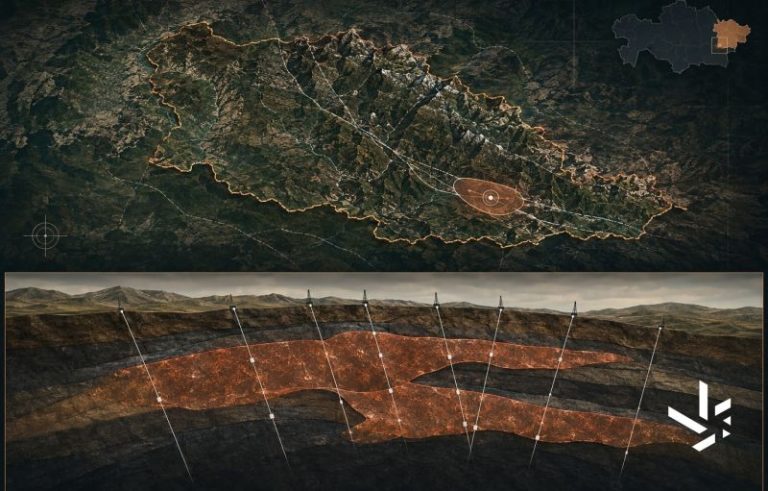
    Pallas Resources has confirmed a shallow, flat-lying supergene copper discovery following laboratory assay results from its maiden drill program at the 100%-owned Satpayev Sediment-Hosted Copper Project in central Kazakhstan.

    In 2025, the company completed 4,800 metres of KGK (aircore-equivalent) drilling across the Satpayev licence area, targeting shallow copper mineralisation beneath thin cover along the interpreted continuation of the Dzhezkazgan mineralised contact. Drilling intersected supergene copper oxides and native copper from depths starting at approximately 6 metres, with assays returning broad, near-surface mineralised intervals consistent with a supergene enrichment zone.

    Notable intercepts from the program include 29.5 m at 3.04% Cu, 31 m at 2.78% Cu, and 30.5 m at 2.73% Cu, highlighting the strength and continuity of mineralisation. The discovery has so far been outlined over an initial area of approximately 400 metres by 150 metres and remains open to the northwest, where powerline infrastructure limited further drilling.

    Drilling depth was also locally restricted by refusal using the selected drilling method, preventing penetration into the underlying bedrock in some areas and leaving any potential primary sulphide copper system untested at this stage. To address this, Pallas is conducting detailed mineralogical and geochemical studies to refine its geological model and develop vectors toward a possible primary copper source beneath the weathered horizon.

    The company is planning a 2026 exploration program that will include additional shallow drilling to expand the supergene footprint, as well as deeper reverse circulation and/or diamond drilling aimed at testing the underlying primary sulphide copper system at depth.

  • ERG to Invest Over $1 Billion in Mining and Metallurgical Projects in Kazakhstan

    ERG to Invest Over $1 Billion in Mining and Metallurgical Projects in Kazakhstan

    Eurasian Resources Group (ERG) plans to invest more than $1 billion in its mining and metallurgical assets in Kazakhstan, marking the largest investment programme in the country in the company’s history.

    The funding will be directed primarily toward ERG’s existing operations, as well as the construction of new production facilities and projects focused on higher value-added products. The investment plans were announced by ERG CEO Shukhrat Ibragimov during a visit to one of the group’s Kazakh sites this week.

    Kazakhstan remains ERG’s core operating base, accounting for more than one-third of the country’s total metals and mining output. The company is also a major player in the Democratic Republic of Congo, where its Metalkol operation ranks among the world’s largest cobalt producers and is a significant source of copper. The government of Kazakhstan holds a 40% equity stake in ERG.

    Key projects scheduled for development this year include a hot briquetted iron (HBI) plant with a planned capacity of 2 million tonnes per year, an iron ore pelletising facility, and an 80-megawatt ferroalloy gas utilisation power station at the Aktobe ferroalloys plant in northwestern Kazakhstan.

    Additional investments will support the development of a new chromium mine with annual capacity of 7.5 million tonnes, as well as modernisation of the Aksu power station. At the Pavlodar alumina plant, ERG plans to build vertical calcination kilns, install new product filtration units, and add recovery facilities capable of producing up to 15 tonnes of gallium per year.

    Both gallium and HBI, which are used in semiconductors, advanced alloys and steelmaking, are not currently produced in Kazakhstan, making these projects strategically significant for the country’s industrial diversification.

    Separately, ERG signed a three-year cobalt supply agreement in 2024 with Electra Battery Materials to supply its refinery in Ontario, Canada. From 2026, ERG is expected to deliver around 3,000 tonnes of cobalt hydroxide annually. Once fully commissioned, the refinery could produce enough cobalt to support battery production for up to 1.5 million electric vehicles per year.

  • Kazakhstan Proposes Revised Energy Efficiency Targets for Major Energy Consumers

    Kazakhstan Proposes Revised Energy Efficiency Targets for Major Energy Consumers

    Kazakhstan’s Ministry of Industry and Construction has submitted for public discussion a draft order revising energy efficiency targets for the country’s largest energy consumers. The proposed changes apply to enterprises included in the State Energy Register (SER) that consume more than 50,000 tonnes of standard fuel per year.

    According to the ministry, the introduction of energy-saving and energy-efficiency measures should not affect product prices or regulated tariffs. Instead, the measures are aimed at more rational energy use and reducing losses, while investments in energy-efficient technologies are expected to pay for themselves through lower energy consumption.

    The draft order forms part of a broader policy framework to reduce the energy intensity of Kazakhstan’s economy under the Energy Conservation Development Concept for 2023–2029. The previous set of target indicators was approved on 29 November 2022.

    At present, 108 organisations fall within the scope of the proposed regulation. Of these, 51 operate in the energy and water supply sector (47.2%), 29 in manufacturing (26.9%), 22 in mining (20.3%), four in pipeline transportation (3.7%), and two in the transport sector (1.9%). The ministry noted that this list is not final and may change as companies’ energy consumption increases or decreases.

    Energy efficiency targets are set individually for each enterprise, based on consumption trends over recent years and the results of mandatory energy audits. Companies will be required to meet the approved targets starting from the first year of implementation.

    The indicators include fuel and energy consumption for electricity and heat generation, specific electricity use per unit of output, energy costs for extraction, processing and transportation, as well as permissible loss levels in electricity and heat transmission.

    Oversight of data accuracy will be carried out by the National Institute for Energy Conservation and Energy Efficiency Development. Failure to comply with annual energy reduction requirements or to submit data to the State Energy Register will result in administrative liability.

  • Kazakhstan Changes R&D Funding Mechanism for Subsoil Users

    Kazakhstan Changes R&D Funding Mechanism for Subsoil Users

    Kazakhstan has revised the procedure for financing research and development (R&D) by subsoil users operating in the hydrocarbons and uranium sectors, the Ministry of Energy has reported.

    Under a joint order signed on 17 December 2025 by the Ministry of Energy and the Ministry of Science and Higher Education, amendments were introduced to the rules governing the funding of scientific research, scientific and technical work, and experimental development (R&D) during the production phase.

    The key change concerns the mechanism for transferring funds. In line with the President’s instructions to centralise mandatory contributions and to align procedures with the Budget Code of Kazakhstan (Article 9, Paragraph 2), subsoil users extracting hydrocarbons and uranium will now be required to transfer R&D contributions directly to the republican budget.

    To implement this change, a dedicated budget classification code has been approved:
    KBC 401103 — “Contributions by subsoil users for scientific research, scientific and technical, and (or) experimental development works on the territory of the Republic of Kazakhstan.”

    Previously, the mandatory 1% R&D contribution paid by producing companies was administered and allocated by the Ministry of Energy.

    The amendments were officially published in the Reference Control Bank of Regulatory Legal Acts of Kazakhstan on 20 November 2025 and will enter into force after a 60-calendar-day transition period, on 19 January 2026.

  • Satellite monitoring uncovers illegal mining sites in Kazakhstan region

    Satellite monitoring uncovers illegal mining sites in Kazakhstan region

    Authorities in one of Kazakhstan’s regions have uncovered widespread illegal extraction of mineral resources following satellite monitoring by the national space operator Қазақстан Ғарыш сапары, according to the regional environmental prosecutor’s office.

    Remote sensing data identified 53 zones of suspected unauthorized subsoil use. Subsequent inspections confirmed violations, leading to the opening of two criminal cases for illegal mining. Investigations resulted in criminal liability for those responsible. Environmental damage amounting to 51 million tenge has already been recovered, while an additional 136 million tenge remains subject to collection.

    The prosecutor’s office noted that under Kazakhstan’s Land Code, the detection and prevention of illegal extraction of minerals falls under the responsibility of city and district authorities. However, checks revealed that in several cases local administrations failed to act. Following a formal submission by prosecutors, regional authorities instructed officials to strengthen oversight of subsoil use, and a number of civil servants were disciplined.

    Kazakhstan has used remote monitoring to detect illegal mining since 2021. Data from satellite surveillance is transmitted to the General Prosecutor’s Office. In November 2025, Deputy Minister of Digital Development and Artificial Intelligence Малик Олжабеков said that in 2025 alone, space-based monitoring of 46 major settlements identified 1,845 sites of shadow subsoil use, including 72 newly discovered areas, 109 previously identified sites with changes in size, and 1,664 locations with no change.