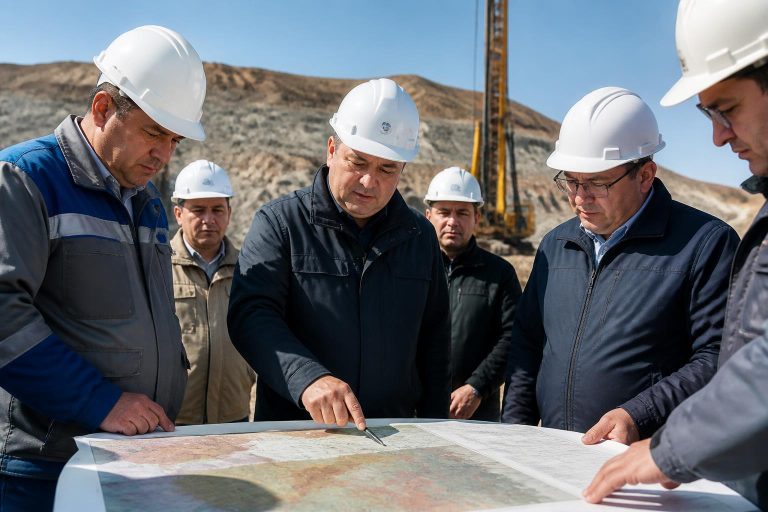
Tag: Geological Exploration

  • Kazakhstan Highlights Exploration Drive and $500m Investment Plan at PDAC 2026

    Kazakhstan Highlights Exploration Drive and $500m Investment Plan at PDAC 2026

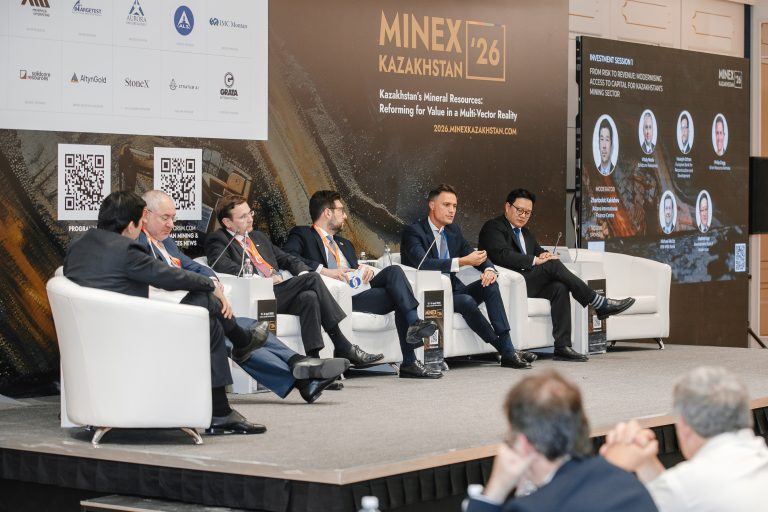
    A Kazakh delegation led by Vice Minister of Industry and Construction Iran Sharkhan took part in PDAC 2026, the world’s leading mining and exploration conference hosted by the Prospectors & Developers Association of Canada in Toronto.

    During the event, the Ministry of Industry and Construction, in partnership with the Kazakhstan Chamber of Mines and Aurora Minerals Group Limited, and with support from the Embassy of Kazakhstan in Canada, organised the international forum “Kazakhstan Day.” The session focused on the country’s geological potential and exploration opportunities.

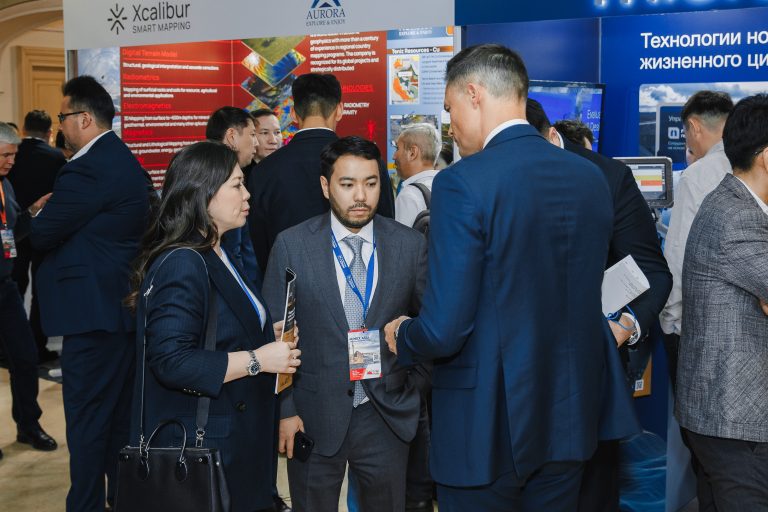
    The forum drew representatives from major international and Canadian mining companies, including Zijin Mining Group, B2Gold, First Quantum Minerals, Hatch, Arras Minerals and Xcalibur Smart Mapping.

    In his address, Iran Sharkhan stressed that the government places strategic importance on improving the geological knowledge base of Kazakhstan’s territory. Over the next three years, approximately $500 million is expected to be allocated to geological exploration, exceeding the total state investment in exploration over the previous three decades.

    According to the Vice Minister, systematic expansion of exploration activities and the opening of new territories for prospecting will create improved conditions for foreign investment and deeper international cooperation in the mining and metallurgical sector.

    Participants were also presented with an overview of key geological discoveries made in 2024–2025, along with successful examples of joint projects implemented with foreign partners.

    On the sidelines of PDAC, the head of the delegation held a series of bilateral meetings with Canadian and international mining executives interested in launching new projects in Kazakhstan. Discussions focused on cooperation in critical minerals, the application of advanced exploration and mining technologies, and potential joint ventures in downstream processing of Kazakh raw materials.

    Officials said Kazakhstan’s participation at PDAC 2026 underscored sustained international interest in the country’s resource base and demonstrated its readiness to expand partnerships with Canadian and global investors across the mining value chain.

  • Kazakhmys Launches 2026 Digital Modernisation Programme for Exploration and Geological Operations

    Kazakhmys Launches 2026 Digital Modernisation Programme for Exploration and Geological Operations

    Kazakhmys Corporation has announced a comprehensive modernisation programme for its geological exploration system in 2026, focusing on digital transformation and the development of new geological infrastructure in Zhezkazgan.

    The decision follows an independent audit conducted across five Kazakhmys deposits using Micromine software, which revealed that existing digital tools were not being fully utilised. According to the assessment, geological calculations were frequently performed in two-dimensional formats, limiting the accuracy of modelling and resource forecasting.

    Under the new programme, the company plans to transition to full three-dimensional geological modelling to improve exploration efficiency and decision-making. Around 400 employees will undergo training in Micromine Origin & Beyond, alongside advanced professional courses under the Micromine Advance programme.

    Kazakhmys has already begun developing integrated lithological and hydrological models for its mining operations, incorporating both ore body geometry and complex natural conditions. A centralised geological data storage and analytics platform, Geobank, will also be introduced across company assets to streamline data management and interpretation.

    The digital transformation initiative will be supported by new physical infrastructure in Zhezkazgan, where construction of a geological cluster covering approximately 14,000 square metres is underway. The facility will include a modern core storage centre with capacity of up to 200,000 linear metres, to be operated jointly with Australian laboratory services provider ALS.

    The planned geo-cluster will additionally house geo-mineralogical and geophysical laboratories, training facilities and a museum. The educational component of the project will be developed in cooperation with the Colorado School of Mines, strengthening professional training and technical expertise within Kazakhstan’s mining sector.

  • Altyn Ken Group Plans Gold Exploration at Mazhera Site in East Kazakhstan

    Altyn Ken Group Plans Gold Exploration at Mazhera Site in East Kazakhstan

    Altyn Ken Group LLP has unveiled a geological exploration programme for hard minerals at the Mazhera site in the Ulan district of East Kazakhstan Region, where gold is expected to be identified across three blocks.

    The company plans to carry out topographic surveying and drill 20 exploration wells with depths ranging from 100 to 200 metres, totalling 3,000 linear metres. Additional geological exploration activities will also be undertaken.

    According to the company’s environmental notification, geochemical work will include lithogeochemical surveying across 80% of the site, with up to 1,000 samples taken at depths of 15–20 cm and analysed for gold using fire assay methods. The objective is to study geological conditions and rock composition, assess peat and sand thickness, determine gold grades in grams per cubic metre, and evaluate the material composition and processing properties of ores and sands in order to select appropriate beneficiation methods. Resource estimates will be calculated in accordance with KazRC standards.

    Altyn Ken Group received its exploration licence from the Ministry of Industry and Construction on 26 December 2025. The company notes that the Mazhera site lies outside the state forest fund, and, according to the National Geological Service, there are no groundwater deposits within the area. The nearest settlement, the village of Zhanuzak, is located 8.4 km east of the site boundary.

    Exploration operations will utilise diesel-powered equipment, including a front-end loader, drilling rig, diesel generator unit, fuel tanker, excavator, water truck, bulldozer, two shift minibuses and a Toyota Hilux SUV. The drilling rig is expected to achieve between 500 and 800 linear metres per month. A team of 16 specialists will work on a rotational basis, either 15/15 or 30/30 days.

    The total area of the Mazhera geological allotment covers 6.48 square kilometres. Exploration is scheduled to begin in the first quarter of 2026 and conclude in the first quarter of 2031.

    The final output of the project will consist of geological data, including core samples, primary documentation, geological maps and a final report with gold and polymetallic resource estimates under categories C2 and P1 for inclusion in the state balance.

    Altyn Ken Group is jointly owned by Xingwang Engineering Kazakhstan Co., Ltd and Inzhu Caspian Gold LLP. The company was registered on 13 November 2025, with Zeng Qi listed as its head. Xingwang Engineering Kazakhstan is fully owned by Guizhou Xingwang Engineering Co., Ltd, while Inzhu Caspian Gold is wholly owned by Aruzhan Sanaeva.

    Earlier, Qazba reported that Shakhtostroy-Gold LLP plans to begin gold exploration in 2026 in the Ulken Naryn district of East Kazakhstan Region.

  • Kazakhstan to Spend ₸240 Billion on Geological Exploration: What and Where the State Plans to Explore

    Kazakhstan to Spend ₸240 Billion on Geological Exploration: What and Where the State Plans to Explore

    Kazakhstan’s government will allocate ₸240 billion to geological exploration, but the specific distribution of these funds and the rationale behind the chosen priorities have raised questions among industry experts. In response to an inquiry from inbusiness.kz, the Ministry of Industry and Construction detailed its plans for 2026–2028 via the eOtinish electronic platform.

    A central focus of the program will be regional geological mapping at a scale of 1:50,000. Preparatory work began in 2025, with 20 design-and-cost project documents developed, covering a total area of around 100,000 square kilometers. These projects предусматривают comprehensive analysis of Earth remote sensing data, airborne geophysical and geochemical surveys, as well as field geological work. The estimated cost of these 20 projects amounts to ₸110 billion.

    Another major spending area is 2D seismic exploration. Six projects are scheduled to begin in 2026 with a combined budget of ₸42.6 billion. The work is aimed at identifying structural traps for hydrocarbons and will cover two blocks in the Shu–Sarysu sedimentary basin and four blocks in the North Turgai basin. In total, 2D seismic surveys will span 25,300 line kilometers, with completion planned by the end of 2028.

    According to the ministry, seismic work will begin simultaneously in several regions. The North Turgai basin will be surveyed in Kostanay Region, while the Shu–Sarysu basin will cover parts of Ulytau, Turkestan and Zhambyl regions. Information on forecast resources will become available after completion of the surveys, and the resulting geological reports are expected to be published in open access on the minerals.e-qazyna.kz portal and the website of the Committee of Geology.

    The ministry stressed that these regional programs should not interfere with the normal operations of existing subsoil users. On the contrary, officials say the data generated by the state program can be used by private companies when planning and implementing their own exploration activities.

    However, industry specialists note that the ministry’s explanation leaves the strategic logic of the program insufficiently articulated. In their view, there is no publicly available document that systematically assesses the prospectivity of different regions and mineral types or sets out a long-term exploration roadmap.

    Experts have also questioned the choice of basins selected for state-funded seismic surveys. Both the Shu–Sarysu and North Turgai basins are already seeing strong interest from national and private companies, while other underexplored areas—such as the Irtysh, Balkhash and Teniz basins—remain largely outside the scope of large-scale government programs.

    Additional criticism relates to institutional bottlenecks, including lengthy procedures for accessing geological data and a five-year confidentiality period for submitted exploration results. Analysts argue that removing such constraints could deliver faster and more tangible benefits for the sector than large-scale mapping or seismic programs alone.

  • Why Junior Exploration Companies Remain the Weakest Link in Kazakhstan’s Mining Investment Cycle

    Why Junior Exploration Companies Remain the Weakest Link in Kazakhstan’s Mining Investment Cycle

    Kazakhstan’s Subsoil and Subsoil Use Code, introduced in 2018, significantly liberalised access to geological exploration and opened the market to junior mining companies. Since then, exploration investment has tripled to more than $1 billion, attracting international players such as Barrick Gold, Fortescue, Teck, Ivanhoe and First Quantum. However, despite this progress, junior explorers continue to face severe financing constraints that threaten the long-term sustainability of the country’s resource base.

    Junior companies typically operate at the highest-risk stage of the mining cycle, conducting early-stage exploration years before reserves can be confirmed under international standards such as JORC or KAZRC. This risk profile makes them unattractive to banks and cautious investors, while major mining companies usually only engage once resources are already proven. As a result, juniors struggle to raise capital despite being responsible for up to 80–90% of primary mineral discoveries globally.

    Industry experts note that Kazakhstan has the geological potential for world-class discoveries, similar to Mongolia’s Oyu Tolgoi deposit, which was initially discovered by a junior company before attracting a major multinational partner. In Kazakhstan, some successful partnerships have emerged, including foreign majors entering joint ventures with juniors, but these remain the exception rather than the norm.

    Analysts also warn that the rapid increase in exploration licences does not necessarily reflect genuine growth of the junior sector. A portion of licence holders conduct minimal fieldwork and focus on speculative resale of licences, undermining confidence in the junior market and creating unfair competition for companies carrying out real exploration.

    Another major challenge is regulatory uncertainty. Frequent changes in subsoil, environmental and tax legislation increase project risk, particularly at the transition from exploration to mining. Juniors preparing assets for sale or partnership with major companies can see project value eroded if regulatory conditions change materially at later stages.

    Experts argue that state involvement is essential to unlock junior financing. International practice shows that governments often share early-stage exploration risk through grants, co-investment funds, tax incentives or specialised venture exchanges. Canada, Australia, Saudi Arabia and Chile all provide structured public support for early exploration, recognising it as critical infrastructure for future mining development.

    Without targeted financial instruments such as exploration funds, risk-sharing mechanisms or state-backed venture vehicles, Kazakhstan risks underinvesting in early-stage geology. Industry specialists warn that without sustained junior exploration, the country’s mining sector could face a shrinking resource base in the decades ahead, undermining future production, processing and export potential.

  • Kazakhstan launches large-scale programme to refine geological mapping and resource forecasts

    Kazakhstan launches large-scale programme to refine geological mapping and resource forecasts

    Kazakhstan will roll out a three-year programme of advanced subsurface studies aimed at improving the accuracy of geological forecasting, according to the Ministry of Industry and Construction. A central element of the initiative is the transition to geological mapping at a scale of 1:50,000, which is four times more detailed than the Soviet-era standard of 1:200,000.

    In 2025, authorities approved 20 projects covering a total area of 100,000 square kilometres. During the next stage, around 30,000 square kilometres of the most prospective territories are expected to be studied annually. Funding of 240 billion tenge, or about $500 million, has been allocated for geological exploration of 20 sites, seismic surveys in poorly studied sedimentary basins, and the creation of a digital geological data infrastructure. This represents the largest level of investment in the sector in the past 15 years.

    The programme includes analysis of satellite imagery, aerogeophysical and geochemical surveys, as well as extensive fieldwork. Areas were selected based on declining reserves, the absence of active subsoil users, and strong potential for key minerals. Priority targets include zones prospective for copper, gold, lead, zinc, rare earth metals, barite and bauxite.

    Special focus will be placed on oil and gas potential. Seismic surveys are planned in the North Torgai, Shu-Sarysu and Syrdarya basins, alongside upgrades to laboratory facilities and the digitisation of geological data.

    According to Ulzhabay Ismailov, генеральный директор GeoByte-Info, mapping at a 1:50,000 scale makes it possible not only to chart territories in detail but also to reconstruct geological history, identify ore distribution patterns and better assess exploration prospects. Refining forecast resources in the R3 and R2 categories will help more precisely select targets for subsequent exploration, he said.

  • Kazakhstan Announces Major New Discoveries of Gold, Rare Earths and Strategic Metals as Geological Survey Intensifies

    Kazakhstan Announces Major New Discoveries of Gold, Rare Earths and Strategic Metals as Geological Survey Intensifies

    Kazakhstan is accelerating its nationwide geological exploration programme, aiming to expand the area of mapped and studied subsoil from 2.1 million sq km to 2.2 million sq km by 2026. According to the Ministry of Industry and Construction, the push is already yielding significant results: exploration work completed in 2024 across 11 sites has led to the identification of promising new deposits of precious, rare and strategic metals.

    Some of the most important discoveries span four key regions. In Abai Region, geologists have outlined forecast resources of 3,200 tonnes of beryllium, 1,100 tonnes of yttrium, and 200 tonnes of niobium. In East Kazakhstan, newly identified deposits are estimated to contain 20,600 tonnes of beryllium and 600 tonnes of tungsten.

    The Karaganda Region delivered the largest rare-earth findings, with early estimates indicating 935,400 tonnes of lanthanoids. Specialists also believe the region may host 98,700 tonnes of copper, 59,800 tonnes of yttrium, 33,480 tonnes of gallium, and 7,000 tonnes of molybdenum.

    Meanwhile, Kostanay Region emerged as the country’s gold leader, with forecast resources reaching 17,500 tonnes. Prospective copper reserves there are estimated at 13,480 tonnes.

    A separate initiative — the “Predictive Assessment of Collision-Zone Granitoids in Eastern Kazakhstan” — identified three target zones with substantial potential for niobium, zirconium, and rare-earth elements. Preliminary estimates suggest more than 500,000 tonnes of niobium, 2 million tonnes of zirconium, 947,000 tonnes of rare earths, as well as 79,800 tonnes of molybdenum and 399,100 tonnes of tungsten.

    As a result of 2024 exploration activities, five new deposits have been officially added to the national register: Kok-Zhon, Altyn-Shoko, Samombet, Studenchesky and Takyr-Kaldzhir. Newly booked reserves include 98 tonnes of gold, 36,000 tonnes of copper, 11 million tonnes of manganese, and more than 1.3 million tonnes of phosphorites.

    The discoveries underscore Kazakhstan’s growing role as a major source of critical minerals and precious metals, supporting both domestic industrialisation goals and international supply-chain diversification strategies.

  • Tau-Ken Samruk Begins Exploration of Rare and Rare-Earth Metals in Rwanda and Afghanistan

    Tau-Ken Samruk Begins Exploration of Rare and Rare-Earth Metals in Rwanda and Afghanistan

    Kazakhstan’s state-owned mining company Tau-Ken Samruk has launched geological exploration efforts for rare and rare-earth metals in Rwanda and Afghanistan, according to Nurlan Zhakupov, Chairman of the Board of Samruk-Kazyna. The initiatives are viewed as strategically important for strengthening Kazakhstan’s resource security and expanding its processing capabilities.

    In Rwanda, the national company has already signed a cooperation agreement that will pave the way for establishing a joint venture with the country’s state enterprise. Once the joint company is formed, exploration activities will begin, eventually leading to the extraction of strategic minerals.

    Work in Afghanistan remains at an early evaluation stage. Specialists collected and analyzed geological samples in July and reported promising results. However, joint mining is not yet under consideration, as licensing and resource assessment procedures still need to be resolved.

    Zhakupov noted that these international exploration projects will help Kazakhstan develop deeper processing of raw materials sourced from third countries. The government has declared its intention to process rare and rare-earth metals domestically, and the Ministry of Industry and Construction has prepared a development program for the sector covering 2024–2028.

    Tau-Ken Samruk continues to focus on gold, copper, and lead-zinc deposits while also identifying strong potential in the extraction of strategic resources, including rare and rare-earth elements.

  • Armenia Reaffirms Commitment to Mining Strategy Despite Challenges

    Armenia Reaffirms Commitment to Mining Strategy Despite Challenges

    Armenia’s mining development strategy is moving forward despite certain challenges, with the government determined to ensure its full implementation, Deputy Minister of Territorial Administration and Infrastructure Asatur Vardanyan said at the Mining Armenia Forum 2025 on October 3.

    Vardanyan highlighted that the strategy is supported by a strong platform involving both private sector representatives and scientific institutions. Key elements include the launch of a comprehensive digitalization process — not merely procedural but based on in-depth analysis and fieldwork to guide policymaking. By 2027, full digitalization of the permitting system is expected, with improvements aimed at increasing transparency and reducing approval times.

    The deputy minister also announced plans to establish a national geological service. Armenia is working closely with the EU and the United States, building on agreements signed in August 2025, to create a new platform that will strengthen governance and enable the development of a unified mining policy.

    He stressed the importance of companies adopting international mineral reporting standards to enhance investor confidence and predictability. The ultimate goal, he said, is to create a mining industry that operates more efficiently and on a stronger economic footing, drawing on Armenia’s accumulated expertise and international practices.

    Vardanyan underlined the need for more extensive and higher-quality geological exploration to secure future reserves, particularly of critical minerals. With rising global demand and metal prices, Armenia has been receiving growing interest from international organizations and foreign investors. The new geological service will also commission state-funded regional exploration to open new deposits.

  • The Devil is in the Detail: Key Concerns of Kazakhstan’s Mining Sector Investors

    The Devil is in the Detail: Key Concerns of Kazakhstan’s Mining Sector Investors

    While Kazakhstan has established itself as one of the most attractive jurisdictions for geological exploration investment, recent developments have unsettled international partners. Ruslan Baimishev, President of the Kazakhstan Mining Chamber, outlined these concerns during a panel discussion in Almaty, as reported by LS.

    Baimishev noted that major industry players invest with long-term horizons—often 10 to 15 years—making regulatory stability crucial. He acknowledged that reforms in 2018 had positioned Kazakhstan as a globally competitive mining jurisdiction. However, he warned against backtracking, citing attempts to reintroduce restrictive policies, such as stricter reserve reporting rules and restricted access to geological data.

    “During the last parliamentary session, several draft laws initially welcomed by MPs were later amended, effectively reverting to outdated practices and deviating from international standards,” Baimishev explained. Though these changes were ultimately halted, the mere attempt sent worrying signals to investors.

    Another pressing issue is tax reform. The new Tax Code, set to take effect in 2026, introduces higher land lease fees, which could discourage large-scale exploration. Baimishev argued that while the intent—to incentivise faster project development—is logical, investors need clarity on post-exploration taxation. He also criticised proposed royalty rates, which, despite being marketed as investor-friendly, may apply unevenly, disadvantaging existing license holders.

    On a positive note, Baimishev praised ongoing government-business dialogue and improvements in geological data accessibility. However, he urged further refinements, particularly in licensing procedures for restricted areas.

    Separately, Nikolai Radostovets of the Republican Association of Mining and Metallurgical Enterprises raised concerns over a proposed 1% R&D levy. While 30% would fund geological studies—a sector priority—he argued the remaining 70% should support industry-specific innovation rather than being absorbed into the state budget.

    Saken Shayakhmetov of Kazakhmys added that without strategic R&D investment, Kazakhstan risks falling behind technologically as mineral reserves deplete.