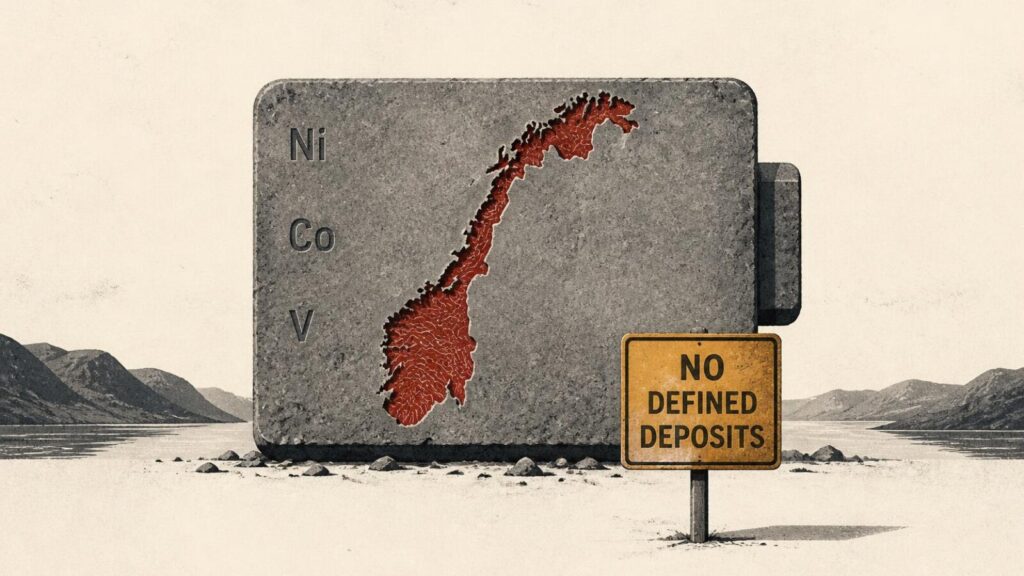
Norway’s potential as a source of battery minerals, particularly nickel, cobalt, and vanadium, is significant according to geological assessments, yet the country currently lacks any producing mines for these critical materials as of November 2026 according to Muflih Hidayat, Mining & Energy Journalist who recently published on Dsicovery/Alert an aricle “Norway’s Battery Minerals: Rich in Rock, Short on Defined Deposits”.
The Geological Survey of Norway (NGU) indicates that while there are nearly 20 million tonnes of nickel ore across various sites, only 8.3 million tonnes are classified under the NI 43-101 standard, which is essential for public reporting of mineral resources. This discrepancy highlights a substantial gap between the geological promise and actual supply capabilities.
The European Union’s Critical Raw Materials Act (CRMA) has intensified scrutiny on Norway’s mineral resources, setting ambitious targets for local extraction and processing of key minerals. Despite the geological potential, Norway’s lack of modern compliant resources and economic reserves for cobalt and vanadium raises concerns about its ability to meet these EU benchmarks. Historical mining activities have left behind a legacy of cobalt production, but no contemporary resources have been established.
Several projects are currently in various stages of exploration and permitting, but none have progressed to the point of financing or construction. The Kingsrose-BHP alliance has received drilling permissions for the Porsanger/Karenhaugen project, while Kingsrose has confirmed nickel-copper-cobalt mineralisation at Råna. The Eigersund project has extraction rights for vanadium, titanium, and iron, but no final investment decision has been made.
Norway’s geological knowledge is strong, yet its mapping and exploration records lag behind those of its Nordic neighbours, Finland and Sweden, which have more advanced projects and operational mines. The CRMA aims to reduce Europe’s reliance on external sources for strategic raw materials, but Norway’s current status as a producer remains uncertain. The country must navigate various hurdles, including geological assessments, market conditions, and permitting processes, to convert its mineral occurrences into economically viable deposits.
While Norway holds promising geological potential for battery minerals, the absence of defined deposits and producing mines poses challenges for the country’s role in Europe’s mineral supply chain. The future of Norway’s battery minerals sector will depend on overcoming these obstacles and aligning with EU policies to enhance its standing in the competitive landscape of critical raw materials.