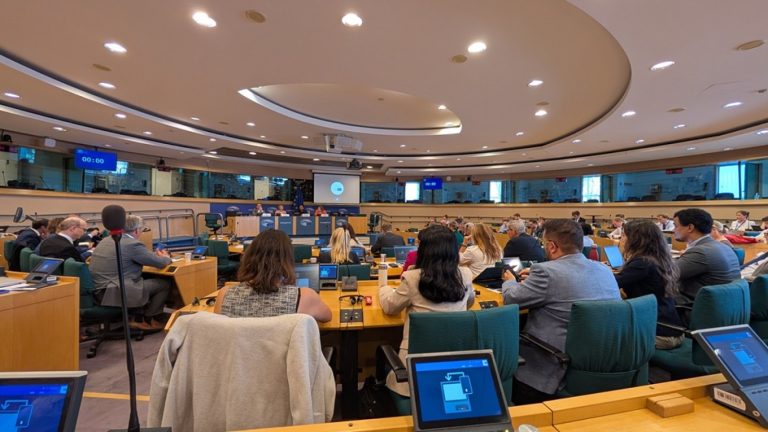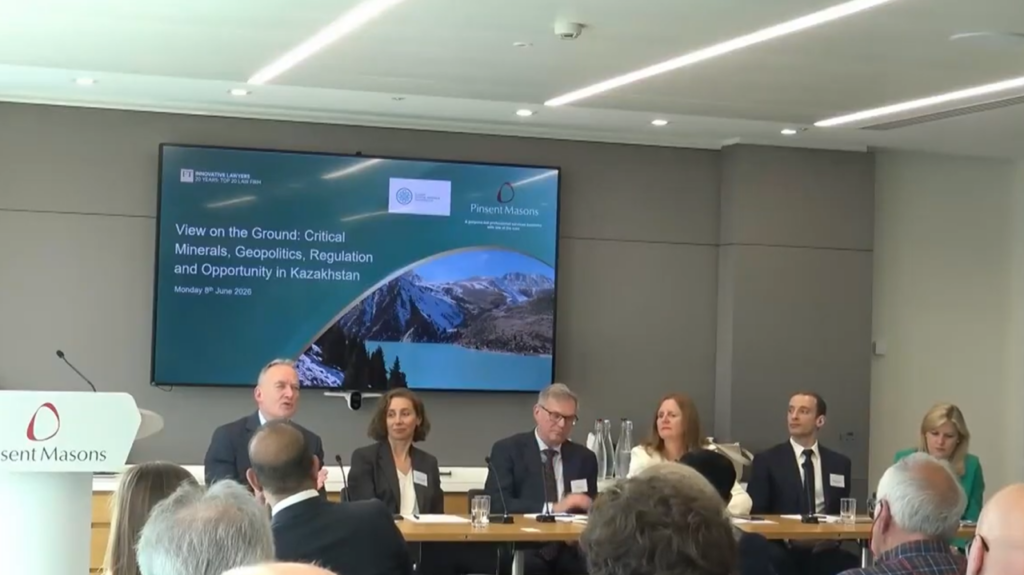
On 8 June, we joined in London a meeting chaired by Ros Lund the CEO of the Eurasia Critical Minerals Organisation and hosted by Pinsent Masons in London — a compact but exceptionally well-informed panel bringing together geoscientists, financiers, lawyers, and diplomats from the Kazakh Embassy.
These are the conversations that rarely make it into press releases. Here is what stood out.
The ground is moving faster than the headlines suggest
Ash Johnson of IGS, returning to Kazakhstan after eight years, was direct: the atmosphere has changed. There is a greater appetite for engaging with international experts, a more realistic appraisal of where Kazakhstan stands on the global exploration investment ladder, and — crucially — a shift from confidence in geological potential toward something more demanding: the question of execution.
In the Fraser Institute rankings, Kazakhstan placed 24th out of 91 jurisdictions in 2017. By the most recent survey, it had slipped toward the bottom quarter of the index — a trajectory that reflects not a failure of geology, but unfinished work on policy and data.
The 2018 mining code reforms, modelled on the Australian first-come-first-served system, remain the single most important driver of renewed interest. Eric Rasmussen — former head of natural resources banking at EBRD, subsequently involved in investment strategy at Rio Tinto, now advising governments across the region — described it plainly: investors today see a more competitive, more predictable licensing process, clearer allocation of rights, and a statutory framework that, while complex, offers security over the long term. As Eric put it: mining is a long-term game. Better to implement things right from the outset than to move quickly and spend years fixing what wasn’t done properly.
The data imperative
The conversation kept returning to one theme: geological data.
IGS’s work at the geological survey interface, from Northern Ireland to a vast programme across the Arabian Shield in Saudi Arabia, has shown consistently that making high-quality data freely available is the single most effective lever for attracting junior exploration capital. Ash’s prescription for Kazakhstan was unambiguous: get the data, get it released, and then use AI to unlock the legacy Soviet archive — tens of thousands of reports, scanned to PDF but not yet fully digitised, written by highly trained geologists and representing an extraordinary unexploited asset.
The Kazakh Embassy’s first secretary confirmed that this is now underway: the National Geological Survey is actively introducing AI tools to translate and systematise that Russian-language archive, and a first tranche of publicly available data is expected before year end. The infrastructure challenge is real — we are talking petabytes, not megabytes — but the direction of travel is right.
A national geoscience database of the quality now being built in Saudi Arabia would, in Ash’s view, be the single most transformative step Kazakhstan could take for investment attraction. There are over 3,000 exploration licences currently active in the country, yet around 65% of the country remains underexplored. That fragmentation is both the problem and — for the right kind of capital — the opportunity.

The consolidation play
Matthew Fisher of La Mancha Resource Capital put a precise investment thesis on the table. La Mancha takes 20–30% of a company, takes seats on the board, uses contractual rights to drive exploration, and engineers consolidation — mergers between adjacent projects, resource aggregation, and scale. They have done it in Africa with Endeavour Mining (invested over a decade ago, now approximately $12 billion market cap), in Australia with Evolution Mining (exited 2021, now $16 billion), and are building a similar position in Latin America with G Mining Ventures (approximately $6 billion). Kazakhstan is next on the list.
The three criteria: good geology (established), a mining-friendly jurisdiction (nuanced but broadly yes, with uranium as the carve-out), and a strong team on the ground willing to commit to the thesis. La Mancha’s chairman Nagib Sawiris has already met with Deputy Prime Minister – Minister of Foreign Affairs of the Republic of Kazakhstan Mr. Murat Nurtleu in January this year. The geology and jurisdiction boxes are ticked. The team question, Matthew was candid, is still being worked.
Matthew also offered what struck me as the most practically useful observation of the evening on regulation: investors can deal with complexity. What they cannot deal with is shifting sands and chaos.
From an investor’s perspective, a degree of red tape, properly implemented, is a blessing, not a burden.

The legislative changes: less alarming than reported
The recent amendments to Kazakhstan’s subsoil use code — signed by President Tokayev in December 2024, in force since March 2025 — introduce two significant mechanisms: a unified digital licensing platform (allowing e-signature registration and royalty payment for exploration and extraction licences) and an electronic auction system for contested ground. Where two or more applications are filed for the same area, an auction is automatically triggered within 15 days.
Sylvia Tonova, Partner and Co-Head of International Arbitration at Pinsent Masons, brought her investment arbitration and public international law perspective to bear. As long as the uranium-related changes are not retroactive — and her reading is that they are not — the direction is clarifying rather than restrictive. She also noted something that tends to get lost in the headlines: the amendments include material incentives for solid mineral processing projects, including exemptions from corporate income tax and land tax for ten years, from property tax for eight years, and VAT on imported equipment for five years. Good news for investors, and largely unreported.
Her wider counsel was pointed: involve disputes lawyers at the transactional stage, not the crisis stage. Kazakhstan has signed bilateral investment treaties with China, the UK, Singapore, the Netherlands, Luxembourg, Switzerland, Italy and the US, among others, as well as the Energy Charter Treaty. These are real instruments of protection — cheaper and more comprehensive than political risk insurance — that investors routinely fail to structure correctly at inception. More importantly, having that treaty architecture in place often brings a counterparty government to the table for dialogue long before arbitration becomes necessary.
As Sylvia put it, with characteristic directness:
it is a little like a prenuptial agreement. You hope you never need it. But you would be unwise to proceed without one.

Operating at the coalface: the Solidcore perspective
Tania Tchedaeva, Executive VP for Corporate Governance and Compliance at Solidcore Resources — the Kazakhstan-focused gold producer formerly known as Polymetal, now listed on the Astana International Exchange — offered what was perhaps the most grounded perspective of the evening: that of a company that has been doing all of this in practice, not in theory, for over a decade.
Solidcore’s story in Kazakhstan is instructive. The company’s first acquisition was built into a processing hub. Its second — a large but long-troubled mine — was unlocked through its proprietary pressure oxidation technology, which handles the refractory ore that defeated previous owners. A new processing facility is now under construction and due for completion in two years. A more recent tin acquisition reflects a deliberate strategy of learning new commodity verticals through smaller, simpler operations before scaling. And crucially, that processing facility will not just serve Solidcore’s own operations: it will process ore from third-party companies, making it both a revenue stream and a strategic asset for Kazakhstan’s broader value-add ambitions.
Tania was equally direct about the human dimension of operating in Kazakhstan: Solidcore invests heavily in local communities, including funding children’s education in the areas where it operates, on the explicit premise that it wants those children to return as qualified professionals. This is not philanthropy as a footnote. It is the operating model.
On the capital markets dimension, Tania made two points that deserve wider attention. First, Solidcore was among the earliest companies listed on the AIX when it launched, and has been working actively with Kazakh regulators ever since — bringing international standards, brokers, and institutional relationships that had never previously looked at Kazakhstan. When Solidcore moved its primary listing from London to the AIX in 2023, it did not come alone. That kind of institutional transfer of know-how is precisely what a nascent exchange needs.
Second — and this is the structural point that rarely surfaces in investment attraction conversations — Kazakhstan is currently classified as a frontier market rather than an emerging market. For a significant category of institutional investors, this is not a deterrent to be argued away. It is a hard constraint. Their mandates physically prohibit investment in frontier-classified jurisdictions, regardless of the quality of the opportunity. Kazakhstan has been working on this reclassification for some time, and Tania noted there is finally some traction. If and when that changes, the effect on available capital flowing into Kazakh mining could be transformative.
Her closing observation on Russia — raised by another panellist as the elephant in the room — was characteristically measured. Solidcore was formerly a top-ten gold producer and top-three silver producer globally. The Russian chapter of that story is now closed. The expertise, however — technical, operational, managerial — is being transferred to Kazakhstan and built upon there. Russia still exerts significant influence across the region. The pragmatic approach, she suggested, is to extract what value you can from that proximity, not to pretend it does not exist.

The Chinese question — and the wider investment geography
The room did not shy away from the China question. Chinese capital is moving faster than OECD-bound investors on virtually every dimension: speed of deployment, appetite for risk, integration of EPC contractors and labour, and — frankly — a different relationship with ESG standards.
Eric Rasmussen put it clearly: western firms are not going to out-pace Chinese capital on speed. The competition, if it is to be won, must be won on the quality and durability of the investment relationship. Standards are not bureaucratic inconvenience; they are long-term risk management. Licences get revoked. Governments change. Communities remember.
That said, the picture is not monolithic. Ash noted that IGS is currently working alongside the China Geological Survey on the Saudi Arabian national data programme — the Chinese are the main contractor — specifically to bring their methodology up to international standards. The Chinese teams have welcomed this, seeing it as a route to greater international competitiveness. And the composition of Chinese investment in Kazakhstan is itself shifting: while CNPC and Sinopec have anchored Chinese capital in oil and gas since the late 1990s, newer entrants are moving into higher value-added industries — amino acid production, metallurgy, and textile clusters. The extractive story is becoming more complex.
The broader investment geography, however, is one that deserves more attention than it typically receives. According to the EDB Monitoring of Mutual Investments database, FDI stock in Kazakhstan from the Eurasian region, China, Türkiye, and the Gulf states combined exceeded $28 billion by mid-2025 — up nearly 50% from 2020, representing more than $9 billion of new capital in five years. The Gulf states have been the fastest-growing source, tripling their investment stock to $4.4 billion, with capital now spanning construction, telecoms, power infrastructure, and mining — including Omani investment in Solidcore Resources itself. The Eurasian region accounts for $9.4 billion, growing at 40%, with Kazakhstan outpacing the regional average by a factor of 2.5.
Türkiye’s position in this picture is particularly worth watching. Turkish FDI stock in Kazakhstan has more than tripled to $3.3 billion, with transport and logistics emerging as the key sector — flagship projects including the modernisation of Almaty International Airport, the construction of Turkistan International Airport, and a logistics hub in Aktobe.
At the end of the Q&As, Eric Rasmussen offered a well-timed caution on the processing ambitions more broadly: pursue concentrate by all means — that is where approximately 70% of the value sits. But be wary of the current fashion for smelters. They are not profitable, and they are highly demanding on energy and water. As he put it: process, yes. But let’s not melt down.