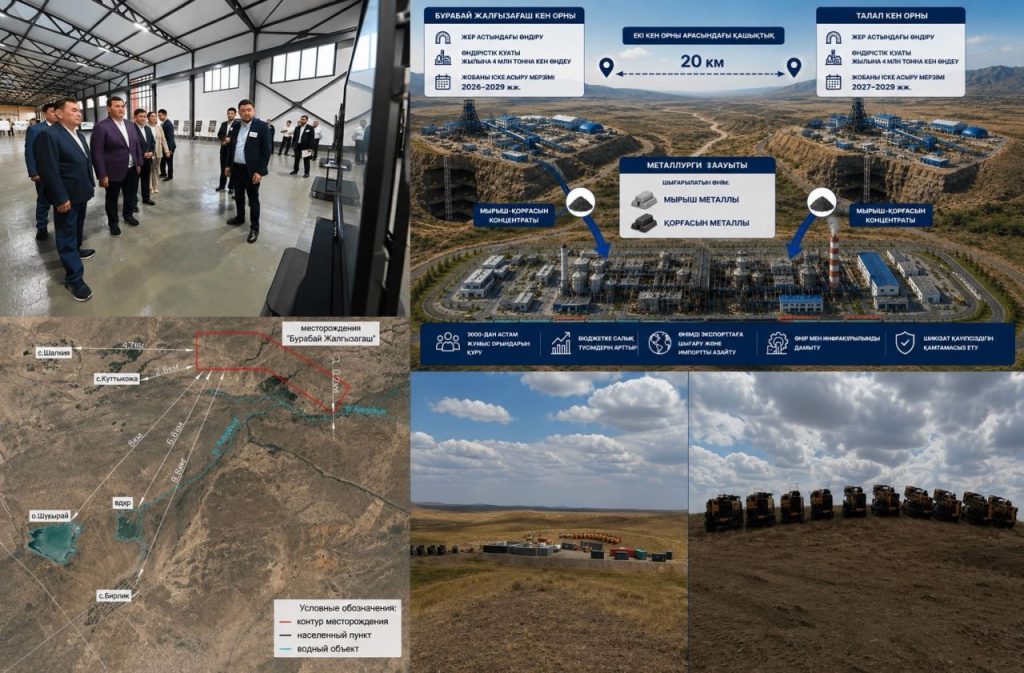
Hongda Group is set to embark on a significant investment project in Kazakhstan that could surpass Kazcink, positioning itself as the largest producer of lead and zinc in Central Asia. The initiative, valued at $1.3 billion, was highlighted during a recent visit by Kazakhstan’s First Deputy Prime Minister, Nurlan Naliyev, to the Kyzylorda region. The project entails the construction of two underground mines and two processing plants in the Zhanakorgan district, with a combined capacity of 8 million tonnes of ore per year, alongside a full-cycle metallurgical plant. This development is expected to create over 3,000 jobs, contributing significantly to the local economy.
The project will focus on the Talap and Burabay-Zhalgyzaghash deposits, located approximately 20 km apart. The Burabay-Zhalgyzaghash site will be developed using underground mining techniques to a depth of 500 meters. Both deposits are part of the Akuyuk-Maidantal lead-zinc ore district in the Karatau region, which is also home to the largest deposit in the area, Shalkiya. Initial exploration activities in this region took place between 1980 and 1985, with detailed surveys conducted from 2010 to 2012. The estimated reserves are classified as C2, with forecasted resources rated as P1. Geologists have noted an average zinc content of 2.01% and lead content of 1.62%, with potential for resource growth at depth.
Investors have indicated that the metallurgical plant will have an annual output of 420,000 tonnes of zinc and 220,000 tonnes of lead, totalling 640,000 tonnes of metals. In comparison, Kazcink is projected to produce 251,800 tonnes of zinc and 76,700 tonnes of lead by 2025. Upon reaching full operational capacity, the new complex could produce 66.8% more zinc and nearly three times the amount of lead than Kazcink. If the project meets its outlined parameters, it stands to become the largest lead and zinc producer in Central Asia. Notably, the Chinese investors have already committed around 9 billion tenge to geological exploration, operating 15 drilling rigs simultaneously. Although official reserves have yet to be disclosed, the scale of drilling and the proposed processing capacity suggest a substantial resource base. An official groundbreaking ceremony is anticipated later this year, marking a significant step in the development of this ambitious project.