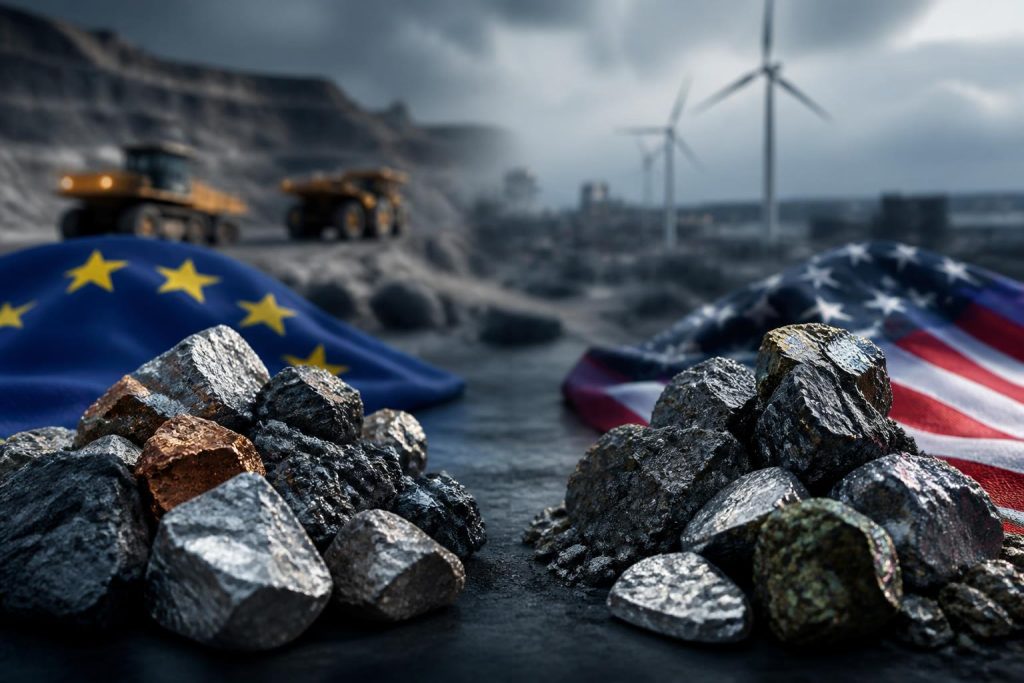
The European Union is at risk of falling further behind the United States in the race to secure critical minerals essential for defence and green technologies, as warned by European officials and industry leaders. The US has made significant investments over the past two years to ensure access to rare earth metals and other materials where China currently dominates global production. Since 2022, Washington has announced approximately $40 billion in provisional funding for mineral projects and has taken equity stakes in various domestic mining companies. Additionally, the US government has actively lobbied for American firms to win mining tenders in countries such as the Democratic Republic of Congo and Kenya.
In contrast, the EU has designated dozens of strategic mineral projects to benefit from expedited permitting rules, committing around €6 billion to these initiatives this year. However, industry representatives caution that the EU’s pace is too slow to effectively kick-start the sector. Bernd Schäfer, CEO of EIT RawMaterials, expressed admiration for the US approach, stating that while Americans act decisively, Europeans tend to hesitate and over-administrate, resulting in lost time.
The US is also working to establish a coalition of countries to create supply chains that circumvent China, through a new initiative known as the Forum on Resource Geostrategic Engagement (Forge). However, this initiative has raised scepticism in Brussels, particularly due to the previous US administration’s unpredictable stance towards the EU. European officials assert that the EU must adopt a similar approach to the US by securing offtake agreements and utilising financial tools to develop its critical minerals supply chain ahead of a new strategy set to be unveiled this autumn.
The EU’s current efforts have primarily focused on designating strategic projects in mining, processing, and recycling, which benefit from faster permitting but lack guaranteed public funding. In stark contrast, the Trump administration invested heavily in developing its supply chain, including acquiring stakes in rare earth producers both domestically and in Europe. For instance, the Pentagon made a $400 million equity investment in MP Materials, a US rare earths producer, and signed a long-term agreement to establish a minimum price for neodymium-praseodymium, a critical alloy used in technologies like electric vehicles and robotics.
Concerns have been raised about the potential for the US to become a second China for Europe in terms of dependence on rare earth metals. Schäfer noted that regardless of the methods employed by the Trump administration, the US has secured more deals in 18 months than Europe has in the past decade. Furthermore, the US government’s investments in European critical minerals companies, such as USA Rare Earth’s acquisition of British firm Less Common Metals, have sparked worries among European stakeholders.
The European Court of Auditors has also indicated that despite Brussels selecting 75 strategic projects for streamlined permitting and investment access, it is ‘unlikely’ that many will meet the bloc’s 2030 targets for developing domestic supplies. A mining executive involved in one of the projects described the EU’s efforts as ‘disappointing’ in terms of financial support, highlighting the complexity of obtaining permits. While being designated as a strategic project may serve as effective marketing, it does not significantly alter the operational landscape for these initiatives.