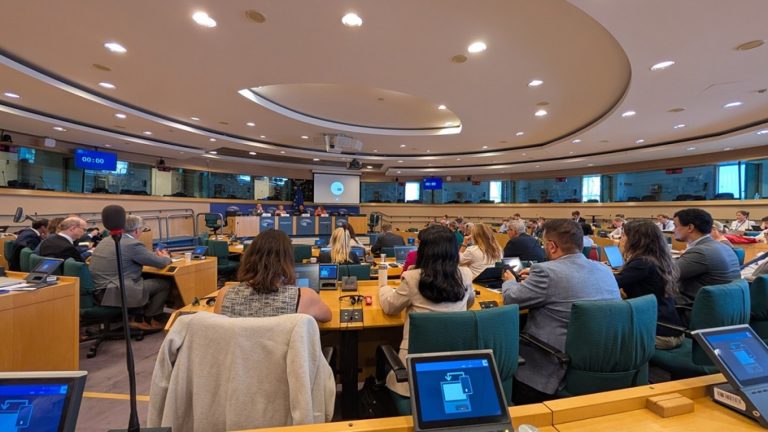
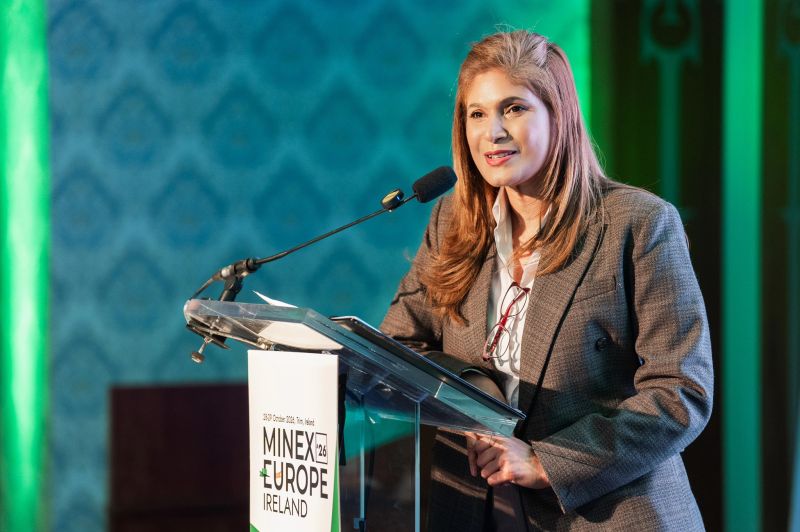
At the 10th MINEX Europe Forum in Trim, Co. Meath, the question hanging over the programme was whether the Critical Raw Materials Act has changed anything real, or mainly the paperwork. Kruthika Bala, Managing Director of Resources Now, who works on geopolitical risk, energy security and critical minerals, handled it from two sides. She moderated the opening session, Beyond Legislation: Can Europe Rebuild Its Mining Industry?, and then gave the opening address for the next one, What Strategic Status Is Really Worth, moderated by James Watson.
Her contribution was practical rather than rhetorical. She set aside the question of whether strategic designation is good policy and asked what it is worth to a project, and to whom. Her answer was that it depends on the constraint the project actually faces. The CRMA has strengthened regulatory predictability, and permitting certainty can shorten development timelines and improve financing conditions. But a project exposed to merchant commodity prices, carrying structurally high operating costs or lacking contracted demand has a different problem, and a designation does not solve it. Those cases need commercial responses, not regulatory ones.
That fits a view we have argued for some time: permitting is not Europe’s only bottleneck, and financing, offtake and state co-investment often decide whether a project is built. Bala’s framework gives that view sharper edges.
Who pays for security
Her second point concerned the distribution of costs and benefits. Diversifying supply is meant to strengthen Europe’s industrial base, and the gains can reach downstream manufacturers. The costs and the qualification risks, she argued, may fall disproportionately on midstream processors and intermediate producers, who must accept new feedstock, new suppliers and new customer approval cycles. Whether the benefit can support investment then depends on the terms of offtake, pricing and risk sharing. A supply chain can be more secure in aggregate while the businesses in its middle become less viable.
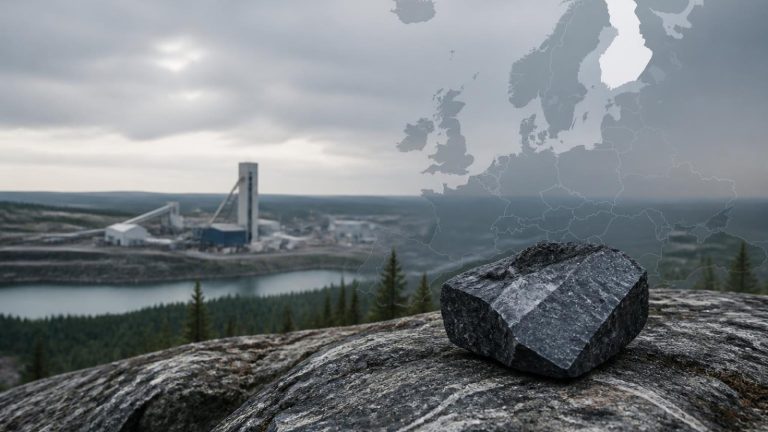
This echoes a concern that ran through the Forum. Europe’s gap in refining and processing capacity is at least as pressing as its gap in mining, and a policy that rewards extraction without protecting the processing stage risks leaving the weakest link where it is.
The greenfield bias
Her third point was the most uncomfortable. Industrial policy tends to favour new projects, while commercially exposed existing processing facilities receive less attention. Europe, she argued, should assess the strategic value of existing capacity alongside new investment, weighing prospective operating economics, replacement costs and credible alternatives. She was careful to add that preserving every facility would be neither commercially sustainable nor necessarily desirable. The argument is not for a blanket rescue, but for a test applied consistently to old and new capacity alike.
Additionality
Her final point concerned public money. When public capital is used to improve a project’s bankability, she said, the central questions are what investment would have occurred anyway, what residual risk the sponsors still carry, and how much security benefit the state secures relative to its exposure. Her conclusion was a distinction that is easy to blur in practice: a project can be financeable with public support without that intervention being justified. As more state banks, funds and offtake arrangements enter European capital structures, that test will matter more than the headline size of any package.
Why it matters for the second wave
With a second cohort of applicants for strategic status awaiting assessment, the questions Bala raised are practical. Which constraint does designation relieve for each project, who absorbs the cost of diversification, and what would have happened without public capital? None has a single answer, and none is a reason to doubt the CRMA’s ambition. They are the questions a lender, an offtaker or a finance ministry will ask before committing money, and the Forum is the place to put them in the same room.
Our thanks to Kruthika Bala for moderating and for setting the terms of the second session so clearly, and to Bernd Schäfer, Åsa Edfelt, Patrick F. N. Anderson, Pól Ó Seasnáin, Oliver Richards, Han Ilhan and James Watson for their contributions to the opening session. We also thank fellow presenters Keit Pentus-Rosimannus, Sean Xun, Kasperi Karhapää, Joaquín Merino-Márquez and Joe David.