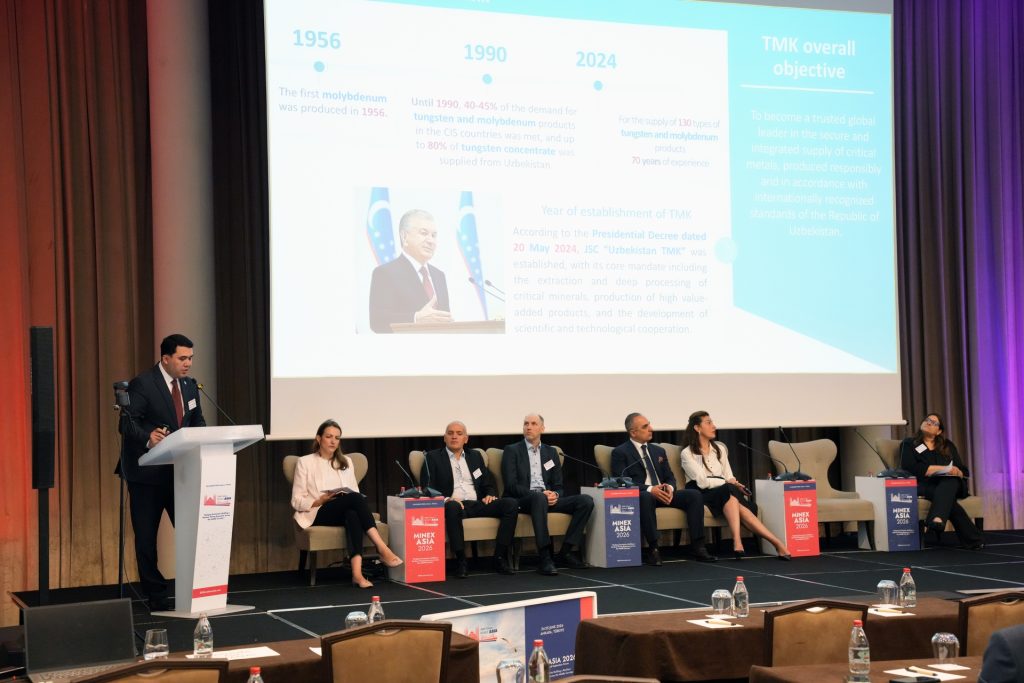
In a recent presentation, Khikmatullaev introduced the Uzbekistan Technological Metals Complex (TMK), outlining a state-backed strategy aimed at unlocking the country’s potential in critical raw materials. He emphasised Uzbekistan’s advantageous geographic position, providing access to major global markets including the EU, the United States, and Asia. The country has experienced consistent economic growth of approximately 5–7% annually, driven by structural reforms that liberalise the economy and enhance the investment climate, making it an attractive destination for foreign capital. The mining sector plays a crucial role, contributing about 24% to the country’s industrial output, indicative of a robust natural resource base and significant industrial potential.
Khikmatullaev highlighted the immense mineral resource base of Uzbekistan, estimated at around $3 trillion under the C2 category, supported by a national register of over 2,500 distinct deposits. This positions Uzbekistan among the top global holders of key reserves, including being the third-largest globally for one resource category and eighth for copper reserves. Notably, only about a third of the country’s territory has been geologically explored, suggesting substantial untapped discovery potential. The country also boasts significant reserves of uranium, lithium, tungsten, and molybdenum, reinforcing its strategic importance as a supplier of critical raw materials.
The presentation detailed TMK’s institutional history and mandate, tracing its roots back to 1956 with a legacy in molybdenum production. Established as a modern corporate entity in 2024, TMK aims to integrate exploration and downstream processing to produce higher value-added products. The company’s strategic objective is to become a trusted global leader in the secure and responsible supply of critical raw materials, aligning with the standards demanded by Western buyers and financiers.
Khikmatullaev elaborated on TMK’s resource bases and active projects, particularly focusing on tungsten, where Uzbekistan’s resource base includes 14 deposits with proven reserves of approximately 188,000 tons. Ongoing exploration is expected to increase total tungsten reserves significantly by 2030. TMK operates a fully integrated supply chain, encompassing geological exploration, refining, and processing, rather than merely functioning as an upstream extraction company.
Looking ahead, TMK plans to implement over 70 distinct investment projects between 2026 and 2030, with an estimated investment of $1.6 to $2 billion, strongly supported by the Uzbek government. A critical aspect of this strategy is the development of a critical raw materials hub connecting mining projects to processing centres in Tashkent and Samarkand, aimed at transforming raw ore into high-purity metals. The government has announced incentives for investors who establish full-cycle operations, including a 10-year tax refund and additional benefits for projects located in special economic zones.
Several flagship projects were highlighted, including a $151 million hydrometallurgical plant in the Samarkand region for processing tungsten concentrate, and plans for a molybdenum cluster with a $25 million investment. Other significant projects include the preparation of the Muskon copper deposit, the Nurkum lithium deposit, and the Tosin graphite deposit, with investments planned in the hundreds of millions. Collectively, these initiatives position TMK as a rapidly scaling industrial operator with a defined project pipeline, government-aligned incentives, and specific production targets across multiple critical minerals, establishing Uzbekistan as a leading opportunity in the global mining landscape.