Tag: Uzbekistan

  • Uzbekistan’s NMMC Reports $7.23 Billion Gold Production in First Half of 2026

    Uzbekistan’s NMMC Reports $7.23 Billion Gold Production in First Half of 2026

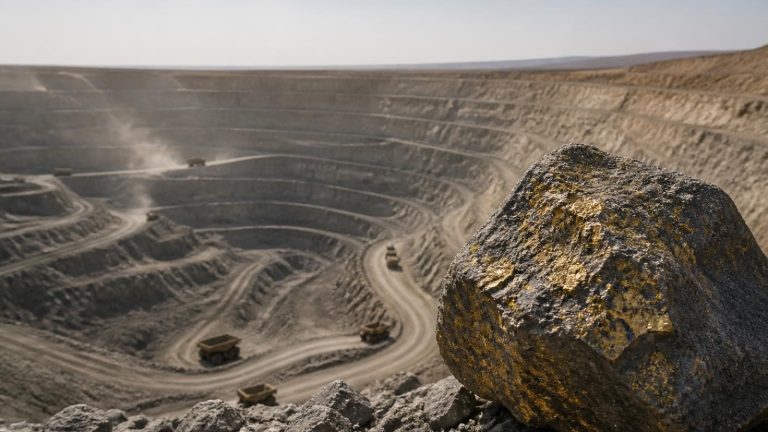
    In the first half of 2026, Uzbekistan’s Navoi Mining and Metallurgical Company (NMMC) achieved a remarkable production of 1.51 million troy ounces of gold, valued at approximately UZS 86.2 trillion (around $7.23 billion). This achievement is attributed to the company’s ongoing commitment to substantial investments in gold mining, ore processing, and infrastructure development. The operational results reflect a robust output, with NMMC producing 1,508.8 thousand troy ounces of gold during this period.

    The company has also made significant strides in local economic development, investing $236.8 million under Uzbekistan’s Investment Programme, which has resulted in the creation of 1,008 new jobs. As part of its localization programme, NMMC produced localized products worth UZS 808.7 billion (approximately $67.8 million). Furthermore, the company engaged in inter-industry cooperation by purchasing around UZS 4.2 trillion (about $352.2 million) worth of products from local producers, thereby bolstering the domestic economy.

    NMMC is actively advancing its major investment projects, particularly the fifth stage of the second phase of the Muruntau mine development, a key asset for the company. Between January and July 2026, over 96 million cubic meters of rock were mined at this site. The company has also enhanced its operational capabilities by supplying new haul trucks and mining equipment to its Central Mining Administration’s transport division. Additionally, construction and installation of conveyor lines using cyclic-flow technology are underway at the mine, which is expected to improve efficiency.

    At the Kokpatas and Daugyztau gold deposits, construction and installation of the tailings storage facility for Hydrometallurgical Plant No. 3 are ongoing. The company has introduced new electric excavators, motor graders, and front-end loaders to enhance operations at the Daugyztau and Vostochny mines.

    Moreover, NMMC is expanding Hydrometallurgical Plant No. 7 to increase its processing capacity. While construction works for the ore preparation and screening sections have been completed, efforts continue on thickening and desorption facilities, as well as on the power-supply infrastructure. The modernization of Hydrometallurgical Plant No. 2, the company’s largest facility by production performance, is also in progress, with the launch of additional mill blocks bringing the total number of operating mills to 82.

    Lastly, NMMC is reconstructing the tailings facility serving Hydrometallurgical Plants No. 2 and No. 7, which includes the construction of new waste-storage cells, embankments, water-intake facilities, and a 21-kilometer slurry pipeline. These developments not only signify NMMC’s commitment to enhancing its operational efficiency but also reflect its dedication to sustainable mining practices in Uzbekistan.


  • Uzbekistan Accelerates Geological Sector Transformation Through Digitalisation

    Uzbekistan Accelerates Geological Sector Transformation Through Digitalisation

    Uzbekistan is embarking on a significant transformation of its geological sector, aiming to attract up to $30 billion in investments by 2030 through the implementation of digital solutions and artificial intelligence. President Shavkat Mirziyoyev recently presented an ambitious plan to modernise the mining and geological industries, highlighting the need for a comprehensive national geological database to enhance global investor interest in new projects. Currently, Uzbekistan lacks a unified geological data platform, unlike Kazakhstan, which has had its Unified Subsoil Use Platform operational since 2025. The establishment of a digital geological map is deemed essential, as it will integrate historical data with current information, thereby improving the attractiveness of Uzbekistan’s geological resources to international investors.

    To facilitate this transformation, Uzbekistan plans to digitise over 36,000 reports and other information sources stored in various formats. This process is expected to take several years, drawing on the experiences of Russia and Kazakhstan, which have already undertaken similar initiatives. The new Centre for Technological Transformation will oversee the digitisation efforts, which will include compiling geological maps, drilling data, laboratory results, and production indicators into a single electronic database. Such a consolidation is anticipated to enhance the efficiency of discovering new mineral deposits.

    The government’s strategy includes leveraging artificial intelligence to expedite the analysis of geological data, improve resource estimation, and enhance drilling operations. Specific targets have been set, including a 10% reduction in the cost of geological exploration and a doubling of the speed at which new deposits are identified. Additionally, the number of investment proposals is expected to quadruple as a result of these digital advancements.

    Currently, only 40% of Uzbekistan’s mineral resources have been explored, but the government is keen to increase this figure significantly. By 2030, the country aims to boost its reserves of gold, silver, and copper substantially. Uzbekistan is home to over 30 types of critical minerals and is actively pursuing 76 investment projects worth approximately €2.4 billion. However, further exploration is necessary for some deposits, particularly for rare earth metals and uranium.

    The government has outlined plans for 44 projects between 2026 and 2030 that will incorporate artificial intelligence and machine learning in geological activities, focusing on six key mining enterprises. These projects aim not only to automate production processes but also to enhance geological exploration through digital transformation. The use of advanced technologies, including digital geological modelling, is already being implemented by major companies like the Navoi Mining & Metallurgy Combinat.

    Furthermore, Uzbekistan is working on a geospatial monitoring system to ensure transparency and accountability in the mining sector. This system will require all mining operators to submit their reports in a machine-readable format, facilitating quicker and more accurate verification of compliance with regulations. The geospatial monitoring initiative aims to prevent illegal activities and ensure adherence to environmental standards, using aerial and satellite technology to monitor mining operations effectively. As of June 2026, information on over 2,000 mineral deposits has already been integrated into this new system, marking a significant step towards a more modern and efficient geological sector in Uzbekistan.


  • Navoiyuran Reports 136% Surge in Net Profit for H1 2026

    Navoiyuran Reports 136% Surge in Net Profit for H1 2026

    Navoiyuran, a state enterprise in Uzbekistan, has reported a remarkable 136.1% increase in net profit for the first half of 2026, reaching nearly 4.3 trillion soums. This significant growth is compared to the 1.8 trillion soums recorded during the same period in 2025. The company’s net revenue also saw a substantial rise, growing by 101.8% year-on-year to 9.7 trillion soums, while gross profit surged by 109.1%, exceeding 7 trillion soums.

    The financial health of Navoiyuran has improved markedly, with total assets climbing to 19.8 trillion soums, reflecting a 70.5% increase from the previous year. Capital has also risen by 60.1% to 15 trillion soums, and retained earnings have increased by 73.3% to reach 13.3 trillion soums. Over the past year, the enterprise’s total profit amounted to 7.9 trillion soums, which is 56.6% higher than the previous year.

    However, the company has also seen an increase in long-term bank loans, which rose to 3.6 trillion soums by the end of the reporting period, compared to 1.6 trillion soums a year earlier. This increase in debt may be a point of concern as the company prepares for future growth.

    Looking ahead, Navoiyuran is planning to conduct an initial public offering (IPO) in the latter half of 2026, aiming to offer between 10 to 15 percent of its shares. Despite these ambitious plans, the company has yet to transition from a state-owned enterprise to a joint-stock company, which is a crucial step before the IPO can take place. The expected IPO could provide Navoiyuran with additional capital to further enhance its operations and financial standing in the competitive mining sector.

  • Concerns Raised Over Ernst & Young Advisory’s Compliance in Navoi Mining Audit Procurement

    Concerns Raised Over Ernst & Young Advisory’s Compliance in Navoi Mining Audit Procurement

    The Agency for Industrial Cooperation and Public Procurement has responded to Anhor.uz’s inquiry regarding procurement number 7081330 by the Navoi Mining and Metallurgy Combinat (NGMK) for an audit of its procurement system and forensic evaluation of anti-corruption mechanisms. This inquiry was prompted by questions from the Association of Public Procurement Participants about the compliance of the winning bidder with established qualification requirements.

    In April 2026, NGMK announced a procurement for a forensic evaluation for the year 2025. The winner was identified as Ernst & Young Advisory, which proposed to carry out the work for 1.16 billion sums, including VAT. One of the requirements in the technical specifications was that the contractor must be a current auditing organisation listed in the relevant register of the Ministry of Economy and Finance. The Association raised concerns about whether the winning company met this requirement, as Ernst & Young Advisory operates as a separate legal entity.

    In response to the inquiry, the Agency stated that it would not consider conducting an audit of this procurement, citing existing regulations that stipulate that compliance with public procurement legislation and internal audits should be conducted by the relevant services of the state customer itself. The Agency recommended that inquiries regarding procurement number 7081330 be directed to the internal audit or compliance service of NGMK.

    Regarding the legality of Ernst & Young Advisory’s participation in the procurement, the Agency did not provide a direct answer about the company’s compliance with the specific requirement of the technical specifications. Instead, it referred to provisions of the Public Procurement Law that regulate the requirements for participants and the responsibilities of the procurement commission. Specifically, the state customer and the procurement commission are responsible for ensuring that the procedure for determining the contractor complies with legal requirements, as well as for the justification and impartiality of decisions made.

    The Agency’s response did not conclude whether Ernst & Young Advisory had the necessary status as an auditing organisation at the time of its participation in the procurement. The Association of Public Procurement Participants noted that merely having founders from an auditing organisation or belonging to an international network does not automatically confer the corresponding status to another legal entity.

    When asked whether such circumstances were sufficient to meet the qualification requirements, the Agency referred to Article 36 of the Public Procurement Law, which outlines requirements for the participant’s resources, their right to enter into contracts, absence of tax debts, insolvency procedures, and being listed among unscrupulous contractors. However, the Agency’s response did not provide a direct assessment of Ernst & Young Advisory’s compliance with the requirement for the status of an auditing organisation.

    The Agency also clarified that it lacks the authority to conduct internal or unscheduled audits of the procurement. According to Article 75 of the Public Procurement Law, state control in this area is carried out by the Accounts Chamber, the General Prosecutor’s Office, the Anti-Corruption Agency, the Ministry of Economy and Finance, and the Committee for Competition Development and Consumer Rights Protection. Consequently, the Agency refrained from providing a legal assessment of the disputed procurement and directed the inquiry to the internal audit or compliance service of NGMK.


  • New Lime Plant Under Construction at Almalyk Mining and Metallurgical Complex

    New Lime Plant Under Construction at Almalyk Mining and Metallurgical Complex

    In a significant move towards industrial modernisation, the Almalyk Mining and Metallurgical Complex (AMMC) is constructing a new lime plant in the Farish district of the Jizzakh region as part of the investment project ‘Development of the Yoshlik I Deposit’. This project is strategically vital for ensuring a continuous and efficient supply of raw materials and reagents to production enterprises, aiming to elevate the industrial potential of the region.

    The total cost of the project, which is being implemented in accordance with the Presidential Decree of the Republic of Uzbekistan No. PP-4731 dated May 2, 2020, amounts to $99.9 million. Once operational, the plant will produce 2,200 tonnes of lime daily, equating to 737,000 tonnes annually. A notable feature of the facility is its full adaptation to operate on coal fuel, which is expected to significantly reduce production costs.

    The financial structure of the project highlights AMMC’s capability to independently and transparently attract external financing. An EPC contract has been signed with the Chinese company Jiangsu Pengfei Group Co., Ltd., with an advance payment of $15 million already disbursed. Additionally, a loan agreement for $84.8 million has been secured with the Bank of China, backed by insurance from Sinosure.

    The raw material base for the plant will consist of local limestone deposits ‘Chimkurgon-1’ and ‘Chimkurgon-2′, located in the Farish district, allowing for complete localisation of the production chain. The project is also set to create 323 new jobs in the region.

    As of August 10, 2026, all necessary expert procedures for the investment project have been successfully completed, and the technical and economic justification for the project has been officially approved by the Cabinet of Ministers. The general contractor has manufactured modern technological equipment valued at $60 million, which is ready for shipment. Furthermore, positive conclusions have been obtained from urban planning, industrial safety, and state architectural and construction control authorities, enabling the official commencement of construction works.

    Currently, construction activities are actively progressing on the 21.2-hectare site. Mobilisation works have been fully completed, and 20 units of special equipment have been brought to the construction site. Concrete slabs have been laid in the administrative and domestic complex, dining hall, and workers’ dormitories, with wall construction ongoing. Importantly, excavation work for the foundations of the main technological installations has begun.

    Simultaneously, the construction of railway infrastructure necessary for transporting finished products and organising efficient logistics is advancing rapidly. Excavation and soil relocation works have been completed, with a total volume of 37,100 cubic metres, achieving 95% readiness. A total of 2,264 concrete sleepers and special beams for switch points have been delivered to the industrial site.

    To ensure stable energy supply to the facility, grounding and cable channel installation works have been completed. Four supports for a 110 kV overhead power line have been installed, and the construction of platforms and concrete bases for two transformer substations, each with a capacity of 16,000 kVA, has been finalised.

    A workforce of 106 highly qualified specialists and workers is currently engaged on the construction site. Resource distribution is being managed according to the project’s priority directions: 80 workers are focused on building administrative and residential facilities, 18 are involved in constructing the railway branch, and 8 specialists are executing complex electrical installation works.

    The systematic and sequential implementation of this investment project will lay a crucial foundation for ensuring the production capacities of the Almalyk Mining and Metallurgical Complex with domestic raw materials. The modern plant, being constructed with advanced technologies, is expected to accelerate the development pace not only of AMMC but also of the entire industry in New Uzbekistan in the coming years.


  • Uzbekistan and KAIST Explore Collaborative Opportunities in Metallurgy and Education

    Uzbekistan and KAIST Explore Collaborative Opportunities in Metallurgy and Education

    On 31 July 2026, F. Khamidova, the First Deputy Minister of Mining Industry and Geology of Uzbekistan, met with a delegation from the Korea Advanced Institute of Science and Technology (KAIST), led by Professor Shin Byungha, the Head of the Department of Materials Science and Engineering. The meeting focused on the potential for expanding scientific, technological, and academic cooperation between Uzbekistan and South Korea, particularly in the metallurgical sector.

    The discussions highlighted the importance of implementing joint projects aimed at enhancing mineral processing technologies and fostering collaborative research initiatives. Both parties recognised the need for innovation in the mining and metallurgy sectors, which are crucial for Uzbekistan’s economic development. The meeting also underscored the significance of academic exchange programmes and the training of highly qualified specialists, which are essential for building a skilled workforce capable of advancing the industry.

    As a result of the meeting, Uzbekistan and KAIST agreed to continue developing joint initiatives and prepare proposals to further strengthen their bilateral cooperation in science, education, and technology. This partnership is expected to contribute significantly to the advancement of Uzbekistan’s mining industry and enhance the capabilities of its educational institutions.


  • Rosatom Proposes Establishment of 3D Printing Centre in Uzbekistan

    Rosatom Proposes Establishment of 3D Printing Centre in Uzbekistan

    In a move towards modernising industrial capabilities in Uzbekistan, Rosatom, the Russian state atomic energy corporation, has proposed the establishment of a dedicated 3D printing centre in the country. This initiative was discussed during a specialised seminar held in Tashkent, which focused on the implementation of additive technologies in various sectors, including mining, automotive, and chemicals. The seminar was organised by the Additive Technologies division of Rosatom’s Fuel Division and saw participation from around 30 representatives from key industries, including the Navoi Mining and Metallurgical Combinat and UzAuto Motors.

    Russian experts showcased innovative solutions in additive manufacturing aimed at enhancing production efficiency and enabling the creation of complex products. Technologies discussed included wire arc additive manufacturing, direct laser deposition, and reverse engineering methods. The proposed Centre for Additive Technologies (CAT) aims to form working groups, conduct audits of production capabilities, identify prospective product lines, and develop state support measures to foster the centre’s growth.

    Ilya Kavelashvili, General Director of the Additive Technologies division, emphasised that the advancement of additive manufacturing in Uzbekistan could expedite the repair and modernisation of industrial equipment, reduce reliance on imports, and broaden the technological capabilities of local enterprises. According to Rosatom, global trends indicate a shift in additive technologies from prototyping to serial production, suggesting a promising future for this sector in Uzbekistan.

    The introduction of 3D printing is expected to lower production costs for Uzbek companies, replace a portion of imported products, and enhance the competitiveness of the local industry. This initiative aligns with Uzbekistan’s broader goals of industrial development and technological advancement, positioning the country as a potential hub for innovative manufacturing solutions in the region.


  • Pipeline Burst at Almalyk Copper Processing Plant Triggers Environmental Investigation

    Pipeline Burst at Almalyk Copper Processing Plant Triggers Environmental Investigation

    On 5 August, a major pipeline burst occurred at the Almalyk Mining and Metallurgical Complex (AGMK) in Almalyk, Uzbekistan. The incident involved a pipeline leading to the tailings storage facility of the copper processing plant, which has raised environmental concerns. Videos of the rupture circulated widely on social media, prompting immediate attention from both the public and authorities.

    In response to the incident, AGMK’s press service reported that the malfunction was swiftly addressed by the plant’s specialists, with repair works completed shortly after the incident. However, the situation has drawn scrutiny from environmental regulators. The Main Department of Ecology and Climate Change of the Tashkent region initiated an investigation into the incident, focusing on potential environmental impacts.

    Environmental monitoring staff collected samples from the site for laboratory analysis. The results of these analyses will determine the necessary actions to be taken in accordance with existing legislation regarding environmental protection and management. This incident highlights the ongoing challenges faced by mining operations in ensuring environmental safety and compliance with regulatory standards.

    As the situation develops, stakeholders in the mining industry are urged to remain vigilant about environmental practices and the potential repercussions of such incidents on local ecosystems and communities. The AGMK has committed to transparency and adherence to environmental regulations as they navigate the aftermath of this incident.


  • Uzbekistan and KAIST Explore Collaborative Opportunities in Metallurgy and Education

    Uzbekistan and KAIST Explore Collaborative Opportunities in Metallurgy and Education

    On 31 July 2026, F. Khamidova, the First Deputy Minister of Mining Industry and Geology of Uzbekistan, met with a delegation from the Korea Advanced Institute of Science and Technology (KAIST), led by Professor Shin Byungha, the Head of the Department of Materials Science and Engineering. The meeting focused on enhancing scientific, technological, and academic cooperation between Uzbekistan and South Korea, particularly in the metallurgical sector.

    The discussions highlighted the potential for joint projects aimed at introducing advanced mineral processing technologies and promoting collaborative research initiatives. Both parties recognised the importance of integrating cutting-edge technology into Uzbekistan’s mining and metallurgy sectors to boost efficiency and sustainability. The meeting also underscored the significance of educational collaboration, with plans for academic exchange programmes and the training of highly qualified specialists to strengthen the workforce in both countries.

    As a result of the meeting, Uzbekistan and KAIST agreed to continue developing joint initiatives and to prepare proposals that would further enhance bilateral cooperation in science, education, and technology. This partnership is expected to foster innovation and drive growth in the mining and metallurgy sectors, positioning both nations as leaders in the field.


  • Azerbaijan and Uzbekistan Forge Joint Venture for Geological Exploration

    Azerbaijan and Uzbekistan Forge Joint Venture for Geological Exploration

    In a significant move to enhance bilateral cooperation in the mining sector, the Azerbaijan – Uzbekistan Investment Company (AUIC), Azerbaijan’s AzerGold CJSC, and Uzbekgeologorazvedka JSC have signed a term sheet to establish a joint venture dedicated to geological exploration in Uzbekistan. This agreement was formalised during the 15th meeting of the Joint Intergovernmental Commission on Cooperation between Azerbaijan and Uzbekistan, which took place in Tashkent. The meeting was attended by key officials, including Azerbaijan’s Minister of Economy, Mikayil Jabbarov, and Uzbekistan’s Minister of Investment, Industry and Trade, Laziz Kudratov.

    The collaboration aims to leverage AUIC’s investment capabilities, AzerGold’s technical expertise, and the extensive experience of Uzbekgeologorazvedka JSC. By combining these strengths, the joint venture intends to create an effective model for project implementation that spans from geological exploration to attracting strategic investors and facilitating the commercial development of mineral deposits. This initiative is expected to not only boost bilateral investment but also to incorporate modern technologies into geological exploration processes, thereby enhancing the overall investment appeal of Uzbekistan’s mineral resource sector.

    As both countries seek to strengthen their economic ties, this joint venture represents a strategic step towards improving the mining landscape in Uzbekistan. The focus on modern technology and strategic investment is poised to attract further interest in the region’s mineral resources, potentially leading to significant advancements in the sector. The partnership reflects a growing trend in the region towards collaborative efforts in resource development, which could serve as a model for future initiatives between other nations in Central Asia.