Tag: TMK

  • Uzbekistan–Turkey Business Forum: A Key Opportunity for MINEX Forum Partners

    Uzbekistan–Turkey Business Forum: A Key Opportunity for MINEX Forum Partners

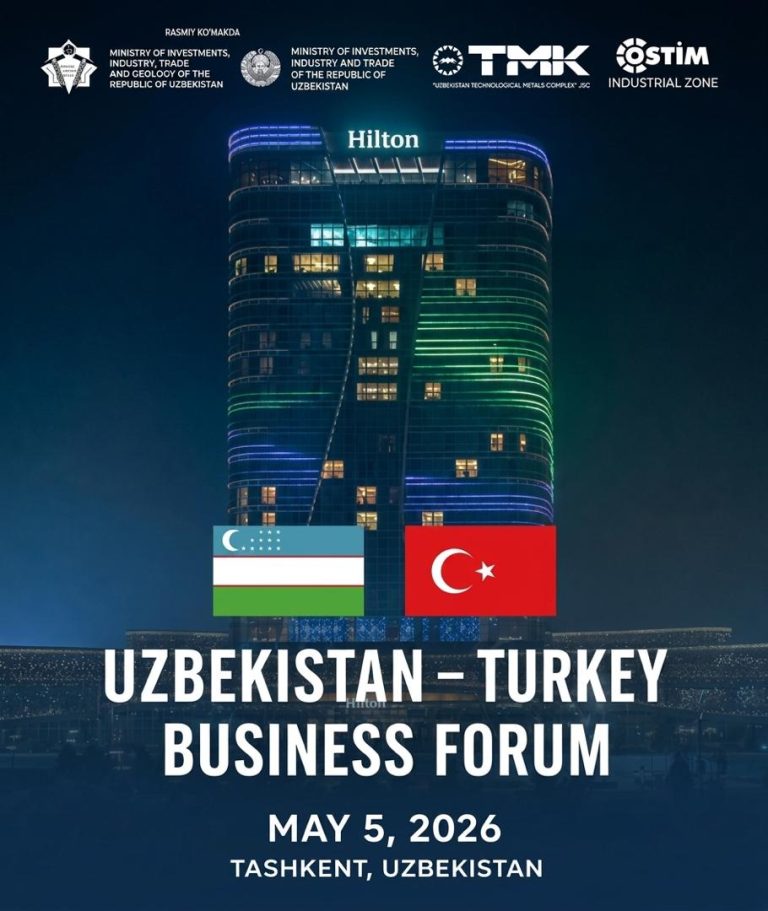
    The MINEX Forum team is delighted to participate in the upcoming Uzbekistan–Turkey Business Forum on 5 May at the Hilton Hotel. This event serves as a vital precursor to our broader regional discussions, focusing on concrete industrial proposals and joint investment ventures.

    The forum is a collaborative effort between OSTIM, the Ministry of Mining Industry and Geology of Uzbekistan, and TMK. It offers a deep dive into Uzbekistan’s ambitious industrial roadmap, specifically focusing on critical minerals and deep processing.

    Key highlights include presentations on:

    • The R&D Park for critical minerals.

    • Technopark initiatives for high-value metal processing.

    • Graphtech’s latest mining developments.

    Our representatives will be on the ground to discuss how these initiatives align with the broader goals of value creation and regional connectivity that we champion at MINEX. We invite our colleagues and partners to join us for a day of high-level networking and strategic planning.

  • Uzbekistan Positions Itself as a Global Critical Minerals Hub Through New “Mine-Metal-Market” Model

    Uzbekistan Positions Itself as a Global Critical Minerals Hub Through New “Mine-Metal-Market” Model

    Uzbekistan is rapidly emerging as a major industrial force in Central Asia, leveraging its rich geological endowment and newly modernized mineral sector to join the global critical minerals value chain. With the country ranked third worldwide in gold reserves and eighth in copper, but with only one-third of its territory fully explored, officials say the potential for new discoveries remains vast.

    Under President Shavkat Mirziyoyev, Uzbekistan has overhauled its geological and industrial policies, launching modern exploration programs and implementing advanced digital tools such as 3D modeling, JORC-compliant reporting and an updated subsoil management system aligned with international standards. A new law on the use of subsoil resources, which came into force in February 2025, is reshaping the regulatory environment to prioritize sustainability, investor protection and the development of high value-added industries.

    At the center of this transformation is the Uzbekistan Technological Metals Complex (TMK), established in 2024 and tasked with demonstrating the country’s capabilities in critical raw materials and strengthening its role in global markets. TMK operates across the entire value chain — from mining to refined metals to finished industrial products — forming a fully integrated “mine-metal-market” ecosystem that includes exploration, processing, R&D and manufacturing.

    The company is currently advancing more than 100 projects across over 25 strategic raw materials, including tungsten, molybdenum, lithium, cobalt and graphite. As Uzbekistan expands its critical minerals ambitions, TMK has become a focal point of international cooperation, with the country signing strategic agreements with the United States, the European Union, Germany, the United Kingdom, Korea and several Central Asian neighbors. TMK itself now works with more than 50 global companies and has joined nine leading international industry associations, positioning it as an emerging player in shaping global standards and accessing cutting-edge technologies.

    Innovation and education have become key pillars of TMK’s strategy. The company has forged partnerships with top-tier institutions such as MIT in the United States and KU Leuven in Belgium to promote joint research, industrial PhD programs and technology transfer. In 2025, TMK launched the Higher School of Technological Metals — Uzbekistan’s first specialized educational institution meeting international standards for the critical minerals sector — developed in cooperation with the University of Pisa and the China University of Geosciences.

    TMK has also implemented globally recognized compliance and ESG practices, including ISO certifications in anti-corruption, compliance management and environmental management. Its initiatives are showcased at nearly 20 major international forums and exhibitions each year, including the Future Minerals Forum, PDAC and MINEX Europe, as the company seeks to expand engagement with global investors and industry leaders.

    As demand for critical minerals accelerates worldwide, Uzbekistan is positioning itself as a new strategic center anchored by a modern regulatory framework, substantial geological potential and a diversified value chain. Through TMK’s integrated approach and global cooperation network, the country aims to become a stable and reliable partner in the international critical minerals market.

  • Uzbekistan Positions Itself as a Global Tungsten Leader Through Major Expansion of the Technological Metals Complex

    Uzbekistan Positions Itself as a Global Tungsten Leader Through Major Expansion of the Technological Metals Complex

    Uzbekistan is accelerating its ambition to become a major force in the global tungsten industry, with the Uzbekistan Technological Metals Complex (TMK) spearheading a comprehensive value-chain strategy supported by advanced technologies and large-scale mining projects. Tungsten, increasingly regarded as the “energy currency” of the global economy, is essential for sectors including green energy, aerospace, automotive, mechanical engineering, chemicals, and space technologies.

    TMK, established under the initiative of President Shavkat Mirziyoyev, has already become the first plant in Central Asia to join the International Tungsten Association—marking a significant step toward integrating Uzbekistan into advanced industrial supply chains. Today, TMK operates across the full tungsten production chain: upstream, midstream, and downstream.

    Upstream activities include geological exploration and development of key deposits. The flagship Sarikul project in the Samarkand region holds an estimated 30,000 tonnes of tungsten metal and is designed to process up to 1 million tonnes of ore annually. The operation is expected to produce 4,000 tonnes of tungsten concentrate per year—meeting 65% of international quality standards—and sustain up to 20 years of production. Over 400 jobs will be created as part of this project.

    TMK is also boosting tungsten recovery from mining waste at the Ingichka deposit through a partnership with China’s Xinhai, increasing concentrate output to 1,050 tonnes and generating projected revenues of $18.4 million. Additional cooperation with Chinese investor Red Persimmon will expand ore extraction to 900,000 tonnes annually, enabling production of up to 5,040 tonnes of concentrate. A separate joint project with Turkey’s International Gold Madencilik at the Sautbay deposit aims to produce 4,811 tonnes of concentrate.

    Midstream development includes the construction of a new hydrometallurgical facility in the Samarkand region, leveraging engineering expertise from Canada, Australia, Finland, and Turkey. Once completed, the plant will process 5,000 tonnes of concentrate by 2027, scaling to 15,000 tonnes by 2030—bringing the value of processed products to more than $300 million.

    TMK’s downstream operations target high-value finished products that elevate the “Made in Uzbekistan” brand. The company is already producing tungsten briquettes, ingots, carbide drill bits, milling tools, electrodes, and drilling equipment, with production increasingly automated and aligned with ESG and IRMA standards. Finished tungsten products are currently being exported to major industrial markets in Europe and the United States, with expansion into Japan and South Korea underway.

    Upon full implementation of its industrial program, TMK expects tungsten concentrate production in Uzbekistan to rise from 300 tonnes to 14,950 tonnes—an increase of nearly 50-fold. Output of tungsten anhydride will grow from 76 tonnes to 4,860 tonnes, while metallic tungsten production will expand from 58 tonnes to 1,860 tonnes.

    These projects are set to reshape the country’s economic landscape. Investment in the tungsten sector will reach $103.9 million, annual production value will climb from $5.5 million to nearly $280 million, and export volumes will soar from $2.4 million to $181.5 million. More than 5,000 new jobs are expected to be created.

    With these advances, Uzbekistan’s global tungsten reserves share is projected to rise from 2% to 5.1% by 2030, while its share of global tungsten extraction will jump from 0.05% to 14.8%.

    As the world seeks reliable and sustainable sources of critical minerals, Uzbekistan is positioning itself as a transparent, technologically advanced, and trustworthy partner. Through TMK’s fully integrated value-chain model, the country aims to secure a prominent role on the global industrial map and support the future of high-tech and green industries worldwide.

  • TMK and KU Leuven Launch Official Cooperation at EU Critical Raw Materials Week 2025

    TMK and KU Leuven Launch Official Cooperation at EU Critical Raw Materials Week 2025

    TMK (Uzbekistan Technological Metals Complex) and KU Leuven formally launched a landmark scientific-industrial partnership during the EU’s Critical Raw Materials Week 2025 in Brussels. The high-level session, organized by the European Commission and dedicated to investment opportunities in Uzbekistan’s critical minerals sector, featured detailed presentations on the country’s mining potential and expanding processing capabilities.

    Han Ilhan, Advisor to TMK’s Chairman, outlined new investment opportunities in Uzbekistan’s critical minerals sector, while Deputy Chairman Amir Abidov presented the company’s major ongoing and future industrial projects.

    The event’s central outcome was the signing of a cooperation agreement between TMK and KU Leuven’s SOLVOMET R&I Centre — recognized globally as the leading hydrometallurgy research institution. The partnership will enable TMK to integrate advanced hydrometallurgical technologies to expand production of rhenium metal salts and improve extraction of rare and rare-earth elements.

    This collaboration marks the beginning of TMK’s systematic adoption of European scientific expertise and aligns with President Shavkat Mirziyoyev’s national strategy to build a modern science-industry-education ecosystem. TMK’s participation in Raw Materials Week 2025 reinforced Uzbekistan’s position as a stable and reliable long-term partner for European industry.

  • Uzbekistan Opens First National Center for Critical Minerals Research

    Uzbekistan Opens First National Center for Critical Minerals Research

    Uzbekistan has launched a new scientific center dedicated to critical minerals, established on the initiative of the Technological Metals Combine (TMK) and located inside the National Library. According to the company, this is the country’s first innovation hub designed to connect science with industrial development and serve as a national analytical platform for critical raw materials.

    The center will operate as an open-access facility for researchers, students, and industry specialists. TMK plans to implement more than 50 projects related to strategic minerals between 2025 and 2027, including 13 new production facilities.

    The Ministry of Mining and Geology reports that Uzbekistan holds deposits containing 28 types of critical minerals, including copper, lithium, graphite, germanium, tungsten, vanadium, tantalum, niobium, and rare-earth elements.

    By 2028, the country aims to complete 70 projects focused on developing strategically important mineral resources, with a total investment portfolio exceeding $1.6 billion.

  • Uzbekistan Eyes Kazakh Tungsten as Global Powers Compete for Strategic Metal

    Uzbekistan Eyes Kazakh Tungsten as Global Powers Compete for Strategic Metal

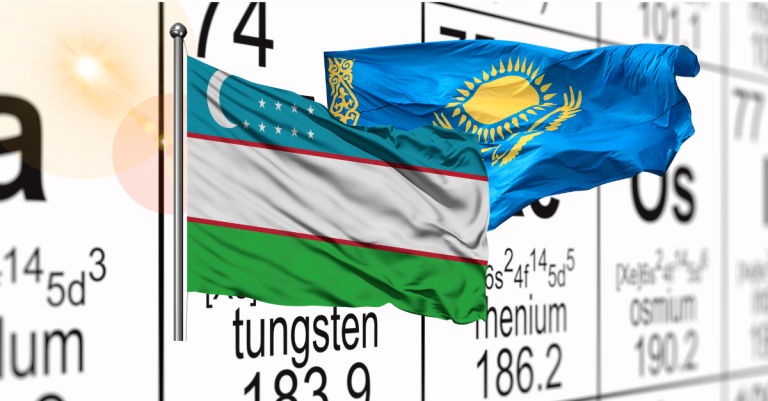
    Uzbekistan is plotting a tighter grip on critical minerals by seeking to purchase tungsten concentrate from Kazakhstan, as Uzbekistan’s government-led Uzbek Metal Processing Plant (TMK) prepares to ramp up production. Metin Alemder, TMK’s technical adviser, told inbusiness.kz at the China Mining summit in Tianjin that TMK is in talks with Kazakh colleagues to secure tungsten concentrate, signaling a strategic push to source raw materials locally for its expanding operations.

    Kazakhstan has been developing tungsten at the Boguty mine in the Almaty region near the Charyn Canyon. The project is led by Zhetyсу Wolfram LLC, in which Chinese-backed Jiaxin International Resources Investment Limited is a major shareholder. Boguty is regarded as one of the world’s larger tungsten deposits, with a mining licence valid through 2040. Early projections estimated an annual processing capacity of 3.3 million tonnes of ore to produce about 10,000 tonnes of 65% tungsten oxide concentrate, primarily destined for China. The site also contains molybdenum, bismuth, and beryllium, with plans to raise tungsten extraction to nearly 5 million tonnes of ore by 2027.

    Other Kazakh tungsten prospects include Aksoran at the SCO-Akmola border, as well as Northern Katpar and Verkhnee Kairakty in Karaganda. Notably, the last two are set to be developed via a joint venture in which Cove Capital (70%) partners with state mining firm Tau-Ken Samruk (30%) in a project budget of about $1.1 billion, with production expected to start in roughly 3.5 years. Cove Capital also has interests in Uzbekistan.

    Alemder notes that China already controls more than 80% of global tungsten production and leads fundamental research in this strategic metal, which Czech-like knowledge in Uzbekistan could help leverage. Tungsten is not a rare earth metal, but it remains a critical material due to its unique properties and supply concentration.

    TMK currently relies largely on local tungsten concentrates, with Uzbekistan able to produce tungsten using both hydrometallurgical and pyrometallurgical methods. The company’s plant in Chirchik is expanding capabilities, and a new hydrometallurgical workshop in Samarkand is slated to begin in 2027, targeting 5,000 tonnes of tungsten oxide annually. By 2030, production is expected to reach 15,000 tonnes per year, requiring growing external ore supplies. In the interim, the plant utilises residual tailings from an older deposit.

    In addition to tungsten, TMK is expanding molybdenum production from tailings from the Almalyk Mining and Metallurgical Complex and is developing tellurium and osmium. A sulfuric acid plant with a capacity of 500,000 tonnes annually is under construction, feeding consumables for the chemical sector, fertiliser production, and uranium mining via in-situ leaching, using sulfur supplied by Uzbekneftegaz and local gas-processing facilities.