Tag: Rio Tinto

  • Rio Tinto Cuts Fees and Loan Interest at $18bn Oyu Tolgoi Mine After Mongolian Pressure and Protests

    Rio Tinto Cuts Fees and Loan Interest at $18bn Oyu Tolgoi Mine After Mongolian Pressure and Protests

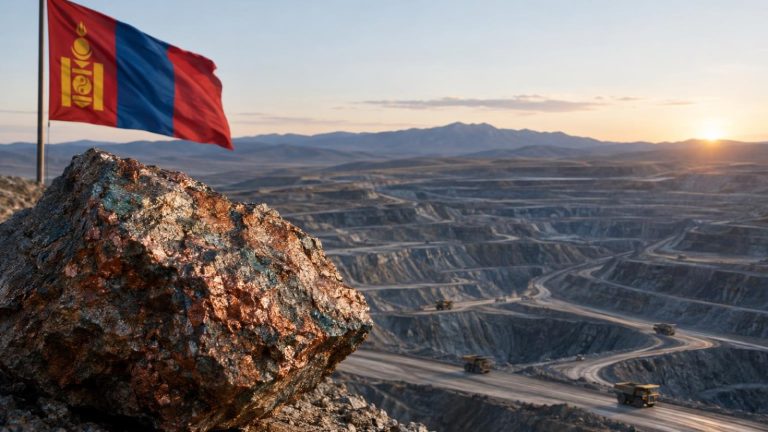
    Rio Tinto has agreed new financial terms for the $18 billion Oyu Tolgoi copper mine in Mongolia, cutting its management fees for the project by 50% and reducing the interest rate on its multibillion-dollar loan to the Mongolian government by 2.5 percentage points, following months of negotiation under mounting political pressure.

    The agreement follows Mongolian officials describing earlier terms as “unfair” and claiming the country was “being deceived” over its single biggest mining project and largest foreign investment. It also arrives as copper prices trade near record highs, raising the stakes around future payouts from the mine, which is expected to produce approximately 500,000 tonnes of copper annually.

    Rio Tinto chair Dominic Barton and head of copper Katie Jackson met Mongolian Prime Minister Uchral Nyam-Osor in Ulan Bator on Tuesday to sign the deal. Jackson said the agreement “demonstrates Rio Tinto’s ongoing commitment to the long-term success of Oyu Tolgoi,” with the reduced interest rate reflecting lower project risk as it matures. The Mongolian government declined to comment.

    The new terms add to a long history of renegotiation at Oyu Tolgoi, under construction for nearly 17 years. Four years ago Rio agreed to waive approximately $2.4 billion of the government’s loan as both sides pledged to “reset” the relationship — a truce that has not held, with elections due next year raising political stakes further. Two weeks ago, protesters successfully disrupted exports from the mine, forcing a halt to concentrate shipments for nearly a day.

    One unresolved issue is when Mongolia, which holds a 34% stake in the project against Rio’s 66%, will begin receiving dividends. Cost overruns and delays have pushed the expected start date from 2017 to around 2037. Rio said it would “bring forward distributions to shareholders” without committing to a specific date.

    RBC analyst Ben Davis described the agreement as “just about a net positive” for Rio, while cautioning that concerns remain over how long it will hold given Mongolia’s volatile political environment and the risk the government will seek a larger share of project economics. Separately, Rio is facing a Mongolian tax probe alleging approximately $450 million in underpayment related to depreciation accounting during 2021 and 2022, a dispute currently proceeding through the courts.

  • Mongolia Seeks Larger Revenue Share from Rio Tinto’s Oyu Tolgoi Copper Mine

    Mongolia Seeks Larger Revenue Share from Rio Tinto’s Oyu Tolgoi Copper Mine

    Mongolia is pushing to renegotiate the commercial terms of the massive Oyu Tolgoi copper mine, seeking earlier profit payments and a larger share of revenues from the project it co-owns with Rio Tinto.

    The Mongolian government, which holds a 34% stake through state-owned Erdenes Mongol LLC., believes the current arrangement does not deliver sufficient economic benefits to the country. Officials are reportedly aiming to increase Mongolia’s share of returns to around 60% and accelerate dividend payments.

    Rio Tinto acknowledged the discussions and said it remains committed to working with its partners to maximise the value of the project. “These discussions reflect our continued commitment to working together to achieve Oyu Tolgoi’s full potential for the benefit of all partners,” the company said in a statement.

    Oyu Tolgoi is one of the world’s largest copper projects and a key asset in Rio Tinto’s long-term growth strategy as global demand for copper rises with the expansion of renewable energy, electrification and infrastructure linked to the energy transition.

    Under the existing agreement, Mongolia is not expected to receive dividends until it repays a multi-billion-dollar loan from Rio Tinto that financed its share of the mine’s development costs. Those costs significantly exceeded early projections, potentially delaying dividend payments until the next decade.

    Rio Tinto has invested heavily in expanding the underground operations at the mine. Copper production rose 61% last year as development progressed.

    Relations between the partners have fluctuated in recent years. In 2022, Rio Tinto cancelled $2.4 billion of debt owed by Mongolia in what it described as a reset of the partnership, allowing the underground phase of the project to move forward.

    However, tensions have resurfaced. Mongolia is currently pursuing a legal claim against Rio Tinto over alleged tax underpayments of roughly $450 million related primarily to depreciation accounting for the 2021 and 2022 tax years.

    The renewed pressure also comes as Mongolia approaches national elections next year and commodity prices remain strong. Copper and gold prices are hovering near historic highs, increasing political scrutiny over how the country benefits from its mineral resources.

    Oyu Tolgoi, which began production as an open-pit mine in 2011, is expected to become the world’s fourth-largest copper mine by 2030 once its underground expansion reaches full capacity.

  • EU Lawmaker Says Serbia’s Jadar Lithium Project Remains Frozen Amid Legal Uncertainty

    EU Lawmaker Says Serbia’s Jadar Lithium Project Remains Frozen Amid Legal Uncertainty

    The proposed Jadar lithium project in Serbia remains suspended due to legal and regulatory uncertainty, despite its strategic importance for Europe’s critical raw materials supply, according to European Parliament representative Hildegard Bentele.

    Speaking to Deutsche Welle, Bentele, a member of Germany’s Christian Democratic Union and rapporteur on critical raw materials policy in the European Parliament, said the project remains “frozen,” although mining major Rio Tinto continues to retain exploitation rights over the deposit.

    She noted that the project could play a significant role in strengthening Europe’s lithium supply chain while delivering economic benefits to Serbia, provided a stable and reliable legal framework is established. According to Bentele, Rio Tinto has indicated its intention to comply with environmental and social standards should regulatory conditions improve.

    The Jadar project, considered one of Europe’s largest lithium deposits, had previously been included on the European Union’s list of strategic raw material projects. Plans linked the development to potential downstream battery manufacturing investments, including earlier discussions involving German industry and automotive supply chains.

    However, Bentele stressed that lithium mining projects require predictable licensing systems and institutional stability, conditions she believes are currently lacking. She pointed to concerns over governance, judicial independence and public trust in state authorities as key factors contributing to the project’s suspension.

    The EU, she added, will not pressure Rio Tinto to resume development under present circumstances, describing continued investment as too risky without regulatory certainty. The company’s earlier decision to halt implementation in Serbia’s Jadar Valley was therefore understandable given public opposition and doubts surrounding permitting procedures.

    While acknowledging broader challenges in sourcing critical minerals globally, often located in politically complex jurisdictions, Bentele emphasised that Serbia’s status as an EU candidate country places importance on alignment with European governance and environmental standards.

    According to her assessment, the future of the Jadar project depends primarily on improvements to Serbia’s legal and institutional framework. Until then, the project remains suspended rather than permanently cancelled, leaving open the possibility of future development if regulatory stability is restored.

  • Glencore Shifts Focus to Asset Sales After Failed Merger Talks With Rio Tinto

    Glencore Shifts Focus to Asset Sales After Failed Merger Talks With Rio Tinto

    Following another breakdown in merger talks with Rio Tinto, Swiss mining major Glencore is turning its attention to asset sales as part of a strategy to strengthen its copper portfolio, Reuters reported.

    Discussions aimed at creating a global mining giant valued at around $240 billion collapsed this week due to disagreements over valuation and ownership structure. The failed talks mark the third unsuccessful attempt to merge the two companies, following earlier efforts in 2014 and 2024.

    As part of its portfolio reshaping, Glencore is expected to announce the sale of a 70% stake in KazZinc in the coming weeks. Analysts estimate the value of the asset at around $5 billion. KazZinc is a major producer of zinc, lead, and gold in Kazakhstan.

    Glencore Chief Executive Gary Nagle has repeatedly spoken in favour of industry consolidation, arguing that combining assets can unlock value and make the mining sector more attractive to investors.

    The company has also set a long-term goal of increasing copper production to 1.6 million tonnes by 2035, up from 852,000 tonnes produced in 2025, through a combination of new mine development and the restart of existing operations.

    In the near term, investors expect Glencore to prioritise divestments to create a more focused copper mining and metals trading business. Talks are reportedly under way to sell a 40% stake in Glencore’s copper and cobalt operations in the Democratic Republic of Congo to a consortium led by Orion Critical Minerals, with backing from the United States.

    Separately, Glencore is exploring potential cooperation with Brazil’s Vale on the joint development of copper deposits in Canada.

    Since the collapse of the Rio Tinto talks, Glencore shares have fallen by more than 10%, although they remain up 19% year-to-date. The company is also reviewing its coal portfolio and has not ruled out a partial spin-off of coal assets to raise additional capital.

    In Kazakhstan, Glencore continues to invest in gold production. In December 2025, the company allocated nearly $500 million to extend the life of the Vasilkovskoye gold mine in the Akmola Region, operated by Altyntau Kokshetau, the main gold supplier for KazZinc.

    Industry expert Nurlan Zhumagulov noted that Altyntau Kokshetau ranked thirteenth among Kazakhstan’s largest taxpayers in 2025, contributing 142 billion tenge, a year-on-year increase of 47%.

    It was also reported that Kazakh businessman Shakhmurat Mutalip is in talks to acquire a 70% stake in KazZinc. In January 2026, he registered two new companies at the Astana International Financial Centre: KazZinc Group Ltd and Central Asia Resources Holding Ltd.

  • Đilas claims Rio Tinto preparing €1–1.5 billion compensation claim against Serbia over Jadar lithium project

    Đilas claims Rio Tinto preparing €1–1.5 billion compensation claim against Serbia over Jadar lithium project

    Rio Tinto is preparing to file a compensation claim against the Republic of Serbia worth between €1 billion and €1.5 billion over the halted lithium mining project in the Jadar Valley, according to Dragan Đilas, president of the opposition Freedom and Justice Party.

    Speaking on the podcast Dežurni krivac, Đilas said the mining company intends to sue Serbia for costs incurred and lost profits after the government abandoned plans for lithium extraction. He argued that commitments made by senior state officials, including President Aleksandar Vučić and former Prime Minister Ana Brnabić, form the basis of the claim.

    Đilas stated that Rio Tinto allegedly received both written and verbal assurances regarding the project’s implementation, stressing that verbal agreements are legally binding in the same way as written ones. According to him, the public is still unaware of the exact guarantees provided by state leadership, which allowed the company to begin exploration, planning, and investment activities.

    He further claimed that once the lawsuit is formally announced, the authorities will shift responsibility onto citizens who protested against lithium mining. Đilas rejected this narrative, saying public opposition was clear, with more than 80% of citizens reportedly against the project.

    The opposition leader accused the country’s leadership of exceeding their authority and violating laws by promising lithium production to international partners, only to later withdraw those commitments. He warned that Serbia could ultimately bear the financial consequences, potentially amounting to hundreds of millions or even more than a billion euros.

    Đilas concluded that the situation reflects broader political risks, arguing that unfulfilled promises to foreign partners could result in additional financial claims against the state in the future.

  • Rio Tinto Scales Back Lithium Expansion, Prioritises Capital Discipline and Existing Projects

    Rio Tinto Scales Back Lithium Expansion, Prioritises Capital Discipline and Existing Projects

    Rio Tinto has pared back its ambitions for rapid lithium growth, telling investors at its capital markets day in London that it will limit investment to projects already under development, with any further expansion contingent on market conditions and strict returns criteria.

    CEO Simon Trott confirmed that the company will complete its current slate of lithium projects — including the Rincon brine operation in Argentina and a single spodumene mine in Canada — to reach approximately 200,000 tonnes per year of lithium capacity by 2028. This figure is below the miner’s earlier guidance of 225,000 t/y, marking a recalibration of expectations amid a volatile market.

    Trott emphasised that Rio Tinto remains bullish on long-term lithium demand, particularly from grid-scale energy storage, but said capital discipline would take precedence over aggressive growth. The company is prioritising delivery of its major ongoing developments, including the Oyu Tolgoi underground expansion in Mongolia and the Simandou iron-ore megaproject in Guinea. Group capital expenditure is expected to fall below $10 billion from 2028.

    Rio Tinto has already halted spending at the Jadar lithium project in Serbia, which has been placed into care and maintenance after regulatory setbacks. The company is also reassessing its next steps in Canada, where the Whabouchi and Galaxy deposits are under review. Energy chief Jérôme Pécresse said both projects will remain active at minimal cost while Rio evaluates which — if either — will proceed. “It’s a reasonable decision to open one mine, not two, but too early to say which one,” he said.

    Trott reiterated that any new lithium investment would move forward only when market fundamentals justify it and when projects meet Rio Tinto’s financial thresholds. The miner has allocated roughly $3 billion per year for growth across the portfolio but will not deploy capital that cannot “move the needle” in terms of shareholder value.

    “We have a clear path to 200,000 tonnes by 2028 and that will be a fantastic business for us,” Trott said. “On other projects, we’ll continue to assess them based on the market fundamentals as they come up to sanction.”

    He added that Rio Tinto still possesses “the best undeveloped lithium assets in the business,” but emphasised that growth for its own sake is off the table. Maintaining a strong balance sheet is the priority, with cost savings from asset reviews and infrastructure optimisation expected to bolster shareholder returns.

  • Rio Tinto Pauses Serbia’s Jadar Lithium Project, but Opponents Warn the Fight Is Far From Over

    Rio Tinto Pauses Serbia’s Jadar Lithium Project, but Opponents Warn the Fight Is Far From Over

    Rio Tinto has placed its controversial $3.6 billion Jadar Valley lithium project into “care and maintenance,” pausing all development while retaining control of the land — a move that critics say is far from a full retreat. An internal company memo obtained by the ABC reveals that the mining giant will halt spending and suspend progress toward an underground lithium mine in Serbia’s Jadar region as it restructures operations under new CEO Simon Trott and continues to face major permitting hurdles.

    The memo underscores Rio Tinto’s view that Jadar remains a “tier one deposit” with the potential to play a major role in Serbia’s and Europe’s energy transition. But it also cites a lack of progress with government approvals as a key factor in the decision.

    The project has been the subject of intense public resistance. Tens of thousands of Serbian citizens have protested in recent years, warning that mining operations in the fertile Jadar Valley would cause irreversible environmental and agricultural damage. Activist groups, including Marš sa Drine and local residents who have refused to sell their land, say Rio Tinto’s pause is merely a “temporary retreat” and insist they will continue to fight until the company leaves Serbia entirely.

    “Care and maintenance is not the cancellation of a project,” said Serbian-Australian actor and activist Bojana Novaković, one of the leading figures in Marš sa Drine. She emphasized that Rio Tinto still maintains offices in the region and has shown no signs of abandoning the site. “Until they pack their bags, close their offices, and sell the land back to the locals, there’s no reason to think they’ve gone away.”

    Rio Tinto had planned to extract 2.3 million tonnes of lithium from what has been called Europe’s largest and highest-grade deposit — enough to supply batteries for one million electric vehicles annually for decades. When the ABC visited the site in late 2024, the company estimated the mine could operate for at least 40 years.

    The project’s recent history has been turbulent. After nationwide protests ahead of Serbia’s 2022 elections, the government initially halted the mine. But the Constitutional Court reversed that decision in July 2024, allowing the project to proceed subject to environmental and legal conditions. Days later, President Aleksandar Vučić, German Chancellor Olaf Scholz and EU Energy Commissioner Maroš Šefčovič signed a landmark agreement granting EU manufacturers access to Serbian lithium — a move Brussels hailed as a “historic day” for Europe’s energy transition.

    However, Serbia’s political climate has since deteriorated. Public anger erupted after the collapse of a Belgrade railway station canopy killed 15 people, sparking massive demonstrations and contributing to the resignation of Prime Minister Miloš Vučević in January. Activists now argue that the Jadar project’s fate is directly tied to political turmoil, and that approval could return once stability does.

    Gavin Mudd of the British Geological Survey noted lithium’s global importance — its market value having grown from hundreds of millions to several billions in just over a decade — but stressed that mining must be conducted responsibly. Opponents in Serbia remain unconvinced. They argue that the Jadar Valley’s fertile agricultural land and populated communities make it unsuitable for mining under any circumstances.

    “This would be the first-ever lithium mine built on fertile soil and populated land,” Novaković warned. “If we allowed it to happen, it would open the floodgates.”

    Rio Tinto declined to comment on the memo or the future of the project.

  • Germany Moves to Secure Bolivian Lithium as Serbia’s Jadar Project Stalls

    Germany Moves to Secure Bolivian Lithium as Serbia’s Jadar Project Stalls

    Germany is accelerating efforts to secure long-term lithium supplies from Bolivia while exploring domestic mining options, even as Rio Tinto’s Jadar project in Serbia remains effectively dormant. Ahead of his visit to La Paz, Germany’s Foreign Minister Johann Wadephul emphasized Bolivia’s strategic importance, calling its vast lithium and rare earth reserves “indispensable” for Germany’s energy transition and electric mobility sectors.

    Wadephul is one of the first foreign officials to engage with Bolivia’s newly elected president Rodrigo Paz Pereira, stressing Germany’s readiness to strengthen cooperation and support the country’s economic recovery. Bolivia holds the world’s largest lithium reserves, but previous governments strictly limited foreign participation in mining projects.

    Germany’s intensified outreach comes as competition for lithium and rare earths escalates globally amid China’s market dominance and ongoing US–China trade tensions. Berlin has also indicated it may tap its national raw materials fund to support domestic lithium extraction projects, including those based on geothermal brines.

    Meanwhile, Rio Tinto’s Jadar project in Serbia—once seen as a cornerstone of Europe’s lithium supply strategy—has made little progress despite receiving strategic backing from the EU and Germany in 2024. Political instability in Serbia has slowed development, with officials now estimating that the environmental impact assessment will take at least 18 months to complete. Final approval remains uncertain, leaving Europe’s long-term battery supply ambitions in limbo.

  • Rio Tinto Mothballs Controversial $2.95bn Jadar Lithium Project in Serbia

    Rio Tinto Mothballs Controversial $2.95bn Jadar Lithium Project in Serbia

    The Rio Tinto Group has placed its contested $2.95-billion Jadar lithium project in Serbia into “care and maintenance”, according to an internal memo this week. The move, confirmed by a company spokesperson, effectively halts active development on what was slated to be Europe’s largest lithium mine, capable of supplying an estimated 90% of the continent’s current lithium demand.


    Key Takeaways and Context

    The decision is a direct consequence of a “lack of progress in permitting” and sustained fierce local opposition and political volatility in Serbia. CEO Simon Trott’s focus on simplifying the company’s sprawling portfolio and cutting spending also played a role, especially given the project’s high capital allocation with no immediate production in sight.

    What does “Care and Maintenance” mean for Jadar?

    “Care and maintenance” is a mining industry term for a temporary suspension of operations. It means that while the site is not actively being developed, it is being managed to ensure it remains in a safe, stable, and environmentally compliant condition so that operations could be recommenced at a later date if regulatory, economic, or social conditions improve.

    Rio Tinto reiterated that it “remains in Serbia” and continues to view Jadar as an “exceptional quality” deposit with the potential to play a “significant role in the energy transition” of Serbia and Europe. Their immediate focus will be on supporting employees and fulfilling legal obligations as responsible landowners in the Jadar valley.


    🇪🇺 Critical Hit to EU’s Raw Materials Strategy

    The mothballing of Jadar is a significant setback for the European Union’s ambitions for self-sufficiency in key battery metals, as outlined in the Critical Raw Materials Act (CRMA).

    • Strategic Project Loss: Jadar was designated as one of the EU’s few Strategic Projects outside of its borders, specifically for lithium. At its estimated full capacity of 58,000 tonnes of lithium carbonate annually, it was considered a cornerstone for establishing a secure, diversified, and domestic European battery supply chain, reducing reliance on dominant suppliers like China.
    • A Warning on Governance: The project’s failure underscores a critical dilemma for the EU. As Peter Tom Jones highlights, attempts to increase self-sufficiency through projects in third countries must not lead to “uncritical support for autocratic regimes”. The sustained local opposition, environmental concerns, and political instability in Serbia—an EU candidate country—demonstrate that effective governance and a democratization process are as critical as the resource itself.
    • Alternative Lithium Projects: The focus will now intensify on accelerating other European lithium projects, such as those in Portugal, France, and Finland, to meet the CRMA’s targets.

    This situation calls for the EU to demand robust ecological and social standards—potentially through collaboration with third-party verification bodies like the Initiative for Responsible Mining Assurance (IRMA)—to rebuild confidence in such projects in the Western Balkans and beyond.

  • Rio Tinto to Halt Serbia’s Jadar Lithium Project as Costs Rise and Progress Stalls

    Rio Tinto to Halt Serbia’s Jadar Lithium Project as Costs Rise and Progress Stalls

    Rio Tinto will suspend development of its long-delayed Jadar lithium project in Serbia, effectively mothballing what was once slated to become Europe’s largest lithium mine. The decision, first reported by Bloomberg and later confirmed by a company spokesperson, places the nearly $3-billion project into “care and maintenance” as the miner seeks to reduce spending and refocus its lithium strategy.

    The move ends Rio’s two-decade effort to unlock the massive Jadar deposit, discovered in 2004 and estimated to produce 58,000 tonnes of battery-grade lithium carbonate annually. Despite the project’s strategic importance for Europe’s battery supply chain, Jadar has repeatedly stalled amid regulatory hurdles, political uncertainty and strong community opposition. Serbia revoked Rio’s licence in 2022 over environmental concerns and only reinstated it last year, but permitting made little progress.

    In the internal memo cited by Bloomberg, Rio said it could no longer justify the level of investment given the limited advancement of the project. Earlier this year, the company raised Jadar’s cost estimate to nearly $3 billion, citing the need to meet stringent EU environmental and human rights standards.

    The suspension is part of broader cost-cutting measures under new CEO Simon Trott, who has introduced restructuring efforts and workforce reductions across the company. With Jadar shelved, Rio is expected to concentrate its lithium ambitions on South America, including Argentina’s Rincon project and joint ventures in Chile.

    Analysts say the decision underscores Rio’s pivot away from hard-rock assets inherited through its merger with Arcadium, and some expect those projects could be sold. The halt also deals a blow to EU plans to secure domestic lithium supply, as Jadar was projected to cover nearly 90% of Europe’s current demand.