Tag: iron ore mining

  • Historic Swedish Church Completes Epic Relocation by LKAB

    Historic Swedish Church Completes Epic Relocation by LKAB

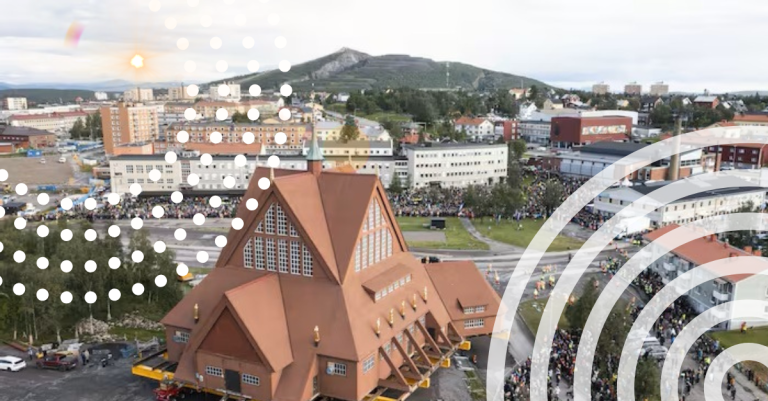
    In a meticulously orchestrated feat of engineering, the iconic Kiruna Kyrka, a 1912 red wooden church weighing 672 tonnes, arrived at its new location in the Arctic town of Kiruna on Wednesday after a two-day, five-kilometre (three-mile) journey. The relocation was necessitated by the expansion of Europe’s largest underground mine, operated by LKAB.

    The church, which began its journey on Tuesday, inched forward at a pace of half a kilometre per hour on two remote-controlled flatbed trailers. Its arrival around 2:30 pm (1230 GMT) was celebrated with a musical fanfare, marking the culmination of a complex logistical operation.

    Kiruna’s entire town centre is being relocated due to the LKAB iron ore mine’s deepening excavations, which have compromised the stability of the ground. The church’s new location, chosen to preserve its character and connection to its surroundings, has been rotated 180 degrees, positioning the altar to face west—a symbolic gesture towards the town and its residents.

    The relocation has captivated widespread attention, with large crowds gathering along the route to witness the historic event. Lisa Weber, a 26-year-old real estate agent from Germany, travelled to Kiruna specifically to see the relocation, describing it as a “historical” moment. “It’s something that you do once in your life, or see once in your life,” she told AFP.

    King Carl XVI Gustaf of Sweden participated in the festivities, engaging with the Argentinian driver, Sebastian Druker, who remotely controlled the trailers using a joystick. The king also joined an attempt to set a world record for the largest “kyrkkaffe” (a coffee break following a church service).

    The town’s relocation process, which began nearly two decades ago, is expected to continue for years. The new town centre was inaugurated in September 2022. LKAB has offered financial compensation or rebuilding services to those affected by the relocation, with 23 historic buildings already moved before the church.

    Despite the meticulous planning, not all residents are satisfied. Critics, including local podcast hosts Alex Johansson and Magnus Fredriksson, have expressed dissatisfaction with LKAB’s handling of the relocation. “LKAB maybe didn’t read the room so well when they destroyed the whole town and then they stage this huge street party for the people,” Fredriksson remarked to broadcaster SVT.

    LKAB’s discovery of Europe’s largest known deposit of rare earth elements near the Kiruna mine in 2023 has added another layer of complexity to the situation. These elements are crucial for the green transition, particularly in the manufacturing of electric vehicles. However, activists argue that mining operations are detrimental to the region’s pristine forests, lakes, and traditional Sami reindeer herding practices.

    The relocation of the church alone is estimated to cost LKAB 500 million kronor ($52 million). Designed by Swedish architect Gustaf Wickman, the church features a blend of architectural influences, including designs inspired by the Indigenous Sami people. The church’s handblown glass windows were removed before the move and replaced with painted plywood. The separate belltower will be relocated next week.

    As Kiruna continues to adapt to the demands of modern industry, the relocation of the Kiruna Kyrka stands as a testament to the town’s resilience and the intricate balance between progress and preservation.

  • Ak Metal to Launch Iron Ore Mining Project in East Kazakhstan

    Ak Metal to Launch Iron Ore Mining Project in East Kazakhstan

    Ak Metal, a company led by an Almaty-based entrepreneur, is gearing up to commence iron ore mining at the Kuzinskoye deposit in East Kazakhstan. The site, located in Shemonaikha District near the village of Poperechnoye, spans 2.84 hectares and boasts two promising ore formations awaiting further evaluation.

    Initial plans include pilot industrial mining, scheduled to start in 2025. During the first two years, the company expects to extract 110,000 tons of ore annually, scaling down to 44,000 tons in 2027. This will involve 144,000 cubic meters of stripping operations, with the ore transported for processing via rail from Shemonaikha station.

    Ak Metal has been actively investing in geological exploration, with 2023 expenditures reaching 39.8 million tenge, far exceeding the required 7.9 million tenge. The company has shown steady growth, reporting 2023 revenue of 589.1 million tenge, a significant rise from 340.9 million tenge in the previous year, while net profit increased to 101.8 million tenge.

    The start of industrial mining marks a significant milestone for Ak Metal, solidifying its position in the iron ore market and driving further development.

  • Nordic Iron Ore applies for additional exploration permit at Blötberget

    Nordic Iron Ore applies for additional exploration permit at Blötberget

    Initial exploration has given signals that the area is promising for expansion. A successful broadened exploration of the area could potentially increase Nordic Iron Ore’s mineral resources.

    Through Nordic Iron Ore’s own exploration work and its participation in the EU-financed project Smart Exploration, knowledge has increased of the geology in the area, as well as previously explored areas. It also worth noting that the area has historically seen several small-scale mining operations. In addition to Smart Exploration’s measures, performed magnetic measurements indicate that the mineralisation in Blötberget continues to the north-east and could potentially be more easily accessible for mining. This makes the area promising for additional exploration. The company has therefore made an additional application to Bergsstaten for an exploration permit, Blötberget nr 6. Following approval of the application, the plan is to undertake core drilling in the area.

    “It is pleasing to see that our exploration work is progressing and we have now made our second application for a new exploration permit during the past year. The purpose of the work is to expand upon the company’s mineral resources and thereby prolong the life of mine and improve profitability for the future mining operations at Blötberget,” said Ronne Hamerslag, VD at Nordic Iron Ore.

  • SevGOK starts producing 68% iron ore concentrate

    SevGOK starts producing 68% iron ore concentrate

    Thanks to the project, the enterprise improved pellets quality and obtained an opportunity to enter new iron ore raw materials sales markets.

    Both stages of the factory technological sections can process ore from the Pershotravnevoye and Gannivske deposits with a three-stage crushing scheme. The design capacity of the factory is 30.5 million tons of ore per year with the ability to produce concentrate with the iron content of 65.8%.

    To produce 68% concentrate the company had to merge sections at the first stage and assemble new routes to transport products between them.

  • Shagarshinskoye iron ore deposit to be developed in Aktobe region

    Shagarshinskoye iron ore deposit to be developed in Aktobe region

    Qazaqstan Mining Company plans to start mining iron ore at the Shagarshinskoye deposit, located in the Aitekebi district of the Aktobe region of the Republic of Kazakhstan. The company published the project on the Unified Ecological Portal of Kazakhstan.

    The subsoil user carried out exploration work at the site in 2019–2021. The reserves of Shagarshinsky were put on the state balance sheet in February 2023. The project documentation of the company states that 1,642 thousand tons of iron ore (742 thousand tons of iron with an average metal content in the ore of 45.2%) were classified as probable reserves, 118 thousand tons of ore (52 thousand tons iron with an average metal content of 44.07%).

    Qazaqstan Mining Company has calculated a mining plan for 2024-2031. The quarry area at the end of mining will be 7.79 hectares, depth – 77 m, bottom horizon – +180 m. The manufacturer is going to process raw materials at his own crushing and screening complex.

    In the first two years of operation of the enterprise, it is planned to build an evaporation pond on the site for the accumulation of quarry waters and their technological maintenance.