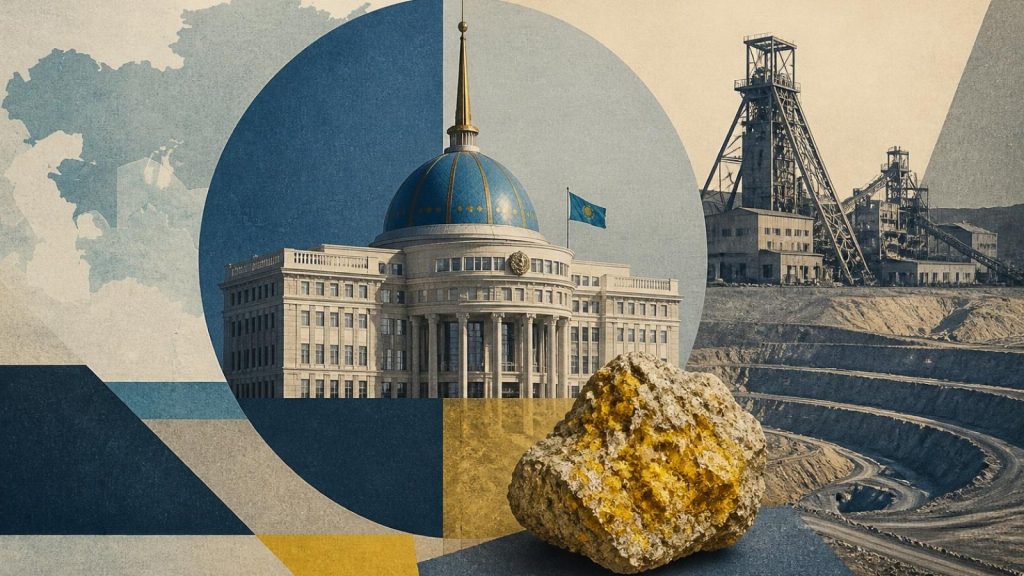
When President Kassym-Jomart Tokayev received Meirzhan Yussupov, chairman of Kazatomprom, on 3 November, the readout from the presidential press office was characteristically dry. Exploration acreage, new sales contracts, research programmes, hospital funding. Read quickly, it is a routine audience. Read carefully, it describes a company being asked to do three jobs at once: supply the world, secure Kazakhstan’s own nuclear future and keep the state’s social ledger in order.
The most consequential line concerned the strategic uranium reserve. Kazatomprom is conducting exploration on six licence areas covering more than 1,000 sq km and plans to start work on a new prospect, Kyzylty, of 124 sq km. This is not stockpiling in the conventional sense. Officials have described a multi-layered system that runs from uranium left in the ground to physical inventories of natural uranium and fuel. The nuclear strategy to 2050 calls for at least 150,000 tonnes to be set aside by mid-century.
Withholding without a warehouse
The distinction matters. A reserve held underground costs almost nothing to maintain, needs no storage licence and cannot be sold on a bad day. It is also, in effect, a codified form of the production discipline that Kazatomprom has been practising informally since 2024. The company has cut output below the levels permitted by its subsoil-use agreements, citing a market in which, in its view, uncovered demand does not yet justify a return to full volumes. Its 2026 guidance, at 27,500–29,000 tonnes on a 100 per cent basis, accounts for roughly a fifth of global primary supply.
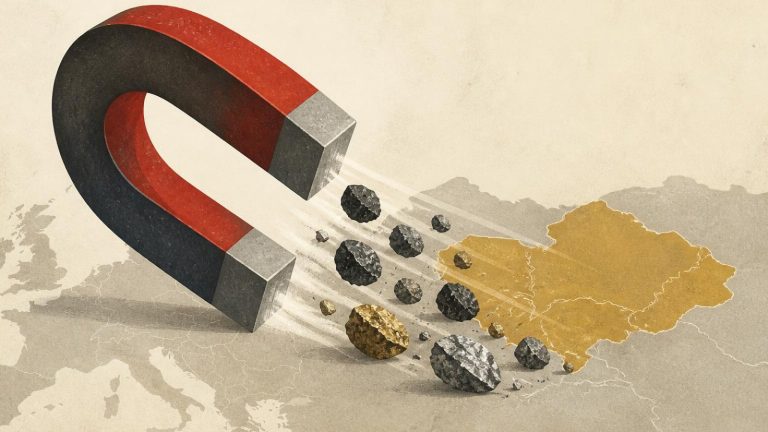
A state reserve gives that restraint a domestic rationale. Cutting production to defend price invites accusations of cartel behaviour from utilities; setting aside resource for Kazakhstan’s own reactors – the strategy envisages 8,000 MWe of capacity by 2050 – does not. For consumers in Europe, Asia and North America, the effect is the same: a slice of the world’s lowest-cost supply is permanently off the table.
The customers are shifting east
The second message in the readout is commercial. New natural-uranium contracts were signed in 2026 with large energy groups in India and China. Kazatomprom has long sold heavily to Chinese buyers, but the addition of India reflects a deliberate effort to diversify demand as Western utilities shorten their reliance on Russian-linked fuel-cycle services and look for alternatives to both Moscow and Beijing.
Here Kazakhstan’s geography is both asset and constraint. Most of its exports travel through Russia or across the Caspian by the Trans-Caspian route; several of its joint ventures, including Budenovskoye and Zarechnoye, have Russian partners. The government’s talk of new markets and deeper participation in the fuel cycle is, among other things, an attempt to reduce that exposure. The more value Kazatomprom captures downstream, the less it is a price-taker in someone else’s supply chain.
Costs are rising, which supports the strategy
The backdrop is a company that is no longer the cheapest pound in the world by as wide a margin as before. Kazatomprom raised its 2026 cost guidance in August: attributable C1 cash cost is now expected at $25.50–27.00 a pound and all-in sustaining cost at $39.00–40.50. Capital spending guidance has risen to KZT 435–450bn, and the move to a standard tax regime after years of exemptions has added to the burden. A third in-house sulphuric acid plant, due in early 2027, should ease the reagent shortages that disrupted output in previous years.
Spot prices that averaged about $88 a pound in the first quarter, and briefly touched $99 in February, leave comfortable margins. But higher costs reduce Kazatomprom’s tolerance for a fall in prices, and strengthen the argument for managing volumes rather than chasing them. “Value over volume”, management’s own phrase, is as much a financial necessity as a philosophy.
The state asks for more than uranium
The readout lists two further demands that are easy to overlook. One is research: Kazatomprom is working on raising the efficiency of in-situ leaching and on recovering rare and rare-earth metals as by-products. Kazakhstan has been courting Western partners on critical minerals, and a state champion that can claim to extract such metals from existing uranium operations, rather than opening new mines, would be a useful addition to that pitch.
The other is social spending. More than KZT 13bn went in 2026 into health, education and sport projects under a programme run at the president’s instruction. Such commitments are a reminder that Kazatomprom’s dividends, and its capital, are not purely commercial matters. A national champion is also a national chequebook, and investors in the London-listed shares should price in the risk that the state’s priorities and minority shareholders’ interests diverge.
What to watch
Three things will show whether this audience marks a shift or simply restates existing policy. The first is the detail of the reserve: how much of it is underground resource and how much is physical metal, who pays, and whether any of it is released to the market. The second is the 2027 production guidance, due in the new year, which will reveal whether discipline holds if prices stay high. The third is the pace at which Kyzylty and the other licence areas move from exploration to reserves in the classification that counts.
For utilities, the lesson is that long-term contracts with Kazatomprom are becoming a strategic relationship rather than a commodity purchase. For Astana, the reserve is a hedge against a world in which fuel security is again a question of state power. In a market that has spent two decades treating Kazakh uranium as an abundant resource, that is a quiet but significant change.
Sources: Akorda readout of the 3 November meeting; Kazatomprom Q1 and Q2 2026 results summaries (Quartr); Interfax, 17 April 2026; Astana Times and Caspian Post on the 150,000-tonne reserve target; World Nuclear News on 2026 production levels; BMO Capital Markets comment on spot prices (via finanzen.at).