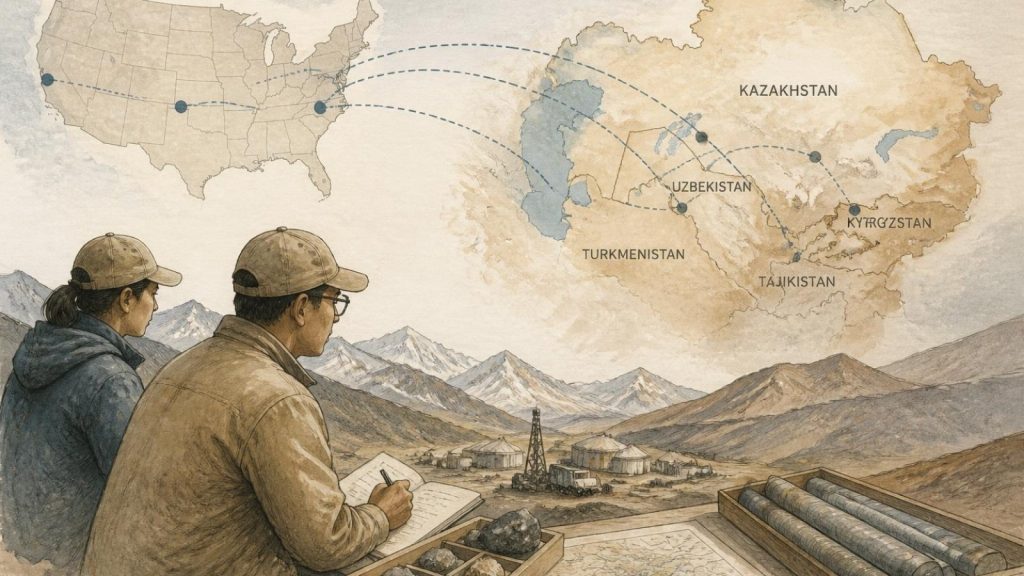
The landscape of U.S. investment in Central Asia’s critical minerals sector has evolved significantly from 2024 to 2026, extending beyond mere mine acquisitions to encompass a broader spectrum of activities including exploration, geological data collection, technology integration, offtake agreements, and potential project financing. While signed agreements and financing indications are promising, the actual deployment of capital remains a crucial factor in determining the success of these initiatives.
Kazakhstan stands out as the leader in direct U.S. mining investment, highlighted by Cove Kaz Capital’s acquisition of a 70% stake in Severniy Katpar LLP, which holds licenses for tungsten mining. The company has also established a joint venture with Qazgeology for the Akbulak rare earth elements project, alongside a portfolio that includes 15 critical-mineral concessions and a lithium tailings license. The U.S. International Development Finance Corporation (DFC) and Export-Import Bank (EXIM) have issued letters of intent for potential financing of up to $1.6 billion, indicating strong financial backing for these ventures.
In Uzbekistan, while the partnerships are more extensive, specific investments in mining deposits are less transparent. Cove has signed an exploration agreement, and Go Green Partners has outlined exploration plans, but the financial specifics remain undisclosed. The DFC has launched a joint investment platform with Uzbekistan, prioritising critical minerals, although project-level financing details are still awaited. Additionally, agreements between UZTMK and Traxys for molybdenum and rhenium supplies suggest a framework for future investments, albeit not directly classified as U.S. investments.
Kyrgyzstan is in the early stages of attracting U.S. investment, with its National Investment Agency signing a memorandum of understanding with Alvarez & Marsal to draw in foreign investors for mining and strategic minerals. A separate initiative aimed at improving railway connectivity could enhance transport logistics for mining operations, although no specific U.S. equity investments in Kyrgyz mineral deposits have been disclosed yet.
Turkmenistan is also engaging in the C5+1 critical minerals dialogue, with Turkmengeology seeking foreign partners for rare-mineral exploration. Discussions among U.S.–Turkmen business groups regarding financing pathways and sourcing industrial commodities, particularly iodine, are ongoing.
In Tajikistan, existing U.S. interests in antimony are complemented by a $30 million memorandum signed between Transparent Earth and Avesto Group to develop a national geological and mineral data platform, which could pave the way for future mining investments. Overall, while Kazakhstan leads in disclosed U.S. investment, the broader region is witnessing active discussions and promising developments in exploration, commercial structuring, and investor outreach.