Uzbekistan is plotting a tighter grip on critical minerals by seeking to purchase tungsten concentrate from Kazakhstan, as Uzbekistan’s government-led Uzbek Metal Processing Plant (TMK) prepares to ramp up production. Metin Alemder, TMK’s technical adviser, told inbusiness.kz at the China Mining summit in Tianjin that TMK is in talks with Kazakh colleagues to secure tungsten concentrate, signaling a strategic push to source raw materials locally for its expanding operations.
Kazakhstan has been developing tungsten at the Boguty mine in the Almaty region near the Charyn Canyon. The project is led by Zhetyсу Wolfram LLC, in which Chinese-backed Jiaxin International Resources Investment Limited is a major shareholder. Boguty is regarded as one of the world’s larger tungsten deposits, with a mining licence valid through 2040. Early projections estimated an annual processing capacity of 3.3 million tonnes of ore to produce about 10,000 tonnes of 65% tungsten oxide concentrate, primarily destined for China. The site also contains molybdenum, bismuth, and beryllium, with plans to raise tungsten extraction to nearly 5 million tonnes of ore by 2027.
Other Kazakh tungsten prospects include Aksoran at the SCO-Akmola border, as well as Northern Katpar and Verkhnee Kairakty in Karaganda. Notably, the last two are set to be developed via a joint venture in which Cove Capital (70%) partners with state mining firm Tau-Ken Samruk (30%) in a project budget of about $1.1 billion, with production expected to start in roughly 3.5 years. Cove Capital also has interests in Uzbekistan.
Alemder notes that China already controls more than 80% of global tungsten production and leads fundamental research in this strategic metal, which Czech-like knowledge in Uzbekistan could help leverage. Tungsten is not a rare earth metal, but it remains a critical material due to its unique properties and supply concentration.
TMK currently relies largely on local tungsten concentrates, with Uzbekistan able to produce tungsten using both hydrometallurgical and pyrometallurgical methods. The company’s plant in Chirchik is expanding capabilities, and a new hydrometallurgical workshop in Samarkand is slated to begin in 2027, targeting 5,000 tonnes of tungsten oxide annually. By 2030, production is expected to reach 15,000 tonnes per year, requiring growing external ore supplies. In the interim, the plant utilises residual tailings from an older deposit.
In addition to tungsten, TMK is expanding molybdenum production from tailings from the Almalyk Mining and Metallurgical Complex and is developing tellurium and osmium. A sulfuric acid plant with a capacity of 500,000 tonnes annually is under construction, feeding consumables for the chemical sector, fertiliser production, and uranium mining via in-situ leaching, using sulfur supplied by Uzbekneftegaz and local gas-processing facilities.
The shifting sands of Kazakhstan’s mining sector were the focus of a recent British-Kazakh Society (BKS) webinar, bringing together legal experts, industry professionals, and policymakers to dissect the impacts of evolving government regulations. Held on 13 November 2025, the discussion revealed a concerning trend of increasing investor uncertainty, despite the country’s rich geological potential.
Land Barriers Continue to Hamper Investment
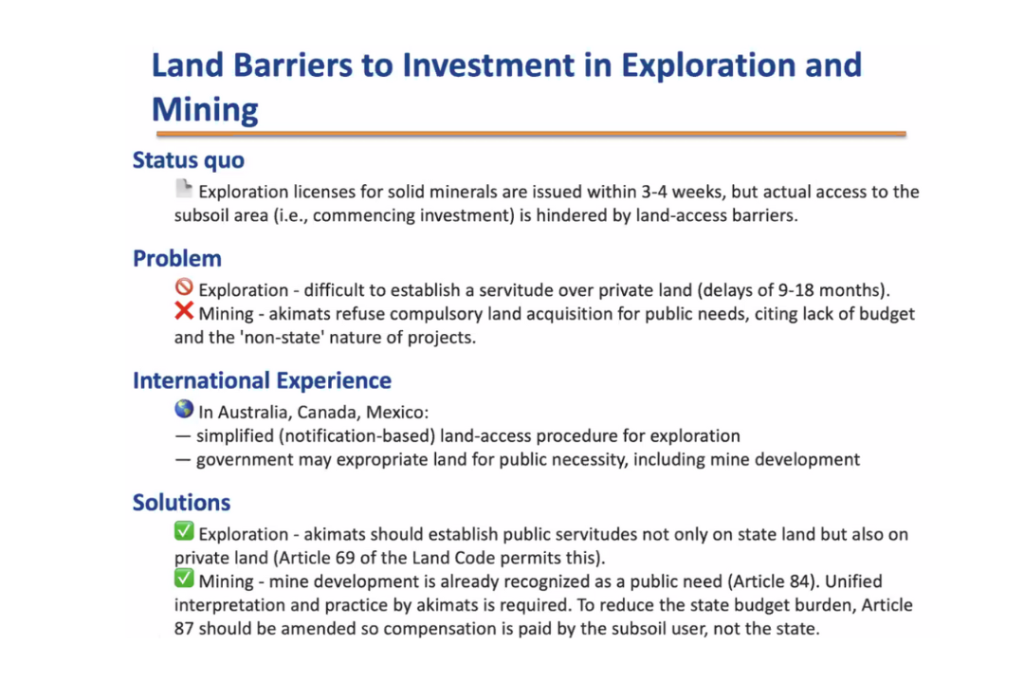
Kazakhstan’s crucial mining sector is undergoing significant changes, grappling with persistent land access issues and the introduction of new tax policies. A presentation by Almat Daumov, Partner at GRATA International in Almaty, shed light on these challenges and proposed solutions, highlighting both potential hurdles and opportunities for investors.
Despite seemingly swift issuance of exploration licenses for solid minerals (within 3-4 weeks), actual investment is frequently stalled by complex land-access barriers. Daumov emphasised that establishing servitude over private land for exploration can cause delays of 9-18 months. Even more critical, “akimats” (local executive bodies) are reportedly refusing compulsory land acquisition for mining projects deemed “non-state” in nature, citing budget limitations.
Drawing on international experience, Daumov pointed to successful models in Australia, Canada, and Mexico, where simplified (notification-based) land-access procedures for exploration and government expropriation of land for public necessity (including mine development) are common.
Proposed Solutions for Land Access:
To address these issues, Daumov proposed key solutions:
Exploration: Akimats should establish public servitudes on both state and private land, as permitted by Article 69 of the Land Code.
Mining: Mine development should be consistently recognised as a public need (Article 84). He stressed the need for unified interpretation and practice by akimats. Furthermore, to alleviate the state budget burden, Article 87 should be amended to ensure compensation is paid directly to the subsoil user, not the state.
New Tax Policies Introduce Volatility and Opportunity
Beyond land access, Kazakhstan’s mining sector is also navigating significant tax policy changes.
Higher Mineral Extraction Tax (MET) on Gold:
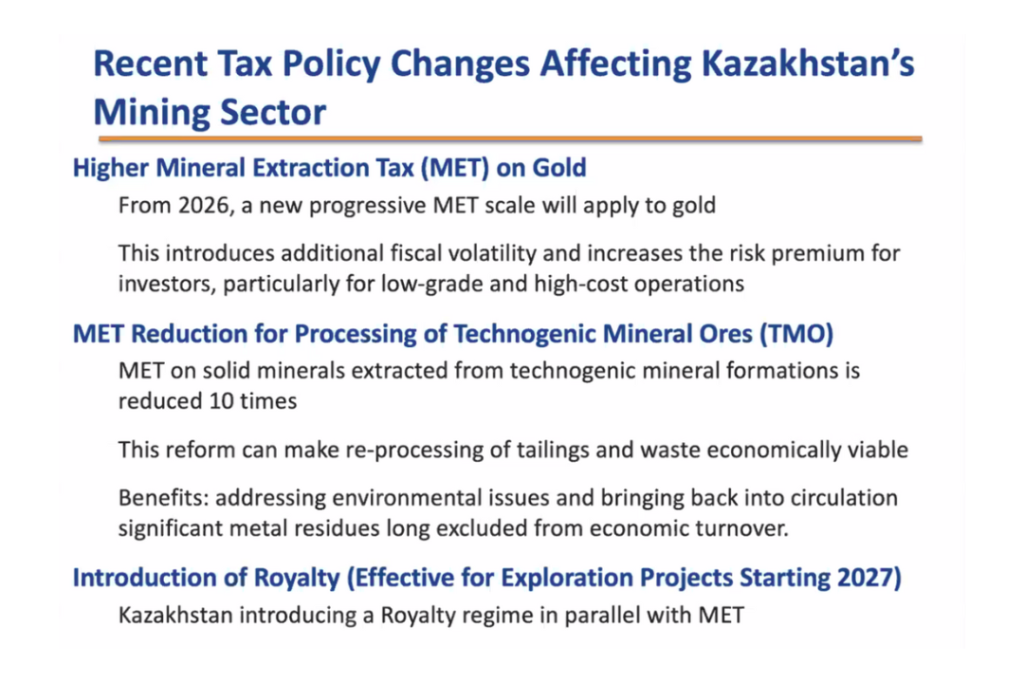
Starting in 2026, a new progressive MET scale will apply to gold. This change is expected to introduce additional fiscal volatility and increase the risk premium for investors, particularly those involved in low-grade and high-cost operations.
MET Reduction for Technogenic Mineral Ores (TMO):
In a more positive development, the MET on solid minerals extracted from technogenic mineral formations will be reduced tenfold. This reform aims to make the re-processing of tailings and waste economically viable. The benefits are twofold: addressing environmental issues and bringing significant metal residues, long excluded from economic turnover, back into circulation.
Introduction of Royalty Regime:
Effective for exploration projects starting in 2027, Kazakhstan will introduce a Royalty regime in parallel with the MET. Current proposed royalty rates are 7% for metals and alloys, 10% for concentrates, and 13% for ores, raising concerns among industry stakeholders.
Daumov’s analysis underscores a critical period for Kazakhstan’s mining sector. While the government aims to streamline processes and introduce new revenue streams, the effectiveness of these reforms will largely depend on clear implementation and a willingness to address investor concerns regarding both land access and fiscal predictability.
Kazakhstan on the Investment Attractiveness Index
Daniel A. Witt, President of the International Tax and Investment Center (ITIC), painted a picture of mixed signals for potential investors. While Kazakhstan has achieved its goal of being a top 50 most competitive country globally (ranking 34th in the 2025 IMD World Competitiveness Report), the micro-picture in the mining sector is less favourable.
Witt cited the Fraser Institute Annual Survey of Mining Companies (2024), noting a significant drop in the country’s Policy Perception Index (PPI) score—the metric heavily influenced by government control over tax, legal, and regulatory parameters.
“Kazakhstan came in 59 [on the Investment Attractiveness Index]. They fell… 59 is just barely passing,” stated Witt, stressing that the key challenge remains building a stable, predictable, and transparent fiscal and regulatory regime to attract large-scale international mining projects, similar to the success seen in the oil and gas sector. Specific concerns raised included the complexity of the tax system, difficulties obtaining VAT refunds, and the need for mechanisms to share risk between the state and investors.
Policy Trends and Regulatory Erosion
Timur Odilov, Founding Partner at Haller Lomax highlighted a worrying erosion of reforms designed to align Kazakhstan with international standards.
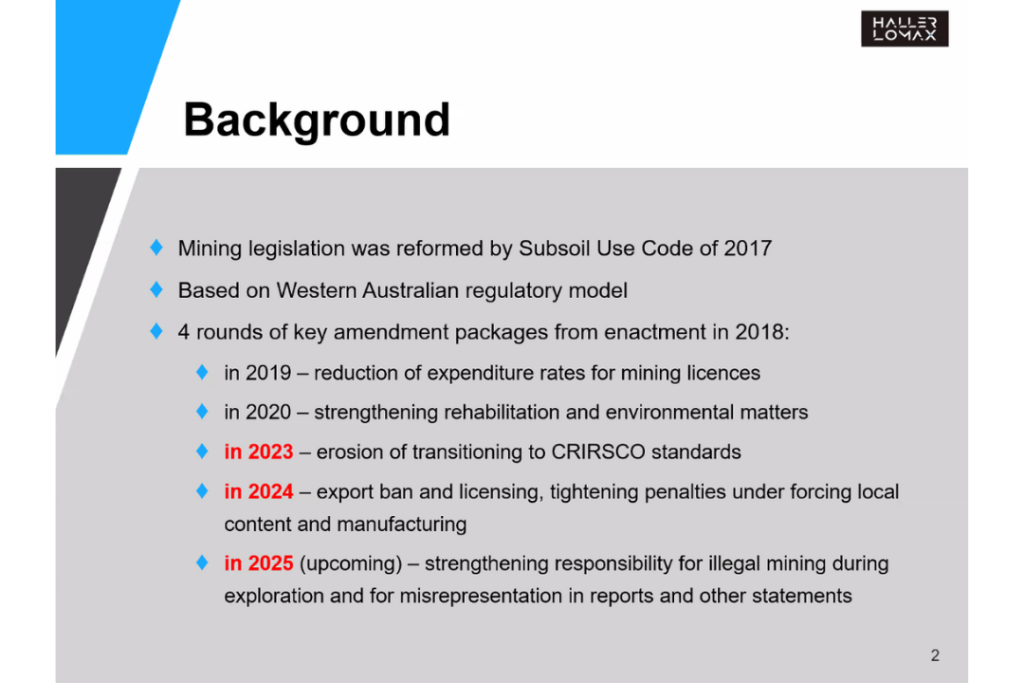
Odilov noted that following the adoption of the Western Australian-based Mining Code in 2017, subsequent years have seen the re-emergence of stricter rules and instability, particularly since 2023. Key changes discussed included:
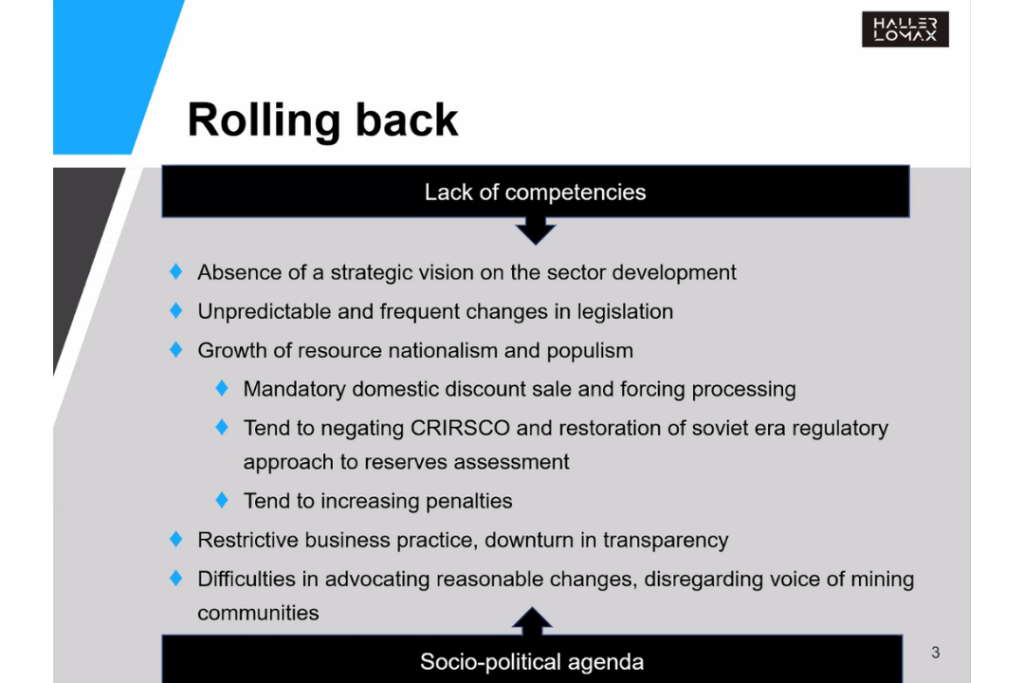
Erosion of CRISCO Standards: Discussions in parliament have begun challenging the transition to international reporting standards, favouring a return to Soviet-era standards.
Resource Nationalism: Increasing pressure for mandatory domestic discount sales and forced processing, even for materials that cannot be domestically processed (such as certain rare earths).
Uncertainty and Lack of Strategy: The policy shifts are driven by a mix of socio-political agendas and a perceived lack of “institutional memory” or a holistic strategic vision for the sector’s long-term development.
Olga Petrova, Rio Tinto Exploration Kazakhstan Country Manager, affirmed this trend, stating that while the government continues to express interest in attracting investment, the actions—such as increasing land access costs for explorers—are “a little different,” appearing as a short-term win that ignores long-term losses.
Investment Opportunities and Future Outlook
Despite the challenges, the webinar underscored the vast potential of Kazakhstan’s mining sector. With abundant geology and a strategic location, Kazakhstan is well-positioned to become a global leader in critical minerals. However, to attract investment, the government must address policy risks, ensure property rights, and create a stable regulatory environment.
Kazakhstan has added five new deposits to its state mineral register based on geological exploration conducted in 2025, Vice Minister of Industry and Construction Iran Sharkhan announced during a government meeting on the development and digitalization of the country’s geological sector.
The newly identified deposits—Altyn-Shoko, Samombet, Studenchesky, Takyr-Kaldzhir and Kok-Zhon at the Bolattobe site—have expanded the national mineral base by approximately 98 tonnes of gold, 36,000 tonnes of copper, 11 million tonnes of manganese and more than 1.3 million tonnes of phosphorites.
Kazakhstan currently holds 103 types of mineral resources and around 10,000 deposits on the state balance. More than 2,900 licenses have been issued to subsoil users, along with 250 contracts for the development of solid minerals.
From 2026 to 2028, geologists plan to survey an additional 100,000 square kilometers, followed by annual exploration covering 30,000 square kilometers through 2030. The government has allocated 240 million tenge to form a portfolio of 20 potential investment projects, aiming to improve early-stage discovery and increase overall efficiency of geological works.
To support advanced scientific methods in exploration, the government approved the creation of a specialized laboratory within a geological cluster in Astana. Construction is scheduled to begin in 2026, enabling comprehensive mineral-geochemical and analytical research.
Kazakhstan’s mining industry took a major step toward global capital market integration in the summer of 2025 with the dual listing of Jiaxin International Resources Investment Limited on the Astana International Exchange (AIX) and the Hong Kong Stock Exchange. The company, which is developing the Boguty tungsten deposit under the “Zhetysu Tungsten” brand, conducted the first yuan-denominated IPO in Central Asia and the first cross-listing between AIX and Hong Kong.
The offering drew massive investor interest, with demand exceeding supply by hundreds of times and share prices more than doubling on the first trading day. Analysts say the strong performance reflects growing confidence in Kazakhstan’s mining sector and its shift toward public market financing.
The event aligns with global trends in resource development, where companies increasingly rely on stock exchanges in addition to bank lending and private investment. Countries such as Canada and Australia have long used public markets—particularly TSX and ASX—to fund early-stage exploration and junior mining companies, allowing them to evolve into major global producers.
Kazakhstan is now moving along a similar path, supported by its substantial mineral base, established technical expertise, and a developing financial infrastructure. AIX’s simplified regime for junior listings enables exploration-stage companies to access public capital, creating opportunities for broader participation in the national resource sector.
Jiaxin’s cross-listing illustrates how Kazakh projects can attract both regional and Asian investors. Experts expect more mining companies to follow, as investors seek exposure to real assets and mining firms pursue transparent, institutional financing channels.
With international partnerships, expanding exchange infrastructure, and mounting interest from global markets, Kazakhstan is positioned to become part of the global network of exchanges that facilitate resource-sector investment. Industry observers say the sector is entering a new phase—one defined by openness, market-based financing, and deeper global integration.
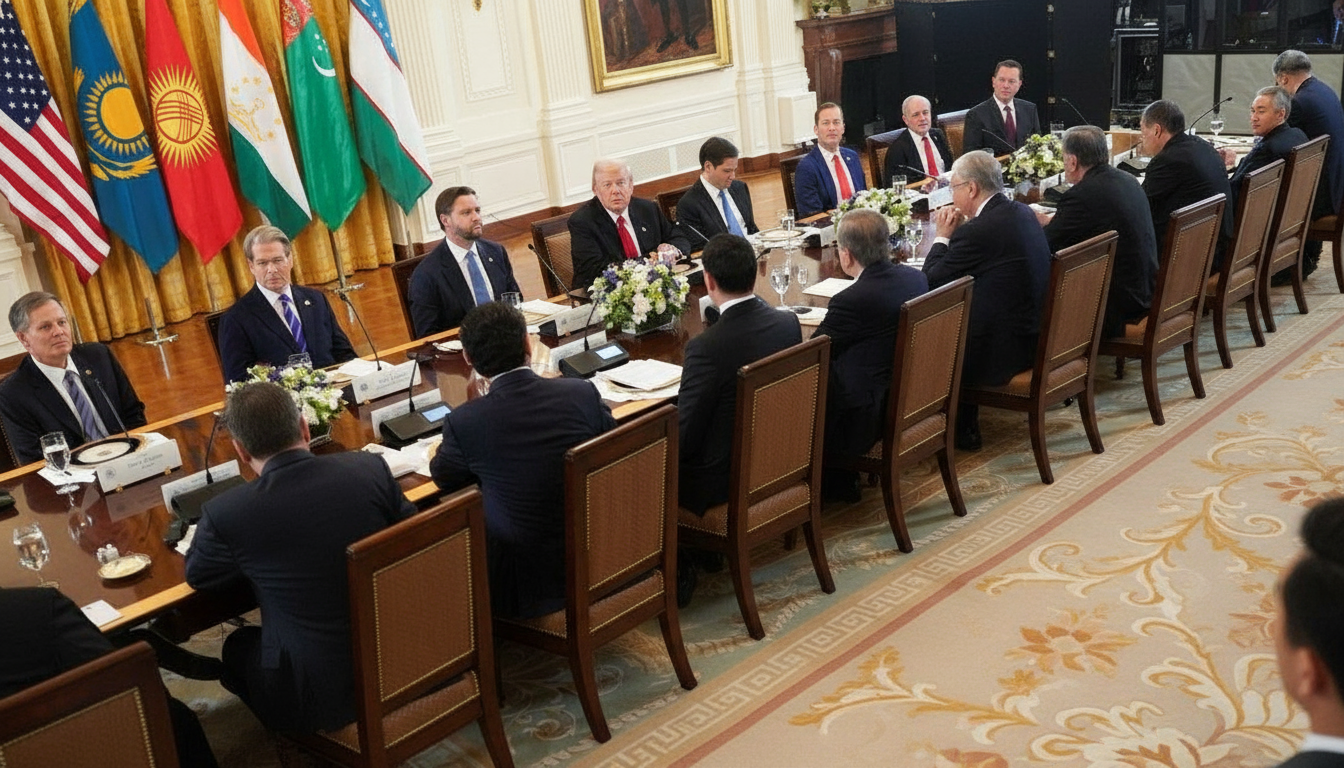
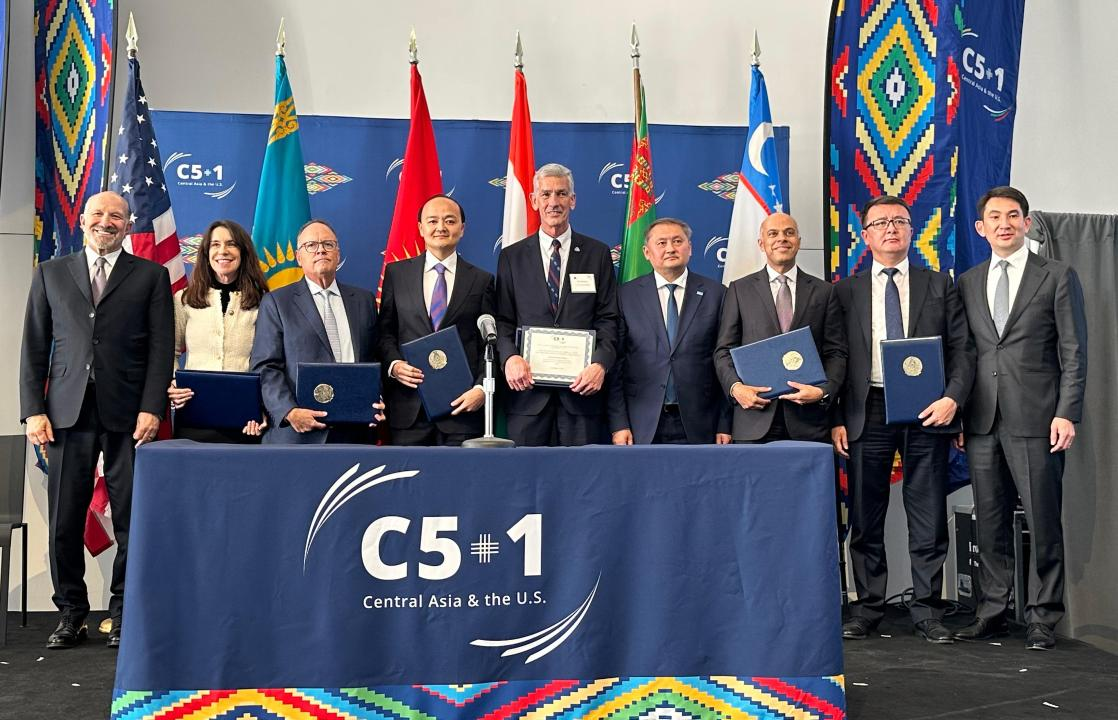
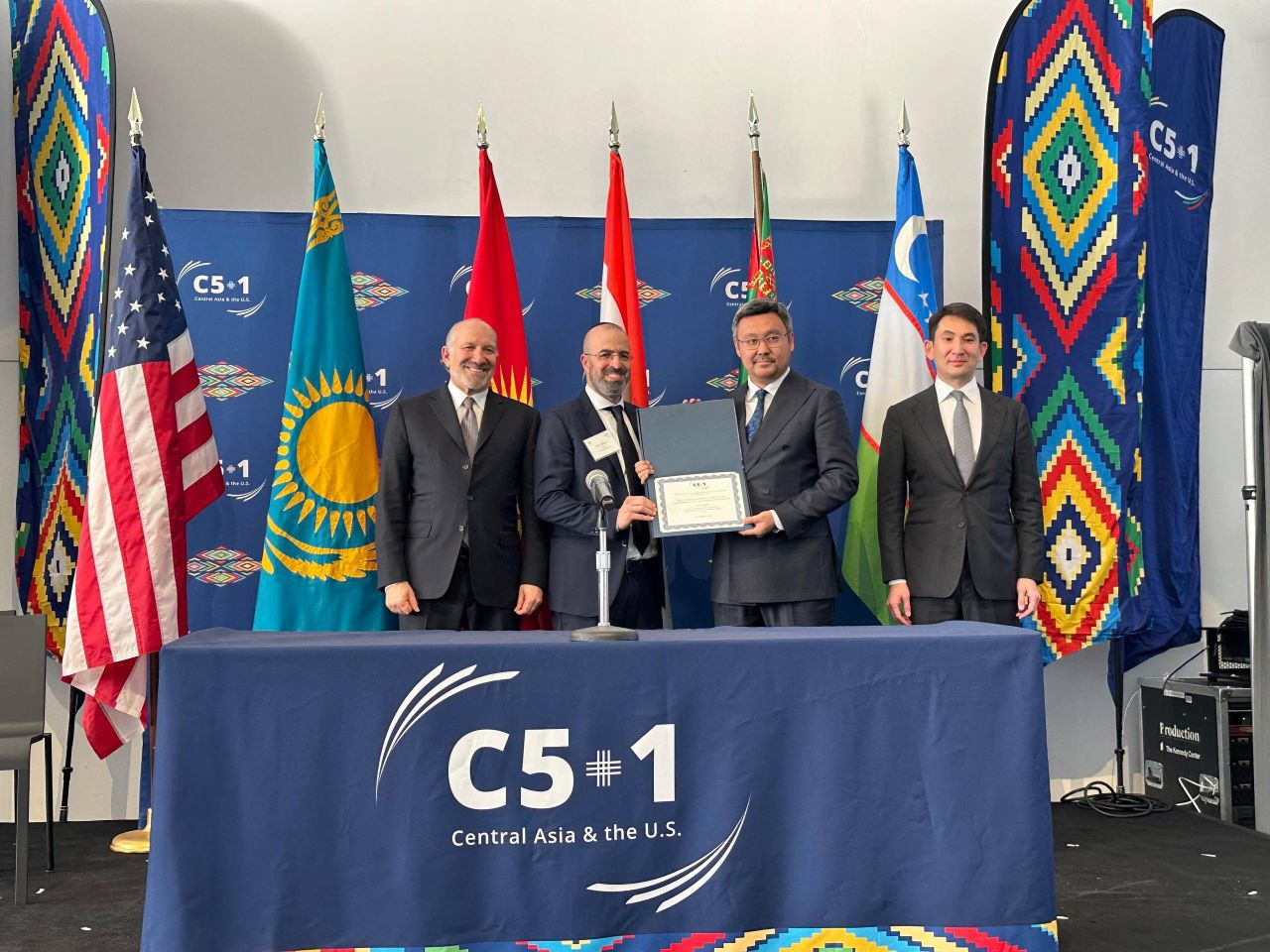
The C5+1 summit held in Washington on November 6, 2025, marks a new chapter in U.S.–Central Asia relations, shifting the focus from energy pipelines to strategic mineral resources. Rare earth elements are now central to Washington’s strategy against China, which dominates mining and processing globally.
Recent agreements—highlighted by substantial investments in Kazakhstan’s tungsten mines and commitments to Uzbekistan—illustrate a strategy that blends economic aims with national security, defense modernization, and leadership in green technologies. By partnering with Kazakhstan, Uzbekistan, and Turkmenistan, the U.S. seeks to counter China’s and Russia’s longstanding influence, establishing a “new resource-centered” framework for engagement. Rare earths are becoming tools of strategic power, supplanting traditional energy diplomacy and strengthening supply chains for renewable energy.
This shift extends beyond resource access; mining investments are shaping political, economic, and diplomatic orientations across Central Asia, challenging China’s Belt and Road Initiative through economic means. The U.S. approach converts energy diplomacy into “mining diplomacy,” turning Central Asia into a global geo-economic crossroads.
America’s renewed focus reflects a broader repositioning—building “strategic balancing” structures rather than pursuing mere economic or military dominance. The C5+1 format has become the central mechanism for promoting a model of regional integration that excludes Russia and China, offering a “third way” rooted in soft power, sustainable development, and technological partnerships.
Strengthening transport routes like the Trans-Caspian corridor aims to liberate Central Asia from Russia’s logistical grip and curtail China’s influence over the Middle Corridor. Moscow and Beijing view these moves as containment strategies, intensifying geopolitical competition while granting Central Asian states greater autonomy through multilateral diplomacy.
Ultimately, America’s strategy is about establishing a new Eurasian power architecture. Its success will depend on delivering sustainable investments and on Central Asian states maintaining independent balancing acts amid great-power competition.
Kazakhstan’s Kazzinc JSC has announced plans to invest over $700 million to expand operations at the Vasilkovskoye gold deposit in the Akmola region. The project is operated by Altyntau Kokshetau JSC, a Kazzinc subsidiary, which currently extracts ore using open-pit methods.
Since the beginning of 2025, Kazzinc has produced 408,000 ounces of gold, down 9% compared to the same period in 2024. The decline is mainly due to lower ore grades as mining moves deeper into the pit, the company said.
Vasilkovskoye remains one of Kazakhstan’s largest gold assets. As of the end of 2024, its total ore reserves were estimated at 40 million tonnes, with an average gold grade of 2.1 grams per tonne, according to Swiss company Glencore, which owns 69.61% of Kazzinc’s shares. The sovereign wealth fund Tau-Ken Samruk holds another 29.8%.
In 2024, the mine produced more than 18.7 tonnes of gold, depleting high-grade ore reserves but delivering higher profits than in 2023.
The new investment project introduces a hybrid mining approach, combining open-pit and underground operations. The open pit will be deepened to 680 meters, with annual ore extraction of up to 6 million tonnes, while a new underground mine will produce up to 2 million tonnes of ore per year.
Austrian companies are exploring new opportunities to participate in Kyrgyzstan’s mining, industrial, hydropower, winter tourism, digitalization, and security technology sectors, the Kyrgyz Ministry of Foreign Affairs announced following high-level meetings in Vienna, Trend reports.
During the visit, Kyrgyz Deputy Foreign Minister Meder Abakirov held a series of discussions with senior Austrian officials, including Markus Hoffer, Head of the Austria–Central Asia parliamentary friendship group, and members of the Austrian Parliament. Talks centered on strengthening economic and technological cooperation between the two countries, as well as expanding dialogue within the Central Asia+ format.
Deputy Minister Abakirov also briefed the Austrian side on preparations for Kyrgyzstan’s parliamentary elections scheduled for November 30, 2025, and invited Austria to join as election observers. Hoffer confirmed that Austrian parliamentarians plan to participate as part of an OSCE monitoring mission.
Economic and Industrial Cooperation
In a separate meeting with Austrian Deputy Finance Minister Andreas Reichhardt, the two sides reviewed progress on agreements reached during Kyrgyz President Sadyr Japarov’s visit to Austria in November 2024. Key focus areas included finance, natural resources development, and digital transformation initiatives.
Both parties emphasized Austria’s technological expertise and discussed the involvement of Austrian firms in a range of Kyrgyz projects, including:
Mining and industrial production,
Hydropower development,
Winter tourism and skiing infrastructure,
Digital and security technology applications.
Strategic Dialogue and Regional Role
Deputy Minister Abakirov also met with experts from the Austrian Institute for European and Security Policy (AIES), where he provided updates on Kyrgyzstan’s reform agenda, current economic and political developments, and the country’s role in regional and global security.
The discussions were also joined by members of the Kyrgyz-Austrian Friendship Society, underscoring the growing diplomatic and cultural engagement between the two nations.
The European Union has established a special communication channel with Chinese authorities to ensure the continuous flow of rare earth materials essential for European industries, EU Trade Commissioner Maros Sefcovic said on Wednesday.
The move comes after China imposed export controls on rare earths earlier this year, triggering alarm in Europe over possible disruptions to the supply of critical materials used in electric vehicles, wind turbines, and permanent magnets — key components for clean energy and high-tech manufacturing.
Speaking at the 2025 GCC–EU Business Forum in Kuwait, Sefcovic told Reuters that he had held multiple discussions with Chinese Commerce Minister Wang Wentao, emphasizing that bureaucratic delays in export procedures could have a “very negative impact on production and manufacturing in the EU.”
Fast-Track Cooperation Mechanism
Brussels and Beijing have agreed to prioritize export permit applications from European companies. Through the newly established channel, EU and Chinese officials are jointly reviewing and fast-tracking export approvals for rare earth shipments.
According to Sefcovic, European companies have submitted about 2,000 applications since the controls were introduced, with just over half already approved. He said the EU was urging China to accelerate the remaining cases while pursuing broader supply chain diversification.
“We continue to press for faster processing,” Sefcovic said, adding that Europe is simultaneously developing alternative rare earth sources, including new mining and magnet production projects in Estonia.
Wider Context
The announcement follows months of tension between Europe and Beijing after China’s export restrictions on rare earths and related technologies. Although subsequent deals with the EU and the United States helped ease the immediate supply squeeze, both regions have intensified efforts to reduce dependence on Chinese critical materials.
On Tuesday, the European Commission confirmed that EU and Chinese officials discussed introducing general export licenses to simplify rare earth shipments — similar to arrangements reportedly secured by the United States.
Kazakhstan has taken a significant step forward in advancing its mining and critical raw materials sectors by signing a $50 million agreement with the prestigious Colorado School of Mines. This partnership will focus on establishing Ulytau Technical University in Zhezkazgan. The initiative aims to enhance technical education, foster innovation, and develop dual-degree programs, positioning Kazakhstan as a leader in the global mining sector.
The Ulytau Technical University in collaboration with the Colorado School of Mines will provide students with state-of-the-art facilities and resources, equipping them with the skills and knowledge needed to excel in the mining industry. The university will serve as a hub for research and development, addressing the critical needs of the mining sector and contributing to the sustainable development of Kazakhstan’s natural resources.
In addition to the partnership with the Colorado School of Mines, Kazakhstan has also signed agreements with Arizona State University and Coursera, totaling $50 million. These agreements emphasize the digitalization of academic processes and the implementation of adaptive learning systems developed in partnership with the Educational Testing Service (ETS). These systems will tailor educational experiences to individual student needs, ensuring more effective and personalized learning outcomes.
Furthermore, a memorandum signed by the Kazakh Ministry of AI and Digital Development, the Ministry of Science and Higher Education, Kazakhtelecom, Freedom Holding, and OpenAI will integrate artificial intelligence into the education sector. This collaboration will provide Kazakh educators with access to ChatGPT Edu, a specialized version of OpenAI’s AI tool designed for educational purposes. Under the agreement, 165,000 OpenAI licenses will be provided annually to Kazakh teachers over the next three years.
Kevin Mills, Head of Education and Government Programs at OpenAI, expressed enthusiasm about the partnership, stating, “Educators worldwide are using AI to save time and focus on what matters most — student learning. Our partnership with the Government of Kazakhstan will help teachers bring AI-powered tools like ChatGPT into classrooms across the country.”
The investments and collaborations are expected to yield significant benefits, positioning Kazakhstan as a leader in mining, critical raw materials research, and education in the region.
Following the announcement of the joint venture between US-based Cove Capital LLC and Kazakhstan’s National Mining Company, JSC Tau-Ken Samruk, further details have emerged regarding the development timeline and scale of the Northern Katpar and Upper Kairakty tungsten projects.
Cove Kaz Capital Group LLC (“Cove Kaz”), a portfolio company of U.S.-based Cove Capital LLC, will hold a 70 per cent interest, with Tau-Ken Samruk retaining 30 per cent ownership of Severniy Katpar LLP, which owns the Northern Katpar and Upper Kairakty tungsten projects.
Cove Kaz will oversee marketing of 100 per cent of project output and has entered into a Letter of Intent with the International Trade Administration at the U.S. Department of Commerce to prioritise supply for U.S. government and commercial needs.
The announcement was made in Washington, D.C., during the C5+1 Leaders’ Summit by U.S. President Donald J. Trump and Kazakhstan President Kassym-Jomart Tokayev.
Total development costs for the Northern Katpar and Upper Kairakty projects are estimated at USD $1.1 billion. The Export-Import Bank of the United States has issued a Letter of Interest for USD $900 million in financing, complemented by a similar commitment from the U.S. International Development Finance Corporation.
Cove Kaz’s project team will be led by Dominic Heaton, who previously oversaw development of the Nui Phao integrated tungsten mine and refinery in Vietnam – the world’s largest tungsten operation outside China. Preparatory work has already commenced to support a Definitive Feasibility Study for Northern Katpar, including the establishment of downstream refining capacity in Kazakhstan to produce ammonium paratungstate (APT) and other tungsten compounds.
Pini Althaus, Chief Executive Officer of Cove Capital and Cove Kaz Capital, expressed gratitude for U.S. and Kazakh government support:
“On behalf of Cove Capital and Cove Kaz, I wish to thank President Donald J. Trump, Secretary of Commerce Howard Lutnick, and the U.S. Trade Advocacy Center for their exceptional engagement. Their efforts have aligned financing, offtake pathways, and policy support to deliver a secure, allied tungsten supply for America’s industrial and defence needs.
“I also wish to thank President Kassym-Jomart Tokayev for his leadership and partnership. This collaboration is a win for both nations—strengthening U.S. supply chains while fostering investment and long-term prosperity in Kazakhstan.”
Tungsten – A Critical Industrial and Defence Mineral
Tungsten is ranked by the U.S. Defense Logistics Agency as a “material of interest” and by the European Union as the raw material of highest economic importance due to its unique physical properties: the highest tensile strength at high temperatures, the highest melting point of any metal, and exceptional corrosion resistance.
Its density and durability make tungsten indispensable in high-performance cutting and drilling tools, aerospace alloys, semiconductor contacts, and radiation shielding. In defence applications, tungsten is used in armour-piercing munitions, missile components, aircraft ballast, and other high-stress environments.
Currently, China controls over 80 per cent of global tungsten production and processing. In February 2025, China imposed new export restrictions on tungsten and tungsten-containing products to the United States.
Severniy Katpar LLP
Severniy Katpar LLP holds licences for two projects—Northern Katpar and Upper Kairakty—located approximately 30 kilometres apart in the established Karaganda mining district of central Kazakhstan, less than 160 kilometres south of the city of Karaganda.
Feasibility studies completed in April 2023 report total JORC-compliant mineral resources of 1.4 million tonnes of tungsten trioxide (WO₃), accounting for around 70 per cent of Kazakhstan’s total tungsten resources. For comparison, the U.S. Geological Survey estimates China’s reserves at 2.4 million tonnes.
Combined production from both projects is expected to reach 12,000 metric tonnes per annum (mtpa) of tungsten trioxide—approximately 15 per cent of current global output.
Cove Capital’s Broader Commitment in Kazakhstan
Cove Capital’s portfolio company, Kaz Resources LLC, became in 2023 the first U.S. entity to receive critical minerals and rare earth concessions in Kazakhstan. These include licences for 13 minerals such as lithium, tantalum, beryllium, niobium, and rare earth elements.
In 2024, Cove Capital and Tau-Ken Samruk formalised a joint venture for exploration of rare earths at the Akbulak project in the Kostanay region, with Cove holding 75 per cent and “Qazgeology” JSC 25 per cent. Cove is fully financing exploration activities until reserves are booked.
About Cove Capital LLC
Founded in 2015, Cove Capital is a mining-focused investment and development firm headquartered in New York and Melbourne. Since 2018, the company has focused on critical minerals projects that enhance U.S. and allied supply chains. Led by CEO Pini Althaus, Cove Capital brings extensive expertise across exploration, mining, processing, and offtake structuring.
About Tau-Ken Samruk
Tau-Ken Samruk, Kazakhstan’s national mining company, manages the sustainable development of the nation’s mineral wealth. Through partnerships with international investors, it aims to strengthen Kazakhstan’s mining sector and support the country’s long-term economic growth.

 Kazakhstan’s crucial mining sector is undergoing significant changes, grappling with persistent land access issues and the introduction of new tax policies. A presentation by