Erdene Resource Development Corp. and Mongolian Mining Corporation had executed debt finance agreements worth up to US$80 million to finance the development of the high-grade, open-pit Bayan Khundii Gold Project in southwest Mongolia.
We are very pleased to close the financing for the Bayan Khundii Gold Project with our strategic partner MMC, Mongolia’s leading publicly traded mining company. With the first gold scheduled in 2025, Bayan Khundii will be one of the highest grade, open pit gold mines globally and Mongolia’s largest primary gold producer when it reaches full production.
Peter Akerley, President and CEO, Erdene Resource Development Corp.
Akerley continued, “The strengthening of our relationship with MMC through this financing supports our goal of creating a major new mining district in southwestern Mongolia. With MMC’s experience in large-scale mining, expertise in construction, power supply, transportation and logistics, and national and international relationships.”
The Bayan Khundii Gold Project will form a strong foundation for future growth in the Khundii Minerals District. Together we will grow the Mongolian mining sector, increase the industry’s contribution to the national economy, and create value for our shareholders.
Peter Akerley, President and CEO, Erdene Resource Development Corp.
Bayan Khundii Financing
Erdene and MMC signed a financial agreement to build the Bayan Khundii Gold Project. The funding is set up as a shareholder loan from MMC to Erdene Mongol LLC which is a joint venture between Erdene and MMC and has the mining licenses for Bayan Khundii, Altan Nar, and the extremely promising Ulaan exploration license.
The US$50 million shareholder loan will finance the building of the Bayan Khundii gold mine and processing complex. Up to five tranches totaling at least US$5 million may be drawn from the loan. The loan will mature five years after the initial draw date, and interest will be charged at a rate of 13.8 %, which will be paid in arrears every three months.
The first four interest payments are capitalizationable at EM’s discretion. When the loan matures, it will be fully repaid. Under the same conditions, MMC may choose to make available an additional US$30 million. Additionally, EM and commercial banks in Mongolia are negotiating a loan package for up to $30 million.
A 50 % guarantee from Erdene and Erdene’s interests in the Project, including its shares of EM and NSR interest and preferential rights over the Khundii, Altan Nar, and Ulaan licenses, will finance the shareholder financing. Under the terms of the companies’ Strategic Alliance agreement, MMC will have first dibs on Erdene’s Zuun Mod project and priority voting rights for as long as the loan is outstanding.
Erdene also has the option to become a lending shareholder on the same terms as MMC and buy 50 % of the loan.
This funding comes after MMC invested US$40 million as part of the Strategic Alliance Agreement to acquire a 50 % equity stake in EM. MMC will contribute a maximum of US$120 million toward the Bayan Khundii Gold Project’s development. The Strategic Alliance’s highlights are as follows:
The main board of the Hong Kong Stock Exchange lists MMC, as the largest mining firm in Mongolia that is traded worldwide.
MMC has made a $40 million investment in EM, Erdene’s Mongolian affiliate that had the Ulaan exploration license in addition to the Khundii and Altan Nar mining licenses.
In addition to the first 400,000 ounces of gold recovered, Erdene is still the owner of a 50 % equity position in EM and a 5.0 % Net Smelter Return royalty on production from the Khundii, Altan Nar, and Ulaan licenses. Erdene also retains ownership of any properties purchased within a 700 km2 area of interest.
The massive Zuun Mod Molybdenum-Copper deposit and Khuvyn Khar Copper project, which are around 30 km east of Bayan Khundii and next to a proposed railroad development, are both owned 100% by Erdene.
Nigel Robinson discusses the positive production results for 2023, with copper, zinc, and lead all meeting or exceeding guidance. He emphasizes the company’s focus on business development and growth opportunities. Kazakhstan is highlighted as a potential area for future projects, with the company teaming up with experienced geologists to explore for new opportunities. R
Central Asia Metals (CAML), a diversified base metals producer, has demonstrated resilience and strategic growth amidst challenging economic conditions in the first half of 2024. Despite facing a 17% decline in metal prices, cost inflation of 10-15%, and tax increases in Kazakhstan for the first time in a decade, CAML has maintained a strong performance. The company reported the production of 6,700 tons of copper, 9,700 tons of zinc, and 13,700 tons of lead in the first six months, aligning with its annual production guidance. This achievement was underscored by a commendable safety record, with a Lost Time Injury Frequency Rate (LTIFR) of 0.8, surpassing the target of 1.3.
Financially, CAML showcased robust results with revenue just under $100 million and an EBITDA of approximately $49 million, translating to a 49% EBITDA margin. The company also generated $24.1 million in free cash flow, enabling a dividend payout of nine pence per share. This financial health is further bolstered by a debt-free balance sheet and cash reserves of $50.6 million.
Strategic projects such as the Sasa transition to paste fill mining and the construction of a solar farm are on track, promising operational and environmental benefits. The transition to paste fill mining at the Sasa mine is expected to enhance metal recovery, reduce dilution, and enable access to complex ore bodies, while also addressing waste management challenges.
On the business development front, CAML has been active, evaluating 22 opportunities, signing five NDAs, and conducting three site visits. Although two focused opportunities did not materialize, the company remains committed to growth, leveraging its strong balance sheet to explore early-stage opportunities and transformative transactions.
CAML’s partnership with Terra Exploration in Kazakhstan exemplifies its strategy to identify and develop early-stage mining opportunities. This collaboration aims to leverage Terra Exploration’s expertise and CAML’s resources to secure new licenses and potentially discover viable mining projects.
The company’s commitment to Environmental, Social, and Governance (ESG) principles is evident in its reporting and operational practices. CAML has published its fourth sustainability report, supports the Task Force on Climate-related Financial Disclosures (TCFD), and plans to report its Scope 3 emissions. Internally, CAML has set ambitious targets across key sustainability pillars, including a 50% reduction in greenhouse gas emissions by 2030 and increased local community investment.
Six journalists from the independent Azerbaijani investigative website Abzas Media have been under arrest since November 2023. They had previously transmitted elements of their investigations to the Paris-based Forbidden Stories collective, which took over their work in collaboration with 14 European news organisations in the “The Baku Connection” project, including FRANCE 24 and RFI. This article focuses on the tensions surrounding a mine in the west of the country, whose gold ends up in the products of major high-tech brands.
The anger was visible on their faces as they faced off against squadrons of riot police sent to silence them. On June 20, 2023, residents of the village of Söyüdlü, in western Azerbaijan, demonstrated to reject the construction of a new reservoir to store toxic waste from a gold mine that has been operating in the area since 2012. An initial reservoir had been installed by Anglo Asian Mining, the British company that operates the mine, but it was close to capacity. The villagers believe it had led to soil and river water pollution, and that the fumes escaping from it were causing an increase in respiratory illnesses.
The first reservoir, with a capacity of 6 million cubic metres, is located a few hundred meters from Söyüdlü. To separate the gold from the rock, Anglo Asian Mining uses cyanide, and dumps the sludge generated by the process, which contains toxic products including cyanide and arsenic, into the reservoir, known as a tailings pond. The company says that the quantities of waste do not threaten the environment or the health of local residents.
‘The police set up roadblocks and turned back journalists who were not under government control’
The study by the U.S.-based International Tax and Investment Center warns that a failure to act could leave China with a “decisive advantage” in the sector, which is crucial to green energy, many new weapons systems and other advanced technologies.
“As the uses for these minerals has expanded, so too has global competition for them in a time of sharply increasing geostrategic and geo-economic tension,” the report says.
“Advanced economies with secure, reliable access to REEs enjoy economic advantages in manufacturing, and corresponding economic disadvantages accrue for those without this access.”
China, which accounts for most of the world’s rare earth mining within its own borders, has not yet had to seek additional supplies from Central Asia, which enjoys plentiful reserves of minerals ranging from iron and nonferrous metals to uranium.
But, the report says, “the massive size of the Chinese economy and the Chinese Communist Party’s conscious efforts to dominate the REE sector globally means such increases are a matter of time.”
Oil-rich Kazakhstan, the region’s economic giant, holds the world’s largest chromium reserves and the second-largest stocks of uranium, while also possessing other critical elements.
Report co-author Ariel Cohen says it is up to the governments of Central Asia to create the investment climate for the development of these resources.
“They may be the next big thing in Central Asia as the engine of economic growth,” Cohen said this week during a panel discussion at the Atlantic Council, a Washington think tank.
Across Central Asia, experts note, REEs are found in substantial volumes in the Kazakh steppe and uplands as well as in the Tien Shan mountains across Kazakhstan, Kyrgyzstan and Uzbekistan, and in the Pamir Mountains in Tajikistan.
Monazite, zircon, apatite, xenotime, pyrochlore, allanite and columbite are among Central Asia’s most abundant rare metals and minerals.
In 2016, the U.S. Geological Survey listed 384 REE occurrences in the region: 160 in Kazakhstan, 87 in Uzbekistan, 75 in Kyrgyzstan, 60 in Tajikistan, and two in Turkmenistan.
US Ambassador to Kazakhstan Outlines US Engagement in Central Asia
Wesley Hill, another expert on Central Asia’s mineral reserves, says production of rare earths at present “is almost wholly monopolized by China.”
“Depending on how you count, between 80 to 90% of REE refining is controlled by China and done directly inside of China,” Hill said.
But, he argued, despite China’s heavy involvement in Central Asia, it has yet to fully take over the region’s rare earth sector. “So, this means that Central Asia is very much at a crossroads,” he said. “Central Asia has the opportunity to expand its REE production without being wholly dependent on China.”
Central Asia is currently in a position where it can develop its REE refining capacities both for its national development strategies and to break the Chinese monopoly, Hill said.
“But this is only going to happen with good policy, both from the American side and the Central Asian side.”
Ambassador John Herbst, Washington’s former top diplomat in Uzbekistan and Ukraine, says the region’s REE assets are “simply another reason for enhanced engagement by the West.”
He said he is not sure that Central Asian governments appreciate how important rare earths can be to their development. “But I do know that the countries of Central Asia want a closer relationship with the United States, and that is one important part of their maintaining their hard-won independence.”
Herbst added that the United States and Central Asia have a common interest in working together to develop the region’s rare earths “for the economy of the future.”
“We have an ability to innovate that far exceeds [China’s]. Their innovation is based largely on taking our technology.”
Central Asian Trade Corridor Gains Interest Amid Regional Tensions
Suriya Evans-Pritchard Jayanti, who serves as energy transition counsel at the U.S. Department of Commerce, says the region is eager for investment.
“It is a development opportunity. Particularly with the geostrategic energy realignment after the Russian invasion of Ukraine, but also, because of the energy transition. Lithium and other REE are necessary for different parts of that transition. So that’s primarily an economic incentive,” she said.
She pointed to the Mineral Strategic Partnership Initiative run by the U.S. State Department’s Bureau on Energy Resources, which is able to promote foreign direct investment in the region while providing technical assistance in the mining sector.
Cohen said the Central Asian countries cannot wait long to develop their rare earths. “There is a competition, and the African countries, Latin American countries and others will compete increasingly.”
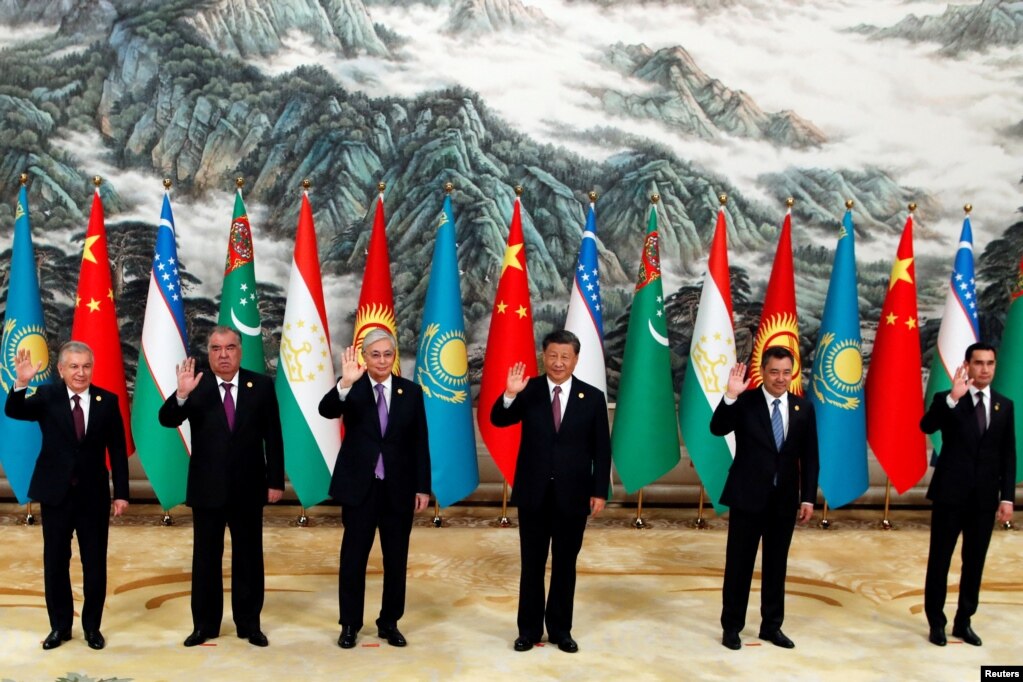
FILE – Chinese President Xi Jinping (center) poses for photos along with the presidents of Kazakhstan, Kyrgyzstan, Tajikistan, Turkmenistan and Uzbekistan during the China-Central Asia Summit in Xian, China May 19, 2023.
Wilder Alejandro Sanchez, who heads a consultancy called Second Floor Strategies, says Central Asia needs a rare earth research center that can provide timely information to prospective customers and investors.
Transportation is key, Sanchez said. “It’s not just about finding and mining them. You have to get them to the international market.”
Access from the landlocked region at present is limited to China’s Belt and Road infrastructure or routes through Russia. Sanchez and others recommend using the Middle Corridor, also called the Trans-Caspian International Transport Route, which can carry goods to Europe across the Caspian and Black seas.
These experts also say progress will depend on regional governments overcoming their traditional secretiveness regarding natural resources. They emphasize the importance of transparency, the rule of law, adherence to best practices and compliance with international norms if they hope to attract Western investment.
As part of the 1st International Forum “KAZSODERZHANIE 2.0”, Eurasian Resources Group ( ERG ) carried out a technological launch of a special coke production plant via teleconference. The new production, after reaching its design capacity, will allow us to abandon a significant part of the import of reducing agents and will increase the percentage of Kazakhstani content in the domestic ferrochrome produced by ERG.
The plant is located on the territory of the coal enterprise Shubarkol Komir JSC in the Karaganda region. Its capacity is 400 thousand tons of special coke per year. Investments in the project amounted to 60 billion tenge. The plant will create 184 jobs. The production uses the most modern technological solutions and automation.
Also at the forum, ERG signed memorandums of cooperation with domestic producers and supply agreements. Documents signed with companiesTPB AGROMIR LLP, Kazakhstan Industrial Enterprise LLP, Zhaik Electric LLP, Machine-Building Plant named after S.M. Kirov”, LLP “Caspian Plus”, LLP “Saryopan Operating”.
For Kazakhstan ERG enterprises, it is planned to purchase high-pressure hoses, spare parts for pumps, bearings, pumps, hydrocyclones, lime, as well as metal supports and components.
– Today we have concluded long-term agreements and memorandums. An off-take contract was also signed with TPB AGROMIR LLP. This provides great business opportunities,” said Serik Shakhazhanov, General Director of ERG in Kazakhstan. – The counterparty will supply high-pressure hoses; previously we purchased these spare parts from dealers and intermediaries. We are glad that the quality of goods and services from domestic producers is growing and becoming competitive in comparison with foreign analogues. All this leads us to a mutually beneficial and long-term partnership.
ERG purposefully, systematically and effectively participates in the implementation of the state policy for the development of local content. The Group is expanding its interaction with domestic manufacturers and demonstrating a steady increase in the purchase of goods, works and services from them from 51% in 2018 to 62.05% in 2022.
Every year the company purchases more than 15,000 goods from Kazakhstani manufacturers – from raw materials fuels and lubricants to finished products.
The Group pays special attention to supporting domestic small and medium-sized businesses. In 2022, ERG purchased goods, works and services worth more than 518 billion tenge from 2,794 domestic manufacturers.
Procurement procedures in ERG are carried out on two main platforms: Electronic trading platform, synchronized with the NADLoC Register, where procurement is carried out according to the rules of subsoil use and natural monopolies (www.e-port.kz) and the ERG Procurement Portal ( www.torgi.erg.kz ), where all other purchases are made.