Chinese President Xi Jinping is meeting Serbian President Aleksandar Vučić on the second day of a state visit to Belgrade, with 35 bilateral agreements expected to be signed covering new investments, infrastructure projects and expanded cooperation across sectors of strategic importance to Serbia.
Vučić said the discussions would focus on the future of the relationship, including new investment commitments and the further strengthening of economic ties. Investment and the economy are at the centre of the talks.
China has already invested approximately €7.8 billion in Serbia through 37 companies employing nearly 40,000 people — making it one of Serbia’s largest foreign investors. The dominant presence in that figure belongs to the mining sector. Zijin Mining has invested €2.2 billion in Serbia, primarily through its Čukaru Peki copper-gold mine near Bor, while Zijin Copper has committed a further €2.7 billion. Together, the two Zijin entities account for nearly half of total Chinese investment in the country.
Other significant Chinese investors include tyre manufacturer Linglong International Europe at €800 million, automotive components producer Minth Automotive Europe at €516 million, steelmaker HBIS Group Serbia Iron and Steel at €166 million and automotive lighting systems firm Xingyu at €137 million.
The visit comes at a moment of deepening Chinese economic engagement across the Western Balkans, with Serbia serving as the primary hub of Chinese industrial investment in the region.
Kazakhstan-registered exploration company ALTYN GEO RESOURCE has announced plans to begin geological exploration at the Taldy alluvial gold prospect in the Samarsky District of East Kazakhstan Region, the latest in a series of licence areas the company is advancing simultaneously across the region.
The Taldy licence area covers 15.8 square kilometres across seven blocks, located approximately 45 kilometres northwest of the city of Altai. The company received its solid minerals exploration licence from the Ministry of Industry and Construction on 30 December 2025. The programme is designed to evaluate alluvial gold prospectivity and calculate reserves to KazRC standards, with the primary objectives of delineating the productive layer, determining overburden and sand thicknesses, and assessing gold grades and processing characteristics.
Exploration will use percussion cable drilling on a grid of 200 to 400 metres between lines and 20 to 40 metres between holes, with approximately 100 boreholes planned across a total of 3,000 linear metres at an average depth of 30 metres. UAV aerial photography will provide detailed topographic mapping at scales of 1:2,000 to 1:5,000. An estimated 257.9 tonnes of samples will be collected. Field operations will be conducted on a rotational basis with teams of 16 specialists working 15-day shifts. The programme is scheduled to run from the first quarter of 2026 through to the fourth quarter of 2031, with the final phase producing a geological report and KazRC-compliant reserve calculation.
The Taldy area is characterised by gold mineralisation associated with fracture, shear and silicification zones in terrigenous rocks, with arsenopyrite serving as an indicator of the highest concentrations of fine-grained gold.
ALTYN GEO RESOURCE is simultaneously advancing two further alluvial gold exploration programmes. In Abai Region’s Zharminsk District, a 20.26 square kilometre licence area called Nizhny Agynykatti is targeted for work commencing in the fourth quarter of 2026 through to end-2031. In East Kazakhstan’s Ulansky District, the Taldybulak licence area of 11.23 square kilometres is similarly scheduled for the same period, with the company noting that gold content in the Taldybulak river valley is irregular in distribution.
The company’s co-owners are listed as Xingwang Engineering Kazakhstan Co. Ltd and Inzhu Caspian Gold LLP. The ownership of Xingwang Engineering Kazakhstan is not publicly disclosed, though its director is identified as Liu Xiangju.
The European Union has identified tungsten, rare earths and gallium as priority candidates for its first coordinated critical minerals stockpile, marking one of the bloc’s most concrete steps yet toward shielding its economy from supply disruptions after China tightened export controls on several strategic materials over the past two years.
Discussions have begun with major logistics hubs including the Port of Rotterdam — Europe’s largest port and a key gateway for industrial supply chains — over potential storage arrangements for the proposed reserves. Sources familiar with the matter also indicated that magnesium is expected to be included on the priority list, with germanium and graphite also likely to make the final selection. Most of the minerals under consideration, with the exception of magnesium, appear on NATO’s list of materials considered critical to defence production.
Ten EU member states are participating in planning groups led by Italy, France and Germany. France, holding the G7 presidency, is pushing for a permanent secretariat to oversee the initiative beyond the bloc’s rotating political leadership cycles — a sign of ambition to make the stockpile a durable institutional feature rather than a temporary political response.
The initiative follows a late 2025 announcement of plans for coordinated stockpiling and reflects mounting concern that China could weaponise mineral exports during future trade or geopolitical disputes. Beijing’s export restrictions on gallium, germanium and graphite have already disrupted global markets in recent years, while restrictions on heavy rare earths imposed in April 2025 sent dysprosium, terbium and yttrium prices surging. China’s dominance is structural: the bloc imports 93% of its permanent magnets for wind turbines from Chinese suppliers, and the combined market share of the top three producing countries for key transition minerals rose from 82% in 2020 to 86% in 2024.
Europe’s push to build domestic supply chains has encountered obstacles. Projects designated as strategic under the EU Critical Raw Materials Act, such as the Chvaletice manganese development in the Czech Republic, have faced lengthy permitting delays, with fast-track measures under the legislation yet to be fully incorporated into Czech national law.
The stockpile discussions reflect a broader shift across Western governments from market-driven supply models toward more interventionist industrial policy as competition for strategic resources intensifies. The US, Japan and South Korea are also building reserves or financing alternative supply chains to reduce exposure to Chinese production dominance.
Давайте начнём с одной цифры. Семьдесят процентов. Именно столько критического минерального сырья Центральной Азии сегодня уходит в Китай. Двадцать пять активных китайских проектов в регионе — это в пять раз больше, чем у всех европейских компаний вместе взятых. При этом Казахстан способен производить половину из тридцати четырёх материалов, которые Евросоюз называет критически важными: литий, кобальт, медь, вольфрам, редкоземельные элементы. В Сенате Казахстана оценивали потенциал казахстанских недр в сорок шесть триллионов долларов. Вдумайтесь в эту цифру.
Вопрос в том — кто станет партнёром в превращении этого богатства из руды в готовую продукцию? Кто поможет выстроить полную цепочку — от геологоразведки до переработки? И кто предложит не просто деньги, а технологии, рынки сбыта и промышленные компетенции?
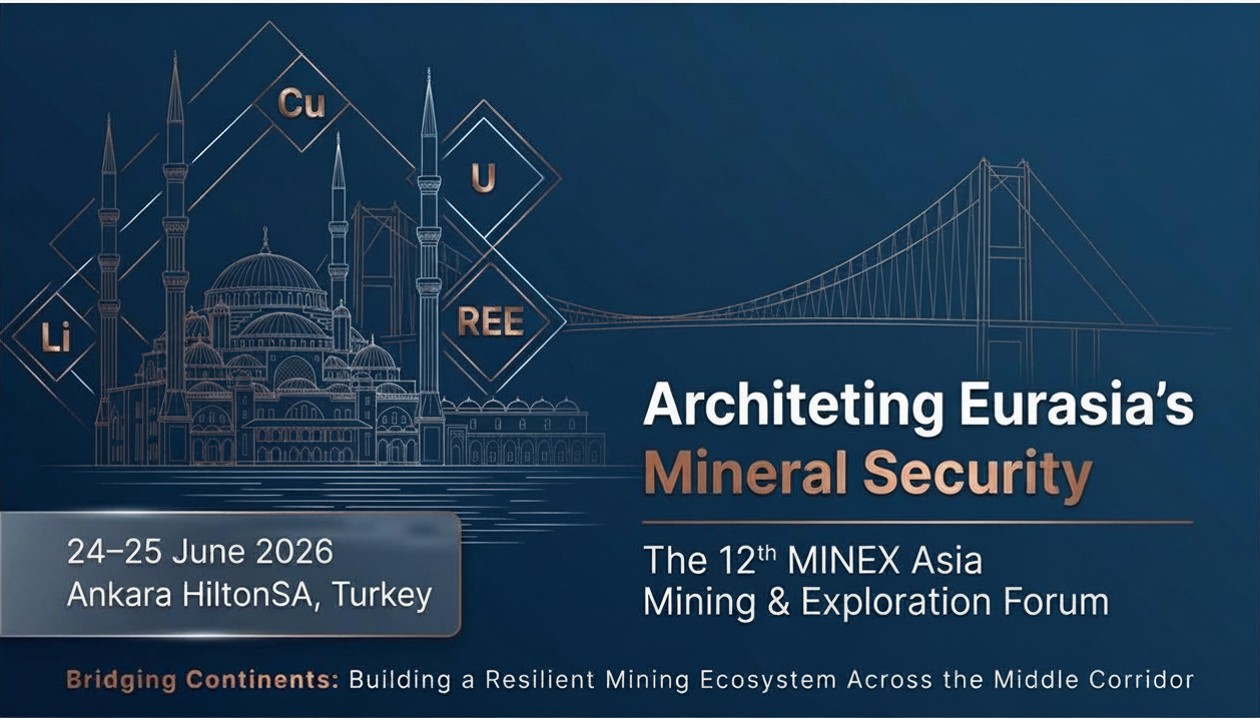
Именно для того, чтобы ответить на эти вопросы, мы проводим двенадцатый Международный горно-геологический форум МАЙНЕКС Азия, который состоится двадцать четвёртого и двадцать пятого июня в отеле HiltonAnkara.
Выбор Турции в качестве места проведения форума не случаен. Форум проводится в номад-формате, перемещаясь из страны в страну и повторяя маршруты Великого Шёлкового Пути. В этом году мы предпринимаем в своём роде уникальную попытку дать глубокую оценку процессов укрепления связей между тюркскими народами и перехода в новое качество объединения богатых минеральными ресурсами странами Центральной Азии с промышленной мощью Турции, а также финансовым капиталом стран Запада и Ближнего Востока.
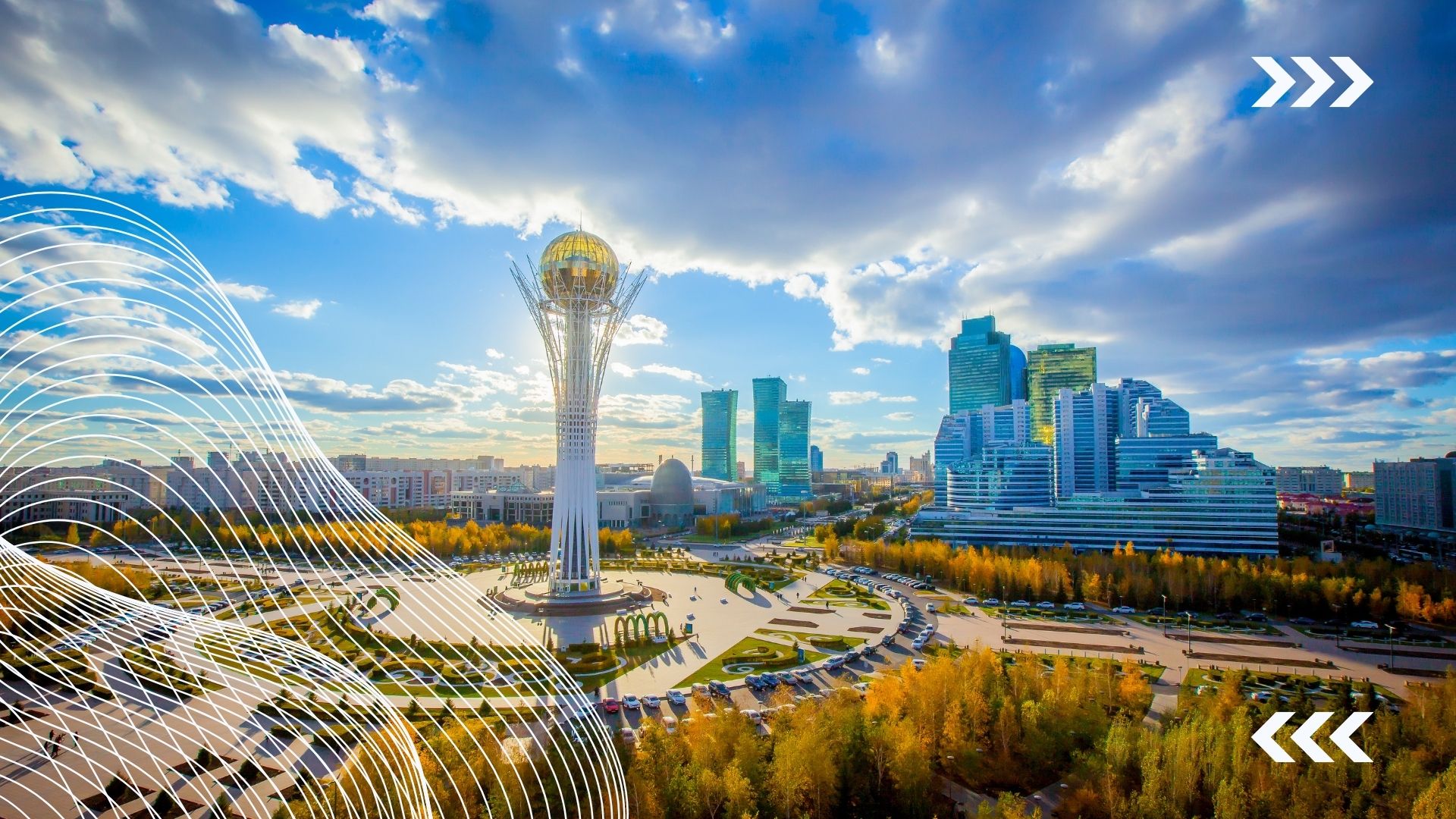
Буквально неделю назад, тринадцатого-четырнадцатого мая, Президент Эрдоган совершил государственный визит в Астану. Было подписано тринадцать соглашений в сферах инвестиций, энергетики и инфраструктуры, включая историческую Декларацию о вечной дружбе и партнерстве. Реализация проектов позволит привлечь свыше 920 миллионов долларов инвестиций и создать более 3 100 рабочих мест в Казахстане.
Президент Токаев особо подчеркнул, что горнодобывающий комплекс является одним из приоритетных направлений взаимодействия. Он отметил богатый опыт турецких компаний и призвал их активнее участвовать в казахстанских проектах. Это не протокольная фраза. Это конкретный политический сигнал. И мы уже видим реальные плоды: компания Miryıldız построит ГОК в Абайской области, Çelikler Holding развивает угольную химию, а Aksa Energy реализует энергетический проект в Кызылорде. На сегодняшний день в Казахстане с участием турецких компаний осуществлено около 100 инвестиционных проектов на 4 миллиарда долларов, и еще 50 проектов на аналогичную сумму находятся в стадии реализации. Общий объем инвестиционного сотрудничества достиг внушительных 8 миллиардов долларов.
Чтобы придать этому еще большее ускорение, Президент Токаев предложил создать совместный фонд для горнодобывающих проектов. Более того, новый Налоговый кодекс Казахстана теперь прямо поощряет глубокую переработку сырья через благоприятный режим роялти.
Активизация взаимодействия с турецким бизнесом происходит практически во всех странах Средней Азии. Недавно в Ташкенте состоялся турецко-узбекский бизнес-форум, на котором были представлены амбициозные планы довести товарооборот до пяти миллиардов долларов. Узбекистан запускает программу развития критических минералов на два с половиной миллиарда долларов. В сентябре прошлого года прошёл кыргызско-турецкий бизнес-форум, задавший новую планку экономического сотрудничества. Кыргызстан определил двадцать два критических минерала для стратегического развития, а турецкие инвестиции в страну уже превышают полтора миллиарда.
Мы наблюдаем системный сдвиг. Тюркские государства переходят от политической риторики братства к прагматическому экономическому партнёрству. И горнодобывающая отрасль находится в самом центре этого процесса.
Теперь о Турции. Это уже давно не просто транзитная страна Среднего коридора. Минерально-сырьевой потенциал Турции оценивается в три с половиной триллиона долларов. Проект Бейликова— одно из крупнейших в мире месторождений редкоземельных элементов. Турция объявила о создании горнорудной биржи в двадцать шестом году и готовит масштабную национальную программу по переработке критически важных металлов. Страна целенаправленно переходит от экспорта сырья к высокотехнологичной переработке — от бора до магнитов из редких земель и батарейных прекурсоров.
Что именно будет обсуждаться на форуме?
Первый день — стратегия и капитал. Мы начнём с горнорудной стратегии Турции и её перехода к модели промышленной автономии. Затем — Средний коридор: как Транскаспийский маршрут может стать не просто логистическим обходом, а интегрированным промышленным поясом, связывающим добычу, переработку и рынки сбыта. Отдельная сессия посвящена острейшему вопросу — кто финансирует будущее горнодобычи в нашем регионе? Китай, Запад, Ближний Восток — каждый играет свою партию, и странам региона необходимо выстроить сбалансированную многовекторную стратегию. Первый день завершится презентациями проектов, реализуемых турецкими компаниями в странах Средней Азии и в Прикаспийском регионе.
Вечером в резиденции посольства Великобритании совместно с Департаментом Бизнеса и Торговли мы проведем фуршет с участием высокопоставленных лиц.
Второй день — технологии и устойчивое развитие. Как Казахстану и странам Центральной Азии вписаться в европейские цепочки поставок с учётом механизма CBAM и требований к цифровым паспортам продукции? Как управлять хвостохранилищами по мировым стандартам? Как искусственный интеллект уже сегодня меняет геологоразведку — от обработки советских архивных данных до беспилотной геофизики?
Кто планирует участвовать в форуме?
Среди ключевых партнёров в организации форума с турецкой стороны принимают участие Высший Горный Совет Союза торговых палат и товарных бирж Турции (TOBB), Ассоциация золотопромышленников и Ассоциация горнопромышленников Турции, на долю которой приходится около 75% всей добычи полезных ископаемых. В форуме также ожидается участие высшего руководства Фонда благосостояния Турции, а также ведущих компаний, таких как Dama Engineering, Argetest, KSE Mining, Kayen Maden, Positive Group Makine Muhendislik, DMT Türkiye, ExxonMobil и многих других.
Теперь — самое важное. Что конкретно даёт этот форум казахстанским компаниям?
Первое. Казахстан производит девятнадцать из тридцати четырёх критических минералов для стран ЕС. Но основная часть по-прежнему уходит на экспорт в необработанном виде. Форум — это площадка, где можно найти партнёра по переработке, и Турция с её промышленной инфраструктурой и логистическим плечом Среднего коридора — естественный кандидат.
Второе. Инвестиции. На форуме предусмотрена специальная сессия, где ваши проекты — медные, золотые, литиевые, редкоземельные — могут быть представлены напрямую инвесторам. Не через посредников, не через переписку, а лицом к лицу с теми, кто принимает решения.
Третье. Корейский институт KIGAM в прошлом году обнаружил месторождение лития в Восточном Казахстане стоимостью почти шестнадцать миллиардов долларов. Комплексный план развития редких и редкоземельных металлов до двадцать восьмого года уже запущен. Но конкурировать с Китаем в переработке сложно — и именно поэтому партнёрство с турецкими компаниями, которые сами строят перерабатывающие мощности, открывает для Казахстана новый маршрут на западные рынки!
И четвёртое. Нетворкинг. Форум — это цифровая система подбора партнёров, двусторонние встречи, неформальный приём в Посольстве Великобритании в Анкаре и гала-ужин. Это те контакты, которые невозможно завязать по электронной почте.
Коллеги, давайте посмотрим на ситуацию широко. Европа ищет альтернативу китайской зависимости в критических минералах. США запустили диалог C5+1 по критическим минералам. Турция строит перерабатывающие хабы. А Казахстан и страны Центральной Азии сидят на ресурсной базе, которую мир буквально разыскивает.
Именно поэтому МАЙНЕКС Азия в Анкаре — это не просто ещё одна конференция. Это место, где ресурсы встречаются с капиталом, а стратегии — с конкретными партнёрами. Регистрация открыта на сайте 2026.minexasia.com.
Приходите не слушать — приходите договариваться. Будем рады видеть вас на форуме двадцать четвёртого и двадцать пятого июня!
China runs five times more mining projects in Central Asia than all European companies combined. But a shift is under way. Türkiye is investing billions, building rare earth processing capacity, and forging a new industrial corridor from the Caspian to the Mediterranean. In this episode, we explore why Ankara is emerging as the pivot point in the global race for critical metals — and what it means for Kazakhstan, Europe, and the West.
Let us begin with a single figure. Seventy per cent. That is the share of Central Asia’s critical mineral output that currently goes to China. Twenty-five active Chinese projects in the region — five times the number of all European projects combined. Meanwhile, Kazakhstan is capable of producing half of the thirty-four materials the European Union classifies as critical: lithium, cobalt, copper, tungsten, rare earth elements. The Senate of Kazakhstan has valued the country’s subsoil potential at forty-six trillion dollars. Let that figure sink in.
The question is — who will become the partner in transforming this wealth from ore into finished products? Who will help build the full value chain, from geological exploration to processing? And who will offer not merely capital, but technology, market access, and industrial expertise?
It is precisely to address these questions that we are holding the twelfth International Mining and Exploration Forum, MINEX Asia, which will take place on the twenty-fourth and twenty-fifth of June at the Hilton Ankara.
The choice of Türkiye as the venue is no coincidence. The forum operates in a nomadic format, moving from country to country and retracing the routes of the Great Silk Road. This year, we are undertaking what is, in many ways, a unique endeavour — to offer an in-depth assessment of the strengthening ties amongst Turkic nations and the transition towards a new quality of partnership, uniting the mineral-rich countries of Central Asia with Türkiye’s industrial might and the financial capital of the West and the Middle East.
Just a week ago, on the thirteenth and fourteenth of May, President Erdoğan paid a state visit to Astana. Thirteen agreements were signed in the fields of investment, energy, and infrastructure, including the historic Declaration on Eternal Friendship and Partnership. The implementation of these projects is expected to attract over 920 million dollars in investment and create more than 3,100 jobs in Kazakhstan.
President Tokayev placed particular emphasis on the mining sector as one of the priority areas of cooperation. He highlighted the considerable experience of Turkish companies and urged them to take a more active role in Kazakh projects. This was not a formulaic diplomatic remark. It was a concrete political signal. And we are already seeing tangible results: Miryıldız is building a mining and processing plant in the Abai region, Çelikler Holding is developing coal chemistry, and Aksa Energy is delivering an energy project in Kyzylorda. To date, approximately one hundred investment projects worth four billion dollars have been carried out in Kazakhstan with Turkish participation, and a further fifty projects of comparable value are currently under way. The total volume of investment cooperation has reached an impressive eight billion dollars.
To lend further momentum to this process, President Tokayev proposed the establishment of a joint fund for mining projects. Moreover, Kazakhstan’s new Tax Code now directly incentivises deep processing of raw materials through a favourable royalty regime.
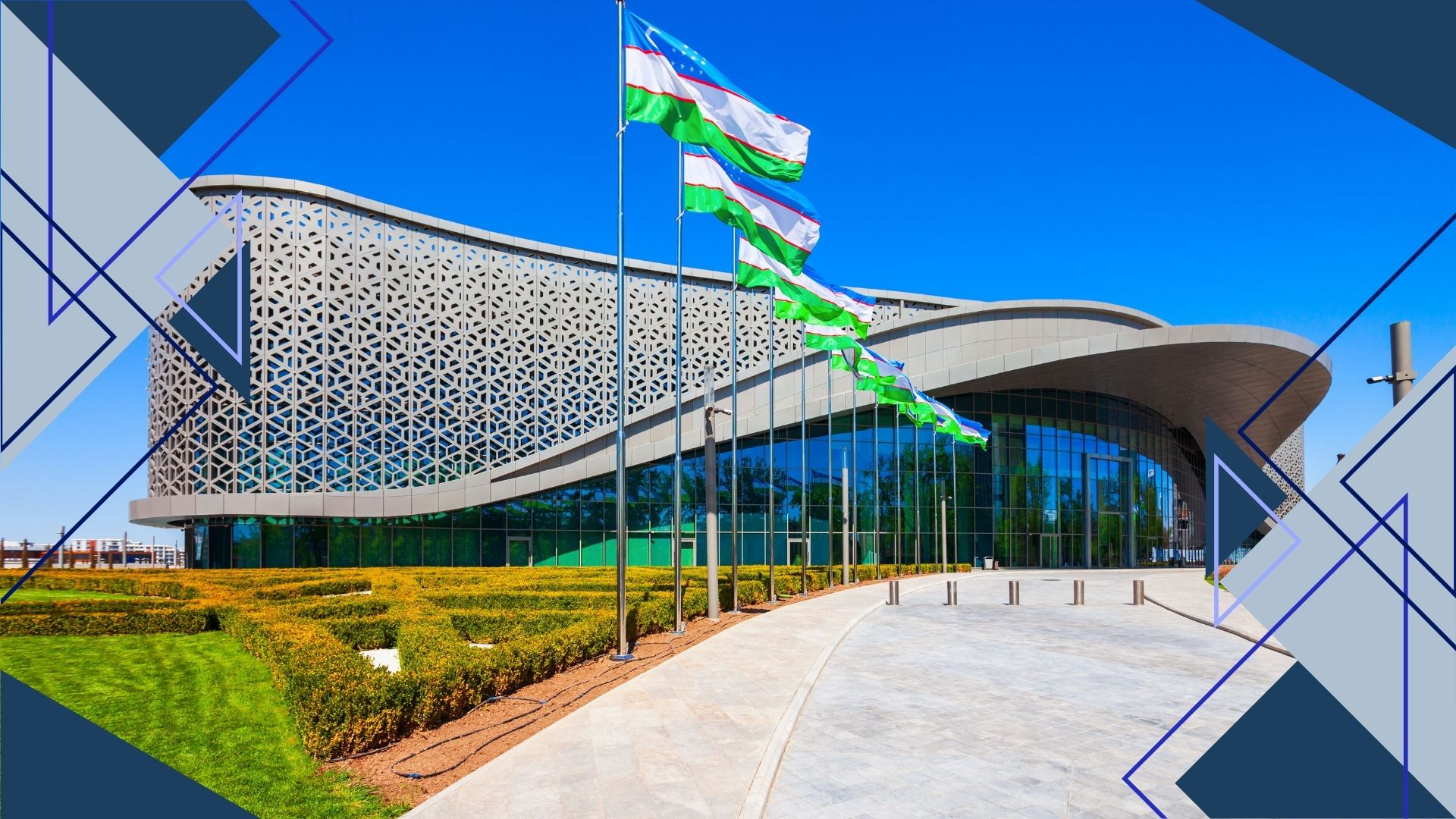
The intensification of engagement with Turkish business is taking place across virtually all Central Asian countries. A Turkish-Uzbek business forum was recently held in Tashkent, where ambitious plans to raise bilateral trade to five billion dollars were presented. Uzbekistan is launching a critical minerals development programme worth two and a half billion dollars. Last September, a Kyrgyz-Turkish business forum set a new benchmark for economic cooperation. Kyrgyzstan has identified twenty-two critical minerals for strategic development, and Turkish investment in the country already exceeds one and a half billion dollars.
We are witnessing a systemic shift. The Turkic states are moving from the political rhetoric of brotherhood towards pragmatic economic partnership. And the mining industry sits at the very heart of this process.
Now, a word on Türkiye. It has long ceased to be merely a transit country along the Middle Corridor. Türkiye’s mineral resource potential is valued at three and a half trillion dollars. The Beylikova project is one of the world’s largest, rare-earth deposits. Türkiye has announced the creation of a mining exchange in 2026 and is preparing a large-scale national programme for the processing of critical metals. The country is purposefully transitioning from raw material exports to high-technology processing — from boron to rare earth magnets and battery precursors.
What precisely will be discussed at the forum?
Day one focuses on strategy and capital. We shall begin with Türkiye’s mining strategy and its shift towards a model of industrial autonomy. Next — the Middle Corridor: how the Trans-Caspian route can become not simply a logistical bypass, but an integrated industrial belt linking extraction, processing, and end markets. A dedicated session will address the most pressing question — who is financing the future of mining in our region? China, the West, the Middle East — each is playing its own hand, and the countries of the region must build a balanced, multi-vector strategy. Day one will conclude with presentations of projects being delivered by Turkish companies in Central Asia and the Caspian region.
In the evening, we shall host a reception at the residence of the British Embassy, in partnership with the Department for Business and Trade, attended by senior dignitaries.
Day two centres on technology and sustainable development. How can Kazakhstan and the countries of Central Asia integrate into European supply chains in light of the CBAM mechanism and digital product passport requirements? How should tailings storage facilities be managed to international standards? How is artificial intelligence already transforming geological exploration — from the processing of Soviet-era archival data to unmanned geophysics?
Who is expected to attend the forum?
Amongst the key organisational partners on the Turkish side are the Supreme Mining Council of the Union of Chambers and Commodity Exchanges of Türkiye (TOBB), the Gold Producers’ Association, and the Turkish Mining Association, which accounts for approximately seventy-five per cent of all mineral extraction in the country. The forum also anticipates the participation of senior officials from the Türkiye Wealth Fund, as well as leading companies such as Dama Engineering, Argetest, KSE Mining, Kayen Maden, Positive Group Makine Muhendislik, DMT Türkiye, ExxonMobil and many others.
Now — the most important point. What specifically does this forum offer Kazakh companies?
Firstly, Central Asian countries, like Kazakhstan, produces nineteen of the thirty-four critical minerals for EU countries. Yet the bulk of output is still exported in unprocessed form. The forum provides a platform to find a processing partner, and Türkiye — with its industrial infrastructure and the logistical reach of the Middle Corridor — is a natural candidate.
Secondly, investment. The forum includes a dedicated session where your projects — copper, gold, lithium, rare earths — can be presented directly to investors. Not through intermediaries, not via correspondence, but face to face with the decision-makers.
Thirdly, the Korean Institute KIGAM last year discovered a lithium deposit in East Kazakhstan valued at nearly sixteen billion dollars. A comprehensive plan for the development of rare and rare earth metals through to 2028 is already under way. However, competing with China in processing is no easy task — and it is precisely for this reason that partnership with Turkish companies, which are themselves building processing capacity, opens a new route for landlocked Central Asian countries to Western markets.
And fourthly, networking. The forum offers a digital matchmaking system, bilateral meetings, an informal reception at the British Embassy in Ankara, and a gala dinner. These are the kinds of networking in-person opportunities simply cannot be forged over email.
Colleagues, let us take a broad view. Europe is seeking an alternative to its dependence on China for critical minerals. The United States has launched the C5+1 dialogue on critical minerals. Türkiye is building processing hubs. And Kazakhstan and the countries of Central Asia are sitting on a resource base that the world is quite literally searching for.
That is precisely why MINEX Asia in Ankara is not just another conference. It is the place where resources meet capital, and strategies meet concrete partners. Registration is open at 2026.minexasia.com.
Come not to listen — come to do business. We look forward to welcoming you to the forum on the twenty-fourth and twenty-fifth of June.
The Astana International Financial Centre has convened a roundtable between representatives of the Astana International Exchange and Hong Kong Stock Exchange to explore practical pathways for Kazakhstani junior mining and fintech companies to access international capital markets — a step the AIFC frames as essential to unlocking investment in the country’s vast but underfinanced early-stage exploration pipeline.
The event brought together exchange leadership, investment banks and exploration companies including Kusto Altyn and Copper, Pallas Resources, KazakhNickel, Atlant Minerals, Altyn Samruk and Qazgeology, alongside members of the AIFC’s Mining Sector Expert Council. The discussion centred on the financing mechanisms and listing requirements of both HKEX and AIX, with particular attention to what Hong Kong can offer companies seeking access to Asian institutional capital.
AIFC chief product officer Zhanbolat Kakishev said junior companies worldwide play a key role in new mineral discoveries but face the greatest financing challenges at early stages. “The launch of Junior Mining Platform was one of AIFC’s steps toward building a financing ecosystem for such projects,” he said, adding that the roundtable was designed to develop practical mechanisms for preparing junior companies for international investment and eventual capital market listings.
A concrete example of the dual listing model was presented to participants: the 2025 simultaneous listing of Jiaxin International Resources Investment Limited — a tungsten producer operating in Almaty Region — on both AIX and HKEX. The offering became the first CNY-denominated IPO in Central Asia and the first Belt and Road segment IPO on AIX. Combined investor demand across global markets exceeded the target volume by more than 220 times, reaching over $34 billion — a figure participants cited as evidence of substantial international appetite for Kazakhstani mining assets.
Johnson Choi of HKEX outlined the key stages of the listing process and highlighted barriers companies typically encounter, including corporate governance standards, disclosure requirements and transparency obligations. Qazgeology CEO Bakyt Chirchikbayev said the platform and roundtable had provided the most comprehensive information his organisation had received on international capital market requirements. “Such initiatives help companies objectively assess their readiness for listing,” he said.
The roundtable also discussed institutional investor interest in rare earth projects from Hong Kong-based funds, the legal mechanics of dual listings, yuan-denominated bond issuance and the role of investment banks in the listing process. The broader context includes growing yuan-denominated capital market activity through AIX: Samruk-Kazyna completed Kazakhstan’s first panda bond placement of three billion yuan on AIX in April 2026, followed by Caspian Solar’s 625 million yuan green bond in May.
The Kazakhstani government has confirmed its support for a major investment project by China’s East Hope Group, with First Deputy Prime Minister Nurlybek Nalibayev meeting the Chinese conglomerate’s director general Chen Lei to advance plans for a full-cycle green aluminium production complex in Kostanai Region.
The project, with a planned investment of approximately $12.6 billion, envisions an environmentally clean aluminium production chain encompassing bauxite mining and processing, an electrolysis plant and a wind power station to supply the operation with renewable electricity. East Hope Group is currently conducting geological exploration across a number of licence blocks in Kostanai and Aktobe regions in preparation for the project’s development phases.
The government’s endorsement follows earlier reports from late March indicating that Chinese investors are planning to construct two alumina plants in Kostanai Region with combined investments exceeding 1.1 trillion tenge. According to the regional administration, the first facility — with annual capacity of one million tonnes of alumina — is expected to begin operations in 2028, followed by a second plant capable of producing up to two million tonnes of alumina per year from 2029.
The scale of the proposed investment would make it one of the largest single foreign direct investment projects in Kazakhstan’s industrial history, and would establish the country as a significant player in global aluminium supply chains by creating fully integrated domestic capacity from raw material extraction through to primary metal production.
Uzbekistan’s Almalyk Mining and Metallurgical Combine has commissioned a new gold processing plant at the Kovuldi deposit, marking the latest expansion of production capacity at one of Central Asia’s largest integrated mining operations.
The Kovuldi gold processing plant was officially opened on 15 May 2026 in a ceremony attended by AMMC management, ministry officials, foreign partners, representatives of the Almalyk city administration, labour veterans and members of the public. A ribbon-cutting ceremony formally marked the launch of the facility.
The plant will process ore extracted from the Kovuldi and Quyi Kenzhasoy deposits, with an annual processing capacity of up to 200,000 tonnes of ore. A second phase of the project is also planned, which will further expand throughput capacity. The commissioning of the facility has created 151 new jobs. Speakers at the opening ceremony said the plant would contribute to strengthening Uzbekistan’s gold reserves through the efficient use of local raw material resources and a systematic increase in gold production volumes.
AMMC is a state-owned enterprise and one of Uzbekistan’s most significant industrial assets, producing copper, gold, silver, zinc and other metals from deposits in the Almalyk district of Tashkent Region.
A regulatory impasse has emerged around Solidcore Resources’ planned acquisition of the Tokhtar gold project in Kazakhstan’s Kostanai Region, after the Ministry of Industry and Construction stated it has received no application to transfer subsoil use rights for the project — even as Solidcore has been publicly waiting for government approval for more than a year.
In a formal response to inbusiness.kz via the eotinish electronic platform, the ministry confirmed it had received no application regarding the acquisition of the Tokhtar, South Tokhtar and Barambai licence areas, and said it therefore had no information on the reasons for the deal’s non-approval or its current status. Solidcore chief executive Vitaly Nesis told the publication in April that the deal had “not been approved by state authorities,” declining to elaborate further. The unresolved status of the transaction was also acknowledged during Solidcore’s 2025 annual results webcast without explanation.
The disconnect is puzzling given standard procedure: applications to transfer subsoil use rights for solid minerals are normally submitted to the relevant sectoral regulator — in this case the Ministry of Industry — raising the question of whether an application was ever formally submitted, and if so where it was directed.
Solidcore announced the intended acquisition more than a year ago. The deal was structured in two phases: a 51% stake to be purchased in the third quarter of 2025 for approximately $25 million, with the remaining 49% to follow based on a resource valuation of the Tokhtar, South Tokhtar and Barambai areas. JORC-compliant mineral resources at Tokhtar and South Tokhtar were estimated at 1.1 million ounces of gold, equivalent to approximately 34.2 tonnes. Aurora Minerals provided geological and legal support for the project.
Ownership records add further complexity to the picture. According to the Ministry of Industry’s solid minerals contract register, the Tokhtar production contract belonged to GRK Tokhtar LLP, while the South Tokhtar-Barambai exploration and production contract was held by Kompleksnaya Geologo-Ekologicheskaya Ekspeditsiya LLP. Both companies were linked to Mukhamedjan Turdakhunov, a long-serving president of the Sokolovskoye-Sarbaiskoye Mining and Processing Association within ERG. Aurora Minerals’ website identifies the seller as KAML Kazakhstan LLP, and public data from adata.kz shows a related entity — KAML Limited, registered in 2024 — with Turdakhunov and ERG board member Eduard Surlevich listed as founders.
China has issued a formal warning to the British government over its plans to nationalise British Steel, urging London to “make decisions prudently” and threatening to take action to protect the interests of Chinese companies if the process moves forward.
Beijing’s commerce ministry said China would “closely follow developments” and take “strong measures to safeguard the legitimate rights of Chinese companies,” after Prime Minister Keir Starmer announced on Monday that Britain could bring British Steel into full public ownership. The Chinese statement called on the UK government to “respect the wishes of firms and market principles, and avoid the abuse of administrative coercive measures.”
The British government seized operational control of British Steel from its Chinese owners, Jingye Group, in April 2025 after the company failed to secure the raw materials needed to keep the Scunthorpe blast furnaces operating. New legislation giving the government the power to bring the steelmaker into public ownership has since been passed. A government spokesperson said the powers would only be used “where the public interest test has been met” and that the administration remained committed to respecting the rights of businesses.
The dispute adds a fresh dimension to an already complex period in UK-China relations, as London attempts to balance economic engagement with Beijing against domestic industrial policy imperatives and growing pressure to protect strategically important manufacturing assets.