Tag: Vulcan Energy Resources

  • From West Australian Gold Dreams to Germany’s Biggest Foreign Mining Investment: The Vulcan Energy Story

    From West Australian Gold Dreams to Germany’s Biggest Foreign Mining Investment: The Vulcan Energy Story

    Francis Wedin arrived in Western Australia 15 years ago as a young English engineer with ambitions in gold mining. Today he is overseeing what has become Australia’s largest investment in European manufacturing — a $3.9 billion lithium project under construction in the Rhine Valley outside Frankfurt that is scheduled to begin production in 2028.

    The pivot from hard rock gold to geothermal lithium extraction in southern Germany began with a magazine article. After reading about lithium’s potential in The Economist more than a decade ago, Wedin became convinced that battery demand for electric vehicles would create a viable development opportunity — particularly for a greener, lower-cost lithium product produced closer to European customers. His first lithium venture in Western Australia had been acquired by Pilbara Minerals in 2017, freeing him to pursue something different.

    The Upper Rhine Valley delivered what he was looking for: hot lithium-bearing brine in natural underground reservoirs with good chemistry, existing infrastructure and wells, cheap geothermal energy, and proximity to European automotive and battery manufacturing. Vulcan’s direct lithium extraction technology pumps brine from underground and captures lithium chloride by attaching lithium salts to an absorbent resin. The resulting lithium chloride is then processed into battery-grade lithium hydroxide and supplied to customers — Vulcan already holds offtake agreements with battery maker LG, cathode producer Umicore, carmaker Stellantis and trader Glencore. The project’s geothermal heat output also supplies cheap green power and heating to local communities, making it a rare mining development that has attracted neighbourhood support.

    The project’s first phase targets 24,000 tonnes of lithium hydroxide per year — enough for approximately 500,000 EV batteries. Wedin deliberately developed the extraction technology in-house. “The technology to do this extraction seemed to mostly come from China, so that was a risk,” he said. “This was really Europe standing up for its own critical raw materials supply chain with Aussie lithium extraction know-how.”

    The financing and equity structure reflects the breadth of institutional confidence in the project. German construction company Hochtief and Siemens are equity investors alongside customer Stellantis, while Gina Rinehart’s Hancock Prospecting holds a 4% stake. The German government made its first-ever equity investment in a critical minerals project through KfW’s fund. Export Finance Australia played a pivotal role in helping Vulcan secure financing from the European Investment Bank, its Canadian equivalent and a range of commercial banks, with the package signed last December.

    Wedin credits Australia’s retail investor base — “mums and dads” — with providing the early-stage capital that allowed Vulcan to develop its technology and prove its concept before institutional investors arrived. He expressed concern that recent federal budget changes to capital gains tax treatment would disadvantage the next generation of junior explorers seeking the same pathway.

  • Vulcan Energy’s Lionheart Project Secures EU Strategic Status Under Critical Raw Materials Act

    Vulcan Energy’s Lionheart Project Secures EU Strategic Status Under Critical Raw Materials Act

    Vulcan Energy (Vulcan, ASX: VUL, FSE: VUL), a leading developer of renewable energy and lithium projects, announced it has been designated a “Strategic Project” under the European Union’s Critical Raw Materials Act (CRMA).

    This prestigious recognition from the European Commission underscores the crucial role Vulcan’s integrated lithium and renewable energy project plays in bolstering Europe’s sustainable energy future. The designation validates Vulcan’s innovative approach to developing a fully domestic and sustainable lithium value chain in Europe.

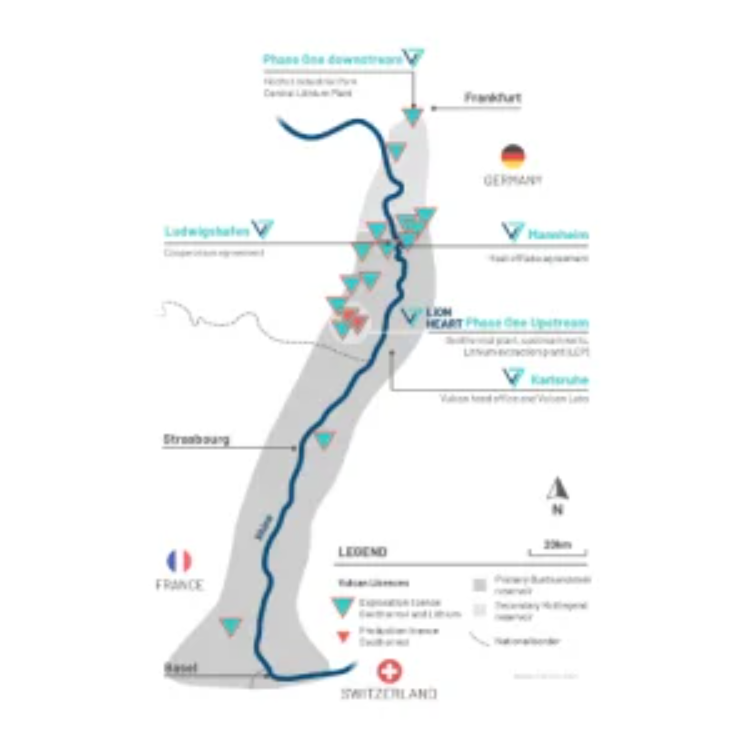
    Vulcan’s 130 km brine-to-battery project, touted as Europe’s most advanced, boasts a unique combination of lithium extraction from geothermal brines and a commitment to 100% renewable energy. This novel approach differentiates Vulcan from conventional lithium mining operations and positions it as a frontrunner in the global transition towards clean energy.

    The Strategic Project status under the CRMA will provide Vulcan with significant advantages, including improved access to funding and investment, streamlined permitting processes, and increased support from the European Commission. This momentum will enable the company to accelerate its expansion plans and solidify its position as a key player in Europe’s lithium supply chain.

    Cris Moreno, Managing Director of Vulcan Energy, expressed pride in the recognition, stating, “This validates the importance of our integrated lithium and renewable energy project to European industry. Our project is strategically positioned to support the CRMA benchmarks and diversify the EU’s lithium supply away from third countries”.

    Vulcan’s project is expected to have a transformative impact on Europe’s automotive industry and broader energy sector, providing a secure and sustainable source of lithium for the production of electric vehicles, batteries, and other critical technologies.

    About Vulcan Energy Resources Ltd

    Vulcan Energy Resources is an Australian and Germany listed company (Vulcan, ASX: VUL, FSE: VUL) is focused on developing a 100% renewable energy powered lithium-brine project in Germany. The company is pioneering a “brine-to-battery” production approach, aiming to establish Europe’s first fully domestic and sustainable lithium value chain.

  • Vulcan Energy Resources Secures €40m for Zero Carbon Lithium Project

    Vulcan Energy Resources Secures €40m for Zero Carbon Lithium Project

    Vulcan Energy Resources has successfully secured a total of €40m ($43m) through a private placement to support the construction work for its phase one integrated Zero Carbon Lithium Project in Germany. Under the terms of the private placement, Vulcan issued ten million shares to CIMIC Group for €25m, five million shares to Hancock Prospecting for €12.5m, and one million shares to Victor Smorgon Group for €2.5m.

    The new shares, priced at €2.50 each, were offered at a 9% discount to Vulcan’s 30-day volume-weighted average price and will rank equally with existing ordinary shares.

    These strategic investments are crucial for funding pre-execution activities during the final stage of project financing and for maintaining the deterministic execution schedule of the project. CIMIC’s €25m investment will establish the company as a substantial shareholder in Vulcan, holding a 6% stake in the outstanding share capital.

  • Vulcan begins commissioning of lithium extraction plant in Germany

    Vulcan begins commissioning of lithium extraction plant in Germany

    ASX-listed Vulcan Energy Resources has started commissioning of its lithium extraction optimisation plant (LEOP) in Landau at Upper Rhine Valley in Germany.

    Considered to be a milestone for Vulcan, the plant will extract, purify and increase the concentration of lithium chloride from brine. This phase is said to be a major step forward for the company and its zero-carbon lithium project.

    The start of the plant will enable the domestic supply independence of lithium, a critical raw material that is used in the production of electric vehicle (EV) batteries.

    Vulcan stated that the commissioning phase will continue until October, which is also when the first brine will be introduced into the plant to begin the lithium extraction process.

    Construction on the project began last year and was designed for optimisation, operational training and product qualification facility to provide commercial readiness by the end of 2025.

    Vulcan CEO Cris Moreno said: “By 2030, Europe is likely to face a significant lithium shortage, which could have serious implications for the European battery and automotive industries if domestic supplies are not realised. Vulcan is gearing up to be the first to produce lithium from Europe, for Europe, but also to be the first company worldwide to produce carbon-neutral lithium.

    “The start of the commissioning of our LEOP facility is a key step toward the implementation of phase one of our Zero Carbon Lithium™ Project, and in enabling a secure and independent European supply chain for lithium.”

    The initial phase of commercial operations at the plant aims to have a production of 24,000tpa of lithium hydroxide production, which will be supplied to off-takers in Europe.

    For lithium extraction from brine, Vulcan will use adsorption-type direct lithium extraction (A-DLE), which is claimed to have been commercially proven.

    The method can be deployed for low operating costs, more time efficiency and reduced carbon footprint compared to legacy industry methods for producing lithium. It will be powered using renewable heat instead of gas.

  • Vulcan fires up European lithium extraction plant

    Vulcan fires up European lithium extraction plant

    Vulcan Energy Resources has fired up its lithium extraction optimisation plant (LEOP) in Germany’s Upper Rhine Valley – a moment the company describes as a “significant milestone”.

    The budding carbon-neutral lithium developer is nudging closer to being the first company in Europe to produce the sought-after lithium hydroxide concentrate – crucial in the manufacturing of lithium-ion batteries – for the European market.

    Management has today revealed it has begun the commissioning phase for its LEOP and it is is expected to run until October, when the first bubbling-hot brine will be introduced into the plant for the lithium extraction process to begin.

    The newly-constructed LEOP is a ramped-up version of Vulcan’s pilot plant that has successfully produced lithium chloride from its producing well sites for the past two and half years.

    To extract lithium from brines, Vulcan is employing the adsorption-type direct lithium extraction (A-DLE) method, which has the added benefits of lower operating costs, greater time efficiency and a lower carbon footprint than legacy industry methods of lithium production.

    In the extraction process, the company will use its proprietary sorbent “VULSORB®”, which it has demonstrated to have a higher performance and lower water consumption for lithium extraction when compared with other commercially-available sorbents.

    From the LEOP, the lithium chloride will be refined to lithium hydroxide at Vulcan’s downstream central lithium electrolyser optimisation plant (CLEOP) in Frankfurt- Höchst and packaged up for further testing by notable offtake partners including Stellantis, Volkswagen, Renault, Umicore and LG Energy Solution.

    The commencement of the commissioning of our LEOP facility represents a significant milestone for us, as well as the entire European battery industry. By 2030, Europe is likely to face a significant lithium shortage, which could have serious implications for the European battery and automotive industries if domestic supplies are not realised. Vulcan is gearing up to be the first to produce lithium from Europe, for Europe, but also to be the first company worldwide to produce carbon-neutral lithium. The start of the commissioning of our LEOP facility is a key step toward the implementation of Phase One of our Zero Carbon Lithium Project, and in enabling a secure and independent European supply chain for lithium.

    Vulcan Energy Resources managing director and chief executive officer Cris Moreno

    With the company’s sights set firmly on a 2025 production target, it is also stepping up to help solve Europe’s looming lithium supply shortfall, with production forecast to supply up to 24,000 tonnes per annum of lithium hydroxide monohydrate.

    Located in the Upper Rhine Valley that extends across France, Germany and Switzerland, Vulcan has its foot on a 300km “graben” system that contains a sedimentary-hosted geothermal lithium reservoir that hosts 26.6 million tonnes of lithium carbonate equivalent – the biggest lithium resource in the European Union.

    Pioneering a carbon-free future, the company lays claim to the world’s first integrated renewable energy lithium extraction and lithium hydroxide project with net-zero greenhouse gas emissions, with the co-production of renewable geothermal energy on a mass scale.

    As Europe sweats through one of its hottest summers on record, discussions around climate change continue to be front and centre as the subcontinent steers towards its lofty 2050 carbon-neutral goals. With the transition to a global electric mobile fleet in full swing, Vulcan is neatly positioned to meet the unprecedented demand for the critical battery metal with its net-carbon neutral lithium.