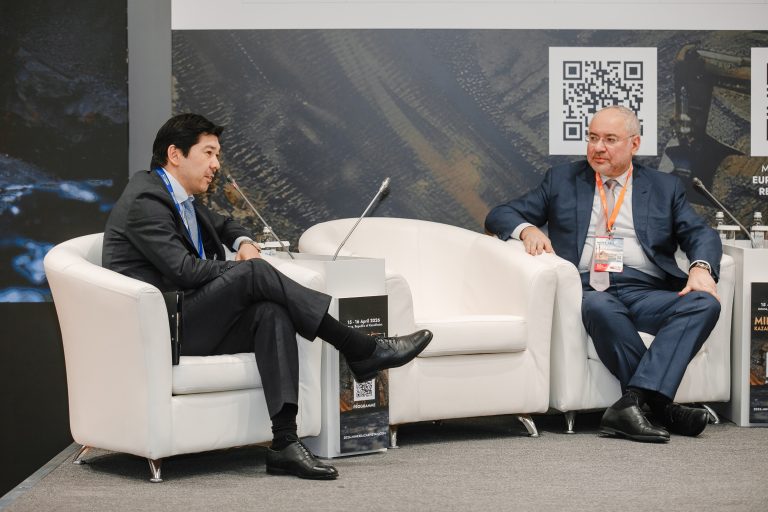
Tag: Vitaly Nesis

  • Solidcore CEO Warns Gold Prices Near Peak as Company Plans Oman Expansion, Bakyrchik Underground Transition and Pavlodar Hydromet Launch

    Solidcore CEO Warns Gold Prices Near Peak as Company Plans Oman Expansion, Bakyrchik Underground Transition and Pavlodar Hydromet Launch

    Solidcore Resources chief executive Vitaly Nesis is maintaining a deliberately conservative stance on gold prices at a moment when most market participants are optimistic, telling Forbes Kazakhstan he expects a significant price decline within three years and budgeting accordingly — while simultaneously planning the most ambitious expansion programme in the company’s history.

    “I personally expect a meaningful price decline on a three-year horizon,” Nesis said. “As a company, we are budgeting this year at $4,000 per ounce and conducting long-term mine planning at $3,000. This reflects our corporate views. We are optimists, but we consider the current level excessive.”

    Against that cautious macro backdrop, Solidcore has set three strategic priorities: vertical integration through the launch of the Ertis Hydrometallurgical Plant in Pavlodar, geographic diversification beyond Kazakhstan, and growth of the mineral resource base. The Pavlodar plant is the most critical near-term project, as it addresses what Nesis describes as the company’s fundamental structural defect — dependence on a tolling contract with a Russian enterprise for processing concentrate. Solidcore is gradually reducing this exposure through China and Kazakhmys, but Nesis said the risk will only be eliminated once EGMK is commissioned. “This is a fundamental defect in the current commercial structure. We live with it, but it is finite.”

    On geographic diversification, Nesis identified Oman as the priority market, with Tajikistan and Uzbekistan also under active evaluation. He said the company plans to complete at least one asset acquisition outside Kazakhstan in 2026. Solidcore is 29.7% owned by Omani company Maaden International Investment, making the Middle East connection structurally logical.

    At Bakyrchik — the company’s flagship asset and one of Kazakhstan’s largest gold deposits — underground mine development is the next major transition. Design work is completing this year, with underground development beginning in 2026. Nesis acknowledged that high capital expenditure during underground construction may cause production to dip temporarily in 2028, but the company is targeting significantly higher output by 2035 as the new mine reaches full capacity. The company also has more than 20 exploration projects and 30 kilometres of drilling planned for 2026, with the objective of replacing depleted reserves tonne-for-tonne with new resource additions. In Kazakhstan, the company is also exploring acquisition of additional assets including an increased stake in the Beshoku project, building on last year’s acquisition of a tin stake at Syrymbet.

    On technology, Nesis claimed industry leadership in digitalisation, singling out Bakyrchik’s fleet management system as a fully algorithmised AI solution that dispatches trucks and excavators without human involvement. “This is not visualisation or an advisor. This is artificial intelligence that gives instructions to people. The results are very impressive both in productivity gains and cost reduction.” The system is planned for rollout across new company assets. Processing plants use machine vision and optimisation software for mill loading and flotation management.

    Despite Solidcore shares being the most liquid on the Astana International Exchange, Nesis said he remains unsatisfied with market liquidity and considers the exchange’s potential unrealised. He also addressed the legacy issue of shares blocked in Euroclear following EU sanctions on Russia’s National Settlement Depository in 2022, noting that the company’s subsequent delisting from Moscow and multi-stage AIX share exchange successfully migrated more than 90% of affected shares, though some shareholders were unable to participate due to their own sanctions constraints.

  • Solidcore Resources Confirms 2028 Completion of Kazakhstan’s First Full-Cycle Gold Processing Plant as Payback Period Shrinks to Seven Years

    Solidcore Resources Confirms 2028 Completion of Kazakhstan’s First Full-Cycle Gold Processing Plant as Payback Period Shrinks to Seven Years

    Solidcore Resources has confirmed that construction of Kazakhstan’s first full-cycle gold concentrate processing facility — the Ertis Hydrometallurgical Plant near Pavlodar — remains on track for completion in the fourth quarter of 2028, with the project’s payback period now estimated at seven to eight years as elevated gold prices dramatically improve the economics of the $978 million investment.

    Speaking at the MINEX Kazakhstan 2026 forum in Astana, Solidcore Resources chief executive Vitaly Nesis said construction was proceeding at full pace and that the company was close to signing legally binding financing documentation with the European Bank for Reconstruction and Development. When the project was originally approved by the board, payback was calculated at 12 years based on a gold price of $2,800 per ounce. “At current price levels, taking into account tax increases and tenge strengthening, payback will be around seven to eight years,” Nesis said.

    The Ertis plant, with a 30-year project lifespan, will be capable of processing up to 300,000 tonnes of gold-bearing concentrate annually and producing up to 500,000 ounces of gold in doré form per year, with a permanent workforce of up to 500 employees. It will be the first facility of its kind in Kazakhstan, marking a significant step in the country’s push to process its mineral wealth domestically rather than export raw concentrates.

    Nesis also commented on a wave of recent consolidation in Kazakhstan’s gold sector. In October 2025, Chinese group Zijin Mining acquired RG Gold — owner of the Raygorodok deposit in Akmola Region — from Bulat Utemuratov for $1 billion. More recently, in late March 2026, entrepreneur Shakhmurat Mutalip, owner of construction company Integra Construction KZ, was reported to have agreed to acquire 100% of Altynalmas, one of Kazakhstan’s three largest gold producers. Nesis said such activity should be welcomed, expressing hope that the deals would lead to more Kazakhstani mining companies listing on the Astana International Exchange.

    On Solidcore’s own acquisition plans, Nesis noted that a deal to acquire the Tokhtar gold deposit in northern Kazakhstan has not yet been approved by state authorities and declined to comment further. He did confirm, however, that the company had established subsidiaries in Oman and Tajikistan over the past six months in the hope of securing deals in those markets.

    Solidcore Resources, listed on the Astana International Exchange, operates the Bakyrchik deposit in Abai Region and the Varvarinskoye and Komarovskoye deposits in Kostanai Region. In 2024 the company acquired a 55% stake in the rare earth and polymetallic Syrymbет deposit in North Kazakhstan Region for $82.5 million, where subsidiary Tin One Mining plans to commission a mining and processing plant in 2028 at an investment cost of $227.8 million. The company is also reported to be borrowing $100 million in Germany toward EGMK construction and plans to liquidate its gold inventory in the first half of 2026.

  • Solidcore Resources Reports Q1 2025 Production Results, Reaffirms Full-Year Outlook

    Solidcore Resources Reports Q1 2025 Production Results, Reaffirms Full-Year Outlook

    Solidcore Resources plc (“Solidcore” or the “Company”) announced its production results for the first quarter ended 31 March 2025. Despite facing temporary shipment delays that impacted sales, the Company reaffirmed its full-year production and cost guidance, citing confidence in a strong recovery during the second half of the year.

    Chief Executive Officer Vitaly Nesis commented, “While sales have been deferred due to shipment delays, the fundamentals of our business remain solid. We expect a meaningful recovery beginning in May as concentrate stockpiles start to unwind.”

    Operational Highlights:

    • Solidcore recorded no fatalities or lost time injuries among its employees and contractors during the quarter.

    • Gold equivalent (GE) production totaled 68 thousand ounces (Koz), a 42% decrease year-on-year, largely due to delays in concentrate shipments from the Kyzyl mine to Amursk POX, impacted by operational challenges linked to international sanctions.

    • Kyzyl’s production of gold in concentrate rose 6% to 97 Koz due to higher ore grades, though shipment delays led to a stockpile of 41 Koz of payable metal.

    • At Varvara, production fell 10% year-on-year as planned, reflecting lower grades and reduced third-party processing.

    • Sales were notably down to 38 GE Koz from 116 GE Koz a year earlier, resulting in revenue of US$ 109 million, a 63% decline year-on-year. A strong rebound is anticipated in the second half as operations normalize.

    Strategic Developments:

    • Solidcore announced the acquisition of the Tokhtar gold property, located near its Varvara hub. The property adds 1.1 million ounces of JORC-compliant Mineral Resources at an average head grade of 2.4 g/t, bolstering the Company’s long-term growth pipeline.

    • The acquisition of the initial 51% interest is on track to complete in Q3 2025, pending regulatory approvals.

    Outlook: The Company reiterated its full-year guidance of 470 GE Koz in production, with Total Cash Costs (TCC) and All-In Sustaining Costs (AISC) expected within the ranges of US$ 1,000–1,100/oz and US$ 1,350–1,450/oz, respectively.

    Solidcore remains well-positioned to navigate near-term operational hurdles and capitalize on favorable gold market dynamics.

  • The head of Polymetal commented on ArcelorMittal’s departure from Kazakhstan

    The head of Polymetal commented on ArcelorMittal’s departure from Kazakhstan

    Gold mining company Polymetal has made a firm commitment to sell its Russian assets, which are subject to U.S. sanctions, no later than the first quarter of next year. The CEO of the company, Vitaly Nesis, informed investors about this during a conference call on the production results for the third quarter last week.

    “When we relocated to Kazakhstan in August, we signed an official commitment stating that the company will sell its sanctioned Russian subsidiary, which is listed on the Specially Designated Nationals and Blocked Persons List, within nine months. This document serves as a preliminary condition for changing jurisdiction. While we cannot be excluded from the Moscow Exchange, we believe that this commitment represents a contractual obligation for us. Violating this obligation would have serious consequences for the company,” said Nesis.

    In September, Nesis predicted that the Russian division of Polymetal International would be sold within the next 6-9 months.

    Nesis also highlighted that if the deal is not completed within the required timeframe, there may be significant consequences.

    “If we fail to meet the deadline, we will lose a substantial amount of political capital in Kazakhstan. Political capital is crucial in the mining sector. I don’t want to draw any inappropriate parallels, but it’s worth considering what happened to ArcelorMittal in Kazakhstan after multiple security failures. While we hope to avoid such a scenario, it is evident that managing potential problems arising from the loss of political reputation is of utmost importance,” he noted in response to a question about the potential issues that may arise if the company’s Russian assets are not sold within the promised period.

    According to Nesis, obtaining official approval from Russian authorities for the planned deal is unlikely to be necessary. However, repatriating the proceeds from the sale to Kazakhstan may face challenges due to currency restrictions imposed in Russia. This is particularly relevant as some of the current shareholders of Polymetal, who may benefit from the sale through dividends, are residents of countries considered unfriendly by the Russian government. The decision on dividend payments for this year will depend on the progress of the sale of Russian assets. If the deal with the Russian subsidiary cannot be completed, the company may consider the previously discussed option of establishing a separate entity in Kazakhstan, although this could have tax implications.

    One of the conditions for finalizing the deal, as discussed with potential buyers, is Polymetal’s requirement for strong assurances that toll processing of low-carbon concentrate from the Bakyrchik deposit in Kazakhstan at the Amursk hydrometallurgical plant will continue. The matter of preserving these supplies from the Kazakh mine is still under discussion with the Office for Foreign Assets Control (OFAC) of the U.S. Treasury’s Foreign Assets Control.

  • Gold miner may revive London listing after Russian asset sale

    Gold miner may revive London listing after Russian asset sale

    Polymetal International’s CEO, Vitaly Nesis, has expressed the possibility of reviving the company’s London listing once its sanctioned Russian unit has been sold. Polymetal, a gold miner that derives approximately 70% of its sales from Russia and the remaining from Kazakhstan, recently re-domiciled from Jersey to Astana as a preliminary step towards spinning off its Russian business in compliance with Moscow’s restrictions. This move, however, made it impossible to maintain its London listing. Nevertheless, the Russian unit was put up for sale after being included in a US sanctions list in May. Once the sale is finalized, Polymetal will reconsider listing alternatives.

    Nesis revealed that there has been significant interest in the Russian business from over ten potential buyers, including investors from China who are willing to take on sanctions risks. At present, the two parts of the company operate as separate entities, with independent funding and management decisions. Nesis, as the CEO, receives periodic reports on the activities of the Russian unit. While sales in Russia were temporarily halted due to sanctions, they have now resumed.

    Due to restrictions on developing Russian assets, Polymetal is exploring alternative options. Nesis mentioned that they are evaluating opportunities in Uzbekistan and Kyrgyzstan, considering potential acquisitions in those regions.

    Regarding the company’s future listing, Nesis stated that once the Russian assets are divested, they may consider a London listing over Dubai or Abu Dhabi. This decision reflects their strategic considerations and aligns with their future plans.