Tag: Uzbekistan

  • Uzbekistan and Germany Strengthen Cooperation on Critical Mineral Resources and Industrial Projects

    Uzbekistan and Germany Strengthen Cooperation on Critical Mineral Resources and Industrial Projects

    Uzbekistan and Germany have engaged in discussions to enhance collaboration on the development and deep processing of critical mineral resources, as well as the production and export of high value-added goods. This was a key topic during a meeting between Uzbek President Shavkat Mirziyoyev and German Chancellor Olaf Scholz, held in Samarkand with representatives from leading companies and banks from both nations.

    The discussions involved prominent figures such as Michael Kellner, Germany’s Parliamentary State Secretary for Economic Affairs and Climate Action, and Michael Harms, Managing Director of the Eastern Committee of German Industry. Major German companies like KNAUF, Siemens Energy, Linde Group, and Aurubis participated, along with financial institutions such as KfW Development Bank and AKA Bank.

    The meeting highlighted the successful outcomes of high-level negotiations, supporting Uzbekistan’s strategic priorities for economic transformation and sector modernization. Both sides agreed on measures to accelerate joint investment projects and trade agreements under a new Program for Industrial and Technological Partnership. Key sectors identified for collaboration include green energy, chemical industry, green hydrogen, machine engineering, textile industry, and pharmaceuticals.

    President Mirziyoyev and Chancellor Scholz emphasized the importance of continuing joint projects in sectors such as construction materials, metallurgy, energy, transportation infrastructure, and agriculture. Scholz’s official visit to Uzbekistan took place on September 15-16, further strengthening bilateral ties.

  • Navoi Mining and Metallurgical Combine Implements Bacterial Leaching Technology to Extract More Uranium

    Navoi Mining and Metallurgical Combine Implements Bacterial Leaching Technology to Extract More Uranium

    The Navoi Mining and Metallurgical Combine (NMMC), in collaboration with scientists, is introducing a new technology to extract additional uranium from previously depleted underground leaching blocks using bacterial solutions. This development was announced by Shavkat Madaminov, the head of NMMC’s Production, Technical, and Innovation Department.

    The combine has a long history of successful scientific research and industrial projects, particularly in the development and application of new technologies to increase uranium production. Madaminov emphasized that the new bacterial leaching technology, developed in partnership with scientists from the Institute of Microbiology of the Academy of Sciences of Uzbekistan, will enhance the extraction coefficient and uranium content in previously exploited wells. This advancement is expected to increase production, extend the lifespan of productive wells and blocks, and reduce the overall cost of production.

    Madaminov further explained that the technology could lead to the extraction of uranium from blocks that were previously 70% depleted, potentially increasing uranium yield by 2.4 times. He also highlighted the growing number of research and innovation projects at NMMC. In 2009, the combine implemented 55 projects worth 4.5 billion sums, while by the end of 2010, more than 90 projects were completed, totaling around 9 billion sums, doubling the achievements of the previous year.

    The key areas of focus include open-pit and underground mining, technology, geotechnology, and engineering. The economic impact of these innovations has, on average, exceeded the cost of the projects by twofold.

  • Uzbekistan Launches Joint Venture with Chinese Company for Mining Machinery Parts Production

    Uzbekistan Launches Joint Venture with Chinese Company for Mining Machinery Parts Production

    Today, on the eve of the Day of Mining and Metallurgical Industry Workers of the Republic of Uzbekistan, a ceremonial event was held in the Akhangaran district to mark the commencement of the joint venture LLC “HG-AMMC.” This venture is being implemented in collaboration with China’s “Huigong (Hebei) Machinery Group Co., Ltd.”

    The event saw the participation of the leadership of the Almalyk Mining and Metallurgical Combine, the president and specialists of Huigong (Hebei) Machinery Group, and various public representatives. It was noted that this enterprise is the result of agreements made during President Shavkat Mirziyoyev’s official visit to China in January of this year.

    The joint venture will undertake the project “Production of Spare Parts for Mining Machines.” This project is valued at $23 million, with an annual production capacity expected to reach $37.5 million. The partner company will produce over 282 types of spare parts for mining machinery. Additionally, an experimental project to convert oil into electricity will be implemented to reduce operational costs of mining equipment and promote green energy at the joint venture.

    The products manufactured will primarily meet local market needs and eventually be exported. The construction of the joint venture is expected to create 150 new jobs. The implementation of this project will significantly contribute to the industrial success of Uzbekistan and support economic growth.

    The event concluded with a symbolic ribbon-cutting ceremony, marking the beginning of construction.

  • Uzbekistan Aims to Tap into Mining Potential, President Urges Action

    Uzbekistan Aims to Tap into Mining Potential, President Urges Action

    Main Body: The domestic geological sector receives an annual allocation of one trillion sums, with last year’s implementation of targeted programs pushing the production volume in the mining industry to nearly $11 billion. However, the bulk of this output is directed towards precious and non-ferrous metals, despite a vast untapped potential for minerals crucial to industry. Thirty-two such valuable minerals have been identified in the country. In response, during a presentation on January 15th, the head of state issued directives to harness opportunities in this sphere. Measures, plans, and proposals were discussed at today’s meeting. With technological advancements driving global developments, there’s a growing demand for rare earth metals in industries like electric vehicles, green energy, and electronics. Consequently, prices for molybdenum, tellurium, selenium, and graphite have surged in recent years. The President emphasized the significant prospects emerging and underscored the need to expand exploration of existing and new deposits of critical raw materials. Currently, six types of such materials are extracted in the country, with the potential to derive high-value-added products from platinum group metals, indium, vanadium, as well as minerals containing tungsten, molybdenum, rhenium, zinc, and manganese. For instance, the production of previously non-existent powder metallurgy products worth $300 million annually and equipment and components worth $100 million annually could be organized. A critical raw material agreement with the European Union has recently been reached, opening access to this vast market. In light of this, officials have been tasked with formulating, with the involvement of foreign experts and investors, a program of promising projects worth $500 million for rare earth metals. Emphasis is placed on developing this direction with a scientific approach, establishing a project office for this purpose, and engaging leading institutions and research centers. The meeting also addressed increasing the production of precious metals at the Navoi Mining and Metallurgical Combine. Responsible officials reported on opportunities for further increasing both reserves and gold production volumes. The President instructed to reduce production costs at the combine by 10-15%, expand industrial cooperation and localization. A directive was issued to establish a Scientific Center for Advanced Technologies in Precious Metals.

  • Uzbekistan’s Ambitious Rare Earth Investment Plans

    Uzbekistan’s Ambitious Rare Earth Investment Plans

    Uzbekistan is set to make a bold move into the rare earth market with plans to invest $500 million in rare earth projects, aiming to position itself as a major producer in Central Asia. President Shavkat Mirziyoyev unveiled this ambitious endeavor, emphasizing the country’s commitment to developing existing deposits and exploring new ones.

    The mining industry in Uzbekistan has already demonstrated significant economic potential, reaching a production volume of nearly $11 billion last year, primarily driven by precious and non-ferrous metals. However, the focus now shifts towards tapping into the untapped potential of critical minerals, including rare earths. A 2018 study by the U.S. Geological Survey identified 87 deposits of rare earths and rare metals within the country, laying the foundation for Uzbekistan’s strategic investment in this sector.

    The European Union emerges as a potential key market for Uzbekistan’s rare earth exports, aiming to reduce its reliance on rare earth imports from China. Just over a month ago, Uzbekistan signed a memorandum of understanding with the EU on critical raw materials, signaling a promising avenue for future collaboration and trade partnerships.

    Meanwhile, neighboring Kazakhstan, linked to the EU through its own raw materials agreement, has also announced a significant expansion of its rare earth industry. With 15 deposits of rare earth metals and 160 rare earth element-bearing mineral occurrences, Kazakhstan presents formidable competition in the regional rare earth market.

  • President Shavkat Mirziyoyev Addresses Priorities in Geological and Mining Industries

    President Shavkat Mirziyoyev Addresses Priorities in Geological and Mining Industries

    President Shavkat Mirziyoyev convened a meeting on April 29 to discuss objectives within the realm of geology and the mining-metallurgical industry in Uzbekistan. The domestic geological sector receives an annual allocation of one trillion sum, with last year’s production volume in the mining industry reaching nearly $11 billion through the implementation of targeted programs, as outlined in a recent report. However, the majority of this volume pertains to precious and non-ferrous metals, indicating significant untapped potential in critical industrial minerals. Notably, the country has identified 32 such valuable minerals. Given this context, directives were issued during a presentation on January 15 to harness opportunities in this sphere. Measures, plans, and proposals were deliberated during the recent meeting. Global technological advancements have led to increasing demand for rare-earth metals in electric vehicle, green energy, and electrical industries, consequently driving up prices for molybdenum, tellurium, selenium, and graphite on the global market in recent years. President Mirziyoyev emphasized the burgeoning opportunities, stressing the need to expand exploitation of existing and exploration of new critical resource deposits. Currently, Uzbekistan extracts six types of such resources. However, there is potential to derive high-value-added products from platinum, indium, vanadium, as well as minerals containing tungsten, molybdenum, rhenium, zinc, and manganese. Efforts could lead to the establishment of previously non-existent powder metallurgy production worth $300 million annually and equipment and components sector worth $100 million annually. A recent agreement with the European Union on critical resources opens broad access to this significant market. Given these developments, officials have been tasked with formulating a program for prospective projects amounting to $500 million in rare-earth metals, involving foreign experts and investors. Emphasis was placed on developing this sector with a scientific approach, establishing a project office for this purpose, and engaging leading institutes and scientific centers. Additionally, discussions at the meeting encompassed strategies to increase precious metal extraction at the Navoi Mining and Metallurgical Combine. Officials presented opportunities for further increasing both reserves and gold production volumes. President Mirziyoyev instructed to reduce production costs at the combine by 10-15%, expand industrial cooperation and localization, and establish a Scientific Center for Advanced Technologies in Precious Metals.

  • President of Uzbekistan Reviews Copper Mining and Processing Project in Collaboration with China

    President of Uzbekistan Reviews Copper Mining and Processing Project in Collaboration with China

    President Shavkat Mirziyoyev of Uzbekistan visited the site of a copper mining and processing project in cooperation with China, located in the Chust district of the Namangan region, on March 25. Geologic exploration is expected to commence as early as April. A representative of the company, Li Fang Yuan, stated that China Mining Energy Group, established in 2003 with assets totaling $32 billion and a workforce of 40,000 across 17 countries, engages in gold, copper, and aluminum mining.

  • Uzbekistan Mulls Collaboration with China Nuclear Uranium for Black Shale Uranium Mining

    Uzbekistan Mulls Collaboration with China Nuclear Uranium for Black Shale Uranium Mining

    In a bid to bolster its uranium mining capabilities, Uzbekistan is considering a partnership with China Nuclear Uranium Co. Ltd for the development of black shale uranium mines, according to reports from Trend. Discussions between representatives of China Nuclear Uranium and Jamal Fayzullaev, the director general of Navoiyuran State Enterprise, have centered around the potential production of black shale uranium at the Jantuar and Ma’danli deposits situated in the Navoi region.

    Geological surveys have been conducted at key sites, including the Ma’danli and Koscheka fields within the Auminzatau Mountains. Sampling and analysis activities at the Ma’danli field have provided insights into the feasibility of extracting uranium and other rare elements from the ore composition, laying the groundwork for potential development in the area.

    This prospective collaboration follows a memorandum of understanding signed in November 2023 between Navoiyuran and China National Nuclear Corporation, outlining mutual cooperation in uranium mining and processing endeavors in Uzbekistan. As part of this agreement, discussions have revolved around various investment initiatives within the uranium sector, signaling a growing partnership between the two entities.

    Jamal Fayzullaev, highlighting future plans, disclosed Navoiyuran’s ambitions to ramp up uranium production by 1.5 times while simultaneously reducing production costs by 20.1 percent. The enterprise aims to intensify geological prospecting activities, covering over 1 million meters of exploration area, alongside extensive drilling operations spanning 3.8 million meters for uranium production purposes in 2024.

  • Uzbekistan Explores Collaboration with China for Black Shale Uranium Mining

    Uzbekistan Explores Collaboration with China for Black Shale Uranium Mining

    Uzbekistan is considering collaboration with China Nuclear Uranium Co., as reported by Navoiyuran’s press service, to develop black shale uranium mines. Rustam Ergashev, head of the investment projects department at Navoiyuran, underscores the increasing significance of atomic energy, which currently fulfills 11% of global electricity demand.

    “This figure reaches 70% in France, 50% in Hungary, and 20% in the USA,” notes Ergashev. Nations like China, India, and countries across the Middle East, Africa, and South America are expanding their nuclear power programs in response to this trend.

    For Navoiyuran, a company focused solely on exports, this presents new opportunities for collaboration in the nuclear raw materials market. The visit of a delegation from China Nuclear Uranium Co. (CNUC), a subsidiary of the China National Nuclear Corporation (CNNC), signals a significant step toward enhancing collaboration in this field.

    “China Nuclear Uranium Co. is a prominent player in China’s nuclear energy sector, involved in uranium exploration, mining, and processing,” explains Ergashev. The company operates uranium mines domestically and engages in joint ventures in countries like Namibia and Kazakhstan.

    During the visit led by Yang Runsheng, the company’s chief engineer, experts from China Nuclear Uranium Co. explored black shale uranium mining fields in Uzbekistan, visiting the “Ma’danli” and “Koscheka” fields to study mining operations and technological samples for uranium and rare element extraction from ore compositions.

    The meeting between Chinese experts and Navoiyuran’s General Director, J. Fayzullaev, focused on developing technologies for black shale uranium mining and exploring prospects for future cooperation. Collaboration between Uzbekistan and China holds promise for advancing the nuclear energy sector in both countries.

    In July 2023, President Shavkat Mirziyoyev endorsed initiatives to boost uranium mining and processing in Uzbekistan, aiming to double production by 2030. In November 2023, Navoiyuran entered a strategic cooperation memorandum with China National Nuclear Corporation (CNNC) in the uranium sector.

    Since 2016, Uzbekistan has consistently held the position of the fifth-largest uranium producer worldwide, with uranium reserves exceeding 100,000 tons. The Navoi Mining and Metallurgical Combine (NMMC), Uzbekistan’s primary uranium mining company, predominantly exports uranium products, constituting 99.5% of its export portfolio.

    French President Macron’s visit to Uzbekistan in November 2023 signals France’s strategic interest in Central Asia and Europe, aiming to diversify energy sources and reduce dependence on China for critical minerals.

  • Navoi Gold: The Unsung Giant in the World of Gold Mining

    Navoi Gold: The Unsung Giant in the World of Gold Mining

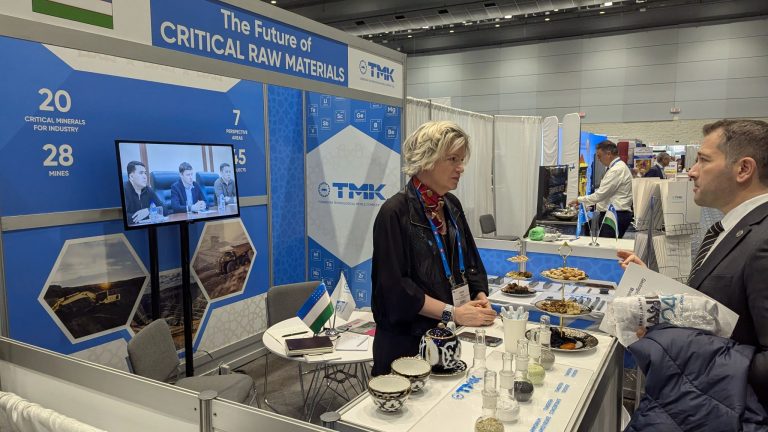
    Toronto, 4 March 2024 — In an exclusive interview at the Prospectors & Developers Association of Canada (PDAC), MINEX Forum sat down with Evgeny Antonov, Chief Transformation Officer of Navoi Gold (Navoi Mining and Metallurgical Company) to learn about the company’s remarkable journey and its pivotal role in shaping Uzbekistan’s economy.

    Toronto, Canada – Navoi Gold, one of the largest gold producers globally, was showcasing its growth potential at the Prospectors & Developers Association of Canada (PDAC) convention in Canada on 3-6 March 2024. In an interview, the company’s Chief Transformation Officer shared insights into their plans for expansion and how they are working towards becoming a more attractive and understandable company for international investors.

    With an annual production of almost 3 million ounces of gold and a low cost per ounce, Navoi Gold is already a significant player in the gold mining industry. However, the company has no plans to slow down and is aiming to increase its production and resource base further. The company has a robust exploration program in place, with a budget of over $100 million for the year, to identify new targets and deepen their understanding of its flagship mine.

    The company is also committed to ESG principles and is taking steps to reduce its water consumption by 20% by 2030. Additionally, Navoi Gold is transitioning to renewable energy sources and plans to introduce over 500 megawatts of solar power by 2030.

    In terms of growth potential, Navoi Gold is looking to expand its production and resource base both organically and through partnerships with other companies. The company is considering teaming up with other companies and exploring new resources outside of their current area of operation, to become a truly international company.

    When asked about the company’s plans for listing on a stock exchange, Antonov explained that it is up to the company’s shareholder, which is currently 100% owned by the state, to decide if and when Navoi Gold will become a listed company. However, the company is taking steps to make sure they are fully ready for such a decision, including implementing IFRS reporting standards and recalculating its resource base according to international standards.

    Navoi Gold’s growth plans are aligned with the state’s plans to grow the economy by 2030, and the company feels a strong sense of responsibility to contribute to the growth of Uzbekistan’s economy. As the largest taxpayer and employer in the country, the company is committed to continuing to play a significant role in the economy and contributing to its growth.

    Overall, Navoi Gold is a company with a strong track record, ambitious growth plans, and a commitment to ESG principles. With their focus on innovation, technology, and partnerships, they are well-positioned to achieve their goals and become a leading player in the international gold mining industry.

    Watch the interview on the MINEX Forum YouTube Channel