Tag: Tethyan Belt

  • Leveraging Advanced Mineralogy and Digital Tools to De-risk Mining Projects in the Tethyan Belt

    Leveraging Advanced Mineralogy and Digital Tools to De-risk Mining Projects in the Tethyan Belt

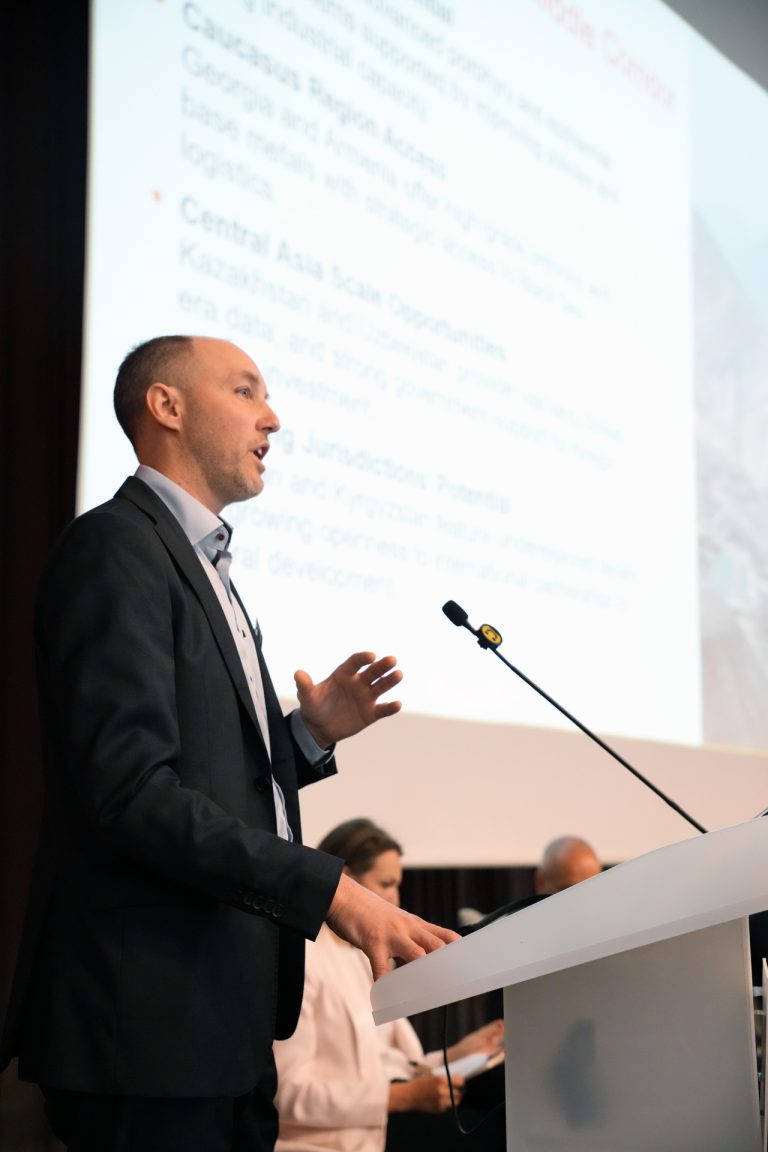
    In a recent presentation, expert Hrstka shifted the focus from geopolitical and financial discussions to the practical technical tools that can aid mining companies and investors in identifying and de-risking promising projects early in their development. He emphasised the importance of advanced mineralogy and digital tools in fast-tracking project development, reducing technical risks, and optimising performance, particularly in the context of the Middle Corridor and Tethyan Belt. Hrstka’s insights were informed by his recent visit to Tajikistan, where he was able to incorporate personal photographs into his presentation, adding a touch of authenticity to his discussion.

    Hrstka’s central thesis highlighted the significant opportunities present in the Tethyan Belt and Middle Corridor, underscoring the existence of geology, known deposits, active projects, and available financing. However, he pointed out the ongoing challenge of transforming geologically interesting discoveries into bankable and operable projects that are sufficiently de-risked for investment. He argued that the technological advancements in the industry have expanded the toolset available to address these challenges, urging stakeholders to leverage these digital capabilities when evaluating deposits in emerging regions.

    A key aspect of Hrstka’s presentation was the distinction between elements and minerals, noting that mining companies extract and process minerals rather than isolated elements. He stressed the importance of understanding the mineral form early in a project’s lifecycle to predict how materials will behave during processing and production. He identified a persistent knowledge gap between early-stage geological and geochemical data and the final product, which he argued contributes significantly to project risk and value destruction.

    Providing geological context, Hrstka described the Tethyan Belt as a vast metallogenic province that stretches from Europe to Central Asia, formed by major tectonic processes and hosting a variety of mineral deposit styles. He referenced existing large-scale projects within the belt as evidence of its potential, while also highlighting the unexplored and underinvested territories in Kazakhstan, Uzbekistan, and Tajikistan. He asserted that the real challenge lies not in geology but in the practical processes required to convert geological potential into functioning projects.

    The urgency of this topic was underscored by the rising demand for copper, lithium, gold, and graphite, driven by sectors such as AI data centres, which are both power and metal-hungry. Hrstka connected this demand surge to broader geopolitical stresses, suggesting that these pressures are pushing the industry to seek more resources and accelerate production, thereby elevating the Tethyan Belt to a strategic importance.

    Delving into the technical core of his presentation, Hrstka explained mineralogy as a critical intermediary between geochemistry and metallurgical test work. He illustrated how modern digital tools enable mineralogical analysis on a larger and more statistically representative scale than previously possible, addressing a long-standing weakness in the industry. He cautioned against the common error of assuming that merely measuring the presence of an element in complex deposits is sufficient for financing decisions, emphasising the need for verification of economic recoverability through processing.

    Hrstka framed mineralogy as a component to be integrated with standard metallurgical test work, building confidence progressively as projects move from evaluation to production optimisation. He provocatively suggested that mandatory mineralogical characterisation could become part of reporting requirements for critical minerals projects, given its direct impact on recovery predictions.

    To illustrate the economic benefits of this approach, Hrstka presented a case study with P2 Gold, where systematic test work improved the gold recovery rate, translating into significant annual savings. He argued that targeted technical investments in understanding ore can yield substantial financial returns. Furthermore, he highlighted the potential for applying modern geometallurgical concepts to legacy projects and old tailings, particularly in Tajikistan, to unlock additional value.

    In conclusion, Hrstka asserted that geology and geochemistry alone are insufficient to tackle the complexities of new mining regions. A thorough understanding of geology through the lens of downstream processing, facilitated by mineralogy, adds essential value. He cautioned against over-reliance on AI, stressing that rigorous test work and technical experience are crucial for de-risking projects, ultimately reinforcing the importance of an early, detailed mineralogical view in supporting sound investment decisions.


  • Tethyan Belt Emerges as Exploration Hotspot as ASX Juniors Target Underexplored Eastern Europe

    Tethyan Belt Emerges as Exploration Hotspot as ASX Juniors Target Underexplored Eastern Europe

    The Tethyan Belt, one of the world’s most prospective mineral regions, is attracting renewed attention from exploration companies as activity accelerates across its underexplored eastern European segment.

    Stretching across 34 countries from Western Europe to Southeast Asia and covering approximately 7.7% of the Earth’s land area, the belt hosts a significant share of global mineral wealth. According to MinEx Consulting, around 685 major deposits have been identified along the belt, representing 6.6% of known global deposits. These include an estimated 555 million ounces of gold, 293 million tonnes of copper, 16.6 million tonnes of nickel, 245 million tonnes of zinc-lead and 470000 tonnes of uranium.

    Despite its scale, the Tethyan Belt remains relatively underexplored. Over the past two decades, it has attracted $9.8 billion in exploration spending—just 3.4% of global expenditure—yet delivered 143 new discoveries, accounting for 7% of global finds during that period.

    The western end of the belt, particularly across Eastern Europe, has proven to be the most fertile area for discoveries. The region has seen 99 significant deposits identified over the past 40 years, including nine in the last decade alone. Countries across this segment collectively host substantial resources, including 216 million ounces of gold and 63.9 million tonnes of copper.

    Serbia has emerged as a leading jurisdiction within this trend, supported by strong exploration success and active investment from major players such as Zijin Mining. The country has also attracted Australian-listed explorers seeking to replicate recent successes, including Strickland Metals, which has defined an 8.6 million ounce gold equivalent resource at its Rogozna project.

    A wave of ASX-listed junior companies has entered the region in recent months. Regener8 Resources has acquired the Srebrenica North project in Bosnia and Herzegovina, targeting polymetallic mineralisation including silver, copper, zinc and antimony in a historically productive district that has seen little modern exploration since the 1970s.

    Bindi Metals has secured a majority stake in the Ravni gold project in Serbia, where high-grade surface mineralisation and porphyry copper-gold potential have been identified. The company is advancing drilling plans following recent approvals and is targeting multi-million-ounce discoveries.

    Meanwhile, MinRex Resources is progressing a merger with Electrum Discovery Corp to create a well-funded explorer focused on Serbian assets, including the Tlamino gold project and the Timok East copper-gold project. Planned drilling campaigns aim to expand resources and test new targets identified through geophysical surveys.

    Middle Island Resources has also expanded its footprint in Serbia through the acquisition of Konstantin Resources, securing a large prospective land package. Early drilling and soil sampling programs have identified encouraging gold, silver and base metal anomalies, with further exploration planned for the 2026 field season.

    Industry analysts note that declining discovery rates globally have increased the attractiveness of underexplored regions such as the Tethyan Belt. With favourable geology, existing mining infrastructure and growing investor interest, Eastern Europe is increasingly viewed as a key frontier for future mineral discoveries.

  • ACG Metals Targets Up to 10 Copper Mine Acquisitions to Scale Production

    ACG Metals Targets Up to 10 Copper Mine Acquisitions to Scale Production

    London-listed ACG Metals is pursuing an ambitious expansion strategy, targeting up to 10 copper mine acquisitions as it seeks to rapidly scale production and position itself as a Western supplier of the strategic metal.

    The company confirmed it is in active discussions over several assets, many of which are located along the Tethyan Copper Belt — a vast mineral-rich corridor stretching from southeastern Europe through Türkiye and into South Asia.

    ACG is focusing on producing or near-production assets, allowing it to accelerate output rather than wait years for greenfield development. The strategy reflects a broader shift across the mining sector toward faster, acquisition-led growth.

    🚀 From gold to copper growth engine
    ACG completed its first major deal in 2024 with the $300 million acquisition of the Gediktepe gold and silver mine in western Türkiye. The company plans to begin copper production at the site this year and is using it as a launchpad for broader expansion.

    Its long-term ambition is bold: scale annual copper output to 300000 tonnes through a series of global acquisitions.

    Founder and CEO Artem Volynets said market volatility could actually support dealmaking.

    “Volatility always presents opportunities,” he noted, adding that while higher spot prices can complicate negotiations, they also create windows for strategic acquisitions.

    📈 Copper’s magnetic pull
    Rising demand for copper — driven by electrification, renewable energy, and the explosive growth of AI data centres — is reshaping the mining landscape and fuelling consolidation.

    Recent industry developments highlight the trend:

    • Ongoing discussions around mega-mergers between major mining players

    • Intensifying competition for high-quality copper assets globally

    Copper prices have already climbed above 13000 per tonne, with long-term expectations pointing toward further increases despite short-term fluctuations.

    Volynets described the outlook as a “stepwise climb,” with prices likely moving in waves toward the 13000–15000 range over time.

    🌍 Geopolitics meets geology
    ACG is positioning itself as a Western-aligned supplier, with copper from its Turkish operations expected to feed European smelters.

    For now, the company is prioritising assets close to its operational base in Türkiye and Eastern Europe — regions offering relatively lower costs and less competition compared to more saturated markets.

    Africa and Latin America remain on the radar for future expansion, though Volynets acknowledged that Africa in particular is becoming a geopolitical battleground for control over critical minerals.

    ⚙️ Cost discipline as survival tool
    Despite bullish long-term fundamentals, ACG is keeping a sharp focus on cost control — the quiet survival skill of mining.

    “Regardless of what prices are doing, miners should focus on cost of production,” Volynets said, noting that ACG’s operations currently sit in the lowest quartile of the global cost curve for gold.

    While copper is the main growth driver, the company continues to produce gold, silver and zinc. Gold, in particular, may remain supported by geopolitical uncertainty, acting as a financial anchor while copper builds momentum.