Tag: tax

  • KGHM Polska Miedź SA, Ministry of Finance, and Ministry of State Assets Discuss Changes to Copper Tax Formula

    KGHM Polska Miedź SA, Ministry of Finance, and Ministry of State Assets Discuss Changes to Copper Tax Formula

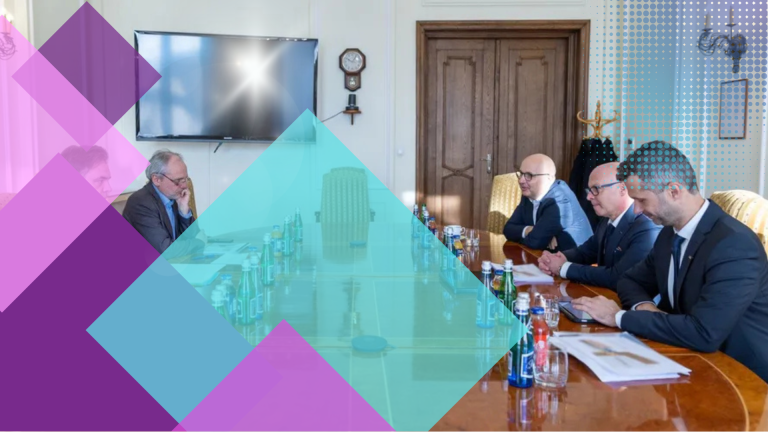
    In a significant development for the Polish mining industry and the country’s economy, KGHM Polska Miedź SA, the Ministry of Finance, and the Ministry of State Assets held talks on January 27, 2025, in Warsaw to discuss proposed changes to the formula of the so-called copper tax and the long-term development of KGHM’s domestic assets through strategic investments in Poland.

    As a key entity for the Polish economy and the largest producer of copper in Europe, KGHM Polska Miedź SA is responsible for almost 50% of the production of mined copper in the European Union, making it a strategic raw material for the European Union. With a strong focus on sustainable growth and responsible mining practices, KGHM continues to strengthen its position as a leading global copper producer.

    The meeting was attended by KGHM Polska Miedź SA’s Management Board, Minister of Finance Andrzej Domański, Deputy Minister Jarosław Neneman, and Deputy Minister of State Assets Robert Kropiwnicki. The primary objective of the meeting was to address the proposed changes to the formula of the copper tax and the possibilities of enhancing KGHM’s long-term development in Poland with strategic investments.

    The copper tax, introduced in 2012, is a significant factor in the profitability of KGHM’s operations, and the proposed changes may impact the company’s financial health. The talks aim to strike a balance between the government’s fiscal objectives and KGHM’s need for a sustainable business environment to ensure the company’s continued growth and success.

    Further details regarding the outcomes of the meeting and the proposed changes to the copper tax have not been disclosed at this time. However, both KGHM and the respective governmental bodies remain committed to fostering a positive and mutually beneficial relationship that supports Poland’s economic growth and strengthens its strategic position within the European Union.

  • Kazakhstan proposes to deduct expenses for unsuccessful geological exploration for tax purposes

    Kazakhstan proposes to deduct expenses for unsuccessful geological exploration for tax purposes

    It was proposed by the First Deputy Executive Director of the Republican Association of Mining and Metallurgical Enterprises (AGMP) Maxim Kononov to deduct the costs of unsuccessful geological exploration in Kazakhstan from the income of the taxpayer company.

    “We propose to introduce a procedure where, in the event of termination of an exploration contract in which there is no commercial discovery, exploration costs would be deducted from the taxpayer’s total income in the tax period when the exploration contract was terminated,” Kononov said, speaking at the government hour in Senate on Friday.

    According to him, there are a number of problems in the field of geological exploration, including those related to taxation.

  • Tax authorities of Kazakhstan are putting pressure on mining and metallurgical companies and have increased the mineral extraction tax to 30-50% – specialized association

    Tax authorities of Kazakhstan are putting pressure on mining and metallurgical companies and have increased the mineral extraction tax to 30-50% – specialized association

    Tax officials are putting pressure on the mining and metallurgical complex (MMC) and have increased the mineral extraction tax (MET) from the beginning of 2023 to 30-50%, said Maxim Kononov, first deputy executive director of the Republican Association of Mining and Mining and Metallurgical Enterprises.

  • Mongolia, Rio Tinto have resolved nearly all copper mine tax issues – PM

    Mongolia, Rio Tinto have resolved nearly all copper mine tax issues – PM

    Mongolia has settled almost all of its outstanding tax issues with Rio Tinto over development of the giant Oyu Tolgoi copper mine and is confident that the remaining issues will be resolved, the country’s prime minister told Reuters.

    The partners spent years mired in a tussle over development of the Gobi Desert mine which is the country’s biggest foreign investment and is set to become the world’s fourth largest copper mine by 2030 as demand heats up for the metal key to the energy transition.

    A resolution to the outstanding tax issues would avoid an arbitration process and would signify the restoration of relations with one of Rio’s top partners that were at one stage so poor they threatened to derail the mine’s development.

    “In the past, we had more than 10 issues that we had to address with Rio Tinto on the Oyu Tolgoi project, but we have successfully resolved more than 90% of them,” Mongolian Prime Minister L. Oyun-Erdene said in an interview during a visit to Washington.

    “There are still some remaining issues but we are confident that we can continue our talks and discussions with our investors so that we can resolve them,” he added.

    Rio Tinto last year bought out majority mine owner Turquoise Hill for $3.3 billion in an effort to simplify development of the mine which will produce more than 500,000 metric tonnes per year. It now owns a 66% stake and the Mongolian government the remainder.

    Rio last year agreed to waive $2.4 billion in debt owed to it by the government and commit to a structure that did not require additional loan financing after development costs blew out to $7.06 billion from $5.3 billion slated in 2016.

    Rio Tinto said at its results that discussions with Mongolia’s government were ongoing. Rio started producing copper from underground operations in March and the copper mine is expected to be a pillar of profit in coming years.

    L. Oyun-Erdene credited Rio Tinto’s board for attending the Mongolia Economic Forum in July, which allowed them to “see the real situation and make proper decisions,” praising the leadership of Chairman Dominic Barton in particular.

    “I’m confident that will not have any disputes in the future and we can successfully resolve all those issues,” he said.

    “And this will serve as a clear demonstration that Mongolia is open to business and investment and also it will contribute to investors’ greater knowledge of Mongolia’s investment climate.”

    Rio said last month that it had submitted an offer to resolve the tax dispute, and CEO Jakob Stausholm said that the “transformed relationship with the Mongolian government and the people of Mongolia is creating serious momentum”.

    (By Simon Lewis, David Brunnstrom and Melanie Burton)

  • German companies in Hungary now face hostile takeovers from the Orbán Government

    German companies in Hungary now face hostile takeovers from the Orbán Government

    German companies are sounding the alarm: the expropriation of foreign companies in Hungary is becoming frequent. This is the thrust of a new exposé from the newspaper Frankfurter Rundschau. “The unbelievable is happening, right in the middle of the EU. Foreign companies are increasingly complaining about massive violations of the law by the [Hungarian] authorities,” it states.

    The newspaper claims that more and more multinationals in Hungary are reporting a political system geared for “legalised” theft and hostile takeover. More specifically, it speaks of disproportionately high “special taxes” affecting non-Hungarian companies only; of legal or logistical blockages preventing said companies from growing; of price fixing; and, quite remarkably, of arbitrary raids on the homes of employees of foreign companies, as issued by public prosecutors.

    Frankfurter Rundschau gives one example in the form of Heidelberg Materials, a German company that started selling cement in Hungary in the 1990s. In 2022, however, the group received a takeover offer from the Orbán Government, which it rejected. In return, a 90% mining tax was imposed on Heidelberg Materials. Now the Hungarian subsidiary is making a loss. Moreover, the prices for cement products are now more or less set by the state. How long the company can keep going is unclear. “But we are ready to fight,” a company manager told Frankfurter Rundschau.

    “Construction, telecommunication, energy, transportation and food trade industry are pressured the most by [Viktor Orbán],” says Edit Zgut, vice-chair of Amnesty International Hungary, whose recent research paper elaborates on this process in great detail. “Stakeholders speak anonymously about this, or decline to comment due to fear of government retaliation. Intimidation and its chilling effect is the linchpin of the regime.

    “[What is happening now] indicates a wind of change in the operation of the regime,” she adds. “While Germany is Hungary’s most important trade partner, Orbán has pushed for forced nationalisation since Covid-19, saying that the key economic sectors have to be in Hungarian hands. One of the first victims was the Heidelberg Materials.”

    Ironically, it was German and Austrian foreign investors that directly and indirectly helped Orbán decimate Hungary’s free press, as reported by Investment MonitorBut now the ‘illiberal democracy’, as Orbán proudly self-identifies, appears to be coming for them. Meanwhile, it has now been more than eight years in which German automotive companies in Hungary have turned a blind eye to Orbán’s actions (while gaining large tax benefits via opaque agreements).

    Frankfurter Rundschau’s allegations offer further evidence of the manner in which the EU, via Hungary, is being undermined. “The Orbán regime becomes more ideological, predatorial, by the day,” says Zgut. “The European Commission and Council have to move faster and more efficiently to protect the integrity of the common market.”