Tag: MINEX Asia 2026

  • Supply Chains Don’t Build Themselves — What the Middle Corridor Still Needs to Move at Speed

    Supply Chains Don’t Build Themselves — What the Middle Corridor Still Needs to Move at Speed

    If Day 1 asked “why does geological wealth not automatically translate into investment?” then Day 2 answered with brutal clarity: because you cannot move critical minerals to global markets without the infrastructure to process them. And that infrastructure — refining, separation, conversion — is the question that defined every session on 25 June.

    The day opened with a deliberate strategic reframing. Nevzat Başlar from MAPEG (Ministry of Energy and Natural Resources) did not call his presentation “Türkiye’s Mining Vision” or “Turkey’s Mineral Wealth.” He titled it: “Bridging Between Reserves and Refining: Türkiye’s Strategic Role in the Global Critical Minerals Race.”

    The phrasing was intentional. Türkiye is not positioning itself as a reserve. It positions itself as a bridge. Not a source country, but an industrial anchor — capable of converting Central Asian ore into finished products for Western supply chains. The argument was structural: Türkiye sits at the point where Central Asian geology meets European demand. But proximity is worthless without processing. The strategic imperative is to develop midstream processing capacity — that transformative layer where raw material from Uzbekistan and Kazakhstan becomes inputs for EV motors, wind turbines, and defence electronics before they reach Western manufacturers.

    This was not background framing. It was the foundation for everything that followed.

    The morning: supply chain positioning and financial instruments

    Sebnem Alp from UKEF followed with a presentation on trade financing. Her argument moved beyond the project-finance logic that had dominated Day 1’s financing panel. Trade finance operates on a different timeline and risk profile: shorter tenors (12–24 months versus 5–7 years), repeatable commodity flows, and off-balance-sheet structures that allow regional banks and development institutions to recycle capital efficiently. The subtext was clear: if the Middle Corridor is going to move tonnes of processed materials, you don’t finance it with mega-loans to mega-projects. You finance it with working capital lines and commodity flows between nodes.

    Article content
    Timur Khikmatullaev – Uzbekistan’s Technological Metals Complex

    Timur Khikmatullaev from Uzbekistan’s Technological Metals Complex presented “Unlocking Uzbekistan’s Critical Raw Materials” — but the word “unlocking” carried weight. Uzbekistan is moving from bilateral Chinese partnerships toward Western supply chain integration. The Complex’s presence as a forum partner signalled that Tashkent now sees Western offtake arrangements and technology partnerships as genuinely competitive with Chinese state finance. Speed, he argued, is no longer China’s monopoly if Western institutions and private capital move with coordinated intent.

    Article content
    Dr Tomas Hrstka

    Dr Tomas Hrstka from SGS brought the assurance layer. His presentation — “Unlocking the Tethyan Belt: The Strategic Role of Advanced Mineralogy and New Technologies in Accelerating Projects, Reducing Development Risks and Optimising Performance” — positioned testing and certification not as compliance overhead but as a competitive accelerator. Advanced mineralogy data at the front end of a project reduces capex uncertainty, speeds permitting, and attracts first-loss capital from Western investors who demand CRIRSCO/JORC compliance. The technical infrastructure arrives before the mining infrastructure.

    Artyom Geghamyan from Armenia presented the regional closure to the morning’s supply chain vision: “Armenia at the Intersection of Critical Minerals, Connectivity and Peace.” The title embedded a geopolitical argument: Armenia’s post-conflict position, its mineral endowment, and its location along the Middle Corridor create a window. Armenia could become a processing node or remain a source of raw exports. The choice is Armenia’s, but the structural logic is the same as Türkiye’s — geography plus processing capacity equals supply chain criticality.

    The morning’s closing speaker was Veda Duman Kantarcıoğlu from the Nuclear Engineers Society — and her presentation reframed what “mining” actually means in a rare earth element context. “Developing National Competencies for Nuclear-Industrial Partnerships for Mining Applications” made explicit what was implicit in Beylikova: rare earth processing generates radioactive byproducts. Processing REE is not standard industrial mining — it is quasi-nuclear operation. It requires workforce training aligned with nuclear safety protocols, regulatory partnerships with nuclear authorities, and infrastructure designed to international IAEA standards. Veda’s presence in the session signalled that Türkiye’s Akkuyu nuclear facility and its nuclear regulatory ecosystem are not separate from the mining story. They are central to it.

    Midday: ESG as competitive advantage, not compliance burden

    Session 6, moderated by Zhanar Faizuldayeva of SLR Consulting, was titled “Responsible Mining: Driving Sustainability, Trust, and Global Standards in Eurasia.” The framing was not defensive. The session positioned ESG as a competitive filter, not a compliance burden. Projects with robust environmental and social governance attract Western capital faster, command better offtake terms, retain social licence, and move through permitting more quickly.

    Tunç Berkman from TBS Investment made the opening case: “Mining’s Greatest Resource is No Longer Underground — It is Public Trust.” The line was powerful. Geological wealth is abundant; public confidence is finite. Companies that build it win capital and speed. Companies that destroy it lose both.

    The session acknowledged that standardisation creates competitive advantage. A zone of ESG compliance across Eurasian projects, certified and transparent, becomes immediately bankable to Western development finance institutions without additional diligence. Standards reduce friction in capital flows.

    The technical constraints no one can sidestep

    Session 7, “Tailings Management, Structural Resilience and Resource Stewardship,” moderated again by Zhanar Faizuldayeva, brought the conversation to the engineering reality that has stopped more mining projects than geology ever has: what happens to the waste?

    The panel assembled the specialists: Sam Safavian (SLR) on risk-based safety reviews; Alistair White (Knight Piesold) on resilience-based design; Iain Pickard (Strategia Worldwide) presenting Tailings Protect — an integrated real-time monitoring and risk management solution; and Azamat Abdulayev (SRK Kazakhstan) closing with water management as competitive advantage in a region facing acute water stress.

    The core argument was unambiguous: modern tailings management is not bolt-on infrastructure. It is central design. Dry stacking, filtered tailings, managed impoundments with real-time monitoring add 10–15% to capex and require operational discipline across the project lifecycle. For the Middle Corridor, the implication was sharp: you cannot replicate the Chinese model of rapid development with lower environmental standards and hope to export to Western markets. Your tailings will be audited. Your water management will be certified. The cost is structural and non-negotiable.

    The afternoon: value chain integration and processing momentum

    Session 8, “From Ore to Application: Operational Technology and Value-Chain Integration,” moderated by Ivan Livinskiy of SRK Kazakhstan, moved to the point where most Central Asian minerals still stop: processing.

    Umid Salokhutdinov from Future Metals Technopark presented the technopark model as Uzbekistan’s answer to a specific problem: you can mine tungsten, but unless you process it into tungsten carbide or high-temperature alloys, you compete with Chinese raw material exports on price and lose. The Technopark is infrastructure for midstream processing — company A mines ore in deposit X, company B processes it at the park, company C manufactures final products, company D integrates them into systems. Profit margins compound at each step.

    Emre Ahmet Kantarci from ExxonMobil brought the multinational perspective. ExxonMobil’s interest in the Middle Corridor is not primarily mining. It is securing feedstock for advanced materials manufacturing — batteries, wind turbine components, defence electronics. The multinational majors are thinking vertically integrated supply chains, not purchasing tonnes of raw ore at commodity prices.

    Burak Köse from ARGETEST closed the session with the data infrastructure argument: none of this works without laboratory certification at every step. ARGETEST’s expansion into Tashkent and three additional Central Asian countries reflects the reality that processing hubs cannot operate without local laboratory capacity.

    The closing: tensions clarified but not resolved

    Session 9’s closing panel — “Bridging the Supply Gap: Türkiye and the Middle Corridor as New Frontier for Critical Mineral Security” — brought together Céleste Laporte (OECD), Zhanar Faizuldayeva (SLR), and Ivan Livinskiy (SRK Kazakhstan) under Han İlhan’s moderation.

    The panellists did not paper over the central unresolved tension. Supply chain positioning along the Middle Corridor: agreed. Industrial anchor capacity: conceptually clear. But the speed remains fundamentally mismatched. Western capital moves at 3–5 years for permitting, 2–3 for financing, 4–5 for construction. Chinese capital moves in 18–24 months. The region has choice — geology is real and governance is improving — but on a timeline that doesn’t match the energy transition’s hunger for supply.

    The other unresolved tension: processing. Every speaker on Day 2 acknowledged that value creation happens downstream, not in extraction. But processing requires different capital intensity, different workforce training, different infrastructure. Mining companies extract ore. Manufacturing companies process it. The Middle Corridor does not yet have enough of the latter to absorb the former’s output at rates that would shift global supply chains.

    The day’s through-line

    By evening, when delegates moved to the Göksu Restaurant for the Day 2 networking dinner, the conversation had shifted but not concluded.

    Day 1 asked “why isn’t geological wealth flowing into investment?” Day 2 answered: because the supply chains do not yet exist — not because they cannot, but because they require simultaneous moves across geology, governance, processing infrastructure, workforce development, ESG certification, water management, and political will at sovereign scale.

    Başlar’s frame — “Bridging Reserves and Refining” — was the day’s synthesis. The Middle Corridor has reserves. It has refining capacity in development. It has governance improving. What it doesn’t yet have is the decision — at sovereign scale, backed by capital commitment — that processing capacity is the strategic priority, not extraction speed alone.

    Kazakhstan is partly there. Uzbekistan is accelerating. The region — with combined geological endowments that dwarf most of the world — remains at the inflection point. The institutions are assembling. The case is being made. The question is whether speed matches opportunity, and whether political will can keep pace with geological advantage.

    Day 2 sharpened the question. It did not answer it.
  • China Controls 90% of REE Processing. Ankara Is Where the Alternative Is Being Built — Hopefully.

    China Controls 90% of REE Processing. Ankara Is Where the Alternative Is Being Built — Hopefully.

    Over 140 delegates from 18 countries gathered at the MINEX Asia Forum in Ankara on Wednesday. The room was senior, the agenda substantive, and the conversation rarely left the strategic layer.

    Why this moment matters: the demand imperative

    Ibrahim Halil Kirsan TOBB Turkey Mining Council President, ÇIFTAY Board Member Mining Council, TOBB, ÇİFTAY

    İbrahim Halil Kırşan, President of the TOBB Türkiye Mining Assembly, opened with the global frame and did not soften it. Drawing on IEA data, he put the stakes plainly: by 2040, mineral utilisation in renewable energy will increase four-fold under the Sustainable Development Scenario and six-fold under Net Zero. On a commodity-specific basis, lithium demand alone is projected to surge 42-fold under the SDS. Electric vehicles, wind turbines, defence systems, smartphones, fibre optic networks: the slide mapping how much metal goes into each clean energy technology was not background material. It was the case for why everyone in the room was in Ankara on a Wednesday morning. Ayhan Yüksel of the Chamber of Mining Engineers picked up the regulatory thread, tracing Türkiye’s mining legislation from the 1954 Mining Law through seven amendments to the 2025 revisions — a progression from state-dominated extraction toward an investment-oriented framework that nonetheless preserves strategic sovereign control over mineral assets.

    Türkiye’s REE ambition: the numbers behind the claim

    The most forensically detailed presentation of the morning came from Dr Hüseyin Çaldırak of TENMAK’s Rare Earth Elements Research Institute, and it moved the Beylikova story from political ambition to technical specificity.

    Ayhan Yüksel of the Chamber of Mining Engineers

    The deposit: 694 million tonnes of resource at approximately 2% NTE grade, containing an estimated 12.5 million tonnes of potential rare earth reserves — widely described as the world’s second-largest REE reserve after China’s Bayan Obo, with a planned full-scale facility targeting 570,000 tonnes of ore per year and projected annual revenues of approximately $220 million. China currently controls approximately 70% of world NTE production and over 90% of processing and magnet manufacturing capacity. Demand will grow more than 60% by 2030, with EV motors as the primary driver — REE demand from electric vehicle motors has risen from less than 1% of total magnet NTE demand in 2015 to 9% today, projected to reach approximately 18% by 2030. minexasia

    The domestic arithmetic is striking. With a 2035 national energy target of 48GW of wind capacity from 15GW today, Türkiye will need approximately 3,461 tonnes of NTE just for its own wind turbine fleet. At 10,000 tonnes per year, Beylikova covers that domestic requirement entirely — and still exports. The Western response to Chinese dominance is correspondingly large: a $12 billion US DoD partnership with MP Materials, NdPr offtake agreements at a $110/kg floor price, and a US National Defense Industrial Strategy that from January 2027 will prohibit SmCo and NdFeB production involving China, Russia, Iran or North Korea at any stage. The technology gap for Türkiye remains real: China controls export licences for all products containing Chinese-origin REEs, and Beylikova’s separation technology is still under development. But the strategic window has rarely been wider.


    The $13.5 trillion question: four countries, four trajectories


    The invisible foundation: data, laboratories and bankability

    Abdullah Buhur of ARGETEST made what might have seemed like a narrower technical argument — but it ran directly to the financing panel that followed. In modern mining, he argued, you must extract the data from the ore before you extract the ore itself. Incomplete or inaccurate geochemical and metallurgical data leads to wrong process designs and facilities that cannot operate. Reliable end-to-end data generation is what makes CRIRSCO, JORC and UMREK-compliant reporting possible — and compliant reporting is what makes a project financeable. ARGETEST, founded in Ankara in 2012 and now holding ISO/IEC 17025 ILAC accreditation, has already opened its first international laboratory in Tashkent, with three further countries in active planning. The message to Central Asian and Caucasus projects represented in the room: the laboratory infrastructure that underpins bankable feasibility studies is arriving regionally, not just in London or Perth.

    The Tethyan Belt — geology mapped, execution pending

    Article content
    EBRD’s Deputy Head of Türkiye, Mehmet Uvez

    EBRD’s Deputy Head of Türkiye, Mehmet Uvez, reframed the Middle Corridor precisely: not a transport route, but a platform for trade resilience and industrial value chains. The numbers behind the commitment: €24.4 billion in cumulative EBRD investment in Türkiye, a record €2.7 billion across 54 projects in 2025 alone, and up to €500 million in sovereign lending for the INRAIL Istanbul North Rail Crossing — a missing link for the Trans-Caspian route. The OECD presented EU-funded research on connectivity and CRM export potential across Central Asia. The USGS gave a frank country-by-country assessment: the region holds 39% of global manganese ore reserves, 31% of chromium, 20% of lead, and significant shares of zinc, titanium, copper and cobalt — the endowment is not in question; investability is. Discovery Alert

    Simon Glancy of Strategic Solutions brought the most granular data of the session. Uzbekistan possesses over 29 types of rare and rare earth metals, but only copper and tungsten are being developed at scale, with UzTMK’s exports forecast to reach $80 million by 2030 — just 3% of total industry output. For nearly every strategic mineral in the region, Chinese investors are already the dominant or sole significant foreign presence. His core proposal — a Central Asian CRM alliance structured around hub processing facilities in Kazakhstan and Uzbekistan, with Kyrgyzstan, Tajikistan and Turkmenistan feeding in semi-processed material — was the most concrete regional architecture offered on the day.

    Key takeaways:

    • The demand case is irrefutable: a 42-fold lithium surge and a 6-fold increase in total mineral use for renewables by 2040 under Net Zero are the operational context for every investment decision in this room
    • Beylikova’s significance rests not on reserve size alone but on arithmetic: at 10,000t/yr NTE, Türkiye covers its domestic wind energy mineral needs and becomes a net exporter to allies seeking diversification from China
    • Laboratory infrastructure — accredited, internationally recognised — is a prerequisite for bankability; its regional arrival is an enabling condition, not a detail
    • Turkish companies have a specific and underexploited opportunity as providers of engineering, processing technology, lab services and advisory capacity across the Central Asian CRM ecosystem

    Who is funding the future — and how fast?

    The financing session assembled the most concentrated group of development finance institutions seen at a MINEX event: EIB, EBRD, IFC, ADB, UKEF, KfW IPEX-Bank, the Türkiye Wealth Fund and BORG Capital Insights, moderated by Han Ilhan of Catalis Strategies. Hogan Lovells opened with the political risk framing: investment treaties, investor-state arbitration and export credit insurance are not bureaucratic formalities — they are the mechanism that makes Western private capital competitive with Chinese state finance. The ADB’s CMM Value Chains Initiative presented a holistic approach: diversified and resilient supply chains, domestic value addition, ESG standards as competitive advantage rather than compliance burden.

    Han Ilhan, Co-Founder and Managing Director Catalis Strategies

    Then came the baseline that set the terms for the panel’s candour. In 2023 alone, Chinese firms invested more than $120 billion in overseas mining and processing; China now controls approximately 60% of lithium processing, more than 70% of cobalt refining, and over 90% of battery material manufacturing. Against that, Western institutional capital’s pace and structural flexibility were scrutinised without diplomatic cover. The headline conclusion: the institutions are present, the mandates are real, the appetite exists — but speed, flexibility and first-loss willingness on frontier projects remain the decisive variables. Kazakhstan’s tungsten makes the point exactly: the country’s entire 2025 export volume — roughly 3,700 tonnes — went to a single destination: China. The mineral wealth is there. The offtake relationships are not. ENERPO JOURNALEast Asia Forum

    Key takeaways:

    • Five multilateral development banks in one session signals intent; coordinated deployment, not just parallel presence, is the next requirement
    • Political risk instruments are the mechanism that makes Western private capital competitive with Chinese state finance on frontier projects
    • The US DoD’s $12bn MP Materials partnership and the 2027 prohibition on Chinese-stage REE production in defence supply chains mark the clearest shift yet from policy to procurement
    • Türkiye imported over 170 tonnes of gold in 2024 while producing just 32 tonnes domestically — a country with $3.5 trillion in reserves running a gold trade deficit is a measure of the distance between geological wealth and industrial policy China Population Density Map

    The Turkish industrial offer

    DAMA Engineering traced four decades of Turkish mining advancement — from Atatürk’s 1935 founding of MTA and Etibank on the same day, pairing geological discovery with production capacity, through the arrival of global majors following the 1985 Mining Law, to the UMREK reporting code and modern integrated processing plants. The arc: Türkiye absorbed international best practice and is now in a position to export that capability eastward along the Middle Corridor.

    Devrim Aksu closed with the challenge that cuts across every projection of regional growth. Global talent shortages in geologists and mining engineers, scarce digital mining skills, the absence of remote operations workforce models at scale: her presentation put the question plainly — “Who Will Build the Workforce Behind the Critical Minerals Boom?” — and left it unanswered, because it is genuinely unanswered. Women remain a structurally underutilised reserve in mining talent pipelines across the region; the business case is now as compelling as the equity case.

    The day’s through-line

    If one argument ran through every session on Day 1, it was this: the strategic case for the Middle Corridor as a global critical minerals supply line is no longer being made — it is being assumed. The debate has moved to execution. Who finances, who processes, who certifies the data, who builds the workforce, and who captures the value — these are the questions that will define the next decade.

    A jurisdiction that ranked 104th in global mining investment attractiveness a decade ago now sits in the global top ten — not because its geology changed, but because its framework did. Türkiye has more mineral wealth, a better geographic position, four decades of engineering capability, and direct access to European markets. Kazakhstan produces 38% of the world’s uranium and has the majors already in country. Uzbekistan has the momentum of a country that has been closed and is now opening fast. The room in Ankara on Wednesday contained many of the institutions that could unlock all three. Whether the urgency matches the opportunity is the question Day 2 will not answer either — but it will sharpen it.

    The evening closed at the British Embassy, hosted by the Department for Business and Trade. Day 2 continues tomorrow.

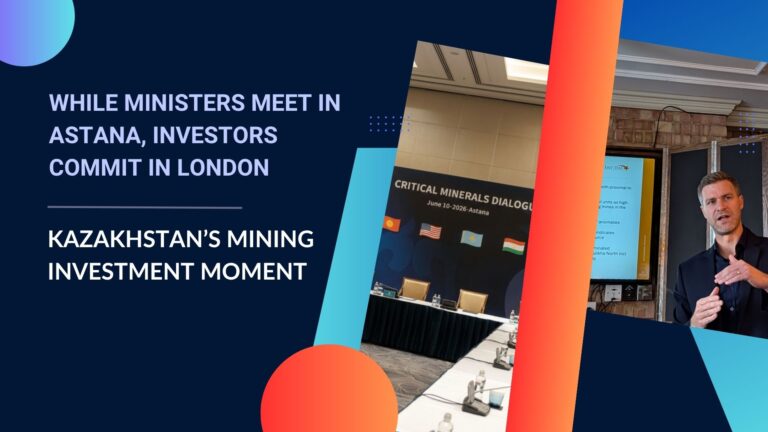
  • Kazakhstan’s Mining Investment Moment:  While Ministers Meet in Astana, Investors Commit in London

    Kazakhstan’s Mining Investment Moment: While Ministers Meet in Astana, Investors Commit in London

    This week, Astana is hosting two very different conversations about Kazakhstan’s mining future.

    In the official corridors, government delegations, US officials, and ministers from across Central Asia are gathered for high-level discussions. Grand statements are being made. Frameworks are being signed. Photographs are being taken.

    On the other side of the world in a brick-walled London dining room — a rather different conversation is taking place. A small group of private investors is gathered around a screen, listening to a junior mining CEO explain, with disarming candour, exactly how he plans to turn a copper deposit in Kazakhstan into a billion-dollar producing mine. Without debt. Without dilution. And without losing sleep over capex blowouts.

    These two conversations are not separate. They are, in fact, the same conversation — just conducted at different altitudes.


    The Ground-Level Reality of Kazakhstan Mining Finance

    East Star Resources CEO Alex Walker presented to investors with the kind of frankness that rarely makes it into official mining forums. His central message: the Verkhuba copper deposit in Kazakhstan is now funded to production, with Chinese EPCM powerhouse Xinhai taking 70% in exchange for carrying all development costs — an estimated US$65 million — to first copper.

    East Star retains 30%, fully carried, with no debt obligation. Xinhai gains majority only when it has delivered US$50 million worth of equipment to site. Until that moment, East Star holds control.

    “You do not get majority until you have sunk way more money into this,” Walker tells his audience.

    It is a deal structure worth understanding carefully, because it illuminates something important about how junior miners are actually navigating the Kazakhstan opportunity in 2026 — and it is a long way from the headline-grabbing announcements coming out of this week’s official forums.

    The Xinhai model — a Chinese EPCM contractor taking equity in exchange for funded development — is not new. But its scale and pace are accelerating. Xinhai now claims over 2,500 projects delivered globally, with more than US$42 million committed to ASX and LSE-listed companies for feasibility and construction in 2025 alone. They manufacture their own processing equipment, manage their own supply chains, and have demonstrated the ability to build a 1.5 million tonne per annum processing plant in Kazakhstan in under twelve months.

    Walker is characteristically direct about the implications: “I visited their factory in Yantai. They make everything — the rubber liners that go in your crushing plants. That means you are not reliant on where you sit in a queue for your equipment provider. You manage your entire supply chain.” When Xinhai told him they thought they could deliver Verkhuba within a compressed timeline, he said, he believed them.

    For a junior miner navigating the gap between resource and production — the graveyard of so many promising projects — this kind of vertically integrated partner is genuinely transformational. Walker is blunt about which risks he had effectively eliminated: financing, capex blowouts, and timing. Three of the five classic killers of junior development projects, struck off in a single deal.


    The Copper Market Context Nobody Is Ignoring

    Walker touched on the macro backdrop, referencing a conversation with senior Goldman Sachs mining analysts about the copper deficit forming in the rest-of-world, non-US market. The figures are striking. Goldman Sachs now projects a deficit of over 640,000 tonnes in ex-US copper markets in 2026 — a number revised sharply upward from a prior estimate of just 60,000 tonnes, driven largely by US front-loading of copper imports ahead of potential tariffs. J.P. Morgan adds a 330,000-tonne deficit projection of its own, while even the historically conservative International Copper Study Group has swung from forecasting a 209,000-tonne surplus in late 2025 to a 150,000-tonne deficit by May 2026.

    The convergence of major institutional forecasters on a significant 2026 deficit is the backdrop against which Walker’s geopolitical point lands hardest. Copper from the DRC loaded onto a ship can be diverted mid-voyage to capture a premium on the COMEX in New York. Copper that travels by rail from Kazakhstan cannot. Its destination is fixed. In a world where tariffs and trade route disruption are rewriting commodity flows in real time, Kazakhstan’s landlocked geography – once a liability – is becoming a structural advantage for certain end markets, particularly China. The supply cannot be diverted. It simply arrives.


    The Questions Investors Are Actually Asking

    The sharpest exchanges of the meeting came during questions. One investor raised the spectre familiar to anyone who has backed a junior miner in a joint venture with a larger partner: what stops the big partner from simply putting the project on ice when it suits them?

    Walker’s answer was layered. First, the deal structure itself: Xinhai only achieves majority when equipment worth US$50 million has been delivered to site. If they walk away before that, East Star keeps its majority and a significant amount of delivered capital. “They’d be selling US$50 million worth of equipment and still getting a good return on capital,” he noted. “So we’ll figure out how to build it ourselves.”

    Second, he made a pointed commercial observation: Xinhai wants East Star to be their business development partner in Kazakhstan, bringing them more deals. Betraying a partner publicly would destroy that franchise. “The first group they screw over — that business model is shut,” he said. “That’s why I don’t think they’d do it.”

    A second question probed the structure of East Star’s 30% retained interest more sharply: does the company actually own 30% of the project, or is it simply entitled to 30% of the copper? And crucially, who controls the surplus capital once the mine is producing?

    Walker confirmed that East Star owns 30% of the project entity, with marketing rights for approximately 30% of production. On dividend distribution, he was direct: under the shareholders’ agreement with Xinhai, dividend policy is a reserved matter requiring mutual agreement — the majority shareholder cannot unilaterally determine how cash is deployed. “Dividend distribution is one of those matters that needs a vote from both sides,” he said. Whether the cash ultimately flows back to shareholders or is redeployed into new projects — perhaps towards building a 300,000-ounce-per-year gold mine with Endeavour — is a question for later. The structural protection, he argued, is real.

    It was, collectively, the answer of someone who has read enough JV agreements to know exactly where the traps are.


    AI and the New Exploration Toolkit

    One detail from the evening deserves particular attention, and it speaks to how the competitive landscape for junior miners in Kazakhstan is changing.

    East Star’s porphyry gold exploration programme — the Snowy and Piket licences on the Balkash-Ili magmatic arc — was initially funded through a grant from the BHP Xplor programme, which Walker described as “a highly competitive programme: 600 applicants, 6 accepted.” The programme is explicitly oriented around applying advanced analytical techniques — including AI-driven target generation — to early-stage exploration. East Star’s selection is a mark of technical credibility that carries weight with institutional investors.

    The broader context matters here. Kazakhstan’s government has been investing heavily in the digitalisation of its geological archive — over 97% of primary geological information, approximately 250 terabytes of data, has now been scanned and consolidated into a unified system. An AI-powered platform has been developed to automatically process this archive, extract coordinates, and generate subsurface geological models. Officials describe the technology as significantly reducing data processing time and improving the quality of exploration decisions.

    For companies like East Star, operating across some of Kazakhstan’s most prospective but underexplored belts, this convergence of digitised state geological data and AI-assisted targeting represents a genuine step-change in the speed and cost of identifying drill-ready targets. The question of where the next Nikolskoye or Verkhuba might be hiding is increasingly one that algorithms, not just geologists, are helping to answer.


    The Regulatory Picture: Nuance Required

    One of the most interesting questions of the meeting came from an investor who had been tracking changes to Kazakhstan’s mining regulatory framework. The question concerned a reported increase in the threshold for mandatory government approval of ownership changes in mining companies, and the role of the national mining company Tau-Ken Samruk in new joint ventures.

    The regulatory picture here is genuinely nuanced, and worth examining carefully.

    Kazakhstan’s December 2025 amendments to the Subsoil and Subsoil Use Code were primarily aimed at digitalisation, transparency, and strengthening strategic investor incentives. Separately, amendments signed by President Tokayev also tightened state control in the uranium sector specifically, raising certain transfer thresholds and granting Kazatomprom priority rights over uranium exploration licences.

    As for Tau-Ken Samruk — the state’s national mining company and a subsidiary of the sovereign wealth fund Samruk-Kazyna — Chambers and Partners’ 2026 Kazakhstan Mining guide notes that the government is actively seeking to restore Tau-Ken Samruk’s priority rights for obtaining exploration and mining licences for critical minerals, a right that had previously been removed as part of earlier liberalisation efforts. “We expect this priority right to be restored in 2026,” the guide notes, describing it as a deliberate effort to increase the state’s foothold in the early stages of the critical minerals supply chain.

    The direction of travel is clear, even if the precise mechanics are still being finalised: Kazakhstan is simultaneously offering incentives to attract international capital and tightening state participation rights in the assets that matter most. For investors in junior miners operating here, this duality is not a contradiction — it is the operating environment. Understanding it, and structuring agreements, accordingly, is the price of entry.


    This is precisely the kind of regulatory intelligence that MINEX Eurasia Forum — convening in London on 30 November as part of London Mining Week — exists to provide. The forum brings together mining investors, operators, legal practitioners, and government representatives from across the region to examine exactly these dynamics: where is capital coming from, on what terms, and under what regulatory conditions?


    The Endeavour JV: A Different Model, Same Logic

    East Star’s joint venture with Endeavour Mining – a US$25 million exploration programme with one of the world’s top ten gold producers – follows a different but structurally similar logic. Endeavour funds exploration through to pre-feasibility study, earning up to 80% along the way. East Star manages the JV until Endeavour reaches 51% and is carried through to PFS completion.

    Again: no dilution beyond agreed thresholds, no unilateral majority until capital milestones are met, and a world-class operator bearing the exploration and development risk.

    Walker’s reference point is Independence Group in Western Australia — a company that held a minority in what became the Tropicana gold project with AngloGold, eventually building that stake into hundreds of millions of dollars of annual cash flow. The analogy is instructive: the value is not in owning the whole mine. It is in owning the right percentage of the right mine, with the right partner, under the right agreement.

    Walker put it simply: “If we have 20% of something that Endeavour is building, even with financing, that’s a billion-dollar company for just East’s percentage. That’s something I’m really excited to maintain.”

    This philosophy is increasingly evident among the better-managed junior miners operating in Central Asia. The era of the go-it-alone junior – raising capital dilutively on the back of exploration results, lurching from drill hole to drill hole – is giving way to something more sophisticated: structured, partner-funded development with clear milestone-based governance.


    MINEX Asia and the Longer Arc

    For those who follow the MINEX forum series closely, none of this comes as a surprise. Over more than a decade, MINEX Eurasia events in London have documented and debated the evolution of mining investment in Central Asia and the Caucasus — the shift from Soviet-era brownfield rehabilitation to greenfield discovery, the growing role of Chinese EPCM capital, the fitful but real improvement in regulatory environments, and the persistent challenge of converting geological endowment into investable projects.

    What is new in 2026 is the intensity of the moment. The critical minerals agenda — driven by the energy transition, by great power competition over supply chains, and by the explicit industrial policy of both the EU and the US — has focused international attention on Kazakhstan, Kyrgyzstan, Uzbekistan, and their neighbours in a way that was not true even three years ago.

    The question that MINEX Asia 2026, convening in Ankara this month, is already pressing — and that MINEX Eurasia Forum will continue to examine in London in November — is whether this intensified international attention translates into genuinely diversified investment, or whether the structural realities of Kazakhstani mining (Chinese EPCM dominance, evolving state participation requirements, infrastructure constraints) mean that the beneficiaries of the critical minerals boom will ultimately be narrower than the official narrative suggests.


    The Real Work

    Back in that London dining room, the questions kept coming. Minority shareholder protection. Dividend policy. The role of assay labs on site. The timeline to production. Each one answered with the same register: direct, detailed, and unspun.

    It was a window into the real sophistication now required to operate as a junior miner in Kazakhstan. The geology is compelling. The copper market backdrop is as strong as it has been in years. Chinese EPCM capital is available, at scale, on terms that can work for a well-advised junior. The regulatory environment, for all its complexity, is navigable.

    But the deals that will create value – the ones that will turn exploration licences into producing mines and producing mines into returns for investors — will be won or lost on the quality of the agreements, the rigour of the governance structures, and the acuity of the people sitting across the table.

    Ministers may gather for the photographs, but the real work happens away from the cameras.

  • The Great Green Game: 5 Surprising Shifts Redrawing the Map of Critical Minerals

    The Great Green Game: 5 Surprising Shifts Redrawing the Map of Critical Minerals

    Your smartphone, the electric vehicle in your driveway, and the massive GPU clusters training the next generation of AI share a common, humble lineage. Their origins aren’t found in Silicon Valley labs, but in the dust of the Alatau and Tien Shan mountains. For decades, these remote ranges in Central Asia and the Caucasus were the silent, overlooked providers of raw dirt. Today, however, the world’s desperate hunger for Critical Raw Materials (CRM) – the lithium, antimony, and rare earth elements (REE) essential for the energy transition – has turned these landscapes into the most contested real estate on the planet.

    Currently, the global economy is tethered to a dangerous single-source monopoly. China controls approximately 60% of global mining for these materials and a staggering 85% of processing capacity. But a massive, counter-intuitive shift in global power is underway. The upcoming MINEX Asia 2026 forum in Ankara is more than just a conference; it is the official unveiling of a new geo-economic axis—a “Middle Corridor” that aims to break the monopoly and redefine the 21st-century economy.

    1. Beyond the “Raw Deal”: Escaping the 5x Revenue Trap

    The traditional arrangement has been a “Raw Deal” for Central Asia: roughly 70% of the region’s minerals currently flow into China as unprocessed ore or primary concentrate. Strategists call this the Value-Added Trap.” By exporting dirt instead of refined metal, regional players lose out on roughly five times the potential revenue.

    This paradigm is shattering. Driven by “multi-vector” foreign policies, countries like Kazakhstan and Uzbekistan are no longer satisfied with being the world’s quarry. They are leveraging the European Union’s Critical Raw Materials Act (CRMA), which mandates that by 2030, the EU must not depend on a single third country for more than 65% of any strategic material. This regulatory limit has turned Western desperation into Central Asian leverage: the West is now funding the factories they once refused to build.

    “China controls about 60% of the world’s production of critical minerals and more than 85% of the world’s capacity for their processing and refining… turning the market for strategic raw materials into a tool of geopolitical influence.”

    To finalise this shift, Türkiye preparing to launch a National Mining Exchange in 2026, creating a transparent marketplace that links Central Asian minerals with Western capital, effectively bypassing the opaque, monopoly-driven pricing of the past.

    Article content

    2. The $15.7 Billion Lithium Haul: Kazakhstan’s “Ghost” Mines

    One of the most startling breakthroughs in battery metals occurred not at a new site, but at the Bakennoye field in East Kazakhstan. During the Soviet era, Bakennoye was a tantalum mine, largely forgotten after the Union’s collapse. However, in 2024, the Korea Institute of Geoscience and Mineral Resources (KIGAM) used modern South Korean exploration tech to “rediscover” the site as a lithium powerhouse.

    The discovery is valued at a staggering $15.7 billion. Under a Comprehensive Development Plan running through 2028, Kazakhstan is using this haul to jumpstart four priority industrial clusters, ensuring they produce more than just raw concentrate:

    • Battery Materials: Domestic production of EV battery components.
    • Semiconductors: High-purity metals for the next generation of chips.
    • High-Temperature Alloys: Essential for aerospace and defense.
    • Permanent Magnets: Critical components for wind turbines and electric motors.
    Article content

    3. The Antimony Shock and the Turkmenistan “Liquid Gold”

    In September 2024, China sent shockwaves through the defense industry by imposing rigid export controls on antimony—a metal critical for everything from ammunition to flame retardants. Prices doubled overnight. In response, the US is aggressively pivoting to Tajikistan, where American firm Comsup Commodities Inc. has invested over $300 million to modernize the Anzob plant, aiming to secure a Western-aligned supply of this vital metal.

    Simultaneously, a second “liquid” shift is happening in the desert. Turkmenistan, long considered a pure gas play, has revealed massive lithium potential in the Garabogazköl Bay. With lithium concentrations in underground brines reaching 15–20 mg/l—well above the industrial threshold—the region is eyeing Direct Lithium Extraction (DLE) technology. This could transform one of the world’s most isolated economies into a pillar of the green energy transition.

    Article content

    4. The “TRIPP” Route: A 99-Year Corridor for Prosperity

    Geopolitics and logistics have converged in the most surprising breakthrough of 2025: the Trump Route for International Peace and Prosperity (TRIPP). Born from a peace agreement between Armenia and Azerbaijan, this 43km corridor through Armenia’s Megri region creates a land bridge linking the mineral-rich Caspian directly to the Mediterranean.

    The TRIPP route utilises a sophisticated “front office – back office” model to solve a centuries-old security dilemma. While Armenia retains absolute sovereignty over the land, the infrastructure (rail, road, and fiber optics) is managed by Western private operators. This provides the “security of management” needed to unlock billions in funding.

    • The Financial Muscle: The US MSP Finance Network and the DFC are already mobilising up to $700 million for regional projects tied to this corridor.
    • The 99-Year Anchor: The United States has secured 99-year infrastructure development rights, signaling a long-term commitment to bypassing Russian and Iranian influence.
    • The Efficiency Dividend: Transit times from Central Asian mines to European markets will be slashed by 25%.
    Article content

    5. Uzbekistan’s $3 Trillion “Open House”

    Uzbekistan is undergoing a rapid metamorphosis from a gold-and-gas economy to a “minerals of the future” powerhouse. At the 2025 Tashkent International Investment Forum, the government revealed a staggering $3 trillion valuation of its mineral reserves.

    Under President Shavkat Mirziyoyev, 76 massive projects have been launched to extract 28 types of strategic metals. To win the race for capital, Uzbekistan has introduced a uniquely aggressive fiscal policy: 10-year tax holidays on royalties (rent payments) for any investor building a “full-cycle” production line. This is a clear invitation for Western tech firms to build their factories directly at the mouth of the mine.

    The ESG Paradox: Mining for the Planet in a Drying Land

    The “Green Great Game” masks a visceral conflict. The very materials required to decarbonize the planet require immense amounts of water to process—in a region where climate change is melting the glaciers of the Tien Shan at twice the global average. This is the FWE Nexus (Food-Water-Energy).

    The industry is reaching a tipping point where environmental stewardship is no longer optional; it is a market requirement. The EU’s Carbon Border Adjustment Mechanism (CBAM) and the introduction of Digital Product Passports mean that any lithium or copper produced through water-wasteful or carbon-intensive methods will be legally locked out of the world’s most lucrative markets. To survive, the region is adopting the concept of the “water dividend”:

    “States must undertake to reinvest a portion of the excess profits from critical mineral sales into water-saving technologies, desalination, and the modernization of crumbling irrigation systems.”

    Article content

    The New Silk Road for the Green Deal

    We are witnessing the birth of a new geo-economic axis. This corridor stretches from the lithium-rich steppes of Kazakhstan and the $3 trillion reserves of Uzbekistan, through the “front-office” transit points of the Caucasus, into the industrial heart of Turkey. It is, in effect, the New Silk Road for the Green Deal.

    As the race for the 21st century’s most vital resources accelerates, a fundamental question remains: Will Central Asia become the new “Silicon Valley” of heavy industry, or will the environmental stakes of this high-speed extraction prove too high to pay? The map of global power is being redrawn in real-time. Look toward MINEX Asia 2026 in Ankara; that is the moment this new map becomes official.

    Article content