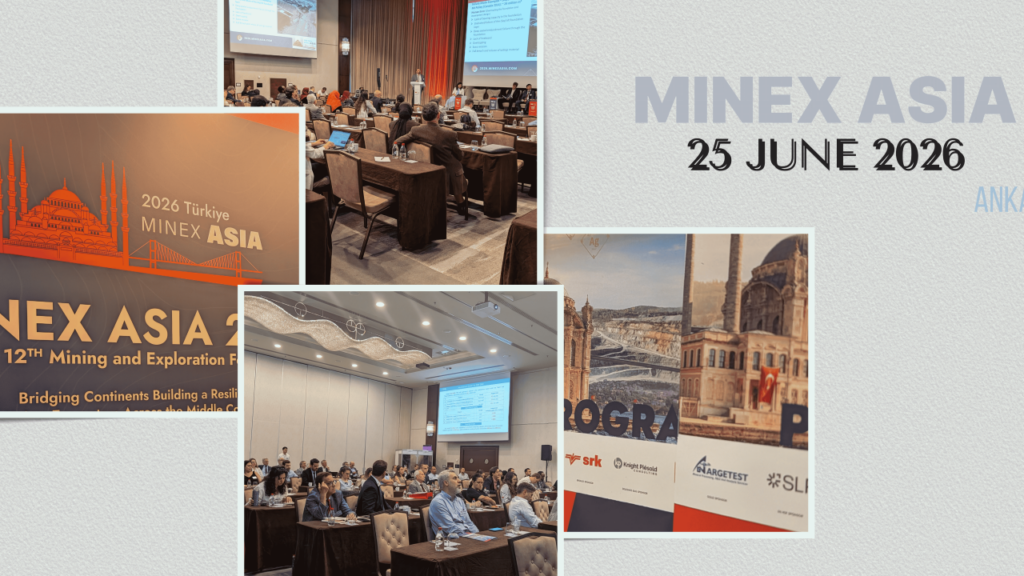
If Day 1 asked “why does geological wealth not automatically translate into investment?” then Day 2 answered with brutal clarity: because you cannot move critical minerals to global markets without the infrastructure to process them. And that infrastructure — refining, separation, conversion — is the question that defined every session on 25 June.
The day opened with a deliberate strategic reframing. Nevzat Başlar from MAPEG (Ministry of Energy and Natural Resources) did not call his presentation “Türkiye’s Mining Vision” or “Turkey’s Mineral Wealth.” He titled it: “Bridging Between Reserves and Refining: Türkiye’s Strategic Role in the Global Critical Minerals Race.”
The phrasing was intentional. Türkiye is not positioning itself as a reserve. It positions itself as a bridge. Not a source country, but an industrial anchor — capable of converting Central Asian ore into finished products for Western supply chains. The argument was structural: Türkiye sits at the point where Central Asian geology meets European demand. But proximity is worthless without processing. The strategic imperative is to develop midstream processing capacity — that transformative layer where raw material from Uzbekistan and Kazakhstan becomes inputs for EV motors, wind turbines, and defence electronics before they reach Western manufacturers.
This was not background framing. It was the foundation for everything that followed.The morning: supply chain positioning and financial instruments
Sebnem Alp from UKEF followed with a presentation on trade financing. Her argument moved beyond the project-finance logic that had dominated Day 1’s financing panel. Trade finance operates on a different timeline and risk profile: shorter tenors (12–24 months versus 5–7 years), repeatable commodity flows, and off-balance-sheet structures that allow regional banks and development institutions to recycle capital efficiently. The subtext was clear: if the Middle Corridor is going to move tonnes of processed materials, you don’t finance it with mega-loans to mega-projects. You finance it with working capital lines and commodity flows between nodes.

Timur Khikmatullaev from Uzbekistan’s Technological Metals Complex presented “Unlocking Uzbekistan’s Critical Raw Materials” — but the word “unlocking” carried weight. Uzbekistan is moving from bilateral Chinese partnerships toward Western supply chain integration. The Complex’s presence as a forum partner signalled that Tashkent now sees Western offtake arrangements and technology partnerships as genuinely competitive with Chinese state finance. Speed, he argued, is no longer China’s monopoly if Western institutions and private capital move with coordinated intent.

Dr Tomas Hrstka from SGS brought the assurance layer. His presentation — “Unlocking the Tethyan Belt: The Strategic Role of Advanced Mineralogy and New Technologies in Accelerating Projects, Reducing Development Risks and Optimising Performance” — positioned testing and certification not as compliance overhead but as a competitive accelerator. Advanced mineralogy data at the front end of a project reduces capex uncertainty, speeds permitting, and attracts first-loss capital from Western investors who demand CRIRSCO/JORC compliance. The technical infrastructure arrives before the mining infrastructure.
Artyom Geghamyan from Armenia presented the regional closure to the morning’s supply chain vision: “Armenia at the Intersection of Critical Minerals, Connectivity and Peace.” The title embedded a geopolitical argument: Armenia’s post-conflict position, its mineral endowment, and its location along the Middle Corridor create a window. Armenia could become a processing node or remain a source of raw exports. The choice is Armenia’s, but the structural logic is the same as Türkiye’s — geography plus processing capacity equals supply chain criticality.
The morning’s closing speaker was Veda Duman Kantarcıoğlu from the Nuclear Engineers Society — and her presentation reframed what “mining” actually means in a rare earth element context. “Developing National Competencies for Nuclear-Industrial Partnerships for Mining Applications” made explicit what was implicit in Beylikova: rare earth processing generates radioactive byproducts. Processing REE is not standard industrial mining — it is quasi-nuclear operation. It requires workforce training aligned with nuclear safety protocols, regulatory partnerships with nuclear authorities, and infrastructure designed to international IAEA standards. Veda’s presence in the session signalled that Türkiye’s Akkuyu nuclear facility and its nuclear regulatory ecosystem are not separate from the mining story. They are central to it.
Midday: ESG as competitive advantage, not compliance burden
Session 6, moderated by Zhanar Faizuldayeva of SLR Consulting, was titled “Responsible Mining: Driving Sustainability, Trust, and Global Standards in Eurasia.” The framing was not defensive. The session positioned ESG as a competitive filter, not a compliance burden. Projects with robust environmental and social governance attract Western capital faster, command better offtake terms, retain social licence, and move through permitting more quickly.
Tunç Berkman from TBS Investment made the opening case: “Mining’s Greatest Resource is No Longer Underground — It is Public Trust.” The line was powerful. Geological wealth is abundant; public confidence is finite. Companies that build it win capital and speed. Companies that destroy it lose both.
The session acknowledged that standardisation creates competitive advantage. A zone of ESG compliance across Eurasian projects, certified and transparent, becomes immediately bankable to Western development finance institutions without additional diligence. Standards reduce friction in capital flows.
The technical constraints no one can sidestep
Session 7, “Tailings Management, Structural Resilience and Resource Stewardship,” moderated again by Zhanar Faizuldayeva, brought the conversation to the engineering reality that has stopped more mining projects than geology ever has: what happens to the waste?
The panel assembled the specialists: Sam Safavian (SLR) on risk-based safety reviews; Alistair White (Knight Piesold) on resilience-based design; Iain Pickard (Strategia Worldwide) presenting Tailings Protect — an integrated real-time monitoring and risk management solution; and Azamat Abdulayev (SRK Kazakhstan) closing with water management as competitive advantage in a region facing acute water stress.
The core argument was unambiguous: modern tailings management is not bolt-on infrastructure. It is central design. Dry stacking, filtered tailings, managed impoundments with real-time monitoring add 10–15% to capex and require operational discipline across the project lifecycle. For the Middle Corridor, the implication was sharp: you cannot replicate the Chinese model of rapid development with lower environmental standards and hope to export to Western markets. Your tailings will be audited. Your water management will be certified. The cost is structural and non-negotiable.
The afternoon: value chain integration and processing momentum
Session 8, “From Ore to Application: Operational Technology and Value-Chain Integration,” moderated by Ivan Livinskiy of SRK Kazakhstan, moved to the point where most Central Asian minerals still stop: processing.
Umid Salokhutdinov from Future Metals Technopark presented the technopark model as Uzbekistan’s answer to a specific problem: you can mine tungsten, but unless you process it into tungsten carbide or high-temperature alloys, you compete with Chinese raw material exports on price and lose. The Technopark is infrastructure for midstream processing — company A mines ore in deposit X, company B processes it at the park, company C manufactures final products, company D integrates them into systems. Profit margins compound at each step.
Emre Ahmet Kantarci from ExxonMobil brought the multinational perspective. ExxonMobil’s interest in the Middle Corridor is not primarily mining. It is securing feedstock for advanced materials manufacturing — batteries, wind turbine components, defence electronics. The multinational majors are thinking vertically integrated supply chains, not purchasing tonnes of raw ore at commodity prices.
Burak Köse from ARGETEST closed the session with the data infrastructure argument: none of this works without laboratory certification at every step. ARGETEST’s expansion into Tashkent and three additional Central Asian countries reflects the reality that processing hubs cannot operate without local laboratory capacity.
The closing: tensions clarified but not resolved
Session 9’s closing panel — “Bridging the Supply Gap: Türkiye and the Middle Corridor as New Frontier for Critical Mineral Security” — brought together Céleste Laporte (OECD), Zhanar Faizuldayeva (SLR), and Ivan Livinskiy (SRK Kazakhstan) under Han İlhan’s moderation.
The panellists did not paper over the central unresolved tension. Supply chain positioning along the Middle Corridor: agreed. Industrial anchor capacity: conceptually clear. But the speed remains fundamentally mismatched. Western capital moves at 3–5 years for permitting, 2–3 for financing, 4–5 for construction. Chinese capital moves in 18–24 months. The region has choice — geology is real and governance is improving — but on a timeline that doesn’t match the energy transition’s hunger for supply.
The other unresolved tension: processing. Every speaker on Day 2 acknowledged that value creation happens downstream, not in extraction. But processing requires different capital intensity, different workforce training, different infrastructure. Mining companies extract ore. Manufacturing companies process it. The Middle Corridor does not yet have enough of the latter to absorb the former’s output at rates that would shift global supply chains.
The day’s through-line
By evening, when delegates moved to the Göksu Restaurant for the Day 2 networking dinner, the conversation had shifted but not concluded.
Day 1 asked “why isn’t geological wealth flowing into investment?” Day 2 answered: because the supply chains do not yet exist — not because they cannot, but because they require simultaneous moves across geology, governance, processing infrastructure, workforce development, ESG certification, water management, and political will at sovereign scale.
Başlar’s frame — “Bridging Reserves and Refining” — was the day’s synthesis. The Middle Corridor has reserves. It has refining capacity in development. It has governance improving. What it doesn’t yet have is the decision — at sovereign scale, backed by capital commitment — that processing capacity is the strategic priority, not extraction speed alone.
Kazakhstan is partly there. Uzbekistan is accelerating. The region — with combined geological endowments that dwarf most of the world — remains at the inflection point. The institutions are assembling. The case is being made. The question is whether speed matches opportunity, and whether political will can keep pace with geological advantage.
Day 2 sharpened the question. It did not answer it.