Tag: Mineral Deposits

  • Kazakhstan Registers 54 New Mineral Deposits, Boosting Resource Reserves

    Kazakhstan Registers 54 New Mineral Deposits, Boosting Resource Reserves

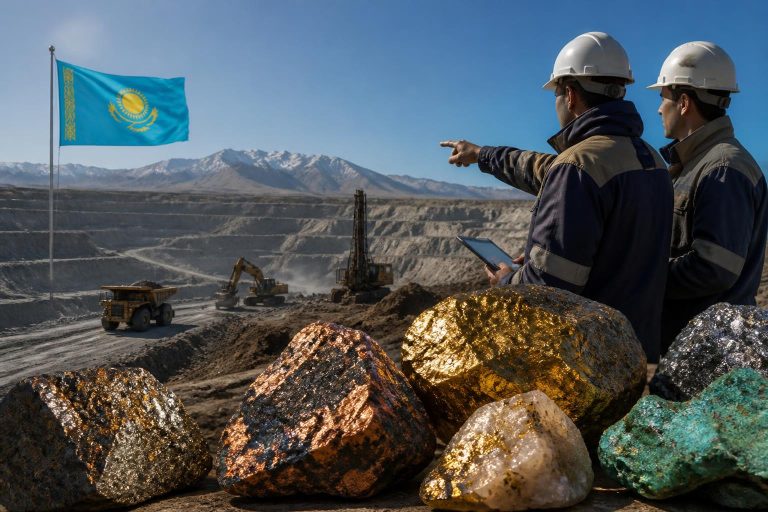
    In a significant development for Kazakhstan’s mining sector, the government has announced the registration of 54 new mineral deposits between 2024 and 2025. This move has resulted in a notable increase in the country’s mineral resources, including an additional 157.2 tonnes of gold, 9,400 tonnes of silver, and 122,700 tonnes of copper. The Ministry of Industry and Construction reported that 35 deposits were registered in 2024, comprising 23 solid minerals, six hydrocarbon resources, and six underground water sources. In 2025, a further 19 deposits were added, including 17 solid minerals, one hydrocarbon resource, and one underground water source.

    The increase in mineral reserves is significant, with notable additions across various minerals. The updated figures include 927,000 tonnes of chrome ore, 171,900 tonnes of zinc, 114,800 tonnes of lead, and 262.2 million tonnes of iron ore. Additionally, the country has identified 199 million tonnes of oil and 22 billion cubic meters of gas, alongside 104,148 cubic meters per day of underground water. Overall, Kazakhstan now has approximately 10,000 registered mineral deposits, with 935,400 tonnes of forecasted rare earth metal resources identified in prospective areas.

    The search for critical and strategic minerals, essential for industrial development and new technologies, has become a key focus for the government. Among these minerals are gold, copper, polymetals, lithium, tungsten, molybdenum, as well as rare and rare earth metals. Kazakhstan possesses a resource base for several of these materials, with significant lithium deposits located at Karagailyaktas, Akhmetkino, and Akhimirovskoye. The largest molybdenum deposits are found in the Karaganda region, including Koktenkol, Verkhne-Kairaktinskoe, and Northern Katpar, while the Aбай region features the notable Aydarly deposit.

    Rare and rare earth metals play a crucial role in modern technologies and prospective industries. Their development is important not only for the raw materials sector but also for the broader industrial advancement of the country. Currently, research has been completed on 11 sites included in the exploration programme, with the Kuyraktykol site in the Karaganda region identified as particularly promising. High forecasted concentrations of rare earth metals such as La, Ce, Nd, and Y have been reported, with total forecasted resources across the sites amounting to 935,400 tonnes. Additionally, reserves in the C2 category have been estimated at 795,800 tonnes in the Irgyz area, with further potential identified at sites like Kenkuduk, Rzhavaya Sopka, Mirolubovsky, Bokai, and Kuneoy.

    The government-funded geological works are part of a budget programme aimed at ensuring the rational and comprehensive use of subsoil resources and enhancing geological knowledge of the territory. For the years 2024-2026, the state budget allocation for these activities totals 62.4 billion tenge, with 6.6 billion tenge earmarked for 2024, 7.9 billion tenge for 2025, and 47.9 billion tenge for 2026. The programme encompasses regional geological surveys, exploration and assessment works, which are expected to improve the quality and completeness of geological information necessary for both state management of subsoil resources and the activities of subsoil users.

    As part of these efforts, data from paper records is being digitised. A unified subsoil use platform has been established, featuring a map of Kazakhstan’s subsoil use, which currently hosts 66,100 initial geological report volumes, linked to 109,500 study contours. Furthermore, over 4.8 million units of primary geological information have been digitised, including approximately 4.3 million sheets of paper records, 355,000 graphic applications, 97,000 magnetic tapes, and 62,000 cartridges. This digitisation effort significantly enhances the accessibility of geological materials for users, allowing investors and subsoil users to access reports and evaluate the potential interest of specific areas without solely relying on paper archives.


  • Uzbekistan Advances Nationwide Geological Mapping and Exploration with 154 Active Projects

    Uzbekistan Advances Nationwide Geological Mapping and Exploration with 154 Active Projects

    At a recent briefing held by the Agency for Information and Mass Communications, N. Dulabova, Head of Department at the Ministry of Mining Industry and Geology of Uzbekistan, detailed the country’s accelerating efforts in geological exploration and mineral resource mapping.

    In 2024, digital geological maps were completed for 75,000 square kilometers in southern Uzbekistan at a 1:200,000 scale. In parallel, comprehensive space-geological and geochemical surveys were carried out over 6,000 square kilometers, including key areas such as the Molguzar and Gissar ranges. Updated tectonic-structural schemes and multipurpose geochemical maps were also developed for these regions.

    Furthermore, detailed re-mapping at a 1:50,000 scale was conducted over a 3,500-square-kilometer mountainous zone encompassing the Auminzatau, Beltau, Tamdytau, Aristantau, Sangruntau, Yakkabag, Gissar, and Kulzhuktau ranges. As a result, 42 promising mineral zones were identified, spanning eight types of valuable resources.

    In 2025, under the framework of the State Geological Program, work is being carried out on 154 geological exploration projects. By the end of the year, Uzbekistan aims to finalize a complete set of national digital geological maps at a 1:200,000 scale and complete space-geological and geochemical research across an additional 3,000 square kilometers.

    These efforts aim to enhance the country’s strategic understanding of its subsoil wealth and unlock new investment opportunities across various segments of the mining industry.

  • Kazakhstan to Hold Auction for Solid Mineral Deposits, Including Bauxite, Coal, and Gold

    Kazakhstan to Hold Auction for Solid Mineral Deposits, Including Bauxite, Coal, and Gold

    The Ministry of Industry of Kazakhstan is set to announce an auction for deposits of solid minerals later this month, according to inbusiness.kz, citing Almas Kushumov, the head of the subsoil use department.
    The ministry plans to offer 23 new deposits to potential bidders, including sites with approved reserves of bauxite, coal, polymetallic ores, and gold.
    Mr. Kushumov stated that all the necessary information regarding the auction will be published on the official website of the Ministry of Industry, allowing interested parties to learn which deposits are available for exploration and licensing.
    He also noted that the state fund holds other valuable plots. However, as subsoil users failed to fulfill their obligations for these deposits, their licenses were revoked. Information about these areas will be made available to the public at a later date.

  • Ministry of Industry and Infrastructure Development to Auction Over 100 Mineral Deposits

    Ministry of Industry and Infrastructure Development to Auction Over 100 Mineral Deposits

    By the end of the first summer month, the Ministry of Industry and Infrastructure Development will showcase more than 100 mineral deposits at an auction, including 23 returned and 83 reserve sites. This announcement was made by the head of the Ministry’s Committee of Geology, Erlan Akbarov, during a briefing at the SCC. All auctions will enforce commitments to ensure production levels do not fall below the average national output. Prospective bidders are reminded of the obligation to allocate funding for the development of regional social infrastructure. In 2023, the Ministry organized two auctions, offering 74 potentially valuable sites, with total subscription bonuses amounting to around 3.5 billion tenge, as reported by the Ministry’s press center. Mr. Akbarov stated that nearly 10 billion tenge is allocated annually for state geological exploration of mineral resources. Over the past five years, approximately 52 billion tenge has been invested in this sector, equating to 8 per square kilometer. Notably ,mineral rights holders have spent significantly more on geological exploration activities over the five−year period, totaling 357 billion tenge.