Tag: global supply chain

  • Rare-Earth Metals Move to the Center of Global Tech Competition as Kazakhstan Emerges as a Major Future Player

    Rare-Earth Metals Move to the Center of Global Tech Competition as Kazakhstan Emerges as a Major Future Player

    Rare-earth metals, long overshadowed by more familiar raw materials, have become the backbone of the global technological race, according to BAQ.KZ citing Energyprom. These 17 elements, found in nature in dispersed form, are essential to modern economic resilience. They are critical for manufacturing microchips, lasers, batteries, electric vehicle magnets, and key components of military electronics.

    Surging demand—driven by the rapid expansion of electric mobility, the growth of renewable energy, and increasing defense budgets—has turned rare-earth elements into one of the world’s most strained and politically sensitive commodity markets. Supply growth continues to lag behind demand, intensifying geopolitical tensions especially given that China controls over 70% of global mining and nearly 90% of processing.

    Over the past two decades, the industry has undergone several drastic shifts, ranging from declining output in the early 2010s to a strong production boom between 2018 and 2023. Global output rose from 101.5 thousand tonnes in 2004 to 379.9 thousand tonnes in 2024—nearly a fourfold increase. China remains the dominant producer with 270 thousand tonnes annually, followed by the United States with 45 thousand tonnes, Australia and Thailand with 13 thousand tonnes each, and Russia with just 2.5 thousand tonnes.

    Beijing continues to leverage its vast production capacity and near-total processing dominance as both an economic and geopolitical tool. In recent months, China has expanded export controls on multiple rare-earth elements. The U.S. has accused China of market manipulation and exerting “economic pressure.” While a recent meeting between leaders of the two nations helped temporarily reduce tensions—China agreed to delay some restrictions and the U.S. softened select tariffs—the underlying rivalry persists.

    China’s share of global production has fluctuated sharply. It dropped from 85.7% in 2014 to 57.3% by 2020, before rebounding to 71.1% in 2024. Despite global efforts to diversify, China remains the central pillar of the supply chain.

    Global rare-earth reserves are estimated at 90–91 million tonnes. China holds roughly half—44 million tonnes—followed by Brazil (21 million), India (6.9 million), Australia (5.7 million), and Russia (3.8 million). In comparison, the U.S., Madagascar, and Thailand possess only minor reserves.

    A new major player, however, is rapidly emerging. Kazakhstan, according to the State Committee on Geology, holds an estimated 28.2 million tonnes of rare-earth reserves, placing it second in the world behind only China. Experts emphasize that true competitiveness depends not just on resources but on processing capacity. While Brazil has vast reserves, it produces only about 20 tonnes per year due to limited processing capabilities. China, in contrast, combines large reserves with unmatched technological strength.

    Recognizing the sector’s strategic importance, Kazakhstan’s President Kassym-Jomart Tokayev has ordered the launch of at least three rare-earth processing and deep-refining enterprises within the next three years. At the same time, Kazakhstan is actively expanding international partnerships, including signing a Memorandum of Understanding with the United States on critical minerals. This move may play a key role in diversifying global supply chains and strengthening Kazakhstan’s position in the emerging resource architecture of the future.

  • China Tightens Grip on Tajikistan’s Antimony Industry

    China Tightens Grip on Tajikistan’s Antimony Industry

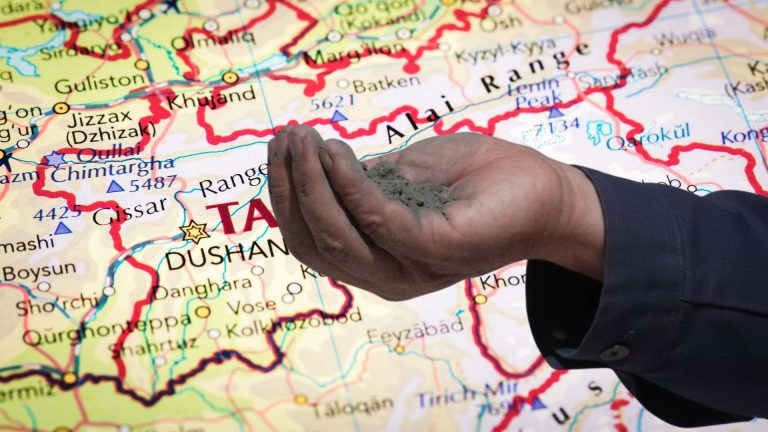
    In Tajikistan’s mountainous heartland, the Soviet-era Saritag antimony mine stands testament to China’s growing influence in Central Asia. Run by the joint venture Talco Gold, a collaboration between Tajik and Chinese companies, the mine produces over 5,000 tonnes of antimony concentrate daily, crucial for many industrial applications. The ore is crushed, ground in large drums, and then separated from the metal using chemical reagents before being dried and bagged as 30% pure antimony. This large-scale operation was made possible by a significant Chinese investment in 2022, which is now being followed by the construction of a new purification plant.

    Pictures of Tajikistan’s long-time President Emomali Rakhmon coexist with portraits of Chinese leader Xi Jinping on posters juxtaposing the country’s past with its present economic reality. While remnants of the Soviet era remain, China has overtaken Russia as the dominant power in the region’s crucial mining sector.

    The full potential of the mine is yet to be unlocked. China’s ambitious $359 million project aims to build a state-of-the-art purification plant on the site, allowing for even greater control over the antimony production chain.

    The Chinese investment, pouring in, signals a strategic move to secure access to vital resources and cement political ties. While offering much-needed economic boost to Tajikistan, it raises concerns about resource dependence and potential environmental consequences.

    This narrative paints a picture of delicate balance: economic prosperity coupled with increasing reliance on a single partner, leaving Tajikistan to navigate the complex landscape of China’s expanding geopolitical footprint in Central Asia.