Tag: energy crisis

  • Europe’s Rivers Face Crisis as Extreme Heat Causes Record Low Water Levels

    Europe’s Rivers Face Crisis as Extreme Heat Causes Record Low Water Levels

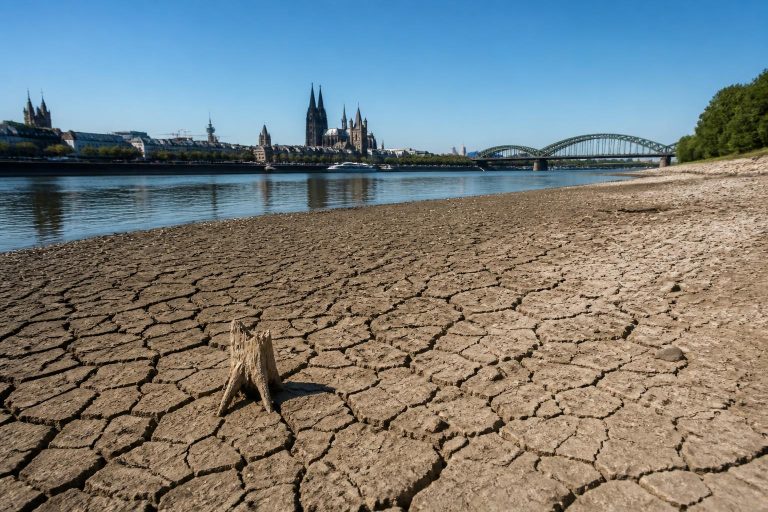
    Europe is grappling with a severe drought as its major rivers, including the Rhine and Danube, experience unprecedented low water levels due to a series of extreme heat waves. This situation poses significant challenges for the region’s heavy industries, which rely heavily on these waterways for the transportation of essential goods such as chemicals and oil products. As water levels drop, freight costs are rising, and power generation at riverside nuclear reactors is being curtailed, leading to increased energy prices and economic strain, particularly in Eastern Europe.

    The Rhine, a critical shipping route, has seen water levels at key chokepoints like Kaub plummet to 25 centimeters, matching the lows recorded during the drought of 2018. Experts predict that levels could fall even further, potentially reaching historic lows not seen since records began in 1880. Companies like BASF, which were forced to reduce production during past droughts, are now seeking alternative transport methods, albeit at higher costs. The situation has prompted discussions among industry leaders about the long-term implications for supply chains and the competitiveness of European industries against global rivals.

    As the drought continues, countries like Hungary and Romania are facing severe energy challenges, with Hungary shutting down its only nuclear plant for the first time in its history due to insufficient cooling water. The Hungarian government has called for more prudent energy and water consumption, while Romania remains on alert as it seeks support from neighbouring Ukraine during peak demand. The ongoing heat waves and drought conditions are not only impacting industrial operations but also threatening agricultural practices, as rivers like the Po in Italy dwindle below historic lows, raising concerns about irrigation and saltwater intrusion. With forecasts indicating continued high temperatures and limited rainfall, the outlook for Europe’s rivers remains bleak, underscoring the urgent need for adaptation to the realities of climate change.


  • EU Unveils Strategic Metals Plan Amid Growing Trade and Energy Challenges

    EU Unveils Strategic Metals Plan Amid Growing Trade and Energy Challenges

    The European Commission has identified 47 strategic projects aimed at strengthening the region’s critical minerals sector and reducing its dependence on imports, particularly from China. These projects, spanning 13 member states, focus on materials essential for batteries and semiconductor production, with the goal of meeting the EU’s 2030 domestic production targets for key minerals like lithium and cobalt.

    However, the EU’s ambitions for the future come at a time of crisis in its traditional metals sector. European steel and aluminum production have suffered due to high energy costs and competition from Chinese overcapacity. Now, U.S. tariffs on aluminum imports pose an additional threat by potentially diverting excess metal into the European market.

    In response, the EU is considering tighter steel import quotas, new aluminum import restrictions, and a “melted and poured” rule to regulate metal origin tracking. Additionally, the Commission is preparing trade measures to curb the outflow of recyclable materials such as aluminum and copper scrap, which are increasingly being exported to the U.S. where they are exempt from tariffs.

    Despite the Commission’s efforts, industry leaders stress the need for immediate action. Paul Voss, Director General of European Aluminium, has called for swift and targeted interventions to stabilize the sector. While the EU is making strides in securing its future metal supply chains, urgent measures are required to prevent further contraction of its industrial base.

  • Germany to Shutdown Seven Lignite-Fired Power Plant Units Amid Energy Crisis

    Germany to Shutdown Seven Lignite-Fired Power Plant Units Amid Energy Crisis

    Germany is set to decommission seven lignite-fired power plant units with a total capacity of 3.1 gigawatts by the end of March, as reported by the news agency dpa in Süddeutsche Zeitung. Originally delayed due to the energy crisis, these closures come as part of efforts to conserve natural gas amidst supply concerns. Five units were removed from the security reserve, while two others continued operation beyond the planned shutdown date. All units were permitted to sell electricity on the wholesale market, a privilege now rescinded. The Federal Network Agency (BNetzA) assured that these shutdowns won’t jeopardize supply security, emphasizing meticulous planning to accommodate the closures in supply forecasts.

  • German сoal plants may have to remain on standby longer than planned

    German сoal plants may have to remain on standby longer than planned

    The German government is evaluating prolonging the period in which decommissioned coal-fired power plants would be demanded to remain on standby for emergency backup past the currently scheduled deadline in the spring of 2024, according to a report in the esteemed German business publication Handelsblatt citing a spokeswoman for the economy ministry.

    In light of the energy and gas crisis precipitated by the loss of Russian gas last year, both utilities and governments are rightly concerned to maintain security of electricity supply during periods of peak demand. Consequently, Germany has already reactivated several coal units operated by RWE and LEAG on a temporary basis until March 2024.

    This preventative step follows the successful utilization of such backup coal capability throughout the previous winter. Now the administration is weighing an extension of this standby arrangement beyond 2024 springtime to forestall any energy shortfalls, per the source mentioned.

    Timely resolution of this matter is pressed by the need for utilities to make adequate arrangements regarding coal procurement and maintaining stable energy infrastructure, as emphasized by a spokesperson for Uniper to Handelsblatt. Currently 11 coal-fired power stations with a combined output of 6.2 gigawatts are contributing additional electricity to the German grid. A sensible decision can thus be expected from the government in due course.

  • Explained: The EU’s handicap in the global race for critical raw materials

    Explained: The EU’s handicap in the global race for critical raw materials

    The EU is highly dependent on third countries for the raw materials needed to engineer its energy transition and digital transformation.

    Russia’s war in Ukraine and the need to wean itself off fossil fuels in order to reach climate targets have prompted the EU to accelerate its green transition in recent months but also forced it to acknowledge its dependencies over access to critical raw materials.

    In the global race for raw materials, the EU faces multiple challenges.

    The first one is China, which recently started restricting exports of gallium and germanium, two metals essential for the production of semiconductors, in response to Western curbs on Beijing’s access to micro-processing technology.

    The EU considers both materials of high strategic importance. As well as semiconductors and other electronic devices, they are used for military applications such as missile defence and radar systems.

    Beijing’s restrictions come as a stark warning as the EU attempts to diversify and boost domestic supply of raw materials to reduce dependency on third countries.

    Reliance on ‘low-governance’ countries

    But diversifying supply chains could mean the EU has to source these materials from countries that don’t adhere to the same standards.

    Recent data suggests the EU’s supply is highly dependent on countries that have a low governance level, based on indicators including political stability, rule of law and corruption control.

    The EU’s Critical Raw Materials Act (CRMA), adopted in March this year, stipulates that EU strategic projects to scale up supply must be assessed taking into account all aspects of sustainability, including environmental protection, socially responsible practices and respect for human rights such as the rights of women.

    But many countries feeding EU supply are not aligned with European values. This raises concerns about the impact on the local communities where materials are mined, as well as the potential exploitation of natural resources.

    For example, the Democratic Republic of Congo, whose governance indicators are among the lowest in the world, supplies 63% of the EU’s cobalt, which is essential for manufacturing batteries for electrical vehicles.

    Diversifying supply a challenge

    The EU is also highly dependent on single countries for key materials such as Magnesium (China, 97%), Lithium (Chile, 97%), Iridium (South Africa, 93%) and Niobium (Brazil, 92%). These dependencies make supply chains vulnerable.

    The Critical Raw Materials Act aims to ensure no third country provides more than 65% of the Union’s annual consumption of any raw material.

    But diversifying supply is complex when refineries of many essential materials are monopolised by one or more global powers. China dominates the refining market for many critical raw materials.

    Russia’s invasion of Ukraine and the ensuing energy crisis has shown the acute dangers of over-reliance for supplies of raw materials. China’s increasingly antagonistic stance and the political instability in many African countries have also served as reminders of the fragility of the EU’s trading relationships.

    A spiralling global demand

    The demand for raw materials is growing steeply, as developed countries race to digitalise and decarbonise their economies. This can only happen with sufficient supply of raw materials, meaning countries must scale up extracting, refining and recycling operations.

    The global demand for lithium, for example, is set to increase a staggering 89-fold by 2050, according to the European Commission. Demand for gallium will multiply 17-fold during the same time.

    The Critical Raw Materials Act sets targets for the Union to extract 10%, process 40% and recycle 15% of its annual consumption of raw materials by 2030.

    To meet these targets and compete on the global stage, European Commission President Ursula von der Leyen has said the EU needs to speed up investments in research and development, recognising that the bloc’s global share of R&D expenditure has fallen 10% in the last 20 years.