Tag: economic growth

  • Britain to Sign Minerals Cooperation Deal with Saudi Arabia

    Britain to Sign Minerals Cooperation Deal with Saudi Arabia

    The UK will sign a minerals cooperation agreement with Saudi Arabia to enhance critical mineral supply chains, attract investments, and support economic growth. Critical minerals like lithium, copper, and nickel, vital for clean energy technologies and AI development, are key priorities for the UK.

    Saudi Arabia, with untapped resources valued at $2.5 trillion, aims to be a global critical minerals hub. The agreement aligns with ongoing UK-GCC free trade negotiations. British Industry Minister Sarah Jones will lead 16 companies to Riyadh’s Future Minerals Forum, emphasizing the UK’s strategic goals in securing resources.


  • Mongolia’s Mineral Wealth: Balancing Economic Growth and Governance Challenges

    Mongolia’s Mineral Wealth: Balancing Economic Growth and Governance Challenges

    Mongolia is at a pivotal juncture, leveraging its abundant mineral resources to bolster economic growth. The nation boasts some of the world’s largest reserves of copper and rare earth elements, making it a key player in global supply chains. Strategically situated between China and Russia, Mongolia aims to diversify its economic and diplomatic ties through its “third neighbor policy.” Despite its mineral wealth, Mongolia faces significant governance challenges, including corruption and political instability. Recent efforts focus on legal reforms and international cooperation to enhance transparency and attract foreign investment.

    Mongolia’s economic strategy is deeply intertwined with its diplomatic maneuvers, seeking to balance relationships with powerful neighbors and global partners. The country’s mineral sector is a cornerstone of this strategy, driving growth and development. However, governance issues pose risks to stability and investor confidence. Mongolia’s government is actively working on reforms to improve regulatory frameworks, ensuring that its mineral wealth translates into sustainable development for its population.

    The nation’s commitment to international cooperation is evident in its efforts to engage with various global entities and countries. By fostering a transparent and investor-friendly environment, Mongolia hopes to harness its mineral wealth effectively while addressing internal governance issues. This delicate balancing act is crucial for the country’s long-term economic prosperity and geopolitical stability.

  • Tajikistan’s Mining Industry Surges with 18% Growth in Early 2024

    Tajikistan’s Mining Industry Surges with 18% Growth in Early 2024

    Mining output in Tajikistan has grown by more than 18% over the past year. Enterprises in the mining and precious metals industry for the first four months of 2024 produced quantities worth 4.3 billion somonis ($398.6 million), which is 667 million somonis ($61.7 million) or almost 19% more than the same period in 2023.

    According to Muhammadvalishokh Makshulov, a Ministry of Industry and New Technologies spokesman, the demand depends primarily on increasing enterprises’ capacity and creating new directions in their work.

    According to the ministry, last year the company Zarafshon launched a metallurgical plant to produce metallic copper, built on the most modern technologies in the world, thanks to the acquisition of more than $119 million.

    Also, on 5 July 2023, the enrichment plant of TVEA Dushanbe Mining Industry LLC, with a capacity of processing 900,000 tons of ore per year in the Ayni district of the Sughd region, started operating. This company started production at two mines: Kumargi Bolo and Duobai Sharqi. The first mine is located at an altitude of almost 4,000 meters, and the second is at 2,300 meters.

    Last year, with the attraction of $43 million in foreign capital, construction began on the second stage of a metallurgical plant to produce lead, silver, and copper for the Tajik-Chinese mining and industrial company.

    Currently, 21 companies are engaged in the mining and processing of minerals and precious metals in Tajikistan, seven of which are active due to Chinese investments.

    About 12,500 people work in the business of mining and processing minerals and precious metals. Of these, 11,500 are Tajik citizens, and the rest are Chinese.

  • Kazakhstan and China Sign Agreement for Major Copper Smelting Plant

    Kazakhstan and China Sign Agreement for Major Copper Smelting Plant

    Prime Minister of the Republic of Kazakhstan, Olzhas Bektenov, and Chairman of the Board of Directors of China Nonferrous Metal Mining Co. Ltd., Xi Zhengping, discussed cooperation in the copper industry, according to Kazinform news agency, citing the press service of the Cabinet.

    The meeting culminated in the signing of an agreement, in the presence of Prime Minister Bektenov, to construct a copper smelting plant with an annual capacity of 300,000 tons of copper. The agreement involves KAZ Minerals Smelting as the client, China Nonferrous Metal Industry’s Foreign Engineering and Construction Co., Ltd. (NFC) as the provider of design and equipment procurement services, and NFC Kazakhstan as the contractor for construction and commissioning.

    The plant will be built near the village of Aktogay in the Abay region. It will use copper concentrate from the Bozshakol and Aktogay mining and processing plants, operated by Vostoktsvetmet. Upon completion, the project will create a cluster combining one of the world’s largest copper mines with modern copper smelting facilities. The project, with an estimated cost of $1.5 billion, is expected to create over 1,000 new jobs and be operational by the end of 2028.

    This high-tech enterprise will be the largest in the republic, producing high value-added products. The technologies used in the copper smelting process will meet global environmental standards. The plant will satisfy domestic market needs for processing copper-containing raw materials and producing cathode copper, which is extensively used in electric power, mechanical engineering, and other industrial sectors. Additionally, the new plant plans to produce refined gold, silver, and sulfuric acid.

    “The Head of State has set a task for sustainable economic growth. The construction of a new copper smelting plant is a major industrial project that will increase the processing of copper raw materials mined in the country and make a significant contribution to our economy. The copper industry is one of the priority sectors of our industry, and its dynamic development is very important to us,” emphasized Olzhas Bektenov.

    China Nonferrous Metal Industry’s Foreign Engineering and Construction Company Ltd (“Non Ferrous China”) is a state-controlled company listed on the Shenzhen Stock Exchange. It participates in international project contracts and the development of non-ferrous metal resources. NFC was the first Chinese company to invest in mining assets for the extraction and processing of non-ferrous metals outside China and also owns mining projects within the country. It operates in over 20 countries worldwide and has been the leading contractor on KAZ Minerals projects – Bozshakol, Aktogay, and Bozymchak.

  • Kazakhstan’s Iron Ore Production Surges in February 2024

    Kazakhstan’s Iron Ore Production Surges in February 2024

    Kazakhstan’s iron ore extraction witnessed a significant surge in the second month of this year, with over 4.187 million tons extracted, marking a 37.5% increase compared to February 2023, according to data provided by the National Statistics Bureau. Production of iron ore agglomerate also experienced a notable uptick, growing by 44.8% for the month. However, in comparison to January 2024, it declined from 475.5 to 456.1 thousand tons. Positive dynamics were also observed in the production of iron ore concentrates, reaching 5.699 million tons in February, marking a 15.9% and 12.3% increase compared to the same month last year and the preceding month of this year, respectively. Additionally, Kazakh mining plants saw a significant rise in the production of non-agglomerated iron ore, with 2.661 million tons processed in February, a 44.9% surge compared to the previous year. The production of iron ore pellets also intensified, reaching 474.8 thousand tons, a 38.8% increase compared to 2023, albeit failing to surpass January’s figures, showing a 2.2% decline. Anticipation is high for a noticeable increase in iron ore extraction following the commencement of operations at the Lomonosovskoye deposit in the Kostanay region, slated for 2025.

  • Navoi Gold: The Unsung Giant in the World of Gold Mining

    Navoi Gold: The Unsung Giant in the World of Gold Mining

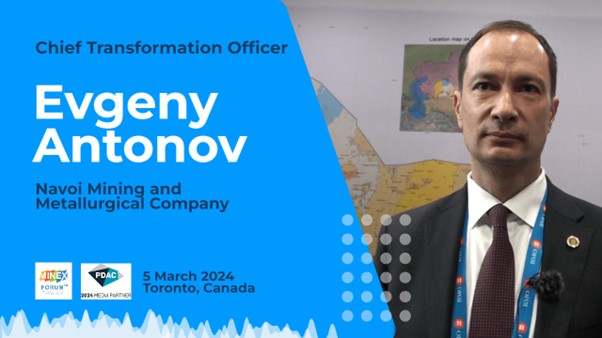
    Toronto, 4 March 2024 — In an exclusive interview at the Prospectors & Developers Association of Canada (PDAC), MINEX Forum sat down with Evgeny Antonov, Chief Transformation Officer of Navoi Gold (Navoi Mining and Metallurgical Company) to learn about the company’s remarkable journey and its pivotal role in shaping Uzbekistan’s economy.

    Toronto, Canada – Navoi Gold, one of the largest gold producers globally, was showcasing its growth potential at the Prospectors & Developers Association of Canada (PDAC) convention in Canada on 3-6 March 2024. In an interview, the company’s Chief Transformation Officer shared insights into their plans for expansion and how they are working towards becoming a more attractive and understandable company for international investors.

    With an annual production of almost 3 million ounces of gold and a low cost per ounce, Navoi Gold is already a significant player in the gold mining industry. However, the company has no plans to slow down and is aiming to increase its production and resource base further. The company has a robust exploration program in place, with a budget of over $100 million for the year, to identify new targets and deepen their understanding of its flagship mine.

    The company is also committed to ESG principles and is taking steps to reduce its water consumption by 20% by 2030. Additionally, Navoi Gold is transitioning to renewable energy sources and plans to introduce over 500 megawatts of solar power by 2030.

    In terms of growth potential, Navoi Gold is looking to expand its production and resource base both organically and through partnerships with other companies. The company is considering teaming up with other companies and exploring new resources outside of their current area of operation, to become a truly international company.

    When asked about the company’s plans for listing on a stock exchange, Antonov explained that it is up to the company’s shareholder, which is currently 100% owned by the state, to decide if and when Navoi Gold will become a listed company. However, the company is taking steps to make sure they are fully ready for such a decision, including implementing IFRS reporting standards and recalculating its resource base according to international standards.

    Navoi Gold’s growth plans are aligned with the state’s plans to grow the economy by 2030, and the company feels a strong sense of responsibility to contribute to the growth of Uzbekistan’s economy. As the largest taxpayer and employer in the country, the company is committed to continuing to play a significant role in the economy and contributing to its growth.

    Overall, Navoi Gold is a company with a strong track record, ambitious growth plans, and a commitment to ESG principles. With their focus on innovation, technology, and partnerships, they are well-positioned to achieve their goals and become a leading player in the international gold mining industry.

    Watch the interview on the MINEX Forum YouTube Channel

  • Poland Emerges as Silver Giant: Implications and Challenges

    Poland Emerges as Silver Giant: Implications and Challenges

    Recent weeks have witnessed a surge of headlines in Poland, revealing a stunning revelation: the country harbors vast silver resources estimated at half a trillion zloty. This development has catapulted Poland into the spotlight as a global leader in silver reserves, a distinction confirmed by the latest report from the U.S. Geological Survey (USGS) titled “Mineral Commodity Summaries 2024.”

    According to the USGS report, Poland boasts an impressive silver reserve of 170,000 tons, surpassing other silver-rich nations by a significant margin. Peru, the second-largest holder, lags behind by 60,000 tons. Despite its recent emergence, Poland has swiftly risen to become the fifth-largest global producer, generating 1,300 tons of silver in 2023.

    This substantial update in reserves, from the previously reported 65,000 tons to the current 170,000 tons, is based on data from Poland’s Geological Service. Earlier indications of this wealth were hinted at in a 2023 report, which highlighted substantial copper and silver deposits across regions like the Fore-Sudetic Monocline and the North Sudetic Basin, particularly in areas surrounding Lubin, Polkowice, and Głogów.

    At current market prices, Poland’s silver reserves are valued at approximately $127 billion, exceeding half a trillion PLN, a sum capable of potentially covering the country’s budget deficit twice over.

    However, despite the economic promise, challenges loom in the realm of silver mining. Adam Stroniawski from the Mint of Poland underscores the importance of these reserves while acknowledging the time-consuming process of accessing, mining, and refining them. He emphasizes the necessity for advanced technology, robust infrastructure, and the scattered distribution of silver deposits.

    Moreover, silver’s significance in various industrial sectors cannot be overlooked, from medicine to electronics and renewable energy. Yet, Stroniawski cautions that while silver remains undervalued and accessible, its exploitation demands careful consideration of environmental impacts and sustainable mining practices.

    The environmental implications of silver mining in Poland are significant, requiring stringent environmental protections and substantial investments in infrastructure, technology, and skills. Developing these resources sustainably is vital for meeting the growing demand for silver in critical sectors such as renewable energy.

    Poland’s ascent as a silver giant signals a pivotal moment in the global market, with potential implications for prices and industrial applications. Nonetheless, navigating the challenges inherent in silver mining demands innovative solutions and international cooperation to ensure that Poland’s newfound wealth benefits both the nation and the global community.

  • Growing cities and mineral reserves are transforming Kazakhstan into an economic powerhouse

    Growing cities and mineral reserves are transforming Kazakhstan into an economic powerhouse

    Thank you for expressing your interest in the exciting opportunities available for businesses outside the UK, particularly in Kazakhstan. This vast country, with its stunning landscapes and untapped potential, offers a wealth of prospects for those seeking to expand their ventures.

    Kazakhstan, being the ninth-largest country in the world, boasts soaring mountain ranges, sprawling deserts, and arid steppes. Its strategic location between the Caspian Sea, Russia, and China, positions it at the heart of the historic Silk Road. With a diverse population of 19 million, Kazakhstan is a modern market with a strong financial outlook and a rapidly growing economy.

    The country’s transformation is evident in its cities, where once-empty plains and grasslands have given way to thriving urban centers. Astana, the gleaming capital, stands as a testament to Kazakhstan’s ambitions and achievements. The magnificent Khan Shatyr, designed by renowned British architect Sir Norman Foster, symbolizes the country’s dominant position in the region. With an economy that grew by 4.1 percent in 2021, Kazakhstan’s economic strength surpasses that of its neighboring countries, making it an attractive destination for investment.

    A significant contributor to Kazakhstan’s economic success is its exceptional mineral wealth. The country is home to abundant reserves of uranium, copper, zinc, and many other elements. The natural resource sector, responsible for a substantial portion of the country’s GDP and exports, presents exciting opportunities for UK firms involved in geological exploration, mining systems development, drilling, and engineering services.

    To ensure transparent and comprehensive state regulation of the mining industry, Kazakhstan adopted a new Mining Code in 2018, aligning national standards with internationally recognized ones. This step has made it even easier for foreign businesses to engage with the mining sector and participate in its development.

    In addition to mineral resources, Kazakhstan’s oil and gas reserves contribute significantly to its natural riches. The industry is embracing innovation and modernization, creating a demand for efficiency solutions and clean technology. The country also offers immense potential for the modernization of its energy infrastructure, including renewable energy projects.

    Agriculture is another thriving sector in Kazakhstan, with over a third of the population relying on the country’s extensive rangelands for their livelihoods. After years of underinvestment, agricultural businesses are seeking modern production technologies. Opportunities abound for businesses to provide farm management technologies, advanced veterinary techniques, and invest in specialty crops, greenhouse operations, and sustainable irrigation systems.

    These technological advancements in sectors such as mining, agriculture, and energy lay the foundation for Kazakhstan’s evolution into a high-tech, diversified economy. UK companies have the opportunity to contribute to the country’s development by providing telecommunications and infrastructure expertise, catering to the demands of a modern regional powerhouse.

    Kazakhstan’s financial reforms have positioned it as one of the most promising markets in the region. The Astana International Financial Centre (AIFC), established in 2018, offers a comprehensive legal platform based on English Common Law, making it an attractive destination for foreign businesses. The AIFC Court, operating independently from the domestic judicial system, ensures fair and enforceable decisions, providing reassurance to companies entering the market.

    From its robust economy and strong regulatory environment to its gateway status for Central Asian markets, Kazakhstan presents a range of benefits for UK businesses looking to capitalize on its vast opportunities.

    The Department for Business and Trade (DBT) is dedicated to supporting businesses like yours as you explore the potential of selling to Kazakhstan. We offer a wide range of free support throughout your exporting journey. To learn more about Kazakhstan and how DBT can assist you, please visit our website at great.gov.uk.