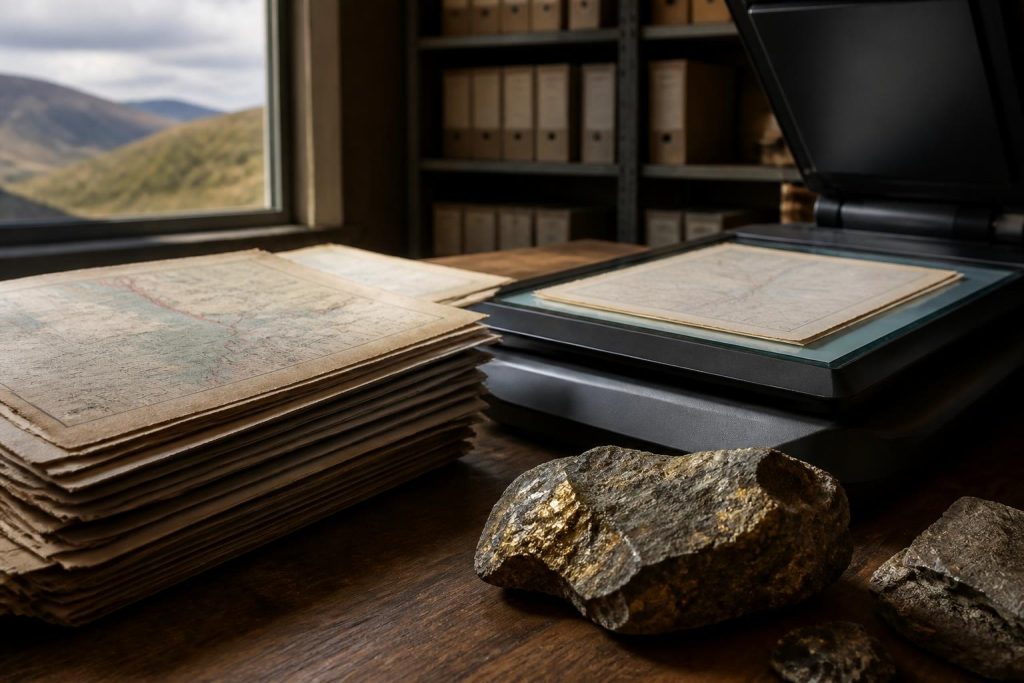
The Mineral Exploration and Investment Grants Act 1972 (MEIGA) has historically stimulated mineral exploration in the UK by providing grants for non-ferrous metals, fluorspar, barium minerals, and potash through the Government’s Department of Trade and Industry. Reports compiled during the 1970s and 1980s contain a wealth of information, including geological mapping, soil and stream sediment geochemistry, geophysical surveys, drillcore logs, and assay data. Until recently, these reports were only accessible in hard copy through the British Geological Survey’s (BGS) National Geoscience Data Centre (NGDC).
In 2023, a digitisation programme, in collaboration with the UK Critical Minerals Intelligence Centre (CMIC), released an initial batch of over 200 mineral exploration reports. The ongoing digitisation efforts have now added an additional 660 reports to the accessible collection, making data collected over forty years ago relevant for identifying critical and precious metal resource potential within the UK. This initiative is particularly significant for the Ardlochan area in south-west Scotland, where Western Gold Exploration completed a shallow drilling programme at the end of 2025, discovering a large breccia pipe system rich in gold. The company utilised MEIGA materials generated by Noranda Mining Limited and Phelps Dodge in the 1970s to complement their own surveys and target other areas of interest.
The MEIGA dataset is proving crucial in refining exploration targets, especially those associated with gold-rich porphyry-breccia systems. The historical reports provide insights into exploration concepts and decision-making processes used by major operators decades ago, allowing for a more confident reconstruction of Ardlochan’s geological story. By integrating these historic insights with modern techniques, companies can accelerate target development and reduce the uncertainty and costs associated with exploration.
The digitisation of BGS archive documents represents a significant effort to valorise legacy datasets, which can greatly impact the exploration sector at minimal cost. The BGS, through CMIC and the NGDC, aims to enhance accessibility to these documents by employing machine learning methods for data extraction and developing large language models for personalised interactions with the archives. The renewed impact of the MEIGA archive underscores the importance of long-term stewardship of geoscience data, ensuring that historic materials can inform modern exploration efforts and unlock new scientific and economic opportunities. The success seen at Ardlochan exemplifies how well-curated archives can facilitate contemporary discoveries, proving that the past can indeed inform the future of mineral exploration in the UK.