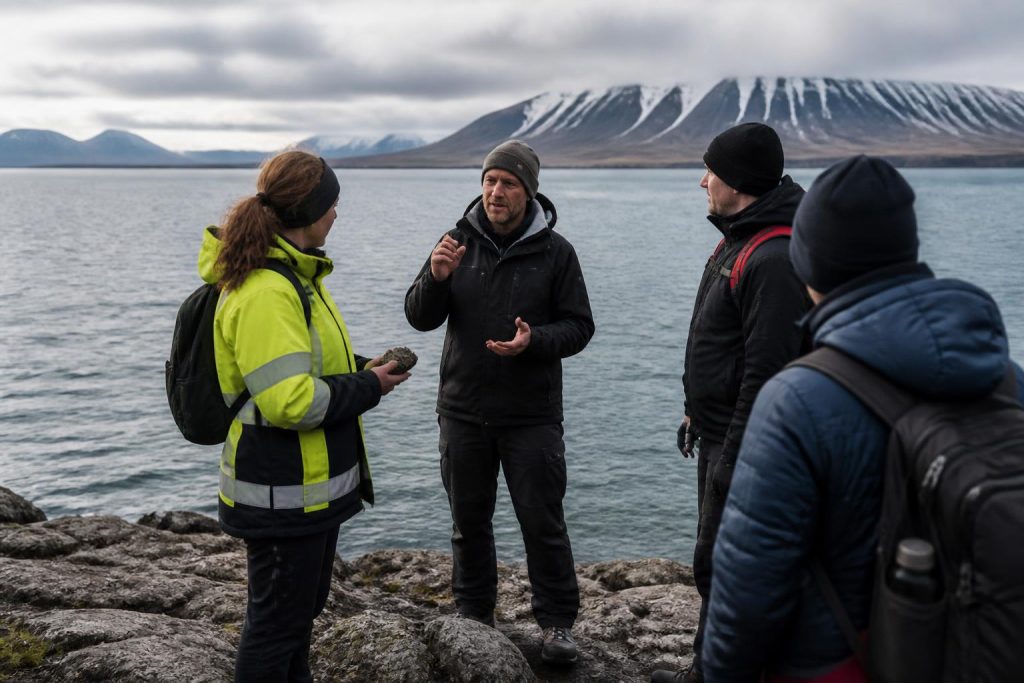
Researchers from the British Geological Survey (BGS) recently embarked on a three-day visit to Iceland, aimed at fostering international partnerships and exploring future collaborative research opportunities under the Research and Innovation Scotland (RIS) initiative. The visit brought together experts from various fields, including marine geoscience, volcanology, geological hazards, geothermal energy, carbon storage, and offshore infrastructure, collaborating with prominent Icelandic organisations such as Iceland GeoSurvey (ÍSOR), the Icelandic Meteorological Office (IMO), and the University of Iceland.
The initiative stemmed from discussions between BGS scientists at the Lyell Centre and Professor Eric Bréard from the University of Edinburgh, focusing on leveraging Iceland’s unique geological features and its renowned expertise in active volcanic and geothermal systems. A primary goal of the RIS-funded project was to strengthen connections between Scottish researchers and their Icelandic counterparts, facilitating knowledge exchange and the identification of future research collaborations.
During the visit, participants engaged in workshops, field visits, and technical discussions, which provided a platform for developing new relationships and sharing insights. A workshop hosted by ÍSOR featured presentations on marine geophysical surveying, geological hazards, volcanology, and carbon storage, highlighting the potential for combining Icelandic marine geophysical capabilities with BGS’s expertise in geological interpretation and hazard assessment.
Field trips to the Reykjanes Peninsula allowed researchers to observe recent volcanic activity and discuss how geological data can enhance understanding of hazards affecting local communities and infrastructure. Additionally, the delegation visited Carbfix facilities to learn about Iceland’s innovative carbon mineralisation technology, discussing future opportunities for collaboration in carbon storage and subsurface characterisation relevant to developments in Scotland and the UK.
The visit culminated in the identification of several collaborative opportunities across various domains, including marine geoscience, offshore hazard mapping, and geological characterisation of the Icelandic shelf. This project was facilitated by BGS’s membership in the Scottish Alliance for Geoscience, Environment and Society (SAGES), which promotes collaboration across environmental sciences and supports the development of international partnerships.
Overall, the visit underscored the importance of international collaboration, highlighting how Iceland’s strengths in geological sciences can complement BGS’s experience in offshore mapping and decision-support products to address shared scientific and societal challenges.