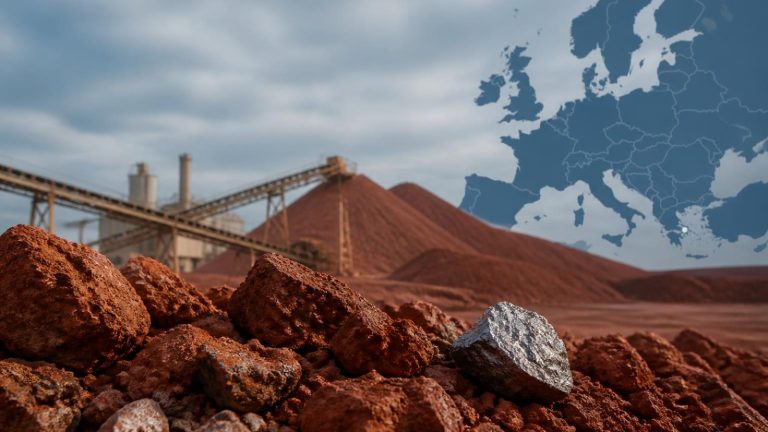
Poland, the Czech Republic, Slovakia and Hungary are each developing distinct approaches to Europe’s critical minerals challenge, but all four face the same structural limitation: the real competition for strategic value lies in processing, refining and advanced manufacturing — stages where China maintains decisive advantages and where none of the Visegrad countries has yet established a compelling position.
The urgency has sharpened since China tightened export controls on critical materials and permanent magnets in 2025, exposing Europe’s continued vulnerability across automotive manufacturing, wind energy and defence production. For the Visegrad Group, the question is whether Central Europe can move beyond its traditional role as a manufacturing base into the higher-value segments of emerging supply chains — a transition that will require more than attracting foreign factories.
Hungary has pursued investment attraction most aggressively, becoming one of Europe’s largest battery manufacturing hubs by drawing major Asian producers including CATL, Samsung, LG and SK On through subsidies and state support. The strategy has delivered factories and jobs, but critics argue that much of the value creation remains outside the Hungarian economy: foreign manufacturers operate within their own supply networks, limiting domestic integration into strategic parts of the battery value chain. Environmental controversies surrounding major projects have also fuelled local opposition.
The Czech Republic is centred on the Cínovec lithium deposit — designated as strategic under the EU’s Critical Raw Materials Act and planned to eventually support battery production for more than one million electric vehicles annually. But mining is not expected to begin until around 2030, and analysts warn that extraction alone will generate limited strategic benefit if downstream processing and recycling take place elsewhere. With one of Europe’s most important automotive sectors, Prague’s real challenge is building the industries that come after the mine.
Slovakia faces similar downstream concerns. Geological surveys suggest lithium and antimony resources exist, but Bratislava remains focused on deposit mapping and assessing potential secondary sources from historical mining sites. Slovak experts identify the absence of active cathode material producers as a critical gap. The country’s exclusion from the first wave of CRMA strategic projects has raised concerns about its ability to benefit from emerging European investment mechanisms without a more assertive industrial strategy.
Poland is taking an unconventional approach, treating mining waste as a critical minerals resource. Coal-bearing formations, spoil heaps and historical mining residues contain germanium, gallium, cobalt and certain rare earth elements that were long discarded. Warsaw has launched a national programme to identify and develop such secondary resources, and plans for a rare earth processing facility in Puławy could strengthen Poland’s position in European supply chains — an approach that reflects the EU’s growing emphasis on recycling and secondary materials alongside primary mining.
Despite differentiated strategies, a common structural weakness runs through all four countries. The European Court of Auditors recently warned that many CRMA objectives lack binding force and could be delayed by permitting procedures that routinely stretch for years — a gap between Brussels’ legislative ambition and on-the-ground implementation that affects Central Europe as much as any other region.