Tag: Urban mining

  • Extraction of raw materials could rise 60% by 2060

    Extraction of raw materials could rise 60% by 2060

    The United Nations’ flagship Global Resources Outlook report is the portrait of a juggernaut. Due to be published later this month by the UN’s International Resource Panel, it highlights how global consumption of raw materials, having increased four-fold since 1970, is set to rise by a further 60% by 2060.

    Already, the technosphere — the totality of human-made products, from airports to Zimmer frames — is heavier than the biosphere. From the 2020s onward, the weight of humanity’s extended body — the concrete shells that keep us sheltered, the metal wings that fly us around — have exceeded that of all life on Earth. Producing this volume of stuff is a major contributor to global heating and ocean acidification, and the rapidly accelerating extinction of plants and animals.

    As the UN report spells out, the extractive activities that lie behind the concrete, metal and other materials we use are disrupting the balance of the planet’s ecosystems. The mining industry requires the annexation of large tracts of land for extraction and transportation; its energy consumption has more than tripled since the 1970s.

    That upward curve is set to continue. The demand for materials is rising, the quality of ores such as copper is declining, and deeper and more remote mines require extra energy for extraction. More seams will be dug and more mountains moved to bring glittering fortunes to some while many regions, above all in developing countries, become sacrifice zones.

    Critical raw materials

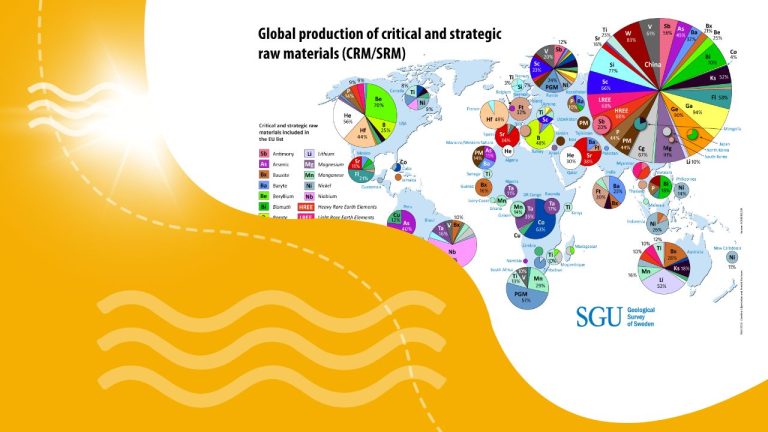
    Attention is increasingly focused on a particular class of material. “Critical” and “strategic” raw materials are those that face supply risk either in their scarcity or their geographical concentration, and which the major powers require for their military sectors and for competitive advantage in tech industries. Right now, the race for critical materials is geopolitical: each major power wants to secure supplies in allied countries.

    Critical raw materials are indispensable to the green transition too. The EU, for example, deems nickel a strategic material in view of its role in batteries.

    A wind turbine can require nine times the mineral inputs of a typical gas-fired power plant, while the average electric vehicle contains between six and ten times those of its conventional counterpart, according to the UN report that is due to be published on February 26.

    None of this means that a green economy would use greater quantities of materials than the current fossil fuel-based one. Energy consumption due to mineral demand for energy transition technologies is dwarfed by that which arises from mineral demand for the rest of the economy.

    Nonetheless, the mineral demand of the energy transition stokes the mining boom in such sectors as copper and lithium.

    Urban mining

    Mining must change in order to reduce its environmental impact. On the supply side, recovering minerals from waste goods can be ramped up, for instance by forcing retailers to offer collections of household electronic waste that can be sent for enhanced recycling.

    There is scope for urban mining: for example, locating copper from inactive underground power cables or recovering elements from construction waste, sewage, incinerator ash and other garbage zones.

    In practice, however, the use of secondary materials relative to newly-extracted ones is declining. The recovery rates of minerals from recycling remain low. Another UN study of 60 metals found the recycling rate for most of them was below one percent.

    The current economic system makes extractive mining cheaper and easier than urban mining. Extractive mining involves the purchase of cheap land, often in developing countries.

    That land gets dug up, pulverised and processed in a simple flow that is amenable to capital-intensive operations. Urban mining by contrast is often labour-intensive and requires a complex and state-enforced regulation of waste streams.

    Urban mining suffers from the refusal of governments to shift taxation from labour to “the use of non-renewable resources”, as Walter Stahel, an originator of the circular economy concept, recommended in 2006. Until robust regulation and taxation is introduced, all forms of circular economy risk unleashing rebound effects.

    So, throwing more materials onto the market lowers prices, which tends to expedite economic growth, raise energy consumption, and proliferate environmental harms. In short, there is nothing intrinsically “green” about urban mining or the circular economy. The progressive potential of all such engineering programmes is governed by the political-economic framework.

  • Urban mining is putting Poland on the path to a greener future

    Urban mining is putting Poland on the path to a greener future

    A paradigm shift is underway in Poland. Traditionally one of the European Union’s heaviest polluters and lowest recyclers, Poland now has the second-highest increase in recycling rates among EU countries over the last decade— new data shows. This is down in part to the work of Pawel Jarski, CEO and Founder of Elemental Holding, and his team. The company’s work is repositioning Poland at the forefront of Europe’s circular economy, a sector that puts eliminating pollution as one of its foundation principles.

    Elemental’s hub of operations lies 40km southwest of Poland’s capital Warsaw. The site is one of energy and contrast. A modern office of floor-to-ceiling glass sits adjacent to a bustling urban mining operation processing electronic waste. A hum of workers busily sort through metal, plastic and cables from massive bags. An assembly line dismantles aging refrigerators, methodically stripping away layers to reveal valuable raw materials. Amidst the ordered chaos, trucks unload circuit boards, adding to the growing heaps.

    It is this well-coordinated mix of hands-on labor and mechanical processing that has powered Elemental’s growth. Founded in Poland in 2010, the company expand into an urban mining and recycling trailblazer with a footprint extending across 15 nations, spanning three continents: Europe, Asia, and North America. They are at the forefront of a new industry dedicated to extracting value from the metal components in disposed electronics and other waste – urban mining.

    IFC is investing $90 million to ramp up the firm’s ability to extract valuable materials from electronic waste while also expanding the firm’s scope to refine them for resale and reuse. At its most fundamental, urban mining seeks to harness electronic materials of untapped and overlooked value – the aluminum, cobalt, and gold in your old mobile phones for example – and transform them back into raw valuable resources. This can quickly add up. A new study in Switzerland puts an estimated $10 million worth of embedded gold in the country’s seven million unused phones. The US throws out $60 million in gold and silver contained in used phones every year based on e-waste disposal rates. While back in 2016, researchers at United Nations University were already estimating the raw materials contained in e-waste to be worth roughly $61 billion on a global scale.

    The financial backing will pave the way for new metal recycling and refining facilities in Poland. Elemental is building one of its most innovative and ambitious projects – a facility to recycle spent lithium-ion batteries from electric vehicles and other products – in the city of Zawiercie in southern Poland, while also employing onsite solar generation and sustainable water management.

    Transforming waste into valuable metals ripe for reuse is challenging. The process of recycling electronic scrap and lithium-ion batteries into valuable resources is still crude and does not always realize the potential recyclable amount. But Elemental’s track record and ambitious vision – environmentally sound and socially responsible mining that can catalyze long-term economic growth – goes beyond driving sustainable growth for one company. It illustrates a viable blueprint for how large businesses can integrate circular economy principles into their operations for the most impact. And it underpins the essence of circular waste management – where every waste stream is a valuable resource waiting to be harnessed.