Tag: Transparency

  • Kazakhstan Lawmaker Proposes Unified Disclosure Rules for Subsoil Users

    Kazakhstan Lawmaker Proposes Unified Disclosure Rules for Subsoil Users

    A member of Kazakhstan’s Mazhilis has proposed introducing unified transparency standards for subsoil users, calling for mandatory disclosure of income and production data across the mining and oil and gas sectors.

    Deputy Yerlan Barlybayev, representing the Ak Zhol faction, submitted the proposal to Prime Minister Olzhas Bektenov, arguing that greater transparency is essential to uphold the constitutional principle that subsoil resources belong to the people.

    The инициативa highlights inconsistencies in disclosure practices among companies operating in the extractive industries. While joint-stock companies are required by law to publish financial statements, many major players in Kazakhstan’s mining and oil and gas sectors operate as limited liability partnerships, whose financial reporting is accessible only to their founders. These include companies such as Tengizchevroil, Kazakhmys Corporation and Kazzinc, as well as entities registered in foreign jurisdictions or within the Astana International Financial Centre.

    According to Barlybayev, this lack of transparency prevents the public from objectively assessing how effectively the country’s natural resources are being utilised. He emphasised that the issue lies not in corporate structure itself, but in the absence of consistent disclosure standards for large subsoil users.

    To address this, the proposal calls for all major extractive companies to provide public reporting aligned with the requirements applied to listed companies under securities market legislation. This would ensure a comparable level of transparency across the sector.

    As a longer-term measure, the deputy also suggested that new entities seeking licences for strategic deposits should be established exclusively as joint-stock companies. While this requirement would not affect existing investors, it is expected to improve transparency and governance standards over time.

    The proposal reflects growing attention to accountability and resource governance in Kazakhstan’s extractive industries.

  • Kazakhstan Considers Mandatory Disclosure Rules for Subsoil Users

    Kazakhstan Considers Mandatory Disclosure Rules for Subsoil Users

    Kazakhstan may introduce new transparency requirements for subsoil users, as lawmakers call for stricter disclosure of financial and production data across the mining and oil and gas sectors.

    Mazhilis deputy Yerlan Barlybayev has proposed legislative changes requiring all major subsoil users to publicly report their revenues and extraction volumes. Citing the constitutional principle that subsoil resources belong to the people, he argued that the state must ensure full transparency in how these resources are utilised and how related revenues are managed.

    Currently, disclosure requirements vary depending on corporate structure. While joint-stock companies are legally required to publish financial statements, many of Kazakhstan’s largest subsoil users, including Tengizchevroil, Kazakhmys Corporation and Kazzinc, operate as limited liability partnerships. As a result, they report only to their founders rather than the public. In addition, some major operators are registered in foreign jurisdictions or within the Astana International Financial Centre, further limiting public access to information.

    Barlybayev noted that this lack of uniform transparency prevents society from objectively assessing how national resources are being exploited. He proposed introducing mandatory public reporting standards for all large subsoil users, aligned with disclosure requirements applied to publicly listed companies under securities market legislation.

    As a longer-term measure, the deputy suggested that new legal entities seeking rights to develop strategic deposits should be required to register exclusively as joint-stock companies. According to him, this approach would not affect existing investors but would gradually improve transparency across the sector.

    At the same time, Barlybayev emphasised that the core issue lies not in corporate structure itself, but in the absence of unified transparency standards for major resource operators.

    The proposal follows the signing of Kazakhstan’s new Constitution on 18 March, which reinforces state ownership of subsoil resources and has prompted renewed debate over governance and accountability in the extractive industries.

  • Kyrgyzstan Unveils Critical Minerals Strategy at MINEX Eurasia Conference in London

    Kyrgyzstan Unveils Critical Minerals Strategy at MINEX Eurasia Conference in London

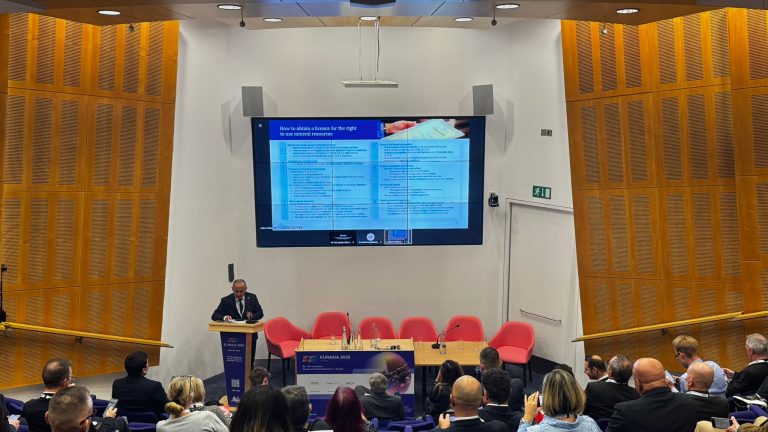
    London, 1 December 2025 – The MINEX Eurasia conference in London hosted a keynote address by H.E. Meder Mashiev, Minister of Natural Resources, Ecology, and Technical Supervision of Kyrgyzstan, outlining the country’s strategic vision for its critical minerals sector.

    Kyrgyzstan’s Strategic Minerals Vision

    The Minister outlined Kyrgyzstan’s methodical approach to prioritising and developing its critical minerals sector, identifying 21 key minerals based on global demand, local deposits, and resource concentrations. Kyrgyzstan’s analysis resulted in the selection of 4 priority projects, 5 promising deposits, and 16 prospective areas for further study and development. These assets, spread across antimony, beryllium, rare earths, molybdenum, bismuth, zinc, silver, and others, offer significant commercial and strategic potential for investors and end-users in energy, electronics, and high-value manufacturing.

    Investment and Development Framework

    State companies, notably Kyrgyzgeology, are driving exploration and project development, supported by government incentives and openness to international partnership. Strategic sites are being actively promoted for joint ventures or direct investment. Major domestic and international firms manage several large sites, while more than 100 mining enterprises operate in the country—spanning gold, copper, and polymetallic ores.

    Tax and Licensing Regime

    The session detailed Kyrgyzstan’s tax policy, which includes a mix of one-time bonuses for mining rights, royalties, profit tax, and VAT. The overall effective tax burden stands between 25–30%, complemented by social and environmental levies such as waste disposal, emissions, and water usage fees. Procedures for subsoil use licensing are harmonized with those in neighbouring countries, with initiatives being considered to simplify the processes and make it more transparent.

    ESG, Transparency, and Sustainable Mining

    Kyrgyzstan’s evolving strategy strongly emphasizes environmental, social, and governance (ESG) standards, aiming to foster responsible mineral development, minimize ecological impact, ensure transparency, and maximize benefits for local communities. The new strategy promotes the deployment of advanced technologies, environmental sustainability, and transparent investment processes, aligning with best practices to attract reliable, long-term partners.

    Opportunities for International Partnership

    Kyrgyzstan welcomes active collaboration with global investors and mining enterprises, seeking to leverage modern mining technologies, improve environmental outcomes, and maximize economic benefits. The country’s critical mineral strategy is closely linked to green growth targets and broader Eurasian supply chain integration.

  • Bishkek Forum Highlights Transparency and Investment as Keys to Kyrgyzstan’s Mining Future

    Bishkek Forum Highlights Transparency and Investment as Keys to Kyrgyzstan’s Mining Future

    Government officials, business leaders, civil society representatives, and international experts gathered in the Kyrgyz capital for the “Dialogue on the Extractive Industry: Investment, Transparency, Development” forum, aimed at fostering an open exchange on the future of Kyrgyzstan’s mining sector.

    The event, organized by the Ministry of Natural Resources, Ecology and Technical Supervision of Kyrgyzstan with the support of the World Bank, the Extractive Industries Transparency Initiative (EITI), and consulting firm Data Lab, focused on advancing reforms to make the country a competitive and sustainable hub for critical mineral investment.

    According to the ministry, the forum’s main goal was to build a framework for cooperation grounded in transparency, accountability, and sustainability — principles vital for developing industries tied to the global energy transition.

    World Bank representative Brian Land emphasized that Kyrgyzstan needs deep and sustained reforms to attract exploration and mining investments, while Arkady Rogalsky, a data consultant for the Bank, noted that the EITI standard remains essential for building trust between government, business, and citizens by promoting openness, anti-corruption measures, and equal rules for all participants.

    At the conclusion of the discussions, participants adopted a resolution outlining future priorities:

    • The government was urged to continue reforms and strengthen coordination in preparation for the EITI 2027 validation.

    • The private sector was encouraged to enhance corporate responsibility and environmental transparency while promoting equal opportunities.

    • Civil society was called to engage more actively in public oversight and dialogue.

    • International partners were invited to support Kyrgyzstan in advancing transparency and sustainable growth.

    Deputy Director of the Kyrgyz Geological Service Ruslan Kalilov stressed that citizen participation and transparency are the cornerstones of trust, adding that the mining industry can become a driver not only of economic growth but also of social development.

    A dedicated session addressed gender inclusion in transparency practices. Data Lab presented a gender analysis of EITI implementation, highlighting the importance of women’s participation in decision-making and leadership roles. Gulnura Toralieva, head of Data Lab, noted that the goal is to foster a “culture of transparency” based on respect and openness, not merely to produce compliance reports.

    The forum concluded with a joint commitment to prepare Kyrgyzstan for the 2027 EITI validation and to continue collaborative efforts to strengthen trust and sustainable development within the extractive industry. As participants agreed, when government, business, and civil society work in concert — the whole country benefits.

  • EU Urged to Prioritise ESG in Central Asia’s Raw Materials Push

    EU Urged to Prioritise ESG in Central Asia’s Raw Materials Push

    The EU must prioritize Environmental, Social, and Governance (ESG) principles in its dealings with Central Asia to secure its access to crucial raw materials, commentators warn.

    The bloc arrived in Samarkand this April with a hefty €13.2 billion Global Gateway package, signaling a desire to move beyond merely buying raw materials from the region. A significant portion, €2.5 billion, is earmarked for new mining and processing projects in Kazakhstan, Uzbekistan, and beyond. This drive is born out of necessity: the EU still relies entirely on China for its heavy rare-earth imports and faces the growing risk of vulnerability.

    While geographically late to the game, Europe has a unique advantage: a reputation for robust ESG practices. Local executives cite European partners as “a sign of quality” due to their unwavering adherence to these standards, something often lacking in Chinese or Russian counterparts. However, this edge relies on Brussels consistently embedding ESG into every euro invested. This means robust monitoring and auditing of remediation plans, transparent royalty structures, and genuine upfront consultation with local communities.

    The EU’s Critical Raw Materials Act (CRMA) sets ambitious goals: attaining 10 percent mining, 40 percent processing, and 25 percent recycling of Europe’s annual CRM demand domestically or in trusted partner states by 2030.

    Realising these goals in Central Asia necessitates investment in sustainable technologies. This includes financing water-efficient processing plants, closed-loop waste systems, and solar-powered smelters, rather than simply opening more exploitative mines.

    The EU’s efforts are beginning to take shape, with the spotlight falling on graphite. Kazakhstan’s Sarytogan deposit has been placed on the EU Commission’s list of “strategic projects” eligible for expedited permits and loan guarantees under the CRMA. Meanwhile, the European Bank for Reconstruction and Development has taken a significant stake in the mine operator, marking a direct investment in the region’s CRM sector. The EU is now actively seeking downstream investors to refine indigenous graphite into anode-grade product, capturing added value that historically flowed to Chinese refiners.

    Lithium development is following a similar trajectory. A partnership between HMS Bergbau and Kazakhstan’s Creada Corporation aims to unlock the potential of Kazakh spodumene through extraction, processing, and refining into battery-ready lithium hydroxide. This would be a direct response to the EU’s new battery-passport regulations, which require materials of a certain purity.

    However, Europe faces a formidable competitor: China. The PRC Mineral Resources Law mandates environmental remediation planning before mining commences, setting a new baseline for responsible resource extraction. While welcomed, the application details remain vague, lacking guarantees on local community engagement and enforcement mechanisms, potentially creating loopholes for exploitation.

    Adding to the pressure, Chinese capital is expanding downstream. East Hope Group’s landmark $12 billion investment in Kazakh non-ferrous metals signifies a vertical integration approach—from mining and smelting to fabrication and renewable power generation. This $12 billion vertical integration project in Kazakhstan showcases China’s willingness to build a fully controllable supply chain.

    Europe must act strategically to counter these challenges.

    Firstly, financial aid should be contingent on stringent ESG benchmarks. EU financing must go hand-in-hand with clear, enforceable standards – ISO-compliant tailings dams, methane monitoring, gender-balanced workforce plans, and robust penalties for non-compliance.

    Secondly, the EU should focus on fostering value-adding industries beyond mining. This means investing in processing plants and recycling facilities, not just mines. By creating domestic processing hubs for cathode powders or rare-earth magnets, the CRMA’s 40 percent processing target can be achieved, generating jobs, technology transfer, and increased tax revenue for beneficiary countries.

    Finally, the EU must simplify visa requirements for Central Asian technical personnel. A targeted visa-facilitation agreement could allow them to train in Europe and return, strengthening the region’s skilled workforce.

    Securing a stable and sustainable supply of raw materials is a critical challenge for the EU. While China’s economic clout is undeniable, Europe has the opportunity to win this race by leveraging its commitment to ESG principles and building a truly sustainable, transparent, and trust-based partnership with Central Asia.

    Time is of the essence. The next 18 months, before China’s revised mining law takes full effect and East Hope’s megaproject begins construction, provide a crucial window for the EU to demonstrate its commitment to ESG beyond rhetoric. The stakes are high, as the fate of Europe’s essential raw materials supply hangs in the balance.

  • Kazakhstan Reaffirms Commitment to EITI Standards and Modernizes Mining Sector

    Kazakhstan Reaffirms Commitment to EITI Standards and Modernizes Mining Sector

    During a discussion, President Kassym-Jomart Tokayev emphasized Kazakhstan’s dedication to the Extractive Industries Transparency Initiative (EITI) since joining the organization in 2007. He noted that Kazakhstan has legislatively mandated subsoil users to comply with the organization’s standards, including reporting on taxes and other payments to the national budget.

    President Tokayev informed the head of EITI, Helen Clark, about regulatory measures aimed at enhancing the country’s geological exploration and mining industries. Key initiatives include the adoption of a Comprehensive Development Plan, the launch of a Unified Subsoil Use Platform featuring an interactive map and access to more than 50,000 geological reports, and streamlined processes for obtaining exploration and production licenses.

    In response, Helen Clark shared the strategic priorities of EITI for the coming period and praised Kazakhstan’s efforts to improve legislation in line with transparency standards for the extractive sector.

  • Kyrgyzaltyn Announces First Gold Delivery to International Market in April

    Kyrgyzaltyn Announces First Gold Delivery to International Market in April

    In a closed briefing attended by journalists, a high-ranking official from the Kyrgyz presidential administration revealed that the first delivery of gold to the international market by Kyrgyzaltyn is slated for April. The official emphasized transparency, stating that the precious metal would be sold at the price prevailing on the London Stock Exchange at the time of delivery. Despite receiving several purchase offers, many of which requested discounts, the authorities are committed to transparency in the process. Additionally, the official expressed a desire to retain as much gold as possible within the country to encourage domestic investment. To facilitate this, Kyrgyzaltyn is finalizing the construction of a plant for the production of weighted ingots, which will be available for purchase by the public. However, approximately 10-12 tons of gold will be allocated for sale to the foreign market. Furthermore, the authorities are actively working towards the development of a thriving jewelry industry within the country.