Tag: strategic partnerships

  • Serbia Zijin Copper Cleans Up Bor’s Legacy Pollution Through Smelter Modernisation and Dust Control

    Serbia Zijin Copper Cleans Up Bor’s Legacy Pollution Through Smelter Modernisation and Dust Control

    A new phase in Kazakhstan–European Union cooperation on critical raw materials was formally launched with the inauguration of the Kazakhstan–EU Gateway’s cooperation platform and its first flagship event, Strategic Partnership on Critical Raw Materials.

    The event, attended by Eureflect, was hosted at the Brussels headquarters of TÜSİAD, one of Turkey’s leading business associations, underscoring the Eurasian dimension of the initiative and its relevance for both European and regional industrial stakeholders. The choice of venue reflected the high-level political and business focus of the platform.

    Held on December 9, 2025, at Av. des Gaulois 13 in Brussels, the conference brought together policymakers, industry leaders and subject-matter experts from across Europe and Central Asia. Discussions centred on strengthening cooperation along the full critical raw materials value chain, from geological exploration and mining to processing, refining and downstream industrial integration.

    The Kazakhstan–EU Gateway is intended to serve as a structured platform to align Kazakhstan’s vast mineral resource base with Europe’s growing demand for secure, diversified and responsibly sourced critical raw materials. The initiative comes as the EU accelerates efforts to reduce strategic dependencies and deepen partnerships with resource-rich, politically aligned countries.

    Participants highlighted the importance of long-term frameworks, transparent governance and investment-friendly conditions to translate political alignment into tangible projects. The launch event marked an initial step toward building sustained collaboration between Kazakh institutions, European policymakers and industrial players seeking resilient supply chains.

  • Kazakhstan–EU Gateway Launches New Platform for Strategic Critical Raw Materials Cooperation

    Kazakhstan–EU Gateway Launches New Platform for Strategic Critical Raw Materials Cooperation

    A new chapter in Kazakhstan–European Union cooperation on critical raw materials opened on 9 December 2025 with the inauguration of the Kazakhstan–EU Gateway’s cooperation platform and its first flagship event, titled “Strategic Partnership on Critical Raw Materials.”

    The event was hosted in Brussels at the premises of TÜSİAD, one of Turkey’s leading business associations, underscoring the Eurasia-focused and high-level nature of the initiative. Located in the EU quarter at Avenue des Gaulois 13, the venue provided a strategic setting for discussions at the intersection of European policymaking, industry and international cooperation.

    The launch brought together policymakers, industry executives, analysts and experts to explore avenues for strengthening collaboration between Kazakhstan and the EU in the sourcing, processing and integration of critical raw materials into European value chains. Participants discussed supply security, investment frameworks, governance standards and the role of Central Asia in supporting Europe’s industrial resilience amid growing geopolitical pressures.

    The Kazakhstan–EU Gateway platform is intended to serve as a permanent forum for dialogue and project development, positioning Kazakhstan as a key strategic partner for Europe as it seeks to diversify supply chains and reduce dependence on dominant external suppliers of critical minerals.

  • Kazakhstan Targets Economic Growth with Rare-Earth Expansion and SEZ Reforms

    Kazakhstan Targets Economic Growth with Rare-Earth Expansion and SEZ Reforms

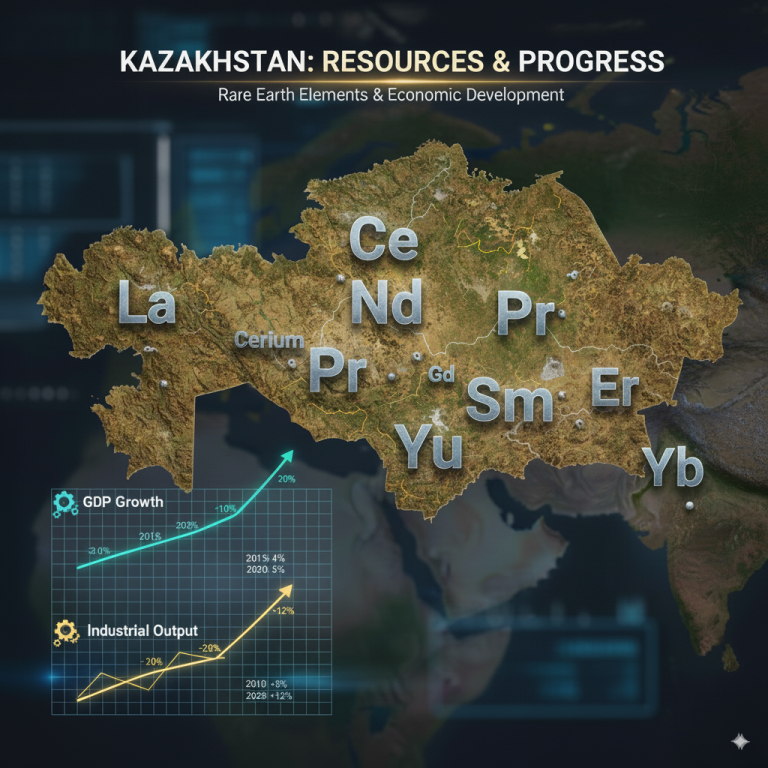
    Kazakhstan is launching a comprehensive strategy to boost economic growth by strengthening special economic zones (SEZs) and expanding rare-earth metal production, as announced by Industry and Construction Minister Yersayin Nagaspayev during a government meeting chaired by Prime Minister Olzhas Bektenov

    To improve SEZ efficiency, the government will conduct a comprehensive review of their performance and strengthen monitoring mechanisms to ensure investors fulfill their obligations. The country also plans to introduce a framework for foreign companies to manage certain SEZs, while local authorities will intensify efforts to attract new investors.

    In addition to SEZs, the government has identified rare-earth metal production as a key area for development. Kazakhstan plans to implement at least three major projects in this field, focusing on the production of battery materials, recycling and manufacturing heat-resistant alloys for jet engines, developing semiconductor components, and reprocessing permanent magnets.

    The country has already established strategic partnerships with leading players from the European Union, the United States, Japan, South Korea, and China. Upcoming projects include the launch of gallium production with an annual capacity of 15 tons, the manufacturing of high-purity manganese sulfate, and the production of graphite for battery components.

    Kazakhstan is also taking significant steps to modernize its geological exploration and mapping. A next-generation geological map will be developed using advanced digital tools, with project preparations already underway and fieldwork scheduled to begin in 2026. The government has allocated funding for new surveying methods, including aerogeophysics, geochemistry, spectral imaging, and high-resolution satellite data analysis.

    Furthermore, the country is introducing a unified digital platform to consolidate all processes related to construction and housing management. The platform will be introduced by the end of 2025 and is expected to enhance efficiency and transparency in the sector.

    The reforms are part of Kazakhstan’s efforts to diversify its economy and reduce its dependence on oil exports. The country aims to become a major player in the global rare-earth market and to attract foreign investment in its SEZs.

  • Qarmet:  A New Era for Kazakhstani Metallurgy Under Domestic Ownership

    Qarmet: A New Era for Kazakhstani Metallurgy Under Domestic Ownership

    Following the state acquisition of ArcelorMittal Temirtau and the departure of its long-standing investor in 1995, Qarmet JSC remains a focal point of interest. Ambitious plans are underway for the enterprise under the new domestic shareholder, with implementation overseen by the government. The top priorities set by the company’s management reflect a commitment to revitalizing operations and ensuring safety.

    Upon the tragic incident at the Kostyanko mine last year, the Kazakhstani government opted to terminate investment cooperation with ArcelorMittal Temirtau, acquiring its assets for $286 million. The Allur Group of companies, led by Andrey Lavrentyev, emerged as the new owner, restoring the plant’s historical name — Qarmet.

    In addition to asset acquisition, the investor has pledged an additional $3 billion for production modernization and environmental protection, with $1.3 billion earmarked for the current year alone. With the new ownership and name come renewed optimism among the plant’s workers, anticipating solutions to existing equipment and working condition issues.

    Talgat Temirkhanov, Qarmet’s official representative, highlighted the development of a comprehensive plan for industrial safety and production modernization, leveraging international best practices and collaborations with industry leaders like BaowuSteel and the Boston Consulting Group.

    The company’s management underscores the priority of restoring production while enhancing labor safety, with a focus on addressing critical equipment issues. General Director Vadim Basin outlined moderate production targets for 2024, anticipating increases in steel and iron ore concentrate production alongside a slight decrease in coal mining volumes.

    In alignment with the name change, Qarmet’s focus extends to environmental sustainability, labor protection in mines, and social responsibility. Investments in new drilling rigs, modern heading combines, and gas monitoring stations underscore the commitment to improving production environments.

    Decisions have been made to introduce positioning systems at all mines, along with plans for central dispatching and mine degassing. New construction initiatives include the development of coke batteries, polymer coating lines, and beneficiation plants, signaling a drive toward revitalizing the plant and empowering its workforce.