Tag: Solidcore

  • Kazakhstan Investment Day in Frankfurt

    Kazakhstan Investment Day in Frankfurt

    Analysis of the Germany-Kazakhstan Strategic Partnership

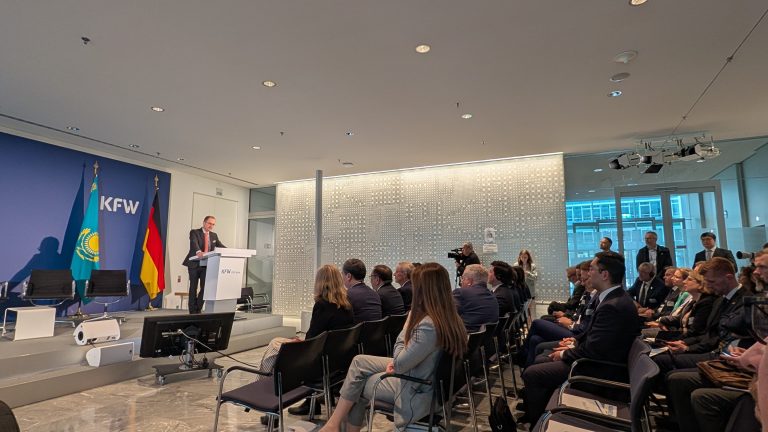
    The Kazakhstan Investment Day, held on 24 February 2026, at the KfW Bankengruppe headquarters in Frankfurt, highlighted a pivotal shift in Eurasian trade dynamics. The event centered on the deepening energy and mining alliance between Germany and Kazakhstan, a relationship that has gained strategic urgency as Kazakhstan effectively replaces Russian oil volumes and leverages deep-rooted cultural ties to strengthen bilateral cooperation.

    Financial and Strategic Framework

    The scale of this partnership is substantial, with bilateral trade recently seeing a 10% increase to reach €4 billion. Kazakhstan is currently positioned to supply 21 of the 34 critical raw materials (CRMs) identified on the EU’s strategic list.

    To facilitate this, several financial and logistical mechanisms have been established:

    • The Development Bank of Kazakhstan (DBK): A $1 billion financing program (2025–2030) has been launched, specifically dedicated to the extraction and processing of rare and critical materials.

    • Foreign Direct Investment (FDI): Kazakhstan aims to attract $400 billion in FDI by 2029, supported by Germany’s raw materials fund and backing from institutions like KfW IPEX and DEG.

    • The Middle Corridor: The Trans-Caspian International Transport Route is being developed as a highly efficient logistical artery connecting Central Asia to Europe, bypassing sanctioned territories.

    Operational Success vs. Bureaucratic Hurdles

    There is a notable contrast between engineering achievements and administrative delays. Industry leaders from Thyssen Schachtbau and Qazaq Kalium have demonstrated successful deep-shaft mining projects, proving that German technology is effectively unlocking Kazakh resources. Furthermore, the German development agency GIZ is pivoting its strategy by forming a dedicated in-country team focused exclusively on CRM partnerships.

    However, several impediments remain:

    • The “Bearocracy”: Despite the strategic need, Kazakh businesses face extreme delays and bureaucratic hurdles regarding German visa regimes, a point acknowledged by German officials.

    • Sanction Compliance: German leadership maintains a hard line, stating there will be zero support for any trade or logistics involving Russia or sanctioned companies.

    • Implementation Lag: While the financial architecture is in place, the actual development of new mining projects remains slowed by EU-wide bureaucratic processes.


    A Shifting Global Context

    The global competition for resources is accelerating. Coinciding with these discussions in Frankfurt, China introduced a supply ban of critical minerals to 40 major Japanese industrial firms over “remilitarisation” concerns. This geopolitical shift forces Japan to seek immediate alternative suppliers, placing Kazakhstan and the broader Central Asian region directly in their sights. The consensus is clear: while the foundations for a Euro-Kazakh partnership are solid, the slow pace of European administration may cause the EU to lose ground in an increasingly aggressive global race for resources.

  • Solidcore Reports Sharp Drop in Gold Output and Revenue Due to Sanctions and Delays

    Solidcore Reports Sharp Drop in Gold Output and Revenue Due to Sanctions and Delays

    Solidcore Resources reported a significant decline in gold-equivalent output for Q1 2025, producing 68,000 ounces — a 42% decrease compared to the same period last year. The company attributed the shortfall to delays in shipping concentrates from the Bakyrchik deposit (part of the Kyzyl project) to the Amur Hydrometallurgical Plant.
    In its statement, Solidcore highlighted ongoing “operational challenges” at the plant in Russia’s Khabarovsk region due to international sanctions. Last year, the company divested its Russian assets to Mangazeya Mining.
    As Solidcore prepares to launch the Irtysh Hydrometallurgical Complex in Kazakhstan’s Pavlodar region, it remains reliant on Russian facilities for processing its complex refractory and double-refractory ores. As a result, 41,000 ounces of gold in concentrate have accumulated over the quarter, with shipments to Amursk now expected to resume in May.
    The production drop was accompanied by a steep fall in sales: only 38,000 ounces of finished product were sold in Q1, down 67% year-on-year. Revenue shrank 2.7 times to $109 million.
    Despite these setbacks, ore extraction rose by 13% to 1.32 million tonnes, mainly due to the Kyzyl project. Total ore processing remained stable at 1.57 million tonnes. At the Varvarinskoye site, ore grades declined as expected, while Bakyrchik saw an improvement.