Tag: resource diplomacy

  • Pipelines and Rare Elements: How Central Asia Became America’s New Geo-economic Frontier

    Pipelines and Rare Elements: How Central Asia Became America’s New Geo-economic Frontier

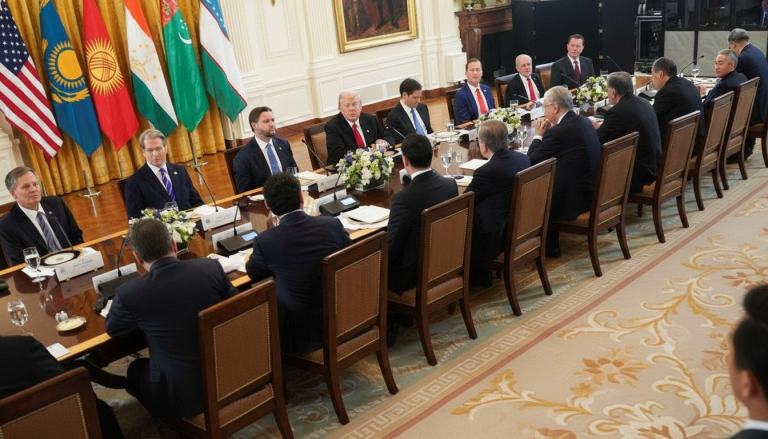
    The C5+1 summit held in Washington on November 6, 2025, marks a new chapter in U.S.–Central Asia relations, shifting the focus from energy pipelines to strategic mineral resources. Rare earth elements are now central to Washington’s strategy against China, which dominates mining and processing globally.

    Recent agreements—highlighted by substantial investments in Kazakhstan’s tungsten mines and commitments to Uzbekistan—illustrate a strategy that blends economic aims with national security, defense modernization, and leadership in green technologies. By partnering with Kazakhstan, Uzbekistan, and Turkmenistan, the U.S. seeks to counter China’s and Russia’s longstanding influence, establishing a “new resource-centered” framework for engagement. Rare earths are becoming tools of strategic power, supplanting traditional energy diplomacy and strengthening supply chains for renewable energy.

    This shift extends beyond resource access; mining investments are shaping political, economic, and diplomatic orientations across Central Asia, challenging China’s Belt and Road Initiative through economic means. The U.S. approach converts energy diplomacy into “mining diplomacy,” turning Central Asia into a global geo-economic crossroads.

    America’s renewed focus reflects a broader repositioning—building “strategic balancing” structures rather than pursuing mere economic or military dominance. The C5+1 format has become the central mechanism for promoting a model of regional integration that excludes Russia and China, offering a “third way” rooted in soft power, sustainable development, and technological partnerships.

    Strengthening transport routes like the Trans-Caspian corridor aims to liberate Central Asia from Russia’s logistical grip and curtail China’s influence over the Middle Corridor. Moscow and Beijing view these moves as containment strategies, intensifying geopolitical competition while granting Central Asian states greater autonomy through multilateral diplomacy.

    Ultimately, America’s strategy is about establishing a new Eurasian power architecture. Its success will depend on delivering sustainable investments and on Central Asian states maintaining independent balancing acts amid great-power competition.

  • U.S. Strengthens Critical Minerals Alliance with Uzbekistan in Bid to Counter China

    U.S. Strengthens Critical Minerals Alliance with Uzbekistan in Bid to Counter China

    The United States has ramped up its efforts to secure critical mineral supplies by signing a new cooperation agreement with Uzbekistan, focused on boosting American mining investments in the Central Asian nation.

    The announcement follows a series of high-level meetings in Washington, where an Uzbek delegation engaged with U.S. business leaders. While specific companies and investment figures were not disclosed, Uzbekistan’s government confirmed that the deal includes commitments to invest in mineral exploration and extraction, the construction of grinding equipment, and specialist training for Uzbek workers.

    The initiative builds on a September memorandum of understanding aimed at enhancing collaboration in the critical minerals sector. On Wednesday, U.S. Secretary of State Marco Rubio met with Uzbek Foreign Minister Bakhtiyor Saidov, underscoring Washington’s intent to strengthen strategic ties in mineral-rich Central Asia.

    “There’s great potential ahead for investments between our countries and cooperation in the critical minerals and other sectors,” Rubio posted on social media following the meeting.

    Uzbekistan, with its extensive deposits of key elements such as rare earths, lithium, and uranium, has been actively courting foreign investors. In early 2025, President Shavkat Mirziyoyev launched a $2.6 billion national program to develop 76 mining projects targeting 28 different elements. The initiative focuses on utilizing advanced technologies to extract raw materials, improve mineral purity, and produce higher value-added products.

    For the U.S., Uzbekistan represents a vital link in reshaping global supply chains away from China’s dominance. The Trump administration has also expanded its critical mineral diplomacy beyond Central Asia, initiating talks with Pakistan, Ukraine, and the Democratic Republic of Congo. These countries hold strategic reserves of minerals essential for defence, battery manufacturing, and clean energy technologies.

    As competition intensifies for access to global mineral reserves, Uzbekistan’s alignment with U.S. strategic goals may position it as a key player in future resource security initiatives.