Tag: Resource Development

  • Kazakhstan’s Strategic Focus on Critical Materials Amid Global Competition

    Kazakhstan’s Strategic Focus on Critical Materials Amid Global Competition

    Kazakhstan is positioning itself as a key player in the global competition for critical materials, particularly rare earth metals, which are essential for high-tech industries. President Kassym-Jomart Tokayev highlighted the country’s significant resource and production potential during a recent Security Council meeting, as reported by Exclusive.kz. He emphasized that Kazakhstan must leverage its advantages in Central Asia to benefit the nation amidst rising global competition for access to these vital resources.

    Tokayev noted that the current global landscape presents unique opportunities for countries with substantial reserves of critical materials. He underscored the strategic importance of these resources for the development of high-tech sectors and acknowledged the intensifying competition among nations for access to them.

    In light of this, Kazakhstan is urged not only to focus on raw material extraction but also to enhance its competencies in processing and developing high-value production chains. The meeting included presentations from government members regarding the current state of the industry, prospects for resource base development, and existing barriers to progress.

    Following the discussions, the government and relevant state bodies were tasked with creating a comprehensive vision for the industry’s development. This includes improving regulations, boosting geological exploration and processing, integrating technogenic mineral formations into the economic turnover, and developing laboratory and human resources. Additionally, efforts will be made to eliminate administrative barriers that hinder progress in this critical sector.


  • Kazakhstan Shifts Focus to Critical Minerals as Exploration Accelerates

    Kazakhstan Shifts Focus to Critical Minerals as Exploration Accelerates

    Kazakhstan is intensifying its geological exploration efforts as it adapts to shifting global demand and prepares for a gradual decline in oil production. While the country has long relied on its vast natural resources, current priorities are increasingly focused on rare and critical minerals, which are emerging as key drivers of future economic growth.

    Over the past year alone, 17 new deposits have been discovered, underscoring the continued potential of the country’s subsoil. Exploration activity has expanded significantly, with geological survey coverage reaching more than 2 million square kilometres. Authorities plan to extend mapping across an additional 100 thousand square kilometres this year, supported by 20 approved project initiatives involving national and industry stakeholders.

    Kazakhstan’s mineral base remains substantial, with approximately 10 thousand deposits identified across the country. Proven reserves include gold, silver, copper, and phosphorites, while total reserves across major resources exceed 2369 tonnes of gold, 4.3 billion tonnes of oil, 3.8 trillion cubic metres of gas, 33.5 billion tonnes of coal, and 26.7 billion tonnes of iron ore.

    A key development is the creation of a certified laboratory complex under the National Geological Service, scheduled for completion by 2028. The facility, valued at 14 billion tenge, will enhance analytical capabilities and support more precise geological data processing.

    According to officials, rising global demand for copper, gold, and rare earth elements is driving a strategic shift in the sector. Greater emphasis is now being placed on improving data accuracy, increasing transparency, and strengthening the investment climate. Over the next three years, the government plans to allocate approximately 240 billion tenge to geological exploration, while also preparing to auction new перспективные участки starting in 2027.

    This renewed focus is partly driven by declining oil output in certain regions, where production has dropped significantly due to resource depletion. In response, exploration is expanding into underexplored sedimentary basins such as the Aral and Syrdarya regions.

    Kazakhstan is also attracting growing private investment, with around 280 billion tenge injected into exploration over the past three years. Rare earth and rare metals are becoming central to this strategy, including deposits such as Kuyryktikol, discovered in 2025, which contains significant reserves of cerium, neodymium, and yttrium.

    More than 100 known deposits across the country contain critical minerals such as tungsten, molybdenum, lithium, beryllium, niobium, tantalum, germanium, and gallium. These materials are essential for high-tech industries, including electric vehicles, electronics, and energy systems, further boosting Kazakhstan’s export potential.

    The evolving structure of the mining sector reflects a broader transformation. Unlike in the past, when extraction often focused on individual elements, modern development requires integrated approaches and advanced technologies. This shift is increasing the sector’s reliance on innovation and international collaboration, as Kazakhstan positions itself as a key supplier in the global critical minerals market.

  • Kazakhstan at PDAC 2026: The Next Major Frontier for Mineral Discoveries?

    Kazakhstan at PDAC 2026: The Next Major Frontier for Mineral Discoveries?

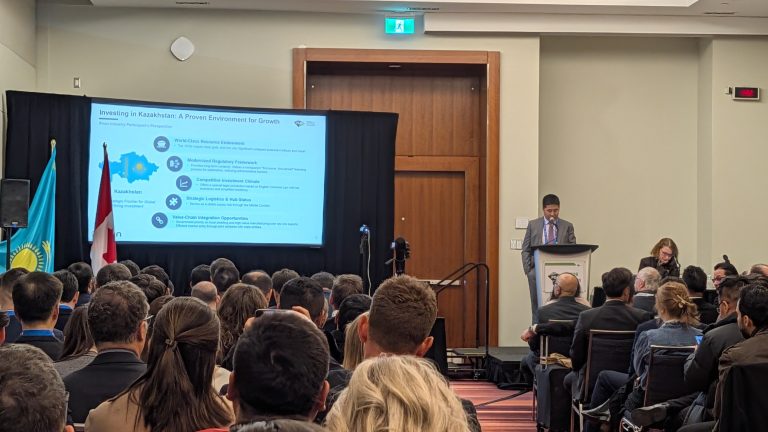
    This year marked a significant milestone as the Kazakhstan Chamber of Mines took the lead as the official organiser of Kazakhstan Day — and what a resounding success the debut turned out to be!

    Despite a packed PDAC schedule, the session drew an impressive crowd of over 130 industry leaders, investors, and exploration experts. The atmosphere in the room confirmed one thing: the global mining community is paying very close attention to Central Asia.

    MINEX Forum was proud to support the event as the Official Media Partner, capturing the insights that are shaping the next wave of exploration in the region.

    Key Highlights from the Plenary Session: The tone was set by Ruslan Baimishev, President of the Kazakhstan Chamber of Mines:

    “Kazakhstan is entering a new era of exploration — driven by robust reforms, international partnerships, and the soaring global demand for copper and critical metals.”

    We also heard high-level perspectives from H.E. Dauletbek Kussainov, Ambassador of Kazakhstan to Canada, and Iran Sharkhan, Vice-Minister of Industry and Construction.

    Expert Insights & Project Showcases: The technical session, “Unlocking New Discovery Potential in Kazakhstan,” featured a stellar line-up including Tim Barry (Arras Minerals), Charlie Liu (Zijin Mining), Simon Cooper (Pallas Resources), and world-renowned experts Anna Fonseca and Professor Jeffrey Hedenquist.

    The afternoon shifted to tangible opportunities, with project presentations from AMG Ltd, Kogadyr Gold, Taskora, and Muzbel. As Tim Barry aptly put it: “Kazakhstan offers unique opportunities for Canadian juniors to enter new jurisdictions — and the future looks bright.”

    Kazakhstan is no longer just a “prospective” jurisdiction; it is rapidly becoming the territory where the next big copper success stories are being written.

    Special thanks to the Kazakhstan Day partners:

    • General Sponsors: Aurora Minerals Group, NAC Kazatomprom, Pallas Resources.

    • Sponsors: Arras Minerals, TauGold Copper.

    Missed the session?  📺 Watch the session recordings and download expert presentations at:

  • U.S. and Kazakhstan Forge Joint Venture to Secure Global Tungsten Supply

    U.S. and Kazakhstan Forge Joint Venture to Secure Global Tungsten Supply

    Following the announcement of the joint venture between US-based Cove Capital LLC and Kazakhstan’s National Mining Company, JSC Tau-Ken Samruk, further details have emerged regarding the development timeline and scale of the Northern Katpar and Upper Kairakty tungsten projects.

    Cove Kaz Capital Group LLC (“Cove Kaz”), a portfolio company of U.S.-based Cove Capital LLC, will hold a 70 per cent interest, with Tau-Ken Samruk retaining 30 per cent ownership of Severniy Katpar LLP, which owns the Northern Katpar and Upper Kairakty tungsten projects.

    Cove Kaz will oversee marketing of 100 per cent of project output and has entered into a Letter of Intent with the International Trade Administration at the U.S. Department of Commerce to prioritise supply for U.S. government and commercial needs.

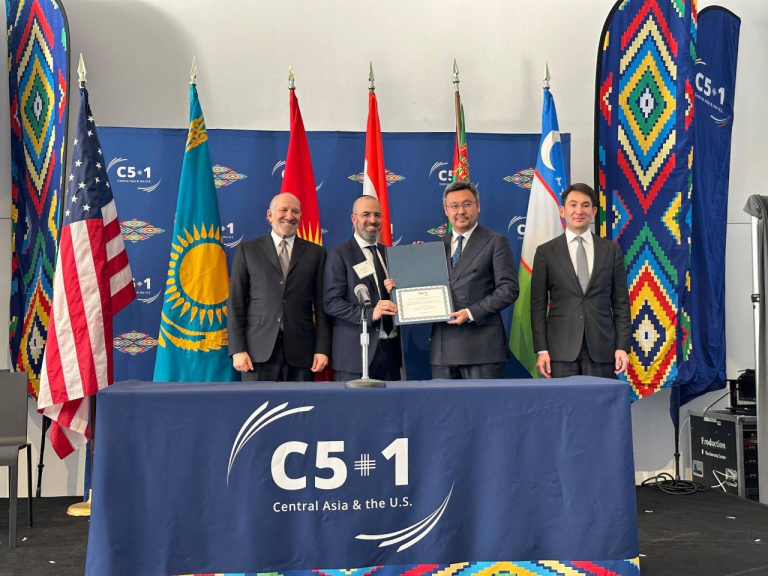
    The announcement was made in Washington, D.C., during the C5+1 Leaders’ Summit by U.S. President Donald J. Trump and Kazakhstan President Kassym-Jomart Tokayev.

    Total development costs for the Northern Katpar and Upper Kairakty projects are estimated at USD $1.1 billion. The Export-Import Bank of the United States has issued a Letter of Interest for USD $900 million in financing, complemented by a similar commitment from the U.S. International Development Finance Corporation.

    Cove Kaz’s project team will be led by Dominic Heaton, who previously oversaw development of the Nui Phao integrated tungsten mine and refinery in Vietnam – the world’s largest tungsten operation outside China. Preparatory work has already commenced to support a Definitive Feasibility Study for Northern Katpar, including the establishment of downstream refining capacity in Kazakhstan to produce ammonium paratungstate (APT) and other tungsten compounds.

    Pini Althaus, Chief Executive Officer of Cove Capital and Cove Kaz Capital, expressed gratitude for U.S. and Kazakh government support:

    “On behalf of Cove Capital and Cove Kaz, I wish to thank President Donald J. Trump, Secretary of Commerce Howard Lutnick, and the U.S. Trade Advocacy Center for their exceptional engagement. Their efforts have aligned financing, offtake pathways, and policy support to deliver a secure, allied tungsten supply for America’s industrial and defence needs.

    “I also wish to thank President Kassym-Jomart Tokayev for his leadership and partnership. This collaboration is a win for both nations—strengthening U.S. supply chains while fostering investment and long-term prosperity in Kazakhstan.”

    Tungsten – A Critical Industrial and Defence Mineral

    Tungsten is ranked by the U.S. Defense Logistics Agency as a “material of interest” and by the European Union as the raw material of highest economic importance due to its unique physical properties: the highest tensile strength at high temperatures, the highest melting point of any metal, and exceptional corrosion resistance.

    Its density and durability make tungsten indispensable in high-performance cutting and drilling tools, aerospace alloys, semiconductor contacts, and radiation shielding. In defence applications, tungsten is used in armour-piercing munitions, missile components, aircraft ballast, and other high-stress environments.

    Currently, China controls over 80 per cent of global tungsten production and processing. In February 2025, China imposed new export restrictions on tungsten and tungsten-containing products to the United States.

    Severniy Katpar LLP

    Severniy Katpar LLP holds licences for two projects—Northern Katpar and Upper Kairakty—located approximately 30 kilometres apart in the established Karaganda mining district of central Kazakhstan, less than 160 kilometres south of the city of Karaganda.

    Feasibility studies completed in April 2023 report total JORC-compliant mineral resources of 1.4 million tonnes of tungsten trioxide (WO₃), accounting for around 70 per cent of Kazakhstan’s total tungsten resources. For comparison, the U.S. Geological Survey estimates China’s reserves at 2.4 million tonnes.

    Combined production from both projects is expected to reach 12,000 metric tonnes per annum (mtpa) of tungsten trioxide—approximately 15 per cent of current global output.

    Cove Capital’s Broader Commitment in Kazakhstan

    Cove Capital’s portfolio company, Kaz Resources LLC, became in 2023 the first U.S. entity to receive critical minerals and rare earth concessions in Kazakhstan. These include licences for 13 minerals such as lithium, tantalum, beryllium, niobium, and rare earth elements.

    In 2024, Cove Capital and Tau-Ken Samruk formalised a joint venture for exploration of rare earths at the Akbulak project in the Kostanay region, with Cove holding 75 per cent and “Qazgeology” JSC 25 per cent. Cove is fully financing exploration activities until reserves are booked.

    About Cove Capital LLC

    Founded in 2015, Cove Capital is a mining-focused investment and development firm headquartered in New York and Melbourne. Since 2018, the company has focused on critical minerals projects that enhance U.S. and allied supply chains. Led by CEO Pini Althaus, Cove Capital brings extensive expertise across exploration, mining, processing, and offtake structuring.

    About Tau-Ken Samruk

    Tau-Ken Samruk, Kazakhstan’s national mining company, manages the sustainable development of the nation’s mineral wealth. Through partnerships with international investors, it aims to strengthen Kazakhstan’s mining sector and support the country’s long-term economic growth.

  • Blue Moon Metals Diversifies with Copper Assets in Norway

    Blue Moon Metals Diversifies with Copper Assets in Norway

    Blue Moon Metals is expanding its portfolio with the acquisition of two former copper-producing properties in Norway to diversify beyond its U.S.-based zinc project and focus on near-term production opportunities. The company, headquartered in Vancouver, announced two deals to acquire the Nussir and NSG properties for $55.3 million and $12 million, respectively, funded through the issuance of common shares priced at C$0.30 each.

    Shares of Blue Moon traded at C$0.355 on Thursday, giving the company a market capitalization of C$18.9 million. The acquisitions are part of a broader plan to raise C$30 million to C$50 million in equity, with the majority allocated to advancing the Nussir project.

    Newly appointed CEO Christian Kargl-Simard described the move as an opportunity to establish a copper-zinc development company in Tier 1 jurisdictions. The Nussir property, with existing infrastructure like roads, power, and port access, hosted mining operations until 1979. The project is supported by an updated feasibility study from SRK Consulting, estimating an initial capital cost of $101 million.

    The NSG property, located in northern Norway, is notable as it could become the first new copper mine in the country in over 50 years. This site, rich in historic copper deposits, holds a historical estimate of 29.4 million tonnes at 0.9% copper and 0.17% zinc. Blue Moon plans to expand on the project’s resource base with regional exploration.

    Meanwhile, the company continues to advance its Blue Moon polymetallic project in California, which has a resource estimate of 3.5 million indicated tonnes at a zinc-equivalent grade of 11.07%. A preliminary economic assessment is expected in early 2025.

    These initiatives aim to balance the company’s historic copper assets in Norway with its zinc-silver resource in the U.S., marking a new phase in its growth trajectory.

  • Amaroq Minerals Achieves First Gold Pour at Nalunaq Mine in Greenland

    Amaroq Minerals Achieves First Gold Pour at Nalunaq Mine in Greenland

    Amaroq Minerals has celebrated a major milestone with the first gold pour at its flagship Nalunaq gold mine in Greenland. The pour occurred on Wednesday, following the Greenlandic government’s approval of Phase 1 commissioning for the Nalunaq processing plant. Over a ten-hour period, the initial pour yielded 1.2 kg of gold.

    The company stated it will optimize the processing plant during this initial phase and aims to achieve weekly gold pours. Looking ahead, Phase 2 commissioning, which includes a flotation circuit, is expected to conclude by the second quarter of 2025.

    Ramp-up to a steady operational capacity of 260-300 tonnes per day with gold grades of 12-16 g/t is anticipated in the fourth quarter of 2024. Additionally, Amaroq plans to release an updated mineral resource estimate for Nalunaq in early 2025.

    The Nalunaq mine previously produced over 350,000 oz. of gold between 2004 and 2013. Since acquiring the project in 2015, Amaroq has expanded the resource base through exploration and introduced a new geological model centered on the Dolerite Dyke.

    Following the announcement, shares of Amaroq Minerals rose 2% to reflect a market capitalization of C$559 million ($399 million).

  • Central Asia’s Green Energy Revolution: Unveiling Turkmenistan’s Potential

    Central Asia’s Green Energy Revolution: Unveiling Turkmenistan’s Potential

    Central Asia is experiencing a surge in green energy investments, with recent weeks marking a significant turning point in the region’s renewable energy landscape. ACWA Power, a prominent Saudi Arabian energy company, made headlines in early March by announcing plans to invest in two wind power plants in Uzbekistan’s Karakalpakstan and Bukhara regions, totaling over 1GW of power capacity. Following suit, Kazakhstan inked agreements for 1GW of wind power development in its Jetisu region, signaling a concerted effort towards sustainable energy initiatives.

    However, it’s the realm of critical raw materials that has garnered the most attention in Central Asia’s green energy transition. Kazakhstan, hailed as a lithium powerhouse, secured agreements worth $500 million from German stakeholders for lithium extraction, with keen interest also emanating from South Korea and China. These investments underscore the pivotal role of the extractives industry in facilitating the global shift towards renewable energy sources and energy storage solutions.

    While Kazakhstan takes center stage, neighboring Turkmenistan emerges as a potential powerhouse in the green energy ecosystem. Acknowledging its rich reserves not only in oil and gas but also in renewables, Turkmenistan is positioning itself as a key player in the transition towards sustainable energy. The recent Turkmen Investment Forum in Paris highlights the nation’s efforts to attract international attention and investment, signaling its readiness to follow Kazakhstan’s trajectory in resource development.

    Despite Turkmenistan’s vast potential, challenges persist, particularly regarding the lack of comprehensive data on reserves, posing risks to investors and hindering investment opportunities. However, Western Turkmenistan, notably the Karabogazgol Bay area, shows promising signs of abundant lithium deposits, along with substantial reserves of iron, copper, and rare earth metals. Geological formations in Southern Turkmenistan also hold significant potential for copper and rare earth materials, essential for electricity grids and digital technologies.

    Approach Recommendations – Stakeholder Map: To unlock Turkmenistan’s potential as a champion in renewable energy and digital materials, several policy recommendations are proposed:

    • Align regulatory frameworks for non-fuel mining with hydrocarbons mining to streamline permit procedures and encourage long-term leasing options.
    • Foster international collaboration with neighboring countries like Uzbekistan and Afghanistan to leverage shared geological formations for critical raw materials.
    • Establish financing mechanisms for sustainable development projects, such as green bonds, to attract investments aligned with economic, environmental, and societal goals.
    • Develop a transparent database of Turkmenistan’s mineral reserves accessible to investors and scientific explorers to enhance investment transparency and promote informed decision-making.
  • AM Resources Expands Portfolio with Acquisition of Extensive Land Package in Austria

    AM Resources Expands Portfolio with Acquisition of Extensive Land Package in Austria

    AM Resources has significantly expanded its portfolio through the acquisition of a vast 1,500km² land package situated in Austria, with a strategic focus on the renowned Austrian Pegmatite Belt nestled within the Austroalpine Nappes. Recognized for its geological richness and abundant mineral reservoirs, the newly acquired region presents a promising prospect for exploration and resource development. CEO David Grondin expressed enthusiasm for the strategic move, emphasizing the company’s commitment to seizing opportunities in a proven mining-friendly jurisdiction. Grondin highlighted AM Resources’ meticulous approach, citing successful exploratory endeavors that confirmed the presence of spodumene on acquired properties. Building upon these findings, the company has staked additional claims within the Austrian Pegmatite Belt, with particular attention given to the Frederick property, which boasts 112 identified pegmatites across a sprawling 52.25km² area. Grondin underscored the significance of this acquisition, positioning it as a pivotal moment in the company’s growth plan and solidifying its presence in one of Europe’s most prospective mineral regions. Leveraging the geological diversity and extensive pegmatite systems within the acquired land, AM Resources aims to capitalize on the potential for significant mineral discoveries in Austria’s Pegmatite Belt.

  • Uzbekistan Mulls Collaboration with China Nuclear Uranium for Black Shale Uranium Mining

    Uzbekistan Mulls Collaboration with China Nuclear Uranium for Black Shale Uranium Mining

    In a bid to bolster its uranium mining capabilities, Uzbekistan is considering a partnership with China Nuclear Uranium Co. Ltd for the development of black shale uranium mines, according to reports from Trend. Discussions between representatives of China Nuclear Uranium and Jamal Fayzullaev, the director general of Navoiyuran State Enterprise, have centered around the potential production of black shale uranium at the Jantuar and Ma’danli deposits situated in the Navoi region.

    Geological surveys have been conducted at key sites, including the Ma’danli and Koscheka fields within the Auminzatau Mountains. Sampling and analysis activities at the Ma’danli field have provided insights into the feasibility of extracting uranium and other rare elements from the ore composition, laying the groundwork for potential development in the area.

    This prospective collaboration follows a memorandum of understanding signed in November 2023 between Navoiyuran and China National Nuclear Corporation, outlining mutual cooperation in uranium mining and processing endeavors in Uzbekistan. As part of this agreement, discussions have revolved around various investment initiatives within the uranium sector, signaling a growing partnership between the two entities.

    Jamal Fayzullaev, highlighting future plans, disclosed Navoiyuran’s ambitions to ramp up uranium production by 1.5 times while simultaneously reducing production costs by 20.1 percent. The enterprise aims to intensify geological prospecting activities, covering over 1 million meters of exploration area, alongside extensive drilling operations spanning 3.8 million meters for uranium production purposes in 2024.