Tag: Olzhas Bektenov

  • Kazakhstan Unveils $500 Million Geology Push and New Rare Earth Discovery at GECA 2026 Forum

    Kazakhstan Unveils $500 Million Geology Push and New Rare Earth Discovery at GECA 2026 Forum

    Kazakhstan’s Prime Minister Olzhas Bektenov has announced a tenfold increase in state funding for geological exploration, with approximately $500 million to be invested over the next three years, as the country moves to unlock what officials describe as one of the world’s most significant untapped mineral resource bases.

    Speaking at the plenary session of the Geoscience and Exploration of Central Asia forum — GECA 2026 — in Astana, Bektenov framed geological exploration as a strategic foundation for Kazakhstan’s broader economic modernisation, linking the sector’s development to the country’s newly adopted Constitution and President Kassym-Jomart Tokayev’s reform agenda. The forum brought together representatives of international organisations, the diplomatic corps and both domestic and foreign mining companies.

    Kazakhstan currently holds approximately 10,000 registered deposits, with total reserves across key commodities estimated at over 2,300 tonnes of gold, 4.3 billion tonnes of oil, 3.8 trillion cubic metres of gas, 33.5 billion tonnes of coal and 26.7 billion tonnes of iron. A notable recent addition to the country’s resource inventory is the Kuyryktykolskoye rare earth deposit, discovered in 2025, which holds an estimated 800,000 tonnes of cerium, neodymium, yttrium and other rare earth elements.

    Bektenov highlighted a series of structural reforms already underway in the geology and subsoil use sector. A unified subsoil use portal has been launched to provide transparent access to licensing services, with a first-come, first-served allocation model drawn from international best practice that has helped attract approximately 280 billion tenge in private investment into geological exploration over the past three years. International reserves reporting standards have been adopted, and the country is transitioning to geophysical mapping at a scale of 1:50,000 to improve the quality of subsurface data available to investors.

    Among the longer-term infrastructure priorities announced is the creation of a geology cluster in Astana, bringing together an analytical laboratory, core storage facility and a geological information archive — a hub intended to concentrate technical and human resources and accelerate specialised research. Work is also ongoing to extend the country’s geological and geophysical survey coverage to 2.2 million square kilometres, with current coverage having reached approximately 2.04 million square kilometres.

    Discussions at the forum also focused on digital transformation and the integration of artificial intelligence into exploration and subsoil management, with contributions from Kazakhstan’s Minister of Industry and Construction Yersaiyn Nagassayev, Uzbekistan’s Deputy Minister of Mining Industry and Geology Rustam Yusupov and senior geological officials from Tajikistan.

  • Kazakhstan Unveils 7.5 Trillion Tenge Energy Plan to Build 7.8 GW of New and Upgraded Power Capacity by 2030

    Kazakhstan Unveils 7.5 Trillion Tenge Energy Plan to Build 7.8 GW of New and Upgraded Power Capacity by 2030

    Kazakhstan has launched a national energy project targeting the construction and modernisation of 7.8 gigawatts of power generation capacity by 2030, as the government moves to address a chronic shortage of baseload electricity infrastructure that has constrained economic growth.

    The initiative, announced by the office of Prime Minister Olzhas Bektenov, will be financed entirely outside the state budget, requiring a minimum of 7.5 trillion tenge in private investment. It represents one of the most ambitious energy infrastructure programmes in the country’s post-independence history.

    At the heart of the plan are several large-scale new power stations. A coal-fired plant with a capacity of 2,640 MW will be built in Ekibastuz — Kazakhstan’s established coal power hub — while facilities of 700 MW and 500 MW are planned for Kurchatov and Zhezkazgan respectively. Advanced coal-fired combined heat and power plants will also be constructed in Kokshetau, Semey and Ust-Kamenogorsk.

    Alongside new builds, eleven existing power stations will be modernised during the same period, including the Aksu State Regional Power Plant, Ekibastuz GRES-2 and the Karaganda energy hub. The upgrades are expected to reduce the average wear rate of core power generation equipment across the sector by 12.6% within five years.

    Environmental standards feature prominently in the design of the new coal capacity. All new facilities will be built exclusively using clean coal technologies, incorporating high-efficiency electrostatic precipitators, catalytic nitrogen oxide reduction systems and wet flue gas desulphurisation equipment — measures the government says will bring emissions in line with international standards.

    The energy programme has been synchronised with upstream coal mining and rail logistics planning. Annual energy coal consumption in Kazakhstan is projected to grow by approximately 20 million tonnes by 2030 to fuel the expanded generation fleet. To meet that demand, the country’s fleet of gondola freight wagons will be expanded by 600 units per day, railway infrastructure will be modernised, and predictable tariff corridors for domestic coal supply will be introduced to provide pricing stability for power producers.

    The government also expects the national project to generate significant knock-on demand across the domestic manufacturing sector, including for locally produced boiler units, power transformers and industrial automation systems — embedding the energy build-out within a broader industrial development strategy.

  • Chinese Firm East Hope Group to Invest in Major Green Aluminium Project in Kazakhstan

    Chinese Firm East Hope Group to Invest in Major Green Aluminium Project in Kazakhstan

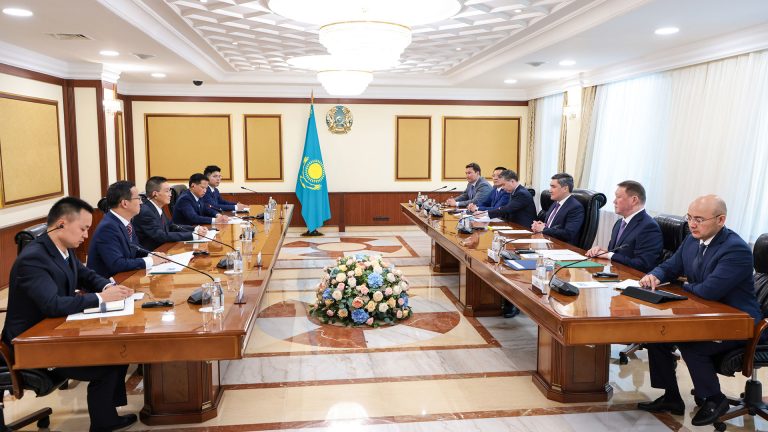
    Kazakhstan’s Prime Minister Olzhas Bektenov met with Liu Yongxing, Chairman of the Board for China’s East Hope Group, to discuss an ambitious project aimed at establishing a vertically integrated industrial park for “green” aluminium production in Kazakhstan. This initiative is designed around the principles of a circular economy, marking a significant step in the nation’s drive to diversify its economy.

    The proposed project encompasses the entire production cycle of “green” aluminium, from raw material extraction to the deep processing of high value-added materials. The initial phase includes constructing an ore dressing plant capable of processing 2 million tonnes of alumina annually, alongside an electrolysis plant to produce 1 million tonnes of aluminium per year. Crucially, the plan integrates renewable energy sources for electricity generation. East Hope Group estimates the project will create over 10,000 permanent jobs.

    “President Kassym-Jomart Tokayev has set the task of building a more diversified and future-oriented economy,” stated Prime Minister Bektenov. “We are gradually reducing our dependence on the raw materials sector and developing high value-added production. The creation of a vertically integrated aluminium production in Kazakhstan is a unique project that will ensure the comprehensive development of this sector within our domestic industry. The Government of Kazakhstan is ready for long-term cooperation.”

    Liu Yongxing highlighted Kazakhstan’s strategic importance as a logistical hub in Eurasia, noting its unique geographical advantages and development potential within the context of the “Belt and Road” initiative. He emphasised that Kazakhstan’s rich mineral resources and ongoing industrial modernisation strategy align perfectly with East Hope Group’s global priorities in “green” aluminium, modern agriculture, and renewable energy.

    Following the meeting, relevant ministries were instructed to provide the necessary support for the project’s implementation. East Hope Group has committed to certain obligations, including the training of local personnel and a phased increase in the proportion of Kazakhstani workers.

    East Hope Group is a global leader in the aluminium industry and is also active in polysilicon, “green” energy, agribusiness, and high-tech sectors.

  • Environmental Audit for Kazzinc Amid Record Smog in Ust-Kamenogorsk

    Environmental Audit for Kazzinc Amid Record Smog in Ust-Kamenogorsk

    The General Prosecutor’s Office will audit Kazzinc LLP for compliance with environmental regulations. Specialists from the Environmental Regulation and Control Committee will assist in the inspection, Prime Minister Olzhas Bektenov announced in response to a request from senators.

    According to the Prime Minister, the audit is prompted by the adverse environmental situation in Ust-Kamenogorsk observed between 23 November and 1 December 2024.

    He also reminded that the roadmap for East Kazakhstan Region and Ust-Kamenogorsk for 2024–2026 includes a number of environmental measures aimed at reducing harmful emissions in the region by 10-20%.

    The key measure is the modernisation of gas purification units at the Ust-Kamenogorsk metallurgical complex of KazZinc LLP. By 2026, the modernisation is expected to reduce sulphur dioxide emissions by 2,200 tonnes. It will also ensure the enterprise’s operations comply with the indicators of the national project “Zhasyl Kazakhstan.”

    Another important initiative is the construction of the “Hydropolimet” workshop at the Ridder metallurgical complex of KazZinc LLP. This initiative aims to reduce sulphur dioxide emissions by 714 tonnes by 2024.

    At the end of November, Ust-Kamenogorsk was covered by a dense smog. The air showed an excess concentration of pollutants. For the first time, due to poor air quality, schoolchildren were moved to remote learning for several days, and residents were advised to limit outdoor activities and use protective masks.

    Ust-Kamenogorsk faces annual issues with windless conditions and severe air pollution, but this year, according to environmentalists, the level of pollution was record-breaking.

  • Five new high-value added production projects to be launched in Pavlodar region

    Five new high-value added production projects to be launched in Pavlodar region

    Pavlodar region is expecting the launch of five projects for the production of high-value added products. The regional akimat (administration) announced the details.

    Earlier, Prime Minister Olzhas Bektenov instructed his deputy Roman Sklyar to hold talks with the owners of all large industrial enterprises and submit specific plans for the creation of new high-value added production facilities in the near future.

    In response to an inquiry from the editorial board, the akimat of Pavlodar region reported that five projects with a total cost of 130 billion tenge will be implemented in the region in such sectors as construction industry, mechanical engineering, and petrochemistry. The projects will create 905 jobs.

    In particular, the launch of two facilities with foreign participation is planned for this year. The project “Organization of mechanical processing of surfaces of products of various purposes in metallurgy, mechanical engineering and power engineering” with a cost of 7.2 billion tenge is under construction and installation works in the region. It is being implemented with the participation of a Russian company. The project is expected to produce 8.7 thousand products per year. It can create 60 jobs.

    An investor from Turkey will help to launch the production of aluminum sheet and foil. It is noted that the construction of the enterprise will start in March this year. The supply of equipment is also expected during this period. The launch of the project is estimated at 8 billion tenge. The capacity is 18 thousand tons per year, and the number of jobs is 70. Aluminum sheets are in demand in the aviation and automotive industries, construction industry, food industry, and in the global market for the production of household appliances.

    Next year, a Kazakh company plans to organize a mechanical processing site. The launch will cost 5.8 billion tenge. The capacity is 40.2 thousand units of wheel-tire products per year, or 4.02 thousand units of deformation tools.

    A forging and tire complex is under construction in the region for 78.5 billion tenge. The enterprise may start operating in 2026. It will produce 54 thousand units of rough tires and 27 thousand units of gear blanks per year.

    In the same year, it is planned to open a plant for the production of alkylate for 30.29 billion tenge. It is expected that 110 thousand tons of raw materials (butane-butylene fraction) will be processed here and 92 thousand tons of finished products will be produced per year.

    Project details

    Project Cost (billion tenge) Capacity Jobs
    Organization of mechanical processing of surfaces of products of various purposes in metallurgy, mechanical engineering and power engineering 7.2 8.7 thousand products per year 60
    Production of aluminum sheet and foil 8 18 thousand tons per year 70
    Mechanical processing site 5.8 40.2 thousand units of wheel-tire products per year, or 4.02 thousand units of deformation tools
    Forging and tire complex 78.5 54 thousand units of rough tires and 27 thousand units of gear blanks per year
    Alkylate production plant 30.29 110 thousand tons of raw materials (butane-butylene fraction) and 92 thousand tons of finished products per year