
Tag: Niobium

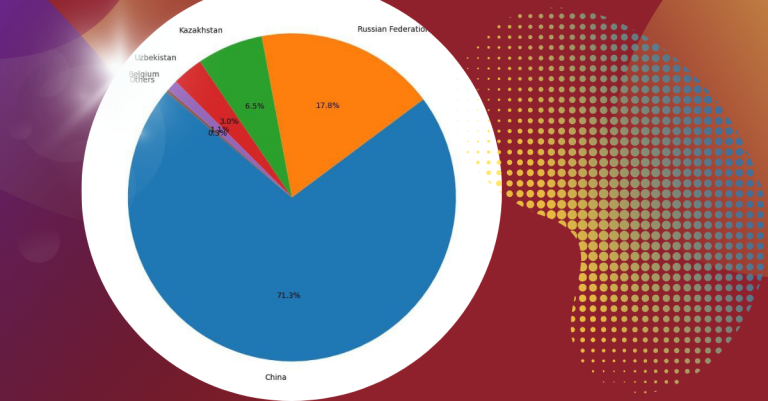
  • China Imports Up to 70% of Critical Metals from Central Asia

    China Imports Up to 70% of Critical Metals from Central Asia

    Despite the lack of official data on the export of rare earth metals by Central Asian countries, an analysis of ore, slag, and ash exports reveals interesting trends. These exports often include critical resources highly sought after by leading global powers, particularly metals such as molybdenum, titanium, and vanadium.

    According to Trademap.org data from 2019 to 2023, Central Asian countries exported a wide range of ores and concentrates, including copper, iron, precious metals, zinc, lead, molybdenum, chromium, and niche metals such as niobium and tantalum.

    In recent years, the market has also seen the introduction of products such as tin, tungsten, and titanium ores. For example, copper ore exports showed stable growth—from approximately $1.17 million in 2019 to around $3.15 million in 2023. Iron ore peaked at $1.6 million in 2021 before experiencing a decline in export volumes in subsequent years.

    One notable trend is the significant increase in molybdenum ore exports, which surged from about $4 million in 2019 to approximately $144 million in 2023. This is a clear reflection of increased global demand and investment.

    An analysis of trade with the European Union under the category “26 Ores, Slags, and Ash” shows that molybdenum stands out: its exports increased from around $11 million in 2021 to nearly $60 million in 2023. In this segment, Kazakhstan holds a dominant position, providing nearly the entire cumulative export value, while contributions from other Central Asian countries remain significantly lower.

    Central Asian countries’ export portfolios reveal a trend towards transitioning from traditional raw materials such as copper and iron to more valuable niche ores, especially molybdenum. This trend is evident both in the global market and in trade with the European Union, where Kazakhstan acts as a key supplier.
    Will the European Union be able to position itself as a key importer of critical metals from Central Asia? The future will tell.

  • Explained: The EU’s handicap in the global race for critical raw materials

    Explained: The EU’s handicap in the global race for critical raw materials

    The EU is highly dependent on third countries for the raw materials needed to engineer its energy transition and digital transformation.

    Russia’s war in Ukraine and the need to wean itself off fossil fuels in order to reach climate targets have prompted the EU to accelerate its green transition in recent months but also forced it to acknowledge its dependencies over access to critical raw materials.

    In the global race for raw materials, the EU faces multiple challenges.

    The first one is China, which recently started restricting exports of gallium and germanium, two metals essential for the production of semiconductors, in response to Western curbs on Beijing’s access to micro-processing technology.

    The EU considers both materials of high strategic importance. As well as semiconductors and other electronic devices, they are used for military applications such as missile defence and radar systems.

    Beijing’s restrictions come as a stark warning as the EU attempts to diversify and boost domestic supply of raw materials to reduce dependency on third countries.

    Reliance on ‘low-governance’ countries

    But diversifying supply chains could mean the EU has to source these materials from countries that don’t adhere to the same standards.

    Recent data suggests the EU’s supply is highly dependent on countries that have a low governance level, based on indicators including political stability, rule of law and corruption control.

    The EU’s Critical Raw Materials Act (CRMA), adopted in March this year, stipulates that EU strategic projects to scale up supply must be assessed taking into account all aspects of sustainability, including environmental protection, socially responsible practices and respect for human rights such as the rights of women.

    But many countries feeding EU supply are not aligned with European values. This raises concerns about the impact on the local communities where materials are mined, as well as the potential exploitation of natural resources.

    For example, the Democratic Republic of Congo, whose governance indicators are among the lowest in the world, supplies 63% of the EU’s cobalt, which is essential for manufacturing batteries for electrical vehicles.

    Diversifying supply a challenge

    The EU is also highly dependent on single countries for key materials such as Magnesium (China, 97%), Lithium (Chile, 97%), Iridium (South Africa, 93%) and Niobium (Brazil, 92%). These dependencies make supply chains vulnerable.

    The Critical Raw Materials Act aims to ensure no third country provides more than 65% of the Union’s annual consumption of any raw material.

    But diversifying supply is complex when refineries of many essential materials are monopolised by one or more global powers. China dominates the refining market for many critical raw materials.

    Russia’s invasion of Ukraine and the ensuing energy crisis has shown the acute dangers of over-reliance for supplies of raw materials. China’s increasingly antagonistic stance and the political instability in many African countries have also served as reminders of the fragility of the EU’s trading relationships.

    A spiralling global demand

    The demand for raw materials is growing steeply, as developed countries race to digitalise and decarbonise their economies. This can only happen with sufficient supply of raw materials, meaning countries must scale up extracting, refining and recycling operations.

    The global demand for lithium, for example, is set to increase a staggering 89-fold by 2050, according to the European Commission. Demand for gallium will multiply 17-fold during the same time.

    The Critical Raw Materials Act sets targets for the Union to extract 10%, process 40% and recycle 15% of its annual consumption of raw materials by 2030.

    To meet these targets and compete on the global stage, European Commission President Ursula von der Leyen has said the EU needs to speed up investments in research and development, recognising that the bloc’s global share of R&D expenditure has fallen 10% in the last 20 years.