Tag: National Geological Survey

  • Kazakhstan Opens 50 Mining Deposits to Auction and Builds New National Geology Lab in Push to Attract Processing-Focused Investors

    Kazakhstan Opens 50 Mining Deposits to Auction and Builds New National Geology Lab in Push to Attract Processing-Focused Investors

    Kazakhstan is expanding access to its subsoil resources and modernising the infrastructure underpinning its geological research sector, as the government advances a strategy to draw in a new class of investor — one committed not just to extraction but to building processing capacity inside the country.

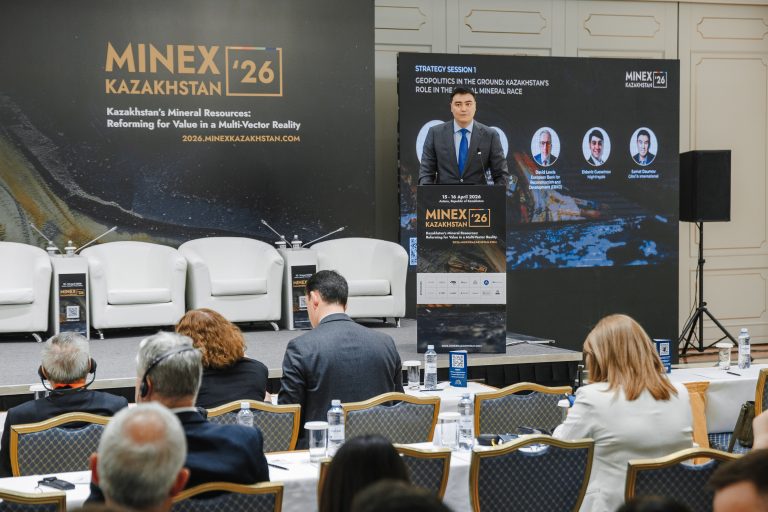
    Speaking at the MINEX Kazakhstan 2026 forum in Astana, vice minister of industry and construction Iran Sharkhan confirmed that auctions for exploration and production rights across 50 deposits of solid minerals are planned for 2026, significantly broadening the pool of opportunities available to both domestic and international investors. The auctions will be conducted through Kazakhstan’s newly launched Unified Subsoil Use Platform, which has digitalised 22 state services and allows investors to browse available areas and submit applications without intermediaries.

    To support the science underpinning exploration, a modern laboratory complex is under construction in Astana on the basis of the National Geological Survey, with commissioning targeted for 2028. The facility is expected to raise the quality and speed of geological research, providing a stronger data foundation for the exploration decisions of both state bodies and private investors. Geological survey coverage has now reached 2.038 million square kilometres against a 2026 target of 2.2 million square kilometres, with a shift to more detailed mapping scales prioritised to sharpen the identification of prospective areas. Seventeen new deposits — including Kok-Zhon, Altyn-Shoko and Samombet — were added to the state register in 2025, bringing the total to approximately 10,000.

    Sharkhan reaffirmed that the legislative framework is being redesigned to reward investors who commit to value-added activity. A royalty system is set to replace the existing mineral extraction tax, and a strategic investor status will provide preferential conditions to companies that take on domestic processing obligations. Amendments to the Subsoil and Subsoil Use Code introduced in 2025 have also targeted the digitalisation of regulatory procedures and the simplification of licensing processes. “Kazakhstan is moving from a raw materials model to a value-added economy,” Sharkhan said. “The priority is deep processing of raw materials within the country, technology development and attracting strategic investors oriented toward long-term impact.”

  • The National Geological Service (NGS) plans to develop another database of geological data, which will be integrated into the information platform minerals.gov.kz

    The National Geological Service (NGS) plans to develop another database of geological data, which will be integrated into the information platform minerals.gov.kz

    According to the comments made by the head of the national company, Erlan Galiev, during the capital conference “Increasing the Investment Attractiveness of Kazakhstan’s Mining Industry,” organized by the Kazakhstan Mining Chamber and reported by inbusiness.kz, the NGS intends to create a database specifically for primary geological information within the minerals.gov.kz portal.

    The minerals.gov.kz platform, which supports solid mineral exploration, was launched into industrial operation last year with the technical support of the national company “Kazakhstan Garysh Sapary.” The Subsoil Code, which came into effect in 2018, anticipated the creation of a special information system in the form of a National Bank of Mineral Resources, through which market participants could access all geological information and submit online applications for subsoil plots based on the “first come, first served” principle.

    Galiev mentioned that 20% of all primary geological information was digitized last year, and this year, they plan to digitize another 30%. By the end of 2025, they expect to fully digitize and populate the minerals.gov.kz IT platform with primary geological reports from the NGS.

    Regarding the selection of IT solutions, negotiations are currently underway with potential suppliers, whom Galiev preferred not to name, among global vendors with experience in working with national geological data banks for Asian, European, and American countries.

    Galiev emphasized the necessity of a separate database for primary geological information to ensure that it is properly structured, cataloged, and accompanied by metadata for the convenience of investors. He explained that the information digitized last year is currently stored on hard disks because simply dumping it into the system without proper organization would be incorrect. The data must be cartographically referenced, and if it involves geophysical information, it must be visualized.

    Galiev clarified that all primary geological data will be stored as part of the activities of the state technical service in Kazakhstan. After digitization, the reports will be translated into English using optical character recognition and artificial intelligence technologies.

    Currently, the downloaded secondary geological data cannot be accessed as minerals.gov.kz is migrating to another platform with the participation of “Kazakhstan Garysh Sapary.” Once the migration is complete, mechanisms for downloading geological reports will be linked to the platform, and users will be able to access them after connecting the acquiring tool.

    Galiev addressed the issue of increasing fees for providing geological data, stating that the pricing list was approved in 2022 and has not been changed since. He emphasized that efforts are being made to improve data packaging for users and expedite the process, reducing the waiting time for reports from several months to 10 working days, or two days at most if the report has already been scanned. Thus, there are no plans to increase fees for geological data provision.