Tag: Mongolia

  • Erdenet Mining Corp Embraces Digital Transformation for Sustainable Operations

    Erdenet Mining Corp Embraces Digital Transformation for Sustainable Operations

    Erdenet Mining Corp, located on the outskirts of Mongolia’s second-largest city, Erdenet, is undertaking a significant digital transformation to enhance its operations at one of the country’s largest porphyry-copper deposits. With an annual processing capacity of 32 million tons of ore, producing 130,000 tons of copper concentrate and over 10,000 tons of molybdenum concentrate, the company is focused on optimising its operations through innovative technology. The chief operations officer, Batmunkh, emphasises the necessity for innovation within the mining sector, stating that the company has established an Innovation Center aimed at modernising its practices to match global standards.

    Historically reliant on paper-based data, Erdenet faced challenges in resource estimation and decision-making due to the cumbersome nature of managing vast amounts of information. The introduction of Seequent software in 2018 marked a turning point, enabling the exploration department to model geology using Leapfrog Geo and process geophysical data with Oasis montaj. This transition to digital has significantly improved efficiency, allowing for near real-time access to insights and models via Seequent Central, a cloud-based data management solution.

    The digitisation of historical data has streamlined operations, reducing the time required for 3D design and resource estimation from months to mere hours. This advancement has fostered collaboration among the 32 departments within Erdenet, breaking down silos and ensuring that all teams can work together effectively. Senior geologist Amarzaya notes that the quality of work has improved, with manual errors reduced and tasks completed in a fraction of the time previously required.

    As a government-run entity, Erdenet is committed to providing accurate information to stakeholders, including investors and regulatory authorities. The integration of advanced mining software has enhanced the company’s ability to deliver precise data, facilitating better decision-making processes. Looking ahead, Erdenet is not only focused on operational efficiency but is also preparing for future challenges, including mine closure and environmental remediation. The Innovation Center is exploring advanced solutions for tailings and dam modelling, ensuring that Erdenet is well-equipped for sustainable mining practices in the years to come. With a projected operational lifespan of another 60 years, the future of Erdenet Mining Corp appears promising, driven by its commitment to innovation and sustainability.


  • Erdene Resource Development Faces Investor Caution Amid Gold Project Execution Risks

    Erdene Resource Development Faces Investor Caution Amid Gold Project Execution Risks

    Erdene Resource Development Corporation (TSX:ERD), a Canadian mining company focused on gold production in Mongolia, has seen its stock decline by 4.20% as of August 28, 2026. This downturn is attributed to investor concerns regarding operational execution, market volatility, and the inherent risks associated with transitioning from development to production. The company’s primary asset, the Bayan Khundii Gold Project, is central to its growth strategy, yet the recent stock performance reflects a broader hesitance among investors who are reassessing the company’s operational capabilities and market conditions.

    As Erdene continues to ramp up production at Bayan Khundii, the company has reported improvements in mining efficiency and operational performance. However, the transition phase is fraught with challenges, including the need for consistent production levels, effective cost management, and the ability to navigate the complexities of mine expansion. Investors are particularly focused on whether the company can sustain its operational improvements amidst fluctuating gold prices and rising costs.

    The gold market remains volatile, influenced by factors such as interest rate expectations, inflation trends, and geopolitical uncertainties. While gold typically serves as a safe haven during economic instability, mining equities can suffer when investors reassess their risk exposure. Erdene’s recent stock decline is a reflection of this cautious sentiment, as investors weigh the company’s production capabilities against the backdrop of a challenging market environment.

    Erdene’s business model is centred around gold production, with its financial performance closely tied to gold prices, production volumes, and operational efficiency. The company is not currently prioritising dividend payments, opting instead to reinvest in growth initiatives and strengthen its production platform. This growth-oriented strategy is aimed at enhancing shareholder returns through increased production and exploration opportunities.

    Despite the challenges, Erdene’s long-term outlook remains optimistic, supported by the potential growth of the Bayan Khundii project and additional exploration assets in Mongolia. However, the near-term outlook is cautious as investors continue to monitor the company’s ability to manage production ramp-up risks, cost pressures, and geopolitical exposures. The future performance of Erdene Resource Development will largely depend on its operational delivery, financial discipline, and progress across its mining portfolio, as investor confidence is closely linked to these factors.

  • Central Asia’s Critical Minerals Moment: What the Reports Don’t Tell You

    Central Asia’s Critical Minerals Moment: What the Reports Don’t Tell You

    A Deep-Dive Analysis | MINEX Forum

    Download report (as pdf)

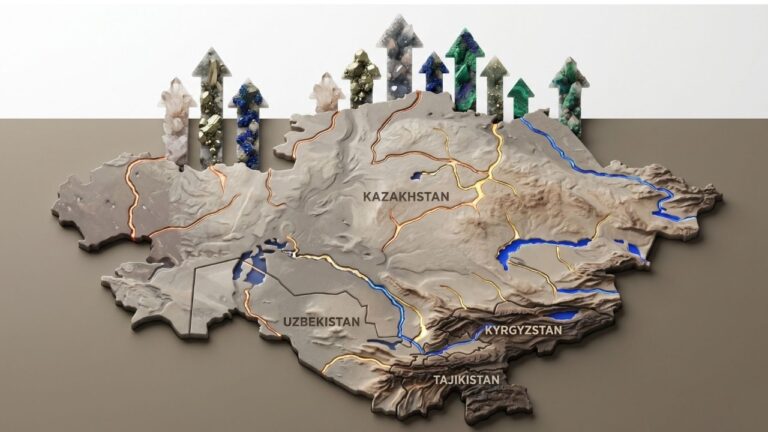
    Something significant has shifted. In the span of eighteen months, Central Asia has moved from a footnote in Washington and Brussels policy documents to a headline. The Caspian Policy Center’s new report — ‘Central Asia and the New Critical Minerals Frontier: Progress in Reshaping Global Supply Chains’ — is the latest in a wave of think-tank, government, and investor analyses arriving at the same conclusion: the region’s critical mineral resources are strategically indispensable.

    This analysis cuts through the optimism to ask the harder questions. What has actually changed on the ground? Which players are genuinely committed versus which are signing MoUs for photo opportunities? And by 2030, what will Central Asia’s real role be in the global supply of critical raw materials?

    This analysis draws on the CPC report, the EU Institute for Security Studies’ Chaillot Paper on China’s critical raw material weapon, the C5+1 Critical Minerals Dialogue in Astana on 10 June 2026, the Carnegie Endowment’s analysis of the Middle Corridor, the CFR’s report on leapfrogging China’s dominance, and the Forum’s accumulated perspective from running MINEX Asia, MINEX Europe, and MINEX Eurasia.

    1. The Geopolitical Wake-Up: Real, But Overdue

    The CPC report is unambiguous: critical mineral supply chains are no longer an economic issue — they are a national security and geopolitical issue. China controls approximately 90% of global rare earth refining, 60% of lithium processing, and over 70% of cobalt refining. By 2022, China controlled 100% of global graphite processing. These are not numbers that have crept up on policymakers. They have been visible for years. What has changed is the willingness to act — and the nature of Beijing’s own use of this leverage.

    The EUISS Chaillot Paper published in May 2026 makes for sober reading. Beijing’s sharp reduction of critical raw material exports in 2025 — covering germanium, gallium, antimony, bismuth, and rare earths — was not a one-off retaliation against US semiconductor restrictions. It evolved into a systematic geo-economic weapon. The paper documents how China used its export licensing regime to extract information about Western defence-industrial networks, coerce EU trade policy on electric vehicle tariffs, and deter Japan from strengthening its defence posture on Taiwan.

    What is less widely understood is how the apparent ‘détente’ of late 2025 conceals a structural tightening. The October 2025 rare earth export controls were suspended for one year as part of the Xi–Trump Busan summit deal — they are due to re-activate in November 2026. Critically, the April 2025 controls remain fully in force; only the October tranche was suspended. More consequentially, China’s export licensing architecture now includes extraterritorial provisions that allow Beijing to restrict re-exports of products containing Chinese-origin rare earth content even between third countries. The détente is not a resolution. It is a one-year suppression of symptoms while the structural disease remains untreated.

    China does not merely hold rocks in the ground. It holds the refinery, the processing plant, the magnet manufacturer, and the pricing mechanism. Owning a deposit in Central Asia without access to non-Chinese processing is like owning an oil field with no pipeline.

    This is the fundamental reality that too many Western policy documents still dance around. The CPC report is admirably direct about the midstream gap — the fact that even where Western investors enter Central Asian mining, the ore typically still travels east for processing. Closing that gap requires not just exploration investment but decades of patient capital in refining and processing infrastructure. That capital has not yet materialised at the required scale.


    2. The MoU Inflation Problem

    What should concern anyone serious about this sector is the following. The United States, the EU, Japan, South Korea, and Türkiye are all engaged in what the Forum terms ‘MoU inflation’ with Central Asian governments. The CPC report catalogues a remarkable number of bilateral frameworks, memoranda of understanding, and strategic partnerships signed since 2025. The C5+1 Critical Minerals Dialogue in Astana on 10 June produced more of the same.

    These instruments are not worthless — they establish political will and create frameworks for future action. Kazakhstan’s Minister of Industry, Yersayin Nagaspayev, rightly highlighted that Kazakhstan has adopted a new Subsoil and Subsoil Use Code, implemented a ‘first come, first served’ licensing principle, launched a unified digital subsoil platform, and fully adopted CRIRSCO international reporting standards since 2024. Investment in geological exploration has tripled since 2018, exceeding one billion dollars. Western majors including BHP (via its Xplor programme), First Quantum Minerals, Ivanhoe Mines, Teck Resources, Fortescue, and US-based Cove Capital have entered the Kazakh market. Chinese companies are moving faster and at greater scale: Zijin Mining completed a $1.2 billion acquisition of Kazakhstan’s Raygorodok gold mine in October 2025, adding to its existing operations at the Taldybulak Levoberezhny mine in Kyrgyzstan and the Jilau and Taror gold mines in Tajikistan — a three-country “Gold Triangle” across Central Asia. East Hope Group — one of China’s largest private industrial conglomerates and a top-ten global aluminium producer — is advancing a $12.6 billion fully integrated aluminium cluster in Kazakhstan’s Kostanay and Aktobe regions: bauxite mining, a two million tonne per year alumina refinery, a one million tonne per year primary aluminium smelter, and a captive one-gigawatt power plant. The project framework was signed with the Kazakh government in February 2025 and geological exploration of eleven deposits is already under way. If delivered, it would be one of the largest single foreign direct investment projects in Kazakhstan’s industrial history. China National Gold Group has signed an MoU with Uzbekistan covering geological exploration and technology transfer. These are real signals of intent — though the Western and Chinese signals point in very different directions.

    But the gap between MoU and mine is measured not in months but in decades. The CPC report states this plainly: developing a major mining project from inception to production can take twenty or more years. Processing and refining require additional capital beyond the mine gate. Political cycles — in Washington, in Brussels, and in Central Asian capitals — run on four-to-five-year horizons. China’s BRI financing runs on twenty-year horizons. This asymmetry is not a detail. It is the central challenge of Western engagement with Central Asia’s mineral sector.

    The question is not whether Kazakhstan, Uzbekistan, Kyrgyzstan, or Tajikistan have the minerals. They do. The question is whether Western partners have the institutional patience, the risk appetite, and the financing instruments to compete with a counterparty that thinks in decades, not electoral cycles.

    The US International Development Finance Corporation’s recent approval of USD 2.5 billion in strategic investments and the C5+1 roadmap for geological exploration, mining and processing, and global value chain integration are positive steps. But the gap between announced capital and deployed capital in this region remains historically wide. The Forum has documented this cycle repeatedly: enthusiasm peaks around major geopolitical events, and then the deals stall in permitting, due diligence, or financing committees.


    3. Where the Real Business Opportunities Are

    The following sets out where genuine commercial opportunities are opening up, rather than where the diplomatic activity is concentrated.

    3.1  Midstream Processing — The Untapped Prize

    The CPC report’s section on closing the midstream gap is the most commercially important part of the document. Central Asia produces raw ore and exports it, largely to China, which captures the value-added margin in processing and refining. The governments in the region know this and want to change it. Kazakhstan and Uzbekistan have explicitly stated they want to develop industrial clusters that capture more of the value chain domestically.

    For investors and mining companies, this creates a specific opportunity: joint ventures in processing and refining that give Central Asian governments the industrial development they want and give Western offtake partners the supply chain security they need. This is not easy — it requires technology transfer, long-term offtake agreements, and patient capital — but it is where the alignment of interests is strongest. Companies with refining technology and Western governments with DFI instruments should be looking at this window seriously.

    3.2  The Middle Corridor — A Structural Shift in Logistics, With a Named Weak Link

    Freight along the Trans-Caspian International Transport Route has increased fivefold in seven years, reaching 4.1 million tonnes across the Caspian in 2024 alone. The war in Ukraine has accelerated this, but the trend is structural. For critical minerals, the Middle Corridor offers an alternative to Chinese-controlled logistics networks. Kazakhstan’s commitment to developing this route is serious, and the Hormuz blockade in place since February 2026 — with oil above $110 a barrel at the time of writing — is providing a live demonstration of exactly why overland alternatives to maritime choke points matter.

    But the optimism around the corridor needs to be tempered by a specific and underreported vulnerability. Georgia is currently the corridor’s only gateway to Europe. Until the TRIPP route via Armenia and Azerbaijan’s Nakhchivan exclave becomes operational, Tbilisi is structurally irreplaceable. Yet the Georgian government has just cut funding for the Anaklia deep-sea port — identified by both the World Bank and the EU’s Trans-European Transport Network as the corridor’s central infrastructure priority — from 150 million lari to 50 million lari. Georgia’s existing port capacity is already nearing exhaustion.

    The explanation for this decision is contested, but one strand is disturbing: after a Western-led consortium lost the Anaklia contract in 2020, the Georgian government selected as its preferred contractor a Chinese-Singaporean firm currently under US sanctions. There is a credible case that Beijing, which benefits from the Northern (Russian) Corridor and has no strategic interest in the Middle Corridor displacing it, is quietly applying pressure on Tbilisi to limit the western terminus’s capacity.

    Kazakhstan’s position in this corridor is more structural than is commonly appreciated: approximately 80% of all rail cargo travelling between China and Europe already passes through Kazakhstan, making it not an emerging alternative route but the existing backbone of Eurasian overland trade. The commercial opportunity in the corridor’s logistics and infrastructure layer is real — port capacity at Aktau and Kuryk, rail and intermodal connectivity through Azerbaijan and Georgia to Türkiye — but companies positioning in this space need to price in the Georgia risk. Türkiye’s role as the corridor’s westernmost reliable node therefore becomes more, not less, strategically significant if Georgia continues to under-invest.

    3.3  Uranium — The Quiet Giant

    Central Asia produces approximately 50% of global uranium. Kazakhstan alone, through Kazatomprom, dominates global supply. The US Geological Survey has added uranium to its updated list of critical minerals. As the energy security debate in Europe and the US re-centres on nuclear power as a baseload complement to renewables, and as advanced reactor programmes (SMRs in particular) gather momentum, uranium supply security from non-Russian, non-Chinese sources becomes a premium.

    The investment thesis for uranium in Kazakhstan is arguably more mature and more deliverable than for rare earths, precisely because the infrastructure already exists. The opportunity is in midstream — converting, enriching, and fabricating fuel outside of Russian-controlled supply chains — and in ensuring Western utilities have long-term offtake agreements with Kazakh producers.

    3.3a  Titanium — The Overlooked Aerospace Play

    Titanium rarely features in critical minerals analysis focused on Central Asia, yet Kazakhstan accounts for approximately 20% of the global aerospace-grade titanium market — a concrete, active commercial relationship, not a geological aspiration. This matters because aerospace titanium supply has been severely disrupted by the Russia sanctions regime: VSMPO-AVISMA, previously the dominant Western supplier accounting for roughly 30% of global aerospace titanium, became inaccessible to Western manufacturers after 2022. Boeing, Airbus, and their tier-one suppliers have been seeking alternative sources ever since. Kazakhstan’s existing market position fills part of that gap and has been doing so quietly while the policy debate concentrates on rare earths and lithium. Titanium is now on both the EU and US critical minerals lists. For investors and industrial offtake partners, the titanium story in Kazakhstan differs from the rare earth story in one crucial respect: the supply chain is already functioning. The opportunity is in expanding and securing existing capacity, not in building it from scratch.

    3.4  Kyrgyzstan and Tajikistan — Early-Stage, High-Risk, Potentially High-Reward

    The CPC report and the C5+1 framework rightly include Kyrgyzstan and Tajikistan. Kumtor Gold in Kyrgyzstan and Zarafshon Gold in Tajikistan are the flagship projects, but the rare earth and critical mineral potential in both countries is largely unexplored. Legal frameworks are weaker, infrastructure is thinner, and political risk is higher. But for investors and juniors willing to absorb early-stage risk, the geological endowment is compelling.

    The legal reform chapter of the CPC report is a necessary reality check here. As Dr. Ruchan Kaya argues directly: No Reform, No Mining. Without clear subsoil use codes, transparent licensing, independent dispute resolution, and ESG frameworks compatible with Western capital markets, foreign investment will remain shallow. Kyrgyzstan and Tajikistan have work to do.

    3.5  Technology Transfer and Workforce Development

    Central Asian governments are unanimous on one point: they do not want to be raw material exporters indefinitely. They want technology transfer, workforce development, and the creation of domestic industrial capacity. This creates a genuine market for mining engineering services, training, metallurgical technology, and environmental management expertise. European, Japanese, and South Korean companies with this expertise have an opening that pure extractive investors do not.


    4. The Six-Party Chess Board: China, Russia, USA, EU, Türkiye, Japan/South Korea

    China — The Incumbent with a Structural Advantage

    China’s position in Central Asian critical minerals is not primarily about geology. It is about infrastructure, processing capacity, financing terms, and decades of relationship-building. The BRI has locked in logistical corridors, off-take agreements, and debt obligations that are difficult to unwind quickly. Chinese firms continue to invest at scale: Zijin Mining — now the world’s fourth-largest gold producer — has assembled a “Gold Triangle” across Kazakhstan (Raygorodok, $1.2 billion acquisition completed October 2025), Kyrgyzstan (Taldybulak Levoberezhny), and Tajikistan (Jilau and Taror mines, where it is the largest gold producer accounting for over 70% of national output). East Hope Group — one of China’s largest private industrial conglomerates and a top-ten global aluminium producer — is advancing a $12.6 billion fully integrated aluminium cluster in Kazakhstan: bauxite mining, a two million tonne per year alumina refinery, a one million tonne per year primary aluminium smelter, and a captive one-gigawatt power plant across the Kostanay and Aktobe regions. The framework agreement was signed with Astana in February 2025; geological exploration of eleven bauxite and coal deposits is already under way. If delivered, it would be one of the largest single foreign direct investment projects in Kazakhstan’s industrial history — and a textbook example of the integrated industrial model China deploys while Western investors are still circling at the MoU stage. China National Gold Group is advancing into Uzbekistan via government-level MoUs on exploration and technology transfer. Chinese cumulative investment in Central Asia reached $35.9 billion by mid-2025, a 1.5-fold increase since 2020, with Kazakhstan in the first half of 2025 alone attracting an estimated $23 billion in BRI-linked commitments — making it the single largest BRI capital recipient globally in that period. Any honest assessment must acknowledge that China will remain the dominant actor in Central Asian mineral supply chains throughout the 2020s.

    The more important question is whether China’s dominance is vulnerable to a strategic discontinuity rather than gradual erosion. The CFR’s February 2026 report makes an argument that cuts against the grain of most current thinking: the United States cannot out-mine or out-process China, and attempting to do so is the wrong strategy. The correct approach is to leapfrog China’s dominance through innovation — scaling rare-earth-free magnets, mine tailings recovery, e-waste recycling, and AI-accelerated materials science. If this thesis is correct, the entire paradigm of building competing mine-to-magnet supply chains in Central Asia may be strategically secondary to the innovation race happening in US and allied laboratories. Central Asian governments and their Western partners should be alert to this possibility: the strategic premium on Central Asian deposits is real today, but it is not permanent if substitute materials technologies mature.

    Russia — The Shadow Partner

    Russia’s invasion of Ukraine has paradoxically accelerated Central Asia’s strategic importance to the West while complicating its own position in the region. Central Asian governments are navigating with care — they cannot afford to antagonise Moscow, which retains significant economic and security leverage, but they are actively diversifying. Russia’s ability to invest in and benefit from Central Asian critical mineral development is constrained by sanctions, capital flight, and the rerouting of its own economy. For the near term, Russia’s role is more that of a constraint than a competitor in the Western engagement story.

    United States — Urgency Without Sustained Patience

    Washington’s engagement since 2025 has been substantive. Project Vault (a USD 12 billion public-private reserve initiative), FORGE (the Forum on Resource Geostrategic Engagement), the Critical Minerals Ministerial with 54 countries, and the DFC’s Central Asia investment pipeline represent genuine institutional commitments. The C5+1 framework gives the US a multilateral architecture in the region.

    However, it is important to understand what FORGE actually is — and what it is not. The Atlantic Council’s analysis makes a distinction that most coverage obscures: FORGE is structurally different from its predecessor, the Minerals Security Partnership. The MSP functioned primarily as a pooled investment co-ordination vehicle. FORGE is designed as a ‘membership by trade’ model — participation conditioned on adherence to shared market rules and price floors, rather than joint capital deployment. Investment remains bilateral. This means FORGE will not produce a multilateral investment fund for Kazakhstani or Uzbekistani mining projects. It will produce a shared pricing and trade architecture that in theory de-risks bilateral deals — but the capital mobilisation burden still falls on individual governments and DFIs acting separately. For Central Asian partners watching from Astana or Tashkent, this distinction matters enormously.

    It is worth keeping the bilateral relationship in perspective: Kazakhstan has attracted more than $480 billion in cumulative foreign direct investment since independence, with gross FDI inflows reaching $20.5 billion in 2024 and investors from more than 120 countries currently active in the country. The US relationship is therefore being built onto an already diversified investment base, not into a vacuum. Kazakhstan signed USD 17 billion in new bilateral agreements with the US during President Tokayev’s November 2025 Washington visit, while Uzbekistan committed to investing up to USD 35 billion in the US over the next three years — directions of flow and deal structures that differ significantly, but which together signal that the C5+1 relationship has acquired genuine commercial weight. But commercial weight at the announcement stage and capital deployed in-country are different things.

    The European Union — Engaged But Fragmented

    The EU’s Critical Raw Materials Act and the selection of 60 Strategic Projects — including Kazakhstan and Ukraine as external partner countries — represent a serious policy commitment. But the EUISS Chaillot Paper is damning on Europe’s pace of execution: American, Japanese, and particularly European diversification efforts are not on track to replace the volume or range of China-dominated production over the next decade.

    The EU’s problem goes deeper than slow bureaucracy or fragmented financing instruments. As of late 2025, despite all the summits, roadmaps, and declared billions, only five EU companies have actually invested in CRM projects in Central Asia. That is not a financing gap problem — it is a near-total absence of private sector engagement. EU policy documents treat Central Asia as five countries of strategic importance; EU commercial reality has concentrated almost entirely on Kazakhstan, which is the only fully recognised EU external strategic partner with both the resource base and the legal framework for large-scale collaboration. Kyrgyzstan, Tajikistan, and even Uzbekistan remain largely outside the EU’s actual investment footprint despite featuring prominently in its diplomatic declarations. Brussels risks building an elaborate architecture of frameworks and roadmaps that covers five countries on paper but delivers in one.

    Türkiye — The Underappreciated Swing Player

    Türkiye’s role in Central Asian critical minerals deserves far more analytical attention than it currently receives. Ankara’s position as a NATO member, a pragmatic economic partner to both Russia and China, and the institutional convener of the Organisation of Turkic States (OTS) gives it a combination of relationships that no other actor in this space possesses.

    The OTS — which brings together Türkiye, Kazakhstan, Uzbekistan, Kyrgyzstan, Azerbaijan, and observer states — is an increasingly active institutional vehicle for economic co-operation amongst Turkic-speaking nations. For critical minerals specifically, it creates a framework for Türkiye to position itself not merely as a transit corridor but as a co-investor and processing ally for Central Asian governments that want to move up the value chain.

    The strategic picture that emerges from available data is striking in its specificity. Türkiye’s mineral engagement operates across four distinct partner-and-material vectors:


    Partner Key Materials / Vectors Türkiye’s Function
    Central Asia Boron, refined REEs, battery recyclables Co-investor and institutional processing ally via the Organisation of Turkic States (OTS)
    China Manganese, chromium, lithium, copper Supply chain alternative and competitor in REE midstream processing
    Russia & Iran Light and heavy rare earth oxides Corridor guardian; bypassing northern routes via the Middle Corridor
    Logistics vectors Transport infrastructure, regional border security Gateway and facilitator for Eurasian mineral freight flows


    Read together, these vectors tell a coherent story. Türkiye is positioning itself simultaneously as a co-investor with Central Asian partners in boron and REE processing (leveraging the OTS institutional framework), as a competitive alternative to China in REE midstream capacity, and as the indispensable corridor guardian for the Middle Corridor route that bypasses both Russia and Iran.

    What is new and underreported is the domestic industrial ambition underpinning this positioning. At the OECD Critical Minerals Forum in Istanbul in April 2026, Türkiye’s Energy and Natural Resources Minister Alparslan Bayraktar made a declaration that amounts to a strategic doctrine: “Having resources alone is no longer sufficient. You must be able to process them. Türkiye is building exactly that, combining extraction with deep processing capacity and high-tech industrial value creation.” The Beylikova REE project in Eskişehir province — described by Bayraktar as potentially one of the world’s largest deposits — already has a pilot facility operational, with plans for full industrial production including separation and processing of rare earth oxides for permanent magnets. A comprehensive Critical Raw Materials strategy is forthcoming from Ankara. This is not transit ambition. This is industrial policy.

    The active Iran conflict and Hormuz disruption, which Bayraktar explicitly cited at the same forum, reinforces the Middle Corridor’s necessity. The corridor’s importance is no longer merely a response to the Ukraine war and the sanctioning of Russian routes — it is now being validated in real time by a second simultaneous crisis in maritime supply chains. Türkiye’s own boron endowment — approximately 73% of the world’s reserves — and the January 2026 mining sector MoU with Uzbekistan, which carries the weight of a presidential-level strategic council endorsement rather than a routine ministerial agreement, position Ankara as a co-architect of the post-Chinese supply chain rather than a passive transit facilitator.

    The MINEX Asia Forum in Ankara on 24–25 June sits at exactly this intersection. Whether Türkiye chooses to deepen its processing and co-investment role, or remains primarily a corridor facilitator, will significantly shape the commercial geography of Central Asian mineral exports through 2030 and beyond.

    Japan and South Korea — Quiet but Serious

    Japan and South Korea have some of the most sophisticated critical mineral diversification programmes of any Western-aligned economies. Japan’s rare earth diversification after China’s 2010 export restriction was a decade-long institutional effort that produced real results. South Korea’s Korea Zinc committed USD 7.4 billion to new zinc refining in the US in 2025. Both countries are watching Central Asia closely and have existing relationships — South Korean companies are active in Kazakhstan’s energy and industrial sectors.

    The EUISS paper notes that US and Japanese stockpiling and state-sponsored diversification efforts have been more successful than Europe’s — and that this risks disrupting the level playing field between downstream industries. Japan and South Korea’s engagement in Central Asia is likely to deepen significantly through 2030, and they may prove more reliable long-term partners than the US for the Central Asians, precisely because they have demonstrated institutional continuity in minerals diplomacy.


    5. A 2030 Forecast: Honest Probabilities, Not Promotional Headlines

    Based on the analysis above, the Forum’s assessment of where Central Asia is likely to stand in the global critical minerals picture by 2030 is as follows.

    What Will Likely Have Happened

    Kazakhstan will have advanced several significant critical mineral projects, particularly in uranium conversion and enrichment outside Russian supply chains, and in copper with one or two major Western-backed expansions. The Middle Corridor will carry materially higher volumes of goods, including mineral concentrates, with improved port and rail infrastructure — assuming the Georgia bottleneck is resolved, either through Tbilisi reversing course on Anaklia or through the TRIPP route becoming operational.

    Uzbekistan will have attracted significant investment in gold and copper, building on its already-strong trajectory, and will have made progress on rare earth exploration, though commercial production at scale is unlikely before 2030.

    Türkiye will have deepened its institutional role through the OTS and established at least one significant co-processing or co-investment arrangement with a Central Asian partner, most likely in boron derivatives or light rare earth oxides. The Beylikova project will have moved from pilot to initial industrial scale, giving Ankara credible processing capacity for the first time.

    FORGE will have produced a shared pricing architecture and several concrete offtake agreements. However, because FORGE is a trade-rules framework rather than a pooled investment vehicle, the capital mobilisation it generates will be diffuse and bilateral rather than concentrated and strategic. The gap between FORGE’s institutional ambition and its actual investment footprint in Central Asia will remain a source of frustration.

    Processing and refining capacity in Central Asia will have increased from its current low base, but will still represent a small fraction of what is needed to be genuinely China-independent. The midstream gap will have narrowed, not closed.

    What Will Likely Not Have Happened

    Central Asia will not have become a major supplier of processed rare earth materials to Western markets by 2030. The timeline from geological survey to commercial rare earth processing facility is typically fifteen to twenty years, and the clock has not been running long enough.

    China’s dominance in processing will not have been broken. It may have been reduced at the margin — particularly for specific materials where Western-backed alternatives have been developed — but the structural advantage Beijing built over three decades cannot be unwound in five years.

    A unified, coherent Western investment approach to Central Asia will not have materialised. The EU, US, Japan, South Korea, and Türkiye will continue to operate largely in parallel rather than in co-ordination, missing the synergies that a genuinely multilateral approach could generate.

    The Wild Cards

    Innovation as disruptor. The CFR’s February 2026 analysis argues that the US and its allies cannot out-mine or out-process China — and should not try. The alternative is to leapfrog China’s dominance through disruptive technologies: rare-earth-free magnets that eliminate the most geopolitically vulnerable inputs, mine tailings recovery that yields critical minerals from existing waste streams faster and more cheaply than new extraction, and e-waste recycling at industrial scale. If these technologies mature faster than expected, the strategic premium on Central Asian deposits could diminish even as geopolitical interest in the region remains high. For Central Asian governments, this is both a warning and an opportunity: the window in which their geological endowment commands maximum strategic attention may be narrower than current diplomatic momentum implies.

    The China re-activation deadline. The October 2025 rare earth export controls suspended under the Xi–Trump deal are due to re-activate in November 2026 unless the deal is renewed. By the time of MINEX Eurasia in London on 30 November, this will be an immediate live issue. If Beijing re-activates, the urgency around alternative supply chains — including Central Asian ones — will intensify sharply. If it extends the suspension, the pressure on Western governments to maintain costly diversification programmes will ease, potentially slowing capital deployment.

    Geopolitical escalation beyond Ukraine. The Hormuz blockade has already demonstrated that disruption can arrive simultaneously from multiple directions. Central Asia’s importance as both a resource base and a logistics corridor increases with every crisis in maritime routes. But escalation can also redirect capital and political attention away from the patient, long-horizon work of building supply chains.

    Domestic political stability in Central Asia itself is not guaranteed. Kyrgyzstan in particular has experienced significant political turbulence. Investors will need to see sustained legal and regulatory reform to deploy long-term capital at scale.

    Conclusion: The Window Is Open — But Not Indefinitely

    Central Asia’s critical minerals moment is real. The geology is there. The geopolitical will is growing. The legal frameworks are improving in Kazakhstan and Uzbekistan. The Middle Corridor is becoming a genuine alternative logistics route — though its Georgian gateway is more fragile than most analyses acknowledge. And for the first time in a generation, Central Asian governments are actively seeking to diversify away from exclusive dependence on Chinese and Russian capital and markets.

    But the picture is more complicated than the wave of optimistic policy documents suggests. FORGE is a trade-rules architecture, not a capital deployment machine — and the distinction matters for Central Asia. The EU has five companies on the ground despite its ambitious declarations. China’s export control détente has a hard expiry date in November 2026. And the CFR’s innovation thesis raises a genuinely uncomfortable question: what if the West’s best path to supply chain security runs through the laboratory rather than the mine shaft?

    Türkiye’s OTS-anchored positioning adds a genuinely new dimension to this picture. An Ankara that is actively building REE processing capacity at Beylikova, institutionalising economic co-operation through the OTS, and serving as the corridor’s most reliable western terminus is not a passive transit hub. It is a co-architect of the post-Chinese critical mineral supply chain — if it chooses to be.

    The businesses and investors who will win in this space are not those signing MoUs at ministerial summits. They are those who are currently doing the detailed geological work, building the processing partnerships, securing the offtake agreements, and positioning in the Middle Corridor logistics chain. They are thinking in fifteen-year horizons, not fifteen-month ones.

    At MINEX Asia in Ankara, MINEX Europe in Ireland, and MINEX Eurasia in London, the Forum is convening these conversations — not about what Central Asia might become, but about what concrete steps, in what sequence, with what capital and what institutions, will make the difference between another wave of declarations and a genuine reorientation of global critical mineral supply chains.

    The rocks are there. The question is whether the will, the capital, and the institutions are there too — and whether they will arrive before the window closes.


    Sources: Caspian Policy Center, ‘Central Asia and the New Critical Minerals Frontier: Progress in Reshaping Global Supply Chains (June 2026); EU Institute for Security Studies Chaillot Paper 189, ‘Beijing’s Critical Raw Material Weapon’ (May 2026); C5+1 Critical Minerals Dialogue, Astana (10 June 2026); Carnegie Endowment, ‘The Much-Touted Middle Corridor Transport Route Could Prove a Dead End’ (April 2026); CFR, ‘Leapfrogging China’s Critical Minerals Dominance’ (February 2026); Atlantic Council, ‘US Critical Minerals Policy Goes Collaborative with FORGE’ (February 2026); CSIS, ‘Rare Earth Export Restrictions One Year Later’ (May 2026); Daily Sabah, OECD Critical Minerals Forum coverage (April 2026); Caspian Post, ‘How Critical Minerals Are Reshaping Türkiye–Uzbekistan Ties’ (January 2026); TRENDS Research, ‘EU–Central Asia Cooperation on Critical Minerals’ (October 2025); OECD Regional Note on Critical Minerals in Central Asia (April 2026); Türkiye strategic minerals vector analysis (2026).


  • Central Asia’s Economic Ascent: The Mining Industry at the Heart of Regional Growth

    Central Asia’s Economic Ascent: The Mining Industry at the Heart of Regional Growth

    Central Asia and Mongolia will remain resilient to geopolitical shocks and record the highest growth rates of the EBRD countries of operation in 2026 and 2027, according to the latest Regional Economic Prospects report published on 3 June 2026, by the European Bank for Reconstruction and Development (EBRD). The combined economies of Kazakhstan, the Kyrgyz Republic, Mongolia, Tajikistan, Turkmenistan, and Uzbekistan are projected to grow by 5.6% in 2026 and 5.3% in 2027.

    These are compelling headline figures. Yet beneath them lies a more consequential story—one that the OECD’s March 2026 report, Advancing Security and Transparency for the Governance of Critical Raw Materials in Central Asia, articulates with rare precision: the region is not merely growing; it is repositioning itself at the very heart of the global critical raw materials race.

    The mining sector is no longer a background variable in Central Asia’s development story. It is the plot itself.


    Article content

    MINEX Asia 2026 is where it gets real. Join EBRD and OECD peers presenting on Kazakhstan’s scale, Tajikistan’s green pivot, Uzbekistan’s processing ambitions—and the governance gaps that determine success.

    🗓️ 24-25 June | Ankara: https://2026.minexasia.com


    The Regional Narrative: Resilience With Structural Depth


    Growth prospects remain robust but are increasingly dependent on the pace of domestic reforms and efforts to strengthen resilience to external shocks. Strong domestic consumption, rising real wages, and robust capital investment are real. But so are the fault lines: downside risks include energy price volatility, supply-chain disruptions, economic sanctions, and slower growth in the region’s largest trading and economic partners, Russia and China.

    The OECD note adds a structural dimension that the growth forecasts alone cannot convey. Central Asia’s substantial yet untapped resource base, combined with its location between major markets in Europe and Asia, raises the region’s relevance in CRM geopolitics and efforts to diversify global supply chains. This is a geostrategic statement. The region holds extraordinary assets: Kazakhstan, already the world’s largest producer of uranium, produces and processes around twenty of the 34 CRMs included on the European Union’s official list. The Kyrgyz Republic and Tajikistan both host some of the world’s largest antimony reserves. Uzbekistan possesses some of the largest copper reserves globally and is advancing lithium and molybdenum production.

    Taken together, these endowments amount to a critical minerals portfolio of exceptional strategic depth. Whether the region can translate that portfolio into durable prosperity is the central question of the coming decade.

    Country by Country: Where the Headlines Don’t Tell the Full Story


    Tajikistan: Gold and Strategic Minerals

    Article content


    Tajikistan: Gold and Strategic Minerals

    Tajikistan’s economic performance continues to confound those who underestimate it. In March 2026, Moody’s upgraded Tajikistan’s sovereign credit rating to B2 with a stable outlook, citing the country’s continued economic resilience. The EBRD projects growth easing to 7.9 per cent in 2026 — still remarkable for a landlocked, remittance-dependent economy navigating elevated regional volatility.

    The mining dimension is crucial. Gold remains the cornerstone of export revenue and fiscal stability, and Tajikistan’s antimony sector is poised for a structural step-change. Tajikistan possesses the world’s second largest antimony reserves, and China’s effective ban on antimony exports to the US and EU provides a significant window of opportunity. Together, France and Belgium accounted for 77% of Tajikistan’s antimony exports in 2024. With TALCO nearing completion of a new antimony metallurgical plant, Dushanbe is finally beginning to capture processing value rather than simply shipping raw material.

    Article content


    But what I find most intriguing about Tajikistan’s trajectory is the emerging convergence of green energy and artificial intelligence with its mining ambitions. The Rogun Hydropower Project — set to have an annual capacity of over 3,600 megawatts once fully operational — would cover most of Tajikistan’s domestic consumption and create the conditions for green aluminium production, with approximately 70 per cent of output earmarked for export to Kazakhstan and Uzbekistan. Cheap, clean electricity is not merely an industrial asset — it is the foundation for competitive mining, smelting, and increasingly, data infrastructure.

    Tajikistan has initiated groundbreaking infrastructure projects, including the launch of “Area AI” — the world’s first dedicated AI Zone — a technopark and cluster designed to serve as a hub for research, development, and application of AI technologies. The country has forged partnerships with international tech firms including Perplexity AI, Google DeepMind, Yotta and Presight to accelerate technology transfer and innovation. The government has declared 2025–2030 the “Years of Digital Economy and Innovation Development.” Taken alongside the Rogun-powered industrial ambitions, this is Tajikistan’s bid to become not just a minerals supplier but a genuinely integrated green industrial economy — using AI and clean energy together to escape the extractive trap.

    The key vulnerability remains Tajikistan’s dependence on Russia, where a slowdown would depress the remittance inflows that underpin household incomes. That risk is real and should not be minimised. But the strategic direction of travel is clear — and it is more ambitious than most Western observers appreciate.

    Article content

    Kyrgyzstan: The Kumtor Imperative and Exploration Needs

    Kyrgyzstan remains the region’s most dramatic case study in resource-dependent growth. Kumtor Gold Company — nationalised in 2022 after nearly three decades of Canadian stewardship — generated net profit exceeding USD 706 million in 2025, contributes 10–15 per cent of GDP, and represents nearly two-thirds of the country’s mineral exports. The March 2025 discovery of an additional 147 tonnes of gold reserves extended the mine’s productive life to at least another 17 years.

    Underground mining operations, launched in August 2025, are transformative. At current gold prices hovering above USD 4,500 per ounce, Kumtor’s economics are exceptional — and the government’s plan to process tailings estimated to contain over 100 tonnes of gold adds further upside. Fixed capital investment rose by 25.5 per cent year on year thanks to strong investment in infrastructure, energy and housing.

    Article content

    Yet the near-term outlook has darkened. The European Union’s 20th sanctions package, announced in late April, restricts exports of dual-use goods to Kyrgyzstan and tightens controls on its financial and logistics sectors. The EBRD has revised its 2026 growth forecast down to 8.7 per cent as a result. This is a significant geopolitical constraint on what would otherwise be an exceptionally strong growth story — and it underscores the OECD’s broader finding that regulatory unpredictability and governance gaps impose real costs on the region’s investment attractiveness.

    The OECD note also flags a structural vulnerability that sits beneath the Kumtor euphoria: limited exploration since independence means that the Kumtor mine, accounting for 90% of the Kyrgyz gold exports, is set to close in 2031 due to reserves depletion — and the lack of exploration since independence will make it harder to offset this decline quickly. The reserve discovery of 2025 has bought time but not resolved the underlying fragility.

    Kazakhstan: Scale, Strategy, and Industrial Output

    Kazakhstan’s mining profile is defined by scale and global strategic significance. The country holds the world’s largest chromium reserves, accounts for roughly 40 per cent of global uranium output, and produces massive quantities of refined copper, largely exported to major industrial buyers like China and Türkiye.

    Graphite is a high-potential sector for Kazakhstan. With the exploitation of its Sarytogan deposit — added to the EU’s list of strategic raw material projects and reported to contain 30% of the world’s graphite reserves — Kazakhstan is expecting to become a crucial player on the world graphite market.

    The tungsten story is equally striking. Kazakhstan holds roughly 2 million tonnes of tungsten resources out of approximately 3.6 million tonnes of global reserves. A joint venture between Kazakhstan’s Tau-Ken Samruk and US-based Cove Kaz Capital Group has been formed to develop the Severniy Katpar tungsten project, with the US International Development Finance Corporation issuing Letters of Interest for up to USD 700 million in potential financing — marking Washington’s most significant entry yet into the region’s critical minerals sector.

    Yet the near-term picture carries a real cautionary note. In Kazakhstan, the extractive industry contracted by 11.4 per cent year on year in Q1 2026 following disruptions to the Caspian Pipeline Consortium pipeline and an incident at the Tengiz oil field. The EBRD projects Kazakhstan’s GDP growth moderating to 4.7 per cent in 2026 and 4.5 per cent in 2027 — the lowest in the region, reflecting the inherent vulnerability of commodity-led economies to infrastructure and logistics shocks.

    Article content

    Uzbekistan: The Ambitious Reformer

    Uzbekistan’s ambitions deserve particular attention. The country is the world’s fifth-largest uranium supplier, a top-ten gold producer, and is rapidly positioning itself as a critical minerals investment destination. Uzbekistan has actively signed Memorandums of Understanding with Western partners, including the United States, for securing supply chains in the mining and processing of Critical Minerals and Rare Earths. The government has also launched massive industrial initiatives to bolster its critical minerals sector.

    The Almalyk Mining and Metallurgical Complex (AMMC) and its specialised subsidiaries targeting tungsten, molybdenum, rhenium, lithium, and graphite signal a genuine strategic shift from raw extraction towards value-added processing. Whether governance and transparency standards keep pace with ambition will be the decisive variable.

    Article content

    The Structural Challenge: From Resource Extraction to Value Creation

    Both the EBRD and the OECD converge on a single, uncomfortable truth: Central Asia’s growth is impressive, but its mining sectors remain structurally exposed. The OECD note identifies several systemic vulnerabilities that macro-growth figures obscure.


    • On reserves reporting: Most countries still operate on Soviet-era GKZ classification systems that differ fundamentally from international CRIRSCO standards — creating information asymmetries that deter sophisticated investors and complicate due diligence. Kazakhstan has made progress through its KAZRC system; other regional peers have barely started.
    • On foreign investment dynamics: Foreign actors, predominantly Chinese, actively invest in Central Asia’s mining industry. China has been a primary investor in the mining sectors of the Kyrgyz Republic and Tajikistan, and is increasing its presence in Kazakhstan and Uzbekistan, not only by investing in extraction facilities but also by supporting the development of initial processing capabilities. This creates a strong strategic dependency that the region’s governments are increasingly aware of — and that Western partners, including the EU, UK, and US, are now actively looking to balance through alternative commercial partnerships.
    • On the Trans-Caspian International Transport Route (TITR): Traffic along the corridor (the Middle Corridor) has increased dramatically as exporters seek reliable East–West trade alternatives. Kazakhstan in particular has long relied on the corridor for its mineral, chemical, and agricultural exports, with a substantial portion of its uranium exports to Western markets utilising this bypass route. This corridor is central to the region’s ability to diversify export markets.
    • On ESG and governance: The OECD is frank: mining in the region is still heavily influenced by large state-owned enterprises with overlapping regulatory and commercial roles, needing stronger occupational health and safety oversight and remediation of legacy environmental risks. These are not peripheral concerns — they are the conditions on which Western investment and international supply chain partnerships will ultimately be conditioned.


    Article content

    The Strategic Opportunity

    The OECD projects global demand for many critical raw materials to increase multifold over the coming decades to meet the needs of the green and digital transitions. Central Asia sits atop a significant share of the reserves that will need to come online to meet that demand. The region holds massive global shares of manganese ore, chromium, lead, zinc, titanium, aluminium, copper, cobalt, and molybdenum.

    That is an extraordinary endowment. Translating it into durable prosperity requires three things that remain in genuinely short supply across the region: transparent governance, world-class ESG practice, and the institutional capacity to negotiate from strength with both regional and global partners.

    This is precisely why platforms like the MINEX Forum matter. The conversation between producers, investors, policymakers, and development finance institutions that happens at these gatherings is not peripheral to the critical minerals agenda. It is where the terms of engagement are shaped.


    Conclusion: Cautious Optimism, Clear Conditions

    The EBRD’s projection of robust regional growth is credible. The OECD’s assessment of the region’s critical minerals potential is genuinely exciting. But both institutions are equally clear-eyed about the conditions that must be met for that potential to be realised responsibly.

    Central Asia’s mining sectors are not simply economic contributors. They are strategic assets in the most consequential industrial transformation of our era. Their management — balancing extraction with environmental stewardship, concentrating revenue into productive capital formation, building institutional capacity, and securing diversified partnerships — will determine whether current growth translates into sustainable prosperity or rehearses the resource curse that has constrained other commodity-rich regions.

    The next chapter will be written in mining offices, government ministries, and international forums across Dushanbe, Bishkek, Astana, Tashkent, and Ulaanbaatar. We should be not merely watching — we should be in the room.

    Article content

    References:


    Central Asia and Mongolia to see highest economic growth in the EBRD regions

    https://www.ebrd.com/home/news-and-events/news/2026/central-asia-and-mongolia-to-see-highest-economic-growth-in-the-ebrd-regions.html

    The OECD report “Advancing Security and Transparency for the Governance of Critical Raw Materials in Central Asia”

    https://www.oecd.org/en/publications/2026/03/advancing-security-and-transparency-for-the-governance-of-critical-raw-materials-in-central-asia_09ced3e9.html

    Big dams, big dreams: Rogun and Central Asia’s geo-economics of green energy

    https://lossi36.com/2025/02/20/big-dams-big-dreams-central-asias-geo-economics-of-green-energy/

    Tajikistan’s: Pioneering AI Leadership in Central Asia and Beyond

    https://www.newscentralasia.net/2025/10/28/tajikistans-pioneering-ai-leadership-in-central-asia-and-beyond/

    EBRD Forecasts 6.5% GDP Growth for Uzbekistan in 2026

    https://www.uzdaily.uz/en/ebrd-forecasts-65-gdp-growth-for-uzbekistan-in-2026/

    About the Author:


    Arthur Poliakov is the Managing Director of the United Kingdom-based company Advantix Ltd and the Executive Chairman and founder of the MINEX Forum. He has over 30 years of experience in international business communications, event management, and natural resource markets.

    He is currently organising the upcoming 12th MINEX Asia Forum (24–25 June 2026, Ankara, Turkey), the 10th MINEX Europe Forum (28–30 October 2026, Trim, Ireland), and the 14th MINEX Eurasia Conference (30 November 2026, London, United Kingdom).

  • Mongolia Fails to Select Investor for Borteeg Coal Project

    Mongolia Fails to Select Investor for Borteeg Coal Project

    Mongolia has failed to identify a suitable investor for the development of the Borteeg section of the Tavantolgoi coal deposit group after none of the bids submitted in an international tender met government requirements.

    The Mongolian government has now decided that the project will be managed by state-owned coal producer Erdenes Tavantolgoi. According to Minister of Economy and Development Jadamyn Enkhbayar, coal production and exports at the site will proceed with the participation of domestic companies, local media outlet Montsame reported.

    The open tender, announced in February, invited both Mongolian and foreign companies to invest in the development of the Borteeg deposit and participate in exploiting its reserves.

    Under the tender conditions, the winning bidder was expected to finance and construct all required infrastructure for coal extraction, processing, sales and transportation. A key condition imposed by the government required Mongolia to receive at least 51% of total sales revenue throughout the life of the project.

    According to the Ministry of Economy and Development, seven companies from Mongolia and abroad submitted proposals. A working group evaluated the bids based on financial and economic returns, experience in implementing similar projects and the existence of a comprehensive development plan.

    However, none of the proposals scored highly enough to proceed to the negotiation stage, ministry officials stated.

    The Borteeg section is estimated to contain 424.2 million tonnes of coal reserves. Annual production capacity could reach up to 15 million tonnes.

  • Steppe Gold Raises Production Forecast, Announces New Auditor

    Steppe Gold Raises Production Forecast, Announces New Auditor

    Ulaanbaatar, Mongolia – December 9, 2025 – Steppe Gold Ltd. (TSX: STGO) (OTCQX: STPGF) (FSE: 2J9) (“Steppe Gold”) today announced a significant upgrade to its fourth-quarter production guidance for the Boroo Gold mine, alongside a change in its external audit firm.

    Following strategic fleet upgrades implemented throughout 2025, coupled with focused maintenance and recovery efforts following a period of downtime in the third quarter, the Boroo Gold mine has demonstrated a remarkable turnaround. As a result, Steppe Gold now anticipates overall fourth-quarter production to surpass 23,000 ounces of gold, a considerable increase from the previously projected 15,000 ounces.

    With the processing of finished goods from September 30, 2025, completed in October, projected sales for the quarter are expected to exceed 30,000 ounces. Looking ahead, the Company projects full year production for the Group – encompassing all of Steppe Gold’s subsidiaries – to reach 70,000 ounces.

    Furthermore, Steppe Gold announced that Kingston Ross Pasnak LLP has resigned as the Company’s auditor, effective December 8, 2025. Emmerich, Córdova y Asociados S. Civil de R.L., a member firm of KPMG International, has been appointed as the successor auditor. This transition was driven by the desire to align the audit relationship with the broader Group and reinforce consistency and transparency across all related entities.

    Importantly, the audit change was executed without any modified opinions or reportable events as defined by National Instrument 51-102 – Continuous Disclosure Obligations (“NI 51-102”). The Board’s decision was reviewed and approved by the Audit Committee and the Board of Directors. All required documentation, including notices of change and supporting letters from both the former and successor auditors, has been filed on SEDAR+.

    Steppe Gold is recognized as Mongolia’s leading precious metals producer.

  • Rio Tinto’s Oyu Tolgoi Mine Exposes the Gap Between Ethical Investment and Reality

    Rio Tinto’s Oyu Tolgoi Mine Exposes the Gap Between Ethical Investment and Reality

    The controversy surrounding Rio Tinto’s Oyu Tolgoi (OT) copper and gold mine in Mongolia has once again drawn global attention to the disconnect between ethical investment claims and corporate accountability. While the mining giant recently paid US$139 million (AU$211 million) to settle a lawsuit with U.S. investors over cost overruns, local Mongolian herders continue to suffer from the project’s long-standing environmental impacts.

    For over a decade, herding families in southern Mongolia have raised alarms over water contamination and soil degradation linked to the mine’s tailings seepage, which Rio Tinto has acknowledged since 2013. According to environmental audits, the leak migrated off-site into a nearby riverbed, threatening groundwater resources critical to local communities and livestock.

    Despite the severity of the issue, Rio Tinto only met with affected herders a year after admitting the leak, and no effective measures have been taken to halt the seepage. Experts say the company’s response has focused on monitoring and containment rather than preventive measures, such as improving tailings storage design or reducing water content in waste materials.

    Auditors and independent assessors have flagged multiple safety and environmental failures, including inadequate seepage collection systems, missing cutoff trenches, and a lack of reliable indicators to monitor contamination. Meanwhile, Rio Tinto has not disclosed the full list of chemicals present in the seepage, nor provided medical screening or compensation for affected herders.

    Critics argue that the cost of these design flaws has been externalised onto local communities and ecosystems, while investors have received swift settlements. “Rio Tinto’s willingness to pay investors but ignore local harm highlights a troubling double standard,” wrote Caitlin Daniel and Julio Castor Achmadi of Accountability Counsel, who have worked with affected communities.

    The Oyu Tolgoi mine, expected to operate for another 30 years, is one of the largest copper projects in the world and a key asset for Rio Tinto’s global portfolio. However, the company’s handling of the project has raised reputational concerns for investors and financiers, including the International Finance Corporation (IFC) and the European Bank for Reconstruction and Development (EBRD), which helped arrange new funding for OT last year despite ongoing environmental disputes.

    The authors argue that ethical investors must demand greater transparency and accountability from Rio Tinto, warning that the company’s pattern of delayed responses and unfulfilled promises could pose both financial and moral risks.

    “If Rio Tinto won’t uphold its environmental and social standards,” they conclude, “investors must ask whether this is a company worth backing — or a liability in the making.”

  • Mongolia Unveils Oyut Copper Deposit with 357 Million Tons of Ore

    Mongolia Unveils Oyut Copper Deposit with 357 Million Tons of Ore

    A newly discovered mineral deposit named Oyut has been identified within the territories of Bayan-Undur and Jargalant districts in Mongolia’s Orkhon province, as reported by Montsame. Preliminary geological exploration indicates that the Oyut deposit contains approximately 357 million tons of ore reserves, positioning it as a potential asset of significant scale, comparable to Mongolia’s largest copper and molybdenum ore mining operation at Erdenet.

    On September 7, Mongolian Prime Minister Zandansahtar Gombojav attended the official opening and preparatory activities for the operational launch of the Oyut deposit. The Prime Minister has authorised a feasibility study for the construction of a concentrator designed to process between 5 to 10 million tons of ore annually. Early estimates suggest that the deposit could sustain operations for 30 to 35 years, marking it as a long-term strategic resource. The initial geological exploration was conducted independently by specialists from the Erdenet Mining Corporation, with senior engineers from the corporation overseeing the project’s design and construction.

    Prime Minister Gombojav emphasised Mongolia’s constitutional commitment to equitable resource distribution, stating that the benefits derived from subsoil resources will be consolidated into the National Sovereign Wealth Fund and fairly allocated to all citizens. The Oyut copper deposit is strategically located approximately 8 kilometres from the Erdenetyn-Ovoo deposit, the foundation of the Erdenet Mining Corporation, and just 3 kilometres from the infrastructure of the Industrial and Technology Park near Erdenet city.

    The launch of operations at the Oyut deposit is anticipated to make a substantial contribution to the Sovereign Wealth Fund. It is also expected to serve as a key driver of socio-economic development in Erdenet city, Orkhon aimag, the Northern region, and Mongolia as a whole. This discovery underscores Mongolia’s potential to leverage its mineral resources for long-term economic growth and development.

  • Kazatomprom Expands Exploration and Seeks International Ventures

    Kazatomprom Expands Exploration and Seeks International Ventures

    Kazatomprom, the world’s largest uranium producer, has announced plans to significantly increase its exploration activities both in Kazakhstan and internationally, as the company seeks to capitalise on growing global demand for uranium. The state-controlled giant revealed that it will triple its exploration efforts in Kazakhstan while also pursuing new ventures abroad, following recent agreements with Jordan and Mongolia.

    Currently, Kazatomprom produces all of its uranium domestically, but last week the company signed a landmark agreement with Jordan to develop the country’s uranium assets. Meirzhan Yussupov, the company’s CEO, addressed the World Nuclear Symposium in London, highlighting the company’s reputation in mining and its growing interest in international expansion. “We are acknowledged for our ability to do mining, and that’s why … we are also looking at opportunities abroad,” Yussupov said.

    Kazatomprom has also made strides beyond Kazakhstan’s borders in recent years. Last year, the company signed a cooperation agreement with Mongolia’s state nuclear company, Mon-Atom, and Yussupov hinted that further international opportunities are being explored, although he did not provide specific details.

    “We are trying to diversify our operations on a global scale geographically,” Yussupov explained, reinforcing the company’s strategy of global expansion.

    The push for greater international expansion comes amid rising demand for uranium. The World Nuclear Association’s report, released on Friday, warned that global uranium demand for nuclear reactors is expected to more than double by 2040, necessitating the development of new mining operations. To meet this demand, Kazatomprom has launched an ambitious exploration programme in Kazakhstan, increasing its exploration capacity threefold.

    The company, which supplies about 20% of the world’s primary uranium, has already seen growth in its output. In the first half of 2025, Kazatomprom boosted production by 13% and confirmed its production guidance for 2025. However, it also noted that it plans to scale back its output expansion in 2026 due to market conditions.

    Uranium prices have been on the rise, more than doubling over the past five years to $76 per pound. However, prices are still well below the February 2024 peak of $106 per pound, which was the highest level seen since November 2007.

    With increased exploration efforts and an eye on global diversification, Kazatomprom appears poised to strengthen its position as a key player in the uranium market, aligning with the long-term outlook of rising nuclear energy demand worldwide.

  • Rio Tinto Shifts Oyu Tolgoi Mine Plan Due to License Delays

    Rio Tinto Shifts Oyu Tolgoi Mine Plan Due to License Delays

    Rio Tinto has announced adjustments to its underground development plan at the Oyu Tolgoi copper-gold mine in Mongolia. While the company remains committed to its target of 500,000 tonnes of copper production per year from 2028 to 2036, development in the Entrée Resources joint venture (JV) area has been paused due to delays in license transfers to the mine’s operating entity.

    This decision allows Rio Tinto to prioritise development in the more accessible Panel 2 South, ensuring the project stays on track.

    However, the delay in the Entrée JV area has caused concern for Entrée Resources, which expressed disappointment over the holdup, highlighting its potential impact on the project’s timeline, cost, and their financial position.

    Despite these challenges, Rio Tinto maintains its 2025 copper production guidance and underscores the importance of Oyu Tolgoi, one of the world’s largest known copper-gold resources, for both its growth strategy and Mongolia’s economic development.