Tag: KGHM

  • Lumina Metals Surges 46% on Warsaw Debut as Poland Eyes “Copper Valley” Strategy on Back of $6.4 Billion Development Plan

    Lumina Metals Surges 46% on Warsaw Debut as Poland Eyes “Copper Valley” Strategy on Back of $6.4 Billion Development Plan

    Lumina Metals shares surged as much as 46% on their Warsaw Stock Exchange debut on Tuesday, reflecting strong domestic investor demand for a company that Poland’s prime minister says could more than double the country’s copper production capacity and underpin a broader national ambition to become a leading European supplier of the metal.

    Prime Minister Donald Tusk attended the Warsaw listing, describing Lumina’s projects as presenting “tremendous opportunities for Poland for a dramatic increase in copper and silver production capacity.” The stock’s strong performance in Warsaw followed a C$406.2 million initial public offering on the Toronto Stock Exchange in April, with Polish investors who could not participate in the Canadian offering driving significant demand at the local debut.

    The company’s Nowa Sól project in southwestern Poland covers 120 square kilometres of the Northern Copper Belt near KGHM’s existing mining and processing operations. Since the deposit’s discovery in 2014, Lumina has completed more than 51,000 metres of drilling and outlined a measured and indicated resource of 604 million tonnes grading 1.24% copper and 38 grams per tonne silver — one of the world’s largest undeveloped copper and silver deposits. In early May, Lumina signed a letter of intent with state-controlled KGHM Polska Miedz to discuss future copper concentrate supply from the project.

    Lumina plans to develop its projects near KGHM’s existing infrastructure, requiring a combined $6.4 billion investment. Average annual copper-equivalent production during the first decade of operation is projected at 390,000 tonnes — matching KGHM’s current entire annual copper output in Poland. Poland is already the EU’s largest copper producer through KGHM’s operations, and a successful Lumina buildout would effectively double national capacity.

    The developments support a government strategy to create a Polish “Copper Valley” extending the country’s role beyond mining into refining, manufacturing and broader value-added industries, reducing dependence on unprocessed metal exports and positioning Poland as a strategic supplier for Europe’s electrification agenda.

    Lumina CEO Jordan Pandoff welcomed the government dialogue but issued a direct challenge on fiscal policy. “At the same time, if you wish to see the next generation of greenfield mines developed in Poland, further progress will be required to ensure the fiscal framework becomes competitive,” he said, noting that the current copper tax regime continues to discourage higher production levels despite some recent relief measures.

  • KGHM Eyes African and European Acquisitions to Feed Polish Smelters as Copper Boom Fuels Expansion Ambitions

    KGHM Eyes African and European Acquisitions to Feed Polish Smelters as Copper Boom Fuels Expansion Ambitions

    KGHM Polska Miedz, the European Union’s largest copper producer, is pursuing an international expansion strategy focused on adding up to 100,000 tonnes of annual production through acquisitions in Europe and Africa while simultaneously evaluating takeover targets across the Americas, as record copper prices and surging demand from the energy transition drive the Polish miner’s most ambitious growth push in years.

    Chief executive Remigiusz Paszkiewicz said the company’s nearer-term expansion priority is securing long-term, stable raw material supplies for its Polish smelters — a strategic necessity given rising processing costs and the company’s deliberate policy of not over-exploiting its domestic deposits. A memorandum on potential investments in Morocco’s raw materials sector has already been signed, and several other locations are under consideration. “The plans for Morocco and several other locations are directly linked to the necessity of securing long-term, stable supplies for our smelters,” Paszkiewicz said.

    KGHM’s stock has surged 180% since the start of last year, lifting its market capitalisation to nearly $18 billion, as copper traded near record highs on demand from artificial intelligence infrastructure, electric vehicles and renewable energy deployment. The company has also benefited from its rare dual position as a significant producer of both copper and silver.

    In the Americas, the company is evaluating assets in Chile, Argentina, the US and Canada and expects to narrow its target list and make a final decision within several months. KGHM’s international operations, acquired primarily through its $2.84 billion purchase of Quadra FNX Mining in 2011, have only recently turned consistently profitable but now generate nearly half of group EBITDA despite accounting for just 20% of volumes. Its Sierra Gorda open-pit mine in Chile reported first-quarter C1 costs 47% lower than its Polish underground operations, underlining the financial rationale for further Americas exposure.

    Domestically, KGHM sees opportunity in Lumina Metals’ discovery of rich copper deposits near its existing Polish sites. Rather than viewing the Canadian company as a competitive threat, Paszkiewicz framed it as a processing opportunity. “There’s no better place for processing their raw materials than at our Glogow smelter,” he said, adding that Lumina’s investment could also provide impetus for reducing Poland’s copper extraction tax — a cost burden that weighs on domestic production economics.

  • KGHM Confirmed as World’s Second-Largest Silver Producer With 1,347 Tonnes Output as Polish Miner Expands Rudna Mine

    KGHM Confirmed as World’s Second-Largest Silver Producer With 1,347 Tonnes Output as Polish Miner Expands Rudna Mine

    Polish state-controlled mining giant KGHM has been ranked the world’s second-largest silver producer, generating 1,347 tonnes of the metal in 2025 — placing it behind only Mexico’s Fresnillo, which produced approximately 1,517 tonnes, according to the World Silver Survey, the industry’s longest-running annual market report now in its 36th year.

    Global silver production exceeded 26,000 tonnes in 2025, the survey found, with KGHM’s output reflecting the scale of its integrated mining complex in southwestern Poland. Silver is produced as a by-product of copper extraction at the company’s Lubin, Rudna and Polkowice-Sieroszowice operations and refined at the Głogów smelter, which has been processing precious metals from copper ore since 1993. The company sells silver in granulated form for industrial customers and as bullion bars primarily supplied to financial institutions, with smaller bars for private investors introduced last year.

    KGHM chief executive Remigiusz Paszkiewicz said the ranking reflected sustained effort rather than a single strong year. “This is not a one-time success, but the result of consistently building operational and technological advantage,” he said.

    Silver’s industrial importance continues to grow, with applications in electronics, renewable energy, medicine and jewellery accounting for nearly 60% of global demand — a figure that underpins the metal’s long-term strategic value alongside its role as a financial asset.

    Beyond silver, KGHM ranks among the world’s top ten copper producers and operates assets across Europe and the Americas, including in the United States and Canada. The Polish state holds just under a third of the company’s shares, making it the largest single shareholder.

    On the capital investment front, KGHM is expanding the Rudna mine in Lower Silesia — one of the world’s largest copper operations — with plans to sink a new shaft that could take up to 12 years to complete. The project carries a price tag of several billion zloty, with the final cost dependent on depth, eventual use and other technical factors.

  • Poland’s KGHM Sits at the Heart of Europe’s Copper and Silver Supply as Global Demand Surges Toward a Critical Shortfall

    Poland’s KGHM Sits at the Heart of Europe’s Copper and Silver Supply as Global Demand Surges Toward a Critical Shortfall

    Thousands of metres below the flat plains of western Poland, in tunnels stretching for hundreds of kilometres under suffocating heat, workers at KGHM’s Polkowice-Sieroszowice mine are extracting what geologists increasingly describe as the metals of the future — copper and silver whose strategic importance to the global economy has never been greater.

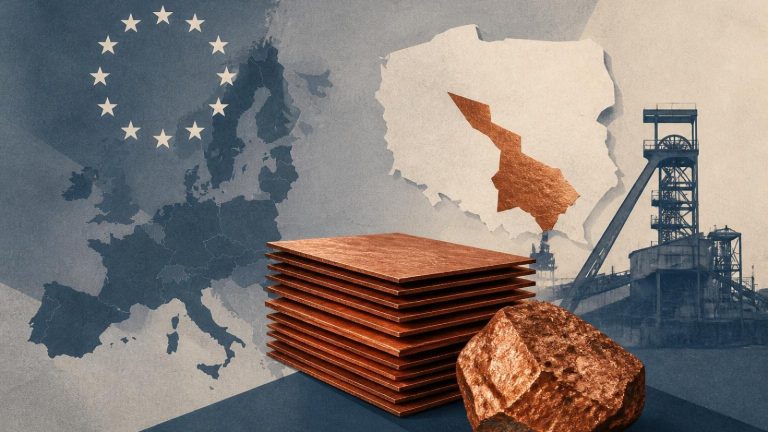
    Poland supplies between 40% and 50% of Europe’s copper, making it the continent’s dominant producer. KGHM, the state-backed metals giant that operates three underground mines alongside local smelters and operations in the Americas, ranked eighth globally in copper extraction volume last year, behind BHP, Glencore and Rio Tinto. It is also the world’s second-largest silver producer. In 2025, the group generated more than 36 billion zlotys ($9.7 billion) in revenue, producing 710,000 tonnes of copper and 1,347 tonnes of silver.

    The timing of that output matters enormously. Global copper demand is forecast to rise by more than 40% by 2040, according to a 2025 UN report, driven by the accelerating electrification of transport, the buildout of renewable energy infrastructure and surging demand from artificial intelligence data centres and defence industries. An electric vehicle contains around 80 kilograms of copper compared with 20 kilograms in a conventional car, while a single wind turbine requires between four and ten tonnes per megawatt of installed capacity. The International Energy Agency projects that supply will lag 30% behind demand as early as 2035, a gap that could require 80 new mines and $250 billion in investment by 2030.

    At KGHM’s Glogow smelter, ore is melted in furnaces at 1,200 degrees Celsius before emerging as 99.99% pure copper plates, each weighing more than 100 kilograms, which are then shipped to buyers around the world. The process underscores the vertically integrated nature of Poland’s copper industry — from extraction through refining to export — a model that gives KGHM and Poland unusual strategic weight within the European supply chain.

    That weight is being felt at the geopolitical level. Copper now appears on the strategic critical metals lists of the European Union, the United States and China simultaneously. In July, US President Donald Trump announced a 50% tariff on copper, citing national security grounds and the metal’s centrality to Pentagon procurement. Prices surged 41.7% in 2025, hitting a record $14,527.50 per tonne in January of this year, and remain elevated at around $12,000 per tonne despite the Middle East conflict and global economic headwinds.

    KGHM vice president for finance Piotr Krzyzewski framed Poland’s position in explicitly continental terms: “It’s no longer about the security of our country alone, but the security of all of Europe.” The group’s known resources are estimated to sustain operations for at least 40 years, independent of new exploration and concession activity. Water consumption at the scale required for deep mining remains a vulnerability as climate change intensifies drought risk across Central Europe.

  • KGHM Signs Impact and Benefit Agreement with Sagamok Anishnawbek for Canadian Mine Project

    KGHM Signs Impact and Benefit Agreement with Sagamok Anishnawbek for Canadian Mine Project

    Polish mining group KGHM has signed an impact and benefit agreement with the Sagamok Anishnawbek First Nation in Canada as part of plans to develop a new copper and nickel mine in Ontario. The agreement relates to the Victoria project, located about 35 kilometers west of the city of Sudbury.

    The arrangement provides for the participation of Sagamok Anishnawbek members in various stages of the project, including mine development and environmental protection activities. The agreement was signed last week by Sagamok Anishnawbek Chief Angus Toulouse and Marek Bednarz, chief executive officer of KGHM International, the Canadian subsidiary of KGHM Polska Miedź.

    KGHM, whose largest shareholder is the Polish state, is one of Poland’s largest industrial companies and among the world’s leading producers of copper and silver. The company acquired the Victoria copper and nickel deposit in 2012 but suspended development for several years due to declining mineral prices. The project was revived approximately three years ago as market conditions improved.

    According to KGHM Polska Miedź CEO Andrzej Szydło, the agreement represents a key milestone in advancing the Victoria project and demonstrates the company’s commitment to social dialogue and maintaining strong relations with local communities. KGHM also noted that it has worked with the Sagamok Anishnawbek for more than a decade during exploration activities and throughout the permitting process.

    The company said the agreement is intended to ensure stable cooperation throughout the mine’s entire lifecycle, from construction and production to eventual closure. It also provides tangible economic and development benefits for the Sagamok Anishnawbek community and guarantees its involvement in environmental protection measures linked to the project.

    The signing comes amid broader efforts by Canadian and Ontario authorities to attract international investment into the mining sector. At the same time, analysts have highlighted the importance of Indigenous consent, noting that First Nations have historically borne disproportionate environmental and social impacts from mining developments.

  • Fatal Rock Collapse at KGHM’s Polkowice-Sieroszowice Copper Mine in Poland

    Fatal Rock Collapse at KGHM’s Polkowice-Sieroszowice Copper Mine in Poland

    A tragic rock collapse at the Polkowice-Sieroszowice copper mine in Poland’s Lower Silesia region has claimed the life of a 37-year-old miner and left two others injured, mine operator KGHM confirmed on Sunday.

    The incident occurred just after 9 p.m. on Saturday evening near a water retention basin within the underground mine. Three miners were working in the affected area when the collapse happened. While two of them were promptly rescued and transported to hospital with minor injuries, the third miner was initially unaccounted for.

    Following an overnight search and rescue operation, the man’s body was found early Sunday morning. “Unfortunately, it turned out that there was a fatal accident,” a KGHM spokesperson stated, extending condolences to the miner’s family. The company has declared three days of mourning.

    A special commission will be formed to investigate the cause of the collapse and determine any necessary safety or procedural changes. The Polkowice-Sieroszowice mine is one of Poland’s major copper producers, extracting approximately 12 million tonnes of ore annually.

  • KGHM and ARP Forge Partnership for Renewable Energy Development

    KGHM and ARP Forge Partnership for Renewable Energy Development

    Listed copper producer KGHM has taken a significant stride towards renewable energy integration by signing a letter of intent with the state industrial development agency ARP, as announced in a press release by KGHM.

    The letter of intent delineates a framework for collaboration between KGHM and ARP, particularly in the realm of renewable energy sources and the facilitation of energy transformation initiatives. Among the key aspects outlined in the agreement is the joint analysis of real estate resources to identify potential investments and the exploration of opportunities for co-implementing projects.

    Additionally, both parties have committed to fostering dialogue with stakeholders from the state administration, European Union institutions, and industry organizations concerning matters pertaining to energy transition.

    In a statement quoted in the press release, KGHM CEO Andrzej Szydlo expressed the company’s strategic approach to bolstering its renewable energy capacity. Szydlo highlighted KGHM’s plans to augment its photovoltaic sources, both through independent investments on its sites and acquisitions of pre-existing plants within the country. The incorporation of photovoltaic farms into KGHM’s assets is viewed as a measure to mitigate market volatility in the energy sector, with the recently acquired installations projected to cover approximately 2 percent of the company’s electricity consumption.

    Echoing this sentiment, KGHM’s CFO, Piotr Krzyżewski, emphasized the company’s commitment to reducing carbon emissions by increasing the share of renewable energy sources in its energy mix by 2030. Krzyżewski underscored specific projects, including photovoltaic power plant installations at various KGHM facilities such as the Glogow smelter, the Cedynia smelter, the Tailings Plant, and the Obora sand plant.

    The signing of the letter of intent took place during the European Economic Congress held in Katowice, marking a pivotal moment in KGHM’s journey towards sustainable energy practices.

  • KGHM Polska Mied has entered into long-term agreement with NKT

    KGHM Polska Mied has entered into long-term agreement with NKT

    “The continuation of cooperation in such a demanding market environment is a mark of effectiveness and attests to the quality of our products. We are efficient and trustworthy. We ensure the security of supplies of metals which are critical for the global energy transformation. We are satisfied with our cooperation with NKT, our wire rod is going to one of the leaders of the European wire and cable marketplace, which provides key solutions for the European energy transformation,” said Tomasz Zdzikot, President & CEO of KGHM.

    “We are pleased to strengthen our long-term collaboration with KGHM by entering into this frame agreement for the supply of copper rod for the coming years. And even more so, that we are able to source copper close to where it is needed, which supports our efforts to reduce the environmental impact of our operations,” says President & CEO of NKT, Claes Westerlind.

    Responsible production

    KGHM consistently strengthens its status as a preferred supplier. Company’s products and services meet the highest market standards, while its stability in delivering raw materials, rapid reaction time to customer needs and its “just in time” logistics distinguish the Company on the European wire rod market.

    The metallurgical plants of KGHM produce metals responsibly and in accordance with the highest standards. KGHM’s Głogów and Legnica Copper Smelters/Refineries and Cedynia Wire Rod Plant are Copper Mark certified, which is a testimony to responsible operating practices with regards to the environment, employees, local communities and governance.

    The Company ensures the safe supply of metals which are critical for the global energy transformation through its access to primary copper deposits. At the same time the goals of the Circular Economy are being developed whilst the possibilities of utilizing recycled materials are growing. In response to the global challenge associated with sustainable development, the Company adopted an ambitious Climate Policy, in which it declared the intention of achieving climate neutrality by the year 2050. KGHM has published the results of its analysis of the environmental and carbon footprint of its products: cathodes, wire rod and Cu-OFE rod. The carbon footprint of its copper wire rod at the level of 2.3 tonnes of CO2 equivalent per tonne of copper is significantly lower than the global average of such indicators.

    Highest quality

    8 mm copper wire rod is one of KGHM’s main products. It is manufactured through the Contirod® continuous process of melting, casting and drawing, and is mainly produced from cathodes manufactured by KGHM Polska Miedź S.A. The Cedynia Wire Rod Plant produces wire rod in five classes of quality, depending on the needs of the customer. The product is primarily used in the wire and cable, electromechanical and electrotechnical industries. The wire rod market, due to its specific nature, is highly competitive and demanding.

    In 2022 KGHM Polska Miedź S.A. produced 284.8 thousand tonnes of wire rod and OFE rod, nearly 11% of European production. This result makes the Company one of Europe’s leading producers of these copper semi-products.

    About NKT

    NKT connects a greener world with high-quality power cable technology and takes centre stage as the world moves towards green energy. NKT designs, manufactures and installs low-, medium- and high-voltage power cable solutions enabling sustainable energy transmission. Since 1891, NKT has innovated the power cable technology building the infrastructure for the first light bulbs to the megawatts created by renewable energy today. NKT is headquartered in Denmark and employs 4,500 people. NKT is listed on Nasdaq Copenhagen and realised a revenue of EUR 2.1 billion in 2022.

    NKT – We connect a greener world. www.NKT.com.

    Disclaimer

    KGHM Polska Miedz SA published this content on 22 August 2023 and is solely responsible for the information contained therein. Distributed by Public, unedited and unaltered, on 22 August 2023 07:05:06 UTC.

  • KGHM has entered into long-term agreement with NKT. The Company will sell copper wire rod with a total value up to PLN 14.2 billion

    KGHM has entered into long-term agreement with NKT. The Company will sell copper wire rod with a total value up to PLN 14.2 billion

    KGHM Polska Miedź S.A. has signed another long-term sales agreement with NKT. Polska Miedź will supply entities belonging to NKT with copper wire rod in the years 2023-2027. The value of the transaction is in a range of PLN 9.6 billion to 14.2 billion, depending on additional options regarding the amount and lifetime of the agreement.

    „The continuation of cooperation in such a demanding market environment is a mark of effectiveness and attests to the quality of our products. We are efficient and trustworthy. We ensure the security of supplies of metals which are critical for the global energy transformation.  We are satisfied with our cooperation with NKT, our wire rod is going to one of the leaders of the European wire and cable marketplace, which provides key solutions for the European energy transformation,” said Tomasz Zdzikot, President & CEO of KGHM.

    “We are pleased to strengthen our long-term collaboration with KGHM by entering into this frame agreement for the supply of copper rod for the coming years. And even more so, that we are able to source copper close to where it is needed, which supports our efforts to reduce the environmental impact of our operations,” says President & CEO of NKT, Claes Westerlind.

    Responsible production  

    KGHM consistently strengthens its status as a preferred supplier. Company’s products and services meet the highest market standards, while its stability in delivering raw materials, rapid reaction time to customer needs and its „just in time” logistics distinguish the Company on the European wire rod market.

    The metallurgical plants of KGHM produce metals responsibly and in accordance with the highest standards. KGHM’s Głogów and Legnica Copper Smelters/Refineries and Cedynia Wire Rod Plant are Copper Mark certified, which is a testimony to responsible operating practices with regards to the environment, employees, local communities and governance.

    The Company ensures the safe supply of metals which are critical for the global energy transformation through its access to primary copper deposits. At the same time the goals of the Circular Economy are being developed whilst the possibilities of utilizing recycled materials are growing. In response to the global challenge associated with sustainable development, the Company adopted an ambitious Climate Policy, in which it declared the intention of achieving climate neutrality by the year 2050. KGHM has published the results of its analysis of the environmental and carbon footprint of its products: cathodes, wire rod and Cu-OFE rod. The carbon footprint of its copper wire rod at the level of 2.3 tonnes of CO2 equivalent per tonne of copper is significantly lower than the global average of such indicators.

    Highest quality

    8 mm copper wire rod is one of KGHM’s main products. It is manufactured through the Contirod® continuous process of melting, casting and drawing, and is mainly produced from cathodes manufactured by KGHM Polska Miedź S.A. The Cedynia Wire Rod Plant produces wire rod in five classes of quality, depending on the needs of the customer. The product is primarily used in the wire and cable, electromechanical and electrotechnical industries. The wire rod market, due to its specific nature, is highly competitive and demanding.

    In 2022 KGHM Polska Miedź S.A. produced 284.8 thousand tonnes of wire rod and OFE rod, nearly 11% of European production. This result makes the Company one of Europe’s leading producers of these copper semi-products.

    About NKT

    NKT connects a greener world with high-quality power cable technology and takes centre stage as the world moves towards green energy. NKT designs, manufactures and installs low-, medium- and high-voltage power cable solutions enabling sustainable energy transmission. Since 1891, NKT has innovated the power cable technology building the infrastructure for the first light bulbs to the megawatts created by renewable energy today. NKT is headquartered in Denmark and employs 4,500 people. NKT is listed on Nasdaq Copenhagen and realised a revenue of EUR 2.1 billion in 2022.

  • NKT signs long-term contract with European copper producer

    NKT signs long-term contract with European copper producer

    To secure the supply of copper in the coming years for its production of power cables, NKT has signed a long-term agreement with Polish copper supplier KGHM.

    KGHM will supply NKT with a minimum of 52,500 tons of copper wire rod annually in the years 2023-2027 with an option to expand quantities and extend the contractual period. The copper will cover a substantial part of NKT’s required supply. KGHM is an integrated copper producer with its own mineral resources, mines, smelters and copper rod production facilities in Europe.