Tag: Kazakhstan Mining

  • Caspian Sunrise Expands into Mining with $25–45 Million Acquisition in Kazakhstan

    Caspian Sunrise Expands into Mining with $25–45 Million Acquisition in Kazakhstan

    UK-based oil and gas company Caspian Sunrise plc is moving to diversify its portfolio through the acquisition of mining assets in Kazakhstan, with a deal valued between 25 and 45 million dollars.

    Under the agreement, the company will acquire 100 percent of Kazikhan Limited, which holds stakes in several entities licensed to explore and develop deposits of manganese, gold, silver, copper, and molybdenum.

    Among the key assets, GRK Borly LLP holds a production licence for manganese with confirmed reserves of approximately 8 million tonnes, while Zhambas PV controls exploration licences for gold and copper, including an estimated 700 kilograms of gold.

    The transaction reflects Caspian Sunrise’s strategic shift toward mining, aimed at increasing profitability while reducing reliance on Kazakhstan’s oil and gas sector. Company leadership views mining projects as requiring lower upfront capital and offering greater resilience to regulatory pressures and commodity price volatility.

    Kazikhan is owned by private shareholders linked to the Oraziman Family Concert Party, which collectively holds a controlling stake in Caspian Sunrise, highlighting a close alignment between the entities involved in the transaction.

    Caspian Sunrise’s core operations remain centred on its BNG contract area in western Kazakhstan, where it is engaged in crude oil exploration and production, alongside oilfield services. However, the latest acquisition follows an earlier move in December, when the company announced the purchase of another Kazakhstan-based asset containing titanium, zirconium, gold, and rare earth elements located near Ekibastuz.

    The expansion signals a broader strategy to build a diversified resource portfolio, positioning the company to benefit from both traditional hydrocarbons and the growing demand for critical and industrial minerals.

  • Altyndara Advances Development of Koktaszhal and Kyzylshoki Deposits in Kazakhstan

    Altyndara Advances Development of Koktaszhal and Kyzylshoki Deposits in Kazakhstan

    A new phase of development has begun at the Koktaszhal and Kyzylshoki deposits in Kazakhstan’s Karaganda region, following the transfer of the project to Altyndara. The company is preparing to expand geological exploration and gradually scale up production across both sites.

    As part of its development strategy, the investor has outlined plans to increase mining activity and construct a processing plant at the Kyzylshoki site. Total investment in the project is expected to exceed 500 million dollars, reflecting a long-term commitment to unlocking the resource base.

    The initiative is projected to create more than 800 jobs and generate broader economic benefits for the region, including growth in supporting services and infrastructure development.

    Preliminary estimates indicate that ore resources at the deposits exceed 50 million tonnes, with confirmed copper reserves surpassing 500 thousand tonnes. The project was previously held by Altai Polymetally before transitioning to its current operator.

    The expansion underscores ongoing efforts to strengthen Kazakhstan’s mining sector by advancing resource development, attracting investment, and increasing domestic production capacity.

  • Kazakhstan at PDAC 2026: The Next Major Frontier for Mineral Discoveries?

    Kazakhstan at PDAC 2026: The Next Major Frontier for Mineral Discoveries?

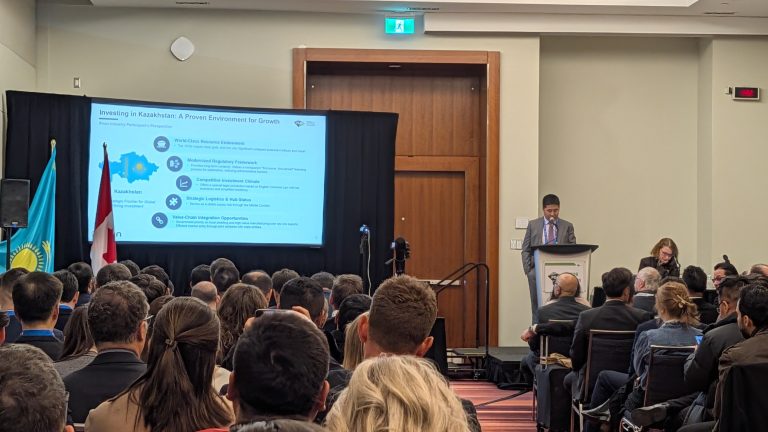
    This year marked a significant milestone as the Kazakhstan Chamber of Mines took the lead as the official organiser of Kazakhstan Day — and what a resounding success the debut turned out to be!

    Despite a packed PDAC schedule, the session drew an impressive crowd of over 130 industry leaders, investors, and exploration experts. The atmosphere in the room confirmed one thing: the global mining community is paying very close attention to Central Asia.

    MINEX Forum was proud to support the event as the Official Media Partner, capturing the insights that are shaping the next wave of exploration in the region.

    Key Highlights from the Plenary Session: The tone was set by Ruslan Baimishev, President of the Kazakhstan Chamber of Mines:

    “Kazakhstan is entering a new era of exploration — driven by robust reforms, international partnerships, and the soaring global demand for copper and critical metals.”

    We also heard high-level perspectives from H.E. Dauletbek Kussainov, Ambassador of Kazakhstan to Canada, and Iran Sharkhan, Vice-Minister of Industry and Construction.

    Expert Insights & Project Showcases: The technical session, “Unlocking New Discovery Potential in Kazakhstan,” featured a stellar line-up including Tim Barry (Arras Minerals), Charlie Liu (Zijin Mining), Simon Cooper (Pallas Resources), and world-renowned experts Anna Fonseca and Professor Jeffrey Hedenquist.

    The afternoon shifted to tangible opportunities, with project presentations from AMG Ltd, Kogadyr Gold, Taskora, and Muzbel. As Tim Barry aptly put it: “Kazakhstan offers unique opportunities for Canadian juniors to enter new jurisdictions — and the future looks bright.”

    Kazakhstan is no longer just a “prospective” jurisdiction; it is rapidly becoming the territory where the next big copper success stories are being written.

    Special thanks to the Kazakhstan Day partners:

    • General Sponsors: Aurora Minerals Group, NAC Kazatomprom, Pallas Resources.

    • Sponsors: Arras Minerals, TauGold Copper.

    Missed the session?  📺 Watch the session recordings and download expert presentations at:

  • Mercuria and Kazakhmys Form Strategic Partnership to Expand Global Copper Trade

    Mercuria and Kazakhmys Form Strategic Partnership to Expand Global Copper Trade

    In February 2026, Swiss commodity trading group Mercuria Energy Group announced an eight-year strategic partnership with Kazakhstan’s mining and metallurgical company Kazakhmys, marking a shift toward deeper industrial collaboration between global traders and resource producers.

    The agreement goes beyond a traditional financing arrangement and is structured as a long-term partnership combining Kazakhmys’ production capacity with Mercuria’s global trading and logistics infrastructure. The collaboration is expected to enhance access for Kazakh copper to international markets and modern trading mechanisms.

    One of the key outcomes of the partnership is the expansion of Kazakhstan’s copper presence in global supply chains. Mercuria’s international network will facilitate integration of Kazakhmys’ output into long-term contracts with industrial consumers, providing more stable export channels and improving visibility over future demand.

    The cooperation also предусматривает переход к международным механизмам ценообразования, основанным на глобальных товарных индексах. This approach is widely used in developed commodity markets and is expected to improve transparency in export operations, strengthen investor confidence and simplify взаимодействие с финансовыми и торговыми партнёрами.

    As part of the agreement, Mercuria plans to establish a local office and marketing centre in Kazakhstan. The facility will serve as a hub for commercial operations, market analysis and risk management, supporting the development of modern trading infrastructure within the country.

    The partnership is also expected to contribute to technological development in Kazakhstan’s mining and metallurgical sector. Areas of focus include improving processing efficiency, внедрение цифровых систем мониторинга и развитие решений по переработке отходов. In addition, cooperation with an international trading house is likely to facilitate knowledge transfer in areas such as commodities trading, risk management and hedging instruments.

    Economic benefits are expected at both national and regional levels. The expansion of export operations and development of trading infrastructure may create new employment opportunities across logistics, services, analytics and equipment supply. For Kazakhstan’s industrial regions, where mining enterprises play a ключевую роль в занятости, such initiatives are seen as strengthening economic resilience.

    The agreement comes amid rising global demand for copper, driven by electrification, renewable energy and digital technologies. In this context, the partnership between Mercuria and Kazakhmys is expected to strengthen Kazakhstan’s position in global supply chains for strategic metals and further integrate its металлургический сектор into the international trading system.

  • Kazakhstan Mining and Energy Companies Deploy AI to Improve Safety and Efficiency

    Kazakhstan Mining and Energy Companies Deploy AI to Improve Safety and Efficiency

    Industrial enterprises in Kazakhstan are increasingly deploying artificial intelligence systems to improve operational safety and efficiency, according to the Ministry of Industry and Construction.

    Several large digital initiatives are currently being implemented at facilities operated by Solidcore Resources. Four major projects aimed at automating safety and production processes are underway across the company’s mining and processing sites.

    At the Bakyrchik mining operation in the Abai region, an automated employee health monitoring system has already been launched. The system uses AI algorithms to assess workers’ physical condition before each shift.

    If the system detects high blood pressure, signs of fatigue or alcohol intoxication, the employee is automatically prevented from performing hazardous tasks.

    Solidcore Resources plans to expand the use of intelligent technologies at its other facilities, including the Varvarinskoye hub in Kostanay region and the Ertis Hydrometallurgical Plant in Pavlodar region.

    One of the upcoming systems will provide real-time personnel positioning, allowing the company to track the location of employees across industrial sites. Workers entering hazardous zones will receive automatic alerts warning them about potential risks.

    Another tool under development is a digital operator assistant designed to support personnel in making operational decisions. The system will recommend optimal technological parameters and help prevent equipment failures.

    By the end of the year, the company also plans to introduce an AI-based flotation monitoring system. The technology is expected to reduce reagent consumption and minimize metal losses during processing.

    Artificial intelligence is also being adopted by other companies within the sovereign wealth fund Samruk-Kazyna.

    The national mining company Tau-Ken Samruk is using an intelligent core analysis system that automatically identifies signs of mineralization from photographs of drill core samples.

    Meanwhile, Samruk-Kazyna Ondeu is developing a digital twin of its sulfuric acid plant in Stepnogorsk. The virtual model will simulate equipment performance and is expected to reduce operating costs by 5–8%, lower downtime by about 5%, and decrease accident rates by 2–3%.

    KazMunayGas is also expanding the use of AI technologies through its ABAI digital platform. The company reported that an AI-based waterflood management module helped generate an additional 12000 tonnes of oil production in 2025, delivering an economic benefit of approximately 1.5 billion tenge.

    Officials say the growing use of artificial intelligence across Kazakhstan’s mining, metallurgy and energy sectors is part of a broader push to modernize industrial operations and improve productivity.

  • Altynalmas Plans 19-Year Development of Karierny Gold Deposit in Kazakhstan

    Altynalmas Plans 19-Year Development of Karierny Gold Deposit in Kazakhstan

    Kazakhstan’s gold mining company Altynalmas plans to develop the Karierny deposit in the Karaganda region over the next 19 years, according to an updated mine closure plan submitted for public review.

    Under the revised mining plan, operations at the Karierny site are scheduled to run from 2026 to 2044. The project is designed to process an average of about 3 million tonnes of gold-bearing ore per year. The deposit covers an area of approximately 4.3 square kilometres and will be mined to a depth of around 200 metres.

    The Karierny site is located in the Aktogay district of the Karaganda region, roughly 100 kilometres east of the city of Balkhash. Infrastructure near the project includes the Balkhash–Aktogay railway line, a 110 kV power transmission line and the Tokrau–Sayak water pipeline. Nearby deposits operated by Altynalmas include the Dolinnoye and Pustynnoye gold fields.

    According to the company’s documentation, all approved reserves at the Karierny deposit will be mined during the project’s lifetime. The mine is expected to produce approximately 43.7 million tonnes of ore with an average gold grade of about 0.9 grams per tonne.

    Based on these figures, the total gold output from the project is estimated at roughly 39.3 tonnes over the life of the mine. At current market prices, this volume would be valued at around $6.4 billion.

    Altynalmas originally received the licence to develop the Karierny deposit in 2011, with the initial contract set to expire in 2026. The revised closure plan likely reflects a renewal or extension of subsoil use rights.

    The project also outlines environmental and post-mining land management measures. Since backfilling the open pit with waste rock is considered economically unfeasible, the site will be fenced to prevent accidents, reduce dust dispersion and stop animals or waste from entering the pit.

    After mine closure, the area could potentially be converted into a recreational water reservoir. Land disturbed during operations will also be rehabilitated to support pasture use, with soil preparation and seeding of perennial grasses planned to restore grazing land for livestock.

    Closure activities are scheduled to begin in 2045, in accordance with Kazakhstan’s legislation requiring reclamation work to start within eight months after the expiration of a mining licence. The company estimates the cost of these activities at approximately $1.8 million.

    Altynalmas currently operates nine gold deposits across Kazakhstan and remains one of the country’s largest gold producers.

  • Kazakhstan Falls Short of 2025 Mining Output Targets Despite Higher Metal Prices

    Kazakhstan Falls Short of 2025 Mining Output Targets Despite Higher Metal Prices

    Kazakhstan failed to meet its planned growth target for metallic ore production in 2025, according to the Ministry of Industry and Construction, although the sector’s value increased significantly due to higher global metal prices.

    Under the ministry’s development plan, metallic ore production was expected to grow by 3.1% in 2025. Instead, output declined by 0.2%, meaning the target was achieved at only 96.8%.

    Officials attributed the shortfall primarily to operational changes at the country’s largest gold deposit, Vasilkovskoye, which supplies roughly 20% of Kazakhstan’s gold-bearing ore. The mine is currently transitioning from open-pit to underground mining, a process that reduced production volumes and lowered the sector’s physical output index by about 2.5%.

    Additional pressure came from declining ore grades at several zinc and lead mines in East Kazakhstan Region, including the Maleevsky, Tishinsky and Dolinny deposits.

    Despite the drop in physical production, the total value of metallic ore extraction reached 5.8 trillion tenge in 2025, representing a 28.3% increase compared with 2024 due to stronger metal prices.

    The ministry also missed its target for metallurgical production. Output in the sector was expected to grow by 5%, but actual growth reached only 1.2%.

    This underperformance was linked to a slight decline in non-ferrous metallurgy production, which fell by 0.5%. Several key metals saw reduced output during the year.

    Production of refined zinc dropped by 6.6%, refined gold by 1.1%, refined silver by 10.4%, and refined lead fell sharply by 29.6%. Authorities cited declining metal content in mined ore as one of the main contributing factors.

    Operational disruptions also affected several major companies. At Kazakhmys Corporation, which accounts for about 22% of the industry, an accident involving an explosion and collapse at the Zhomart mine disrupted operations. The mine supplies about 40% of the feedstock for the Zhezkazgan copper smelter.

    In addition, shipments of approximately 40,000 tonnes of raw material from Russia’s Russian Copper Company were halted due to sanctions affecting Russian businesses.

    Another producer, Tau-Ken Altyn, saw a sharp reduction in recycled feedstock — falling from 2.5 tonnes to just 60 kilograms — because of repair work at Russia’s Amur Mining and Metallurgical Plant.

    Kazzinc, which represents about 30% of Kazakhstan’s non-ferrous metallurgy sector, also faced supply disruptions. Due to customs restrictions under the “red corridor” import regime introduced by the State Revenue Committee, the company lost a contract to import around 40,000 tonnes of raw materials from Tajikistan. Kazzinc depends on imports for roughly 40% of its feedstock.

    Overall, the ministry met 19 out of 29 performance indicators for the year. Five targets were not achieved, while final statistical data for another five indicators has yet to be confirmed.

    Despite the short-term challenges, longer-term mining output trends remain positive. Between 2021 and 2025, copper ore production in Kazakhstan increased by 31.8% to 162.9 million tonnes. Gold-bearing ore production rose by 20.4% to 39.2 million tonnes, while lead-zinc ore extraction grew by 19% to 9.9 million tonnes.

    The Bureau of National Statistics is expected to publish final industry data for these indicators on July 3, 2026.

  • Tau-Ken Samruk and Rwanda’s Ngali Holdings Sign Agreement to Develop Rare Earth Deposits

    Tau-Ken Samruk and Rwanda’s Ngali Holdings Sign Agreement to Develop Rare Earth Deposits

    Kazakhstan’s national mining company Tau-Ken Samruk, a subsidiary of the sovereign wealth fund Samruk-Kazyna, has signed an agreement to jointly develop rare and rare-earth metal deposits in Rwanda in partnership with local investment group Ngali Holdings.

    The agreement was formalised during meetings in Kigali between Samruk-Kazyna chief executive Nurlan Zhakupov and representatives of Rwanda’s mining authorities and investment institutions. Participants included Jean-Guy Afrika, CEO of the Rwanda Development Board, Alice Uwase, CEO of the Rwanda Mines, Petroleum and Gas Board, and Joseph Butera, CEO of Ngali Holdings.

    According to Samruk-Kazyna, the parties signed a Term Sheet outlining plans for joint exploration and development of rare and rare-earth metal deposits in Rwanda. The cooperation will focus on geological exploration and potential mining projects aimed at unlocking the country’s mineral resources.

    Officials from both countries also discussed broader opportunities for collaboration in the mining sector, including the expansion of geological exploration activities and technology exchange.

    Zhakupov noted that relations between Kazakhstan and Rwanda have strengthened following the visit of Rwandan President Paul Kagame to Kazakhstan in 2025, which helped open new avenues for economic cooperation.

    The planned projects highlight growing international interest in rare-earth minerals, which are critical for modern technologies including electronics, renewable energy systems and defence applications. Through the partnership, Tau-Ken Samruk aims to expand its international mining footprint while contributing technical expertise to the development of Rwanda’s mineral sector.

  • Kazzinc Loses Tajik Raw Material Supply Contract Amid Customs Controls

    Kazzinc Loses Tajik Raw Material Supply Contract Amid Customs Controls

    Kazakhstan’s largest gold producer Kazzinc, in which Swiss commodities group Glencore holds a 70.2 percent stake, has reportedly lost a key raw material import contract from Tajikistan following stricter customs controls imposed by Kazakhstan’s State Revenue Committee.

    According to Kazakhstan’s Ministry of Industry and Construction report for 2025, the contract was affected by the application of the “red corridor” customs inspection regime on imported raw materials. Kazzinc relies on imported feedstock for roughly 40 percent of its production needs, and the lost contract involved approximately 40,000 tonnes of raw materials — representing about 20 percent of the company’s imports.

    The material had been supplied from Tajikistan by a company linked to Chinese mining group Zijin Mining. The loss of the contract highlights supply chain challenges facing Kazakhstan’s mining and metallurgical sector.

    Industry data in the report indicate that production of metallic ores, excluding iron ore, declined by 0.7 percent in 2025. The drop was partly attributed to operational changes at the Vasilkovskoye deposit in Akmola region, the country’s largest gold mine operated by Kazzinc, which is transitioning from open-pit to underground mining.

    Resource depletion at several zinc and lead deposits in East Kazakhstan — including the Maleevsky, Tishinsky and Dolinny mines — has also contributed to declining output. As a result, forecasts for 2026 suggest growth in most major metals such as steel, pig iron, rolled products and copper, while production of refined gold and metallic zinc is expected to fall.

    Gold output is projected to decline from 29.45 tonnes to 21.27 tonnes due to depletion at the Vasilkovskoye mine. Zinc production is also expected to drop from 259,600 tonnes to 239,000 tonnes because of declining ore grades and uncertainty surrounding planned zinc concentrate supplies from Russia.

    Overall, production in 2025 declined across several refined metals. Output of metallic zinc fell by 6.6 percent, refined silver by 10.4 percent, refined gold by 1.1 percent and refined lead by 29.6 percent.

    These developments come as Glencore reportedly considers selling its majority stake in Kazzinc as part of a broader portfolio restructuring. Market analysts estimate the value of the asset at around $5 billion.

    Media reports have suggested that Kazakh businessman Shakhmurat Mutalip is in discussions to acquire the stake for approximately $4–4.5 billion. In early 2026, Mutalip registered two new mining companies at the Astana International Financial Centre — KazZinc Group Ltd. and Central Asia Resources Holding Ltd. — both focused on copper, lead and zinc mining and processing.

  • Proposed ERG Ownership Restructuring Raises Geopolitical and Sanctions Concerns

    Proposed ERG Ownership Restructuring Raises Geopolitical and Sanctions Concerns

    A reported restructuring of ownership at Eurasian Resources Group (ERG) is drawing attention from analysts and policymakers due to potential geopolitical implications involving sanctions enforcement, Russian financial influence and the control of critical mineral assets.

    ERG is one of the largest mining groups operating across Eurasia and Africa, with major copper and cobalt operations in the Democratic Republic of Congo. These minerals are essential for battery production, defence technologies and advanced manufacturing, placing the company within supply chains considered strategically important by Western governments.

    According to media reports and industry sources, Kazakh businessman Shakhmurat Mutalip is expected to acquire a significant stake in ERG in a transaction estimated at around $1.4 billion. The move has been interpreted by some observers as part of a broader effort by Kazakhstan’s leadership to reshape ownership structures among major domestic industrial assets.

    However, questions have emerged regarding the potential sources of financing and the broader network of business relationships connected to the proposed transaction. Some reports have suggested possible links between Mutalip and Russian banking institutions including VTB and Sberbank, both of which are subject to Western sanctions. If confirmed, such connections could raise concerns among regulators about exposure to secondary sanctions risks.

    Additional scrutiny has focused on ERG’s chief executive, Shukhrat Ibragimov. Ukrainian authorities have imposed a travel ban on Ibragimov on national security grounds, citing alleged concerns about possible involvement in facilitating sanctions circumvention by individuals connected to Russia. He has not been publicly included in Ukraine’s formal sanctions list.

    Observers have also highlighted business ties between Ibragimov and Kazakh investor Kenes Rakishev, a prominent figure in Kazakhstan’s financial sector. Rakishev is known for longstanding relationships within Kazakhstan’s political and business circles and has previously been associated with networks linked to Chechen leader Ramzan Kadyrov.

    Some reports have further drawn attention to allegations involving Kazakhstan Paramount Engineering, a defence manufacturing company reportedly linked to Rakishev through leaked communications referenced by the Kazakhstani Initiative on Asset Recovery. According to those claims, vehicles produced by the company were later observed in areas of Ukraine during the conflict. These allegations remain a subject of debate and scrutiny.

    The broader concern for policymakers lies in the strategic significance of ERG’s mineral assets. Copper and cobalt resources controlled by the group are central to global supply chains for energy transition technologies, defence systems and advanced industrial production.

    Analysts note that any ownership restructuring that increases exposure to sanctioned financial networks could potentially attract attention from regulators in the United States and the European Union. Western authorities have previously taken enforcement actions where indirect ownership structures were used to bypass sanctions.

    The situation also reflects wider dynamics within Kazakhstan’s political and economic landscape. In recent years, President Kassym-Jomart Tokayev has pursued efforts to reshape elite ownership structures that emerged during the Nazarbayev era. However, analysts note that shifts in corporate control do not necessarily eliminate the influence of longstanding financial and political networks operating across the region.