Tag: Kazakhstan mining reform

  • Kazakhstan’s Mining Reform Delivers 2.5-Fold Investment Rise But Resource Depletion Looms as MINEX Forum Weighs Next Steps

    Kazakhstan’s Mining Reform Delivers 2.5-Fold Investment Rise But Resource Depletion Looms as MINEX Forum Weighs Next Steps

    Kazakhstan’s subsoil reform programme has delivered a 2.5-fold increase in geological exploration investment — rising from $400 million in the pre-reform period of 2012 to 2017 to $1 billion between 2019 and 2024 — but the country now faces a fresh challenge: several major deposits are approaching exhaustion, and new discoveries must be made within the next five years to safeguard the industry’s long-term future.

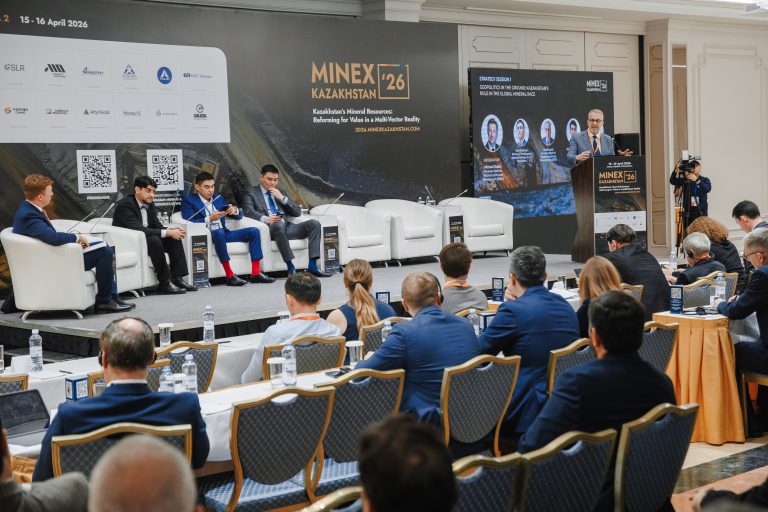
    Those were among the most striking findings to emerge from the MINEX Kazakhstan 2026 forum in Astana, where more than 500 specialists from 33 countries and 40 exhibitors gathered under the motto “Mineral Resources of Kazakhstan: Reforming for Value in a Multi-Vector Reality.”

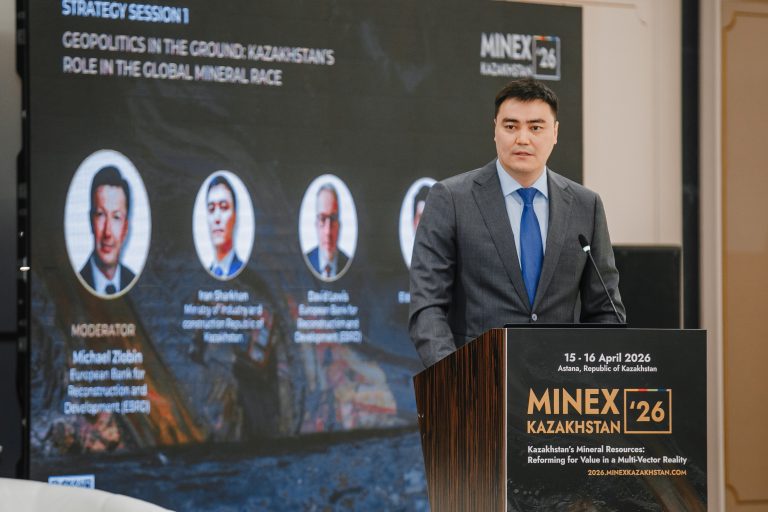
    Vice minister of industry and construction Iran Sharkhan opened a strategic session by detailing the concrete results of the 2025 exploration season. The 17 deposits newly registered on the state roster this year — including the largest, Kok-Zhon, Altyn-Shoko and Samombet — yielded reserve additions of 136 tonnes of gold, 152 tonnes of silver, 75,000 tonnes of copper and 1.3 million tonnes of phosphorites. Kazakhstan’s mineral resource base now encompasses approximately 10,000 registered deposits, and the 2018 Subsoil Code reform has created the competitive environment that produced the investment surge the sector has seen in recent years.

    Rustam Shuntukov, managing director of the mining and metallurgical complex department at the National Chamber of Entrepreneurs Atameken, acknowledged significant systemic progress — particularly the opening of virtually all of Kazakhstan’s territory to exploration through improved access to geological information and the integration of digital decision-making tools. But he struck a note of urgency on depletion. “We have old deposits where the remaining extraction period is only five to six years — that is a major risk for the sector,” he said. “We need to structure our work so that over the next five years we can open new deposits and then ensure their full development over ten years.”

    Nikolai Radostovets, executive director of the Republican Association of Mining and Metallurgical Enterprises, welcomed the influx of new investors and modern technology as a long-awaited development. But it was Ruslan Baimishev, president of the Kazakhstan Mining Chamber, who raised one of the forum’s most pointed governance questions: how to preserve market-wide transparency while extending preferential rights to strategic investors.

    Baimishev acknowledged that the strategic investor status cannot and should not be available to all — but warned that the mechanism must be clearly understood across the industry if it is not to damage the broader investment climate. “For investors operating under the general regime, transparency in decision-making is critically important,” he said. “The mechanism must be comprehensible to the entire sector, and transparency can be ensured through digitalisation and open data.”

  • Kazakhstan Vice Minister Details Royalty Shift, Strategic Investor Status and 50 New Auctions in Mining Sector Overhaul

    Kazakhstan Vice Minister Details Royalty Shift, Strategic Investor Status and 50 New Auctions in Mining Sector Overhaul

    Kazakhstan’s vice minister of industry and construction has set out the most detailed account yet of how the country intends to move away from its raw material export model, outlining a package of tax, regulatory and infrastructure reforms at the MINEX Kazakhstan 2026 forum in Astana.

    Iran Sharkhan described the transition as a shift toward a value-added economy, with domestic deep processing, technology development and the attraction of long-term strategic investors at its core. He confirmed that 2025 amendments to the Subsoil and Subsoil Use Code were designed to improve sector regulation, attract investment and digitalise licensing and permitting procedures — building a more transparent and predictable environment for business.

    On taxation, the government plans to replace the mineral extraction tax with a royalty system, a change officials say will improve transparency and better align Kazakhstan with international investment norms. Alongside this, a new strategic investor status will be introduced, granting preferential conditions to companies that commit to processing raw materials inside the country — creating a direct financial incentive for domestic value-added production rather than export of unprocessed ore.

    Sharkhan emphasised the breadth of Kazakhstan’s geological endowment, noting that the state register contains approximately 10,000 deposits. In 2025 alone, seventeen new deposits were added, including Kok-Zhon, Altyn-Shoko and Samombet. Geological survey coverage has now exceeded two million square kilometres, with particular emphasis being placed on more detailed mapping scales to improve the precision of prospective area identification.

    To expand business access to subsoil resources, auctions for exploration and extraction rights across 50 deposits of solid minerals are planned for this year. On the infrastructure side, a modern laboratory complex is being built in Astana on the basis of the National Geological Survey, with commissioning scheduled for 2028. The facility is expected to raise the quality of geological research and accelerate the pace of deposit development across the country.

  • MINEX Kazakhstan 2026 Marks Turning Point for Mining Sector as Forum Calls for Legislative Overhaul and Proactive Investor Engagement

    MINEX Kazakhstan 2026 Marks Turning Point for Mining Sector as Forum Calls for Legislative Overhaul and Proactive Investor Engagement

    Kazakhstan’s mining sector has reached a turning point, with the era of easy extraction behind it and a new strategic imperative to build domestic value chains, attract long-term investors and align national legislation with international best practice — that was the overarching message from the XVI MINEX Kazakhstan 2026 forum in Astana, held under the motto “Mineral Resources of Kazakhstan: Reforming for Value in a Multi-Vector Reality.”

    The forum brought together more than 500 representatives of government bodies, mining company executives, financiers, scientists and technology suppliers from over 30 countries. Opening the event, MINEX executive chairman Artur Polyakov declared that the global mining industry had entered a new era in which the focus is shifting from rapid extraction to the strategic use of key minerals as instruments of economic competitiveness, energy security and international influence.

    Vice minister of industry and construction Iran Sharkhan reaffirmed the scale of Kazakhstan’s geological endowment — approximately 10,000 registered deposits, with 17 new objects including Kok-Zhon, Altyn-Shoko and Samombet placed on the state register in 2025 alone — and highlighted the 2025 amendments to the Subsoil and Subsoil Use Code as a significant step toward simplified administrative procedures, investment attraction and process digitalisation.

    However, the forum also surfaced persistent structural problems. Nikolai Radostovets, executive director of the Association of Mining and Metallurgical Enterprises, acknowledged the importance of the 2018 Subsoil Code while noting that its adoption failed to fully synchronise provisions with the Land, Water, Environmental and Tax codes — a gap that continues to generate administrative barriers for exploration and production projects. “Kazakhstan must not only maintain investment attractiveness but also bring national legislation in line with the best international practices,” he said, citing growing global interest in critical and rare earth metals as a further reason for urgency.

    Geopolitical forecasting analyst Eldaniz Huseynov, founder of Nightingale Ind., argued that Kazakhstan should move beyond passive openness to investment toward actively offering turnkey projects to international partners. He identified molybdenum, zinc, cobalt, uranium and tungsten as priority resources for domestic processing, and said competition between investors from China and Europe could itself serve as a lever to improve cooperation terms. “Kazakhstan must build strategic partnerships and confidently offer its own projects to the international community,” he said, adding that investor engagement should encompass technology development, domestic supply chain integration, job creation and infrastructure commitments — not merely raw material exports.

    The forum concluded that Kazakhstan must simultaneously advance extraction infrastructure, refine its legislative framework, improve the investment climate and consolidate its position as a reliable partner in global critical mineral supply chains.

  • Kazakhstan Pivots From Raw Materials to Value-Added Economy With Royalty Reform and Strategic Investor Status at MINEX 2026

    Kazakhstan Pivots From Raw Materials to Value-Added Economy With Royalty Reform and Strategic Investor Status at MINEX 2026

    Kazakhstan is accelerating its transition from a raw materials export model toward a higher value-added economy, with deep in-country processing, legislative reform and the attraction of long-term strategic investors now at the centre of its mining sector strategy, according to the country’s vice minister of industry and construction.

    Speaking at the MINEX Kazakhstan 2026 forum in Astana, Iran Sharkhan outlined the government’s core priorities for the subsoil use sector. “Kazakhstan is moving from a raw materials model to a value-added economy,” he said. “The priority is deep processing of raw materials within the country, technology development and attracting strategic investors oriented toward long-term impact.”

    Central to the reform agenda are two significant legislative changes introduced through 2025 amendments to the Subsoil and Subsoil Use Code. The first is a shift from a mineral extraction tax to a royalty-based system, which the ministry says will improve sector transparency and make Kazakhstan more attractive for long-term investment, particularly in the deep processing segment. The second is the formal introduction of a “strategic investor” status, granting preferential conditions to investors who commit to processing raw materials domestically — creating a direct incentive for value-added industrial development over simple extraction and export.

    On the geological front, Kazakhstan’s mineral resource base encompasses approximately 10,000 registered deposits. In 2025, seventeen deposits were placed on the state register for the first time, including Kok-Zhon, Altyn-Shoko and Samombet. Survey coverage has now reached 2.038 million square kilometres against a target of 2.2 million square kilometres by 2026, with a transition to more detailed geological mapping scales planned to improve the identification of prospective areas. In 2026, auctions for subsoil use rights across 50 deposits are planned for both exploration and hard mineral extraction. A modern laboratory complex is also under development in Astana on the basis of the National Geological Survey, with commissioning scheduled for 2028.

    MINEX Kazakhstan 2026, running from 14 to 16 April in Astana, has brought together more than 500 participants, over 100 speakers, 40 exhibitors and more than 1,000 visitors from 33 countries, with industry reform, processing development and investment attractiveness as its central themes.