Tag: Kazakhstan mining policy

  • Kazakhstan Rewrites the Rules for Mining Investors With Royalty Switch and Processing Incentives at Heart of New Strategy

    Kazakhstan Rewrites the Rules for Mining Investors With Royalty Switch and Processing Incentives at Heart of New Strategy

    Kazakhstan is overhauling the terms on which it engages with the mining industry, replacing a decades-old extraction tax with a royalty system and creating a new class of privileged investor for companies prepared to process minerals inside the country — a package of changes that vice minister of industry and construction Iran Sharkhan says marks a decisive break with the country’s raw material past.

    The reforms, introduced through 2025 amendments to the Subsoil and Subsoil Use Code, are designed to do two things simultaneously: make Kazakhstan more competitive against other mineral-rich jurisdictions in the global race for investment, and ensure that the country captures more of the economic benefit from its own resources rather than simply shipping them abroad. The royalty system replaces the mineral extraction tax with a mechanism officials say is more transparent and better aligned with international investment norms. The strategic investor status adds a direct incentive for downstream commitment — companies that agree to process raw materials domestically receive preferential treatment unavailable to those focused solely on extraction.

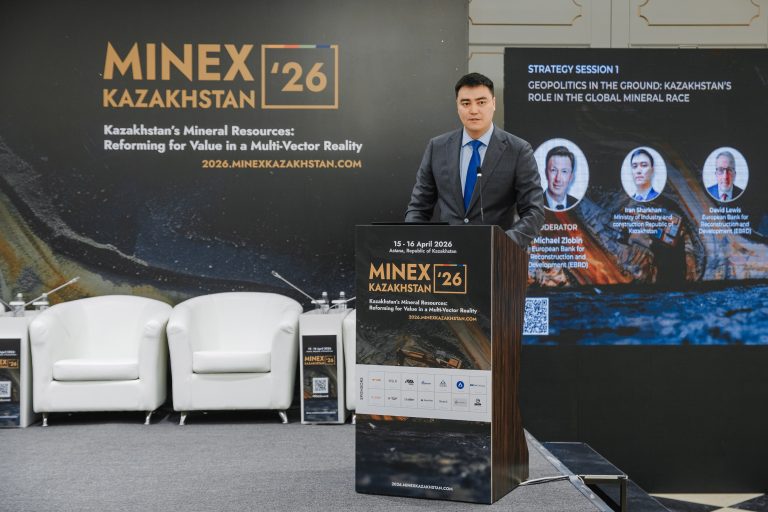
    Sharkhan told the MINEX Kazakhstan 2026 forum in Astana that the country’s geological endowment gives it an unusually strong hand to play in the current global environment. Ten thousand deposits are registered on the state books, seventeen of them added for the first time in 2025 — among them Kok-Zhon, Altyn-Shoko and Samombet. Geological survey coverage has reached 2.038 million square kilometres against a 2026 target of 2.2 million square kilometres, with a move to more detailed mapping scales in progress to sharpen identification of high-potential areas.

    To translate geological potential into investment activity, fifty deposits will go to auction this year for exploration and extraction rights. And to strengthen the scientific infrastructure underpinning the entire system, a modern laboratory complex is being built in Astana on the basis of the National Geological Survey, due for commissioning in 2028.

    The MINEX forum, running from 14 to 16 April, brought together more than 500 participants and over 1,000 visitors from 33 countries, with processing development and investment climate reform at the top of its agenda.

  • Laramide Resources exits uranium exploration project in Kazakhstan’s Chu-Sarysu basin

    Laramide Resources exits uranium exploration project in Kazakhstan’s Chu-Sarysu basin

    Canada-listed uranium developer Laramide Resources has terminated its option agreement to explore for uranium in Kazakhstan’s Chu-Sarysu basin, citing regulatory changes that have reduced the project’s economic attractiveness.

    In a company statement reported by inbusiness.kz, Laramide said it had decided to immediately withdraw from its agreement with Aral Resources, which granted access to more than 5,500 sq km of prospective ground near major uranium deposits and operating mines controlled by national producer Kazatomprom.

    Laramide explained that amendments made late last year to Kazakhstan’s Subsoil and Subsoil Use Code significantly altered the investment framework for uranium exploration. The changes increased Kazatomprom’s mandatory participation in new uranium mining ventures from 50% to 75% and granted the national company priority rights to uranium exploration, effectively limiting opportunities for foreign juniors.

    The option agreement, signed in 2024, envisaged securing up to 22 licenses in the Chu-Sarysu basin, an area considered prospective not only for uranium but also for copper and other minerals. Aral Resources had previously planned to invest tens of billions of tenge in exploration across the licensed areas.

    Laramide said it will now refocus on uranium projects in Australia and the United States, which it described as more competitive and stable mining jurisdictions.

    Commenting on the decision, Laramide CEO Mark Henderson said Kazakhstan’s policy amounted to a de facto nationalisation of future uranium exploration, increasing political, country and potential expropriation risks for new entrants. He warned that while Kazakhstan is seeking to secure long-term control over new discoveries, Kazatomprom itself faces a looming decline in its resource base, according to its own investor disclosures.

    Henderson added that underinvestment in global uranium exploration is likely to deepen future supply deficits, potentially driving uranium prices significantly higher to incentivise new discoveries and development.