Tag: Kazakhstan gold

  • Altynalmas Flags National Bank Gold Monopoly as Key Risk in AIX IPO Prospectus as Company Targets 750,000 Ounce Output by 2035

    Altynalmas Flags National Bank Gold Monopoly as Key Risk in AIX IPO Prospectus as Company Targets 750,000 Ounce Output by 2035

    Kazakhstan’s second-largest gold producer Altynalmas has identified the National Bank of Kazakhstan’s statutory right to purchase all refined gold produced in the country as a material risk to its business, according to the prospectus published ahead of the company’s initial public offering on the Astana International Exchange.

    Under Kazakhstan’s Law on Precious Metals and Precious Stones, the National Bank holds a legislated priority right to buy all refined gold produced domestically before it can be exported or sold to third parties. In practice, Altynalmas delivers virtually all of its output — in doré bar form — to the state refinery, with the refined gold then sold to the National Bank at prices linked to the monthly average LBMA gold price in US dollars, converted at the official dollar-tenge exchange rate. The prospectus, published in English only, warns that this arrangement concentrates credit risk in a single institutional counterparty and prevents the company from accessing international commodity markets directly.

    The regulatory structure also creates specific challenges for project financing. Many international lenders and project finance banks require that gold be processed at an internationally accredited facility and sold on international markets as security for loan repayment — conditions that the National Bank’s priority purchase right makes difficult or impossible to satisfy, the prospectus states.

    On production, the prospectus confirms that Altynalmas mined 433,000 ounces — approximately 13.5 tonnes — of gold in 2025, down from 511,000 ounces in 2024. The company holds proven and probable reserves of 4.4 million ounces under the JORC standard, alongside measured, indicated and inferred resources of 22.3 million ounces — sufficient, at last year’s production rate, to sustain at least a decade of operations from existing reserves alone.

    Near-term output is projected at 380,000 to 430,000 ounces annually through to 2029, supported primarily by existing and expanding assets. A more significant step-up is anticipated from 2030 to 2035, when production is forecast to rise to between 600,000 and 750,000 ounces per year — a level that would make Altynalmas one of the more significant mid-tier gold producers in Central Asia.

  • Turkey’s Miryıldız Mining Breaks Ground on $480 Million Kazakhstan Gold Project With 750,000-Ounce Deposit at Its Core

    Turkey’s Miryıldız Mining Breaks Ground on $480 Million Kazakhstan Gold Project With 750,000-Ounce Deposit at Its Core

    Turkish mining company Miryıldız Mining has announced preparations to develop the Zhanan gold deposit in Kazakhstan’s Abai Region, committing $480 million across construction, site development and exploration as the company consolidates its position as one of the more ambitious new entrants in the country’s mining sector.

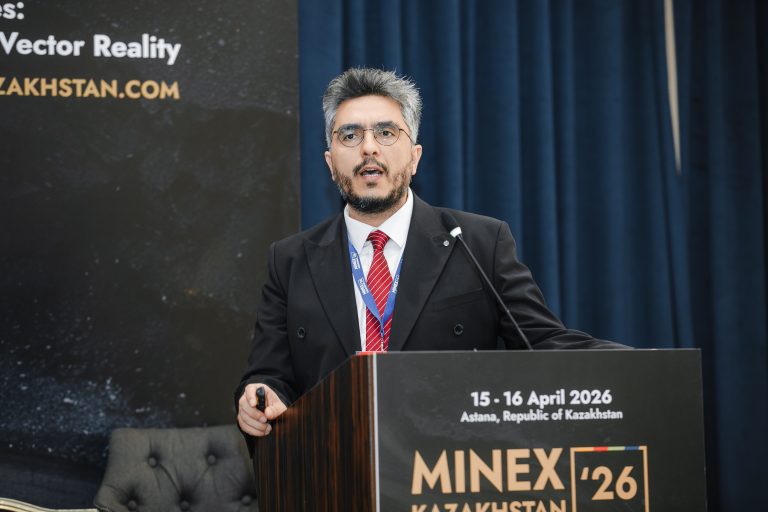
    Chief executive Emrah Erdem made the announcement at the MINEX Kazakhstan 2026 forum in Astana, confirming that construction of a gold ore production complex at Zhanan is already underway. The deposit, located 100 kilometres from Semey, holds confirmed reserves exceeding 750,000 ounces of gold — equivalent to 23.3 tonnes — across a licence area of 1,030 square kilometres. Once in production, the site is expected to employ between 1,300 and 1,800 people.

    The project is currently at the pre-production stage. Geological data on Zhanan was originally compiled during the Soviet era, when gold was previously extracted at the site using heap leaching methods. Miryıldız began its own exploration in 2025, conducting aeromagnetic surveys across the full licence area. Subsequent geophysical work and drilling confirmed the Soviet-era data and returned strong results, providing the foundation for the company’s investment commitment.

    Beyond Zhanan, Miryıldız holds four additional exploration projects distributed across Kazakhstan: a 358 square kilometre licence area near Balkhash, 440 kilometres from Almaty; a 172 square kilometre area near Bayanaul, 165 kilometres from Pavlodar; a 77 square kilometre area near Boke-Ayagoz, 175 kilometres from Ust-Kamenogorsk; and a 63 square kilometre area 130 kilometres from Almaty. Seven drilling rigs are currently active across the portfolio, with geophysical survey work ongoing at all sites.

    Miryıldız entered Kazakhstan two years ago and currently holds 25 licences — 24 exploration and one production. The company, which ranks among the three largest copper producers in Turkey, is targeting gold, copper, chromium and other metals across its Kazakhstani portfolio.

  • Turkish Miner Miryıldız Commits $480 Million to Kazakhstan Gold Project as Zhanan Deposit Targets Late 2026 Production Start

    Turkish Miner Miryıldız Commits $480 Million to Kazakhstan Gold Project as Zhanan Deposit Targets Late 2026 Production Start

    Turkish mining company Miryıldız Mining is pressing ahead with a $480 million investment programme in Kazakhstan, centred on the development of the Zhanan gold deposit in Abai Region, with production targeted to begin before the end of 2026 and a potential stock exchange listing to follow, the company’s chief executive Emrah Erdem announced at the MINEX Kazakhstan 2026 forum in Astana.

    The total investment covers construction of an ore processing plant, development of the Zhanan deposit and geological exploration across several additional licence areas. The Zhanan project — located 100 kilometres from the city of Semey — is at the pre-production stage and holds confirmed reserves of more than 750,000 ounces of gold, equivalent to over 23.3 tonnes. The deposit covers 450 licence blocks across approximately 1,030 square kilometres. Infrastructure prerequisites are already in place: the site is connected to electricity and water supply ahead of project launch.

    A field camp of 150 workers — 122 of them Kazakhstani nationals — is currently active at Zhanan. Exploration began in 2025 with a first-phase budget of $18 million across Kazakhstan, of which $17 million has already been deployed. The company has confirmed Soviet-era geological data through its own drilling programme, supported by aerial photography, aeromagnetic surveys and resistivity studies that have returned strong geophysical results.

    Erdem noted that Soviet geologists had previously extracted gold at Zhanan using heap leaching, but at grades of 0.2 to 0.5 grams per tonne — too low to be economically viable at scale. The company’s own drilling has identified higher-grade zones capable of supporting a conventional mining and processing operation. Construction of the mining project is already underway, with a workforce of between 1,300 and 1,800 people expected once gold and copper ore processing is at full capacity.

    Beyond Zhanan, Miryıldız holds a total of 25 licences in Kazakhstan — one production and 24 exploration — spanning interests in gold, copper, chromium and other metals. Its exploration portfolio includes 159 blocks near Balkhash covering 358 square kilometres, 76 blocks near Bayanaul covering 172 square kilometres, 34 blocks near Boke-Ayagoz covering 77 square kilometres, and 28 blocks on the Almaty project covering 63 square kilometres. The company has recently commenced geophysical survey work in Pavlodar and Zhetysu regions.

    Company presentation materials indicate that Miryıldız Mining is considering a listing on the Toronto Stock Exchange or a comparable exchange once production at Zhanan is underway. Erdem cited Kazakhstan’s strong geological potential and straightforward logistics as the primary factors behind the company’s decision to invest. Miryıldız is one of Turkey’s top three copper producers and operates the Gaziantep copper mine with 18 million tonnes of resources at an average grade of 1.7 grams per tonne, alongside a chrome mine and processing plant in Mersin and 137 exploration licences across multiple metals in Turkey. The company also holds five exploration licences covering 2,500 square kilometres in the Central African Republic.

  • Zijin Gold Nets $120 Million Profit in First Three Months at Kazakhstan’s Raygorodok Mine and Eyes Tripling Output to 11 Tonnes Annually

    Zijin Gold Nets $120 Million Profit in First Three Months at Kazakhstan’s Raygorodok Mine and Eyes Tripling Output to 11 Tonnes Annually

    Chinese mining giant Zijin Gold International has reported that its newly acquired Raygorodok gold mine in Kazakhstan’s Akmola Region generated approximately $190 million in revenue and $120 million in net profit in the final quarter of 2025 alone — recouping roughly a tenth of the approximately $1 billion acquisition price within just three months of completing the purchase.

    The mine, acquired from Kazakh businessman Bulat Utemuratov and formally transferred in October 2025, produced 1.2 tonnes of gold under Zijin’s ownership last year, though the company reported selling 1.3 tonnes from the Kazakhstani operation during the same period. Total gold output at Raygorodok for the full year 2025 reached 6.5 tonnes in doré form — including 6.1 tonnes from the main processing plant and 349 kilograms from heap leaching operations — meaning approximately 5.3 tonnes were attributable to the previous shareholder before the deal closed.

    Zijin reported all-in sustaining costs of approximately $1,249 per ounce following the acquisition, and said the post-acquisition transition had proceeded smoothly, with improvements in strip ratios, recovery rates and equipment utilisation. The results were aided by the record gold price rally that marked the final months of 2025.

    The company’s most significant disclosure concerns its expansion ambitions. Zijin plans to increase annual ore processing capacity from the current 6 million tonnes to 16 million tonnes, with an intermediate target of adding 10 million tonnes of annual processing capacity in the near term. That expansion is projected to lift annual gold production to approximately 11 tonnes — a level that would place Raygorodok close to the output of Kazakhstan’s leading gold producers, including Kazakhzinc, Altynalmas and Solidcore Resources, each of which produces more than 12 tonnes annually. Production guidance for 2026 is set at 6.4 tonnes. The mine’s remaining life is estimated at 16 years, with probable reserves of 84 tonnes of gold and measured and inferred resources potentially reaching 195 tonnes.

    Beyond expanding existing operations, Zijin plans to invest in exploration across six licences it holds in the surrounding area. The company intends to conduct deep and peripheral drilling within the current mining zone to extend the mine’s operational life, and will carry out exploration at the Novodneprovske and Sharyk deposits within recently acquired licence areas to assess their boundaries and resource potential.

  • Chinese Mining Firm Jinxin Secures Kazakhstan Gold Deposit Near Chinese Border After Auction Winner Defaults on Payment

    Chinese Mining Firm Jinxin Secures Kazakhstan Gold Deposit Near Chinese Border After Auction Winner Defaults on Payment

    Chinese company Jinxin Mining has been awarded the rights to develop the Ketmen alluvial gold deposit in Kazakhstan’s Almaty Region, after the original auction winner apparently failed to complete payment — handing the licence to the Chinese firm in circumstances that have drawn public scrutiny.

    The deposit, also known as Predgorny Ketmen, is located close to the Chinese border in the Uygur and Raimbeksky districts of Almaty Region, near the Ketmen and Shalkudysu rivers. Total forecast alluvial gold resources at the site were estimated in 2015 at 7.1 tonnes. According to earlier reporting from 2018, the deposit remained underexplored at that time, with its reserves not fully calculated, a gold-bearing placer extending 15 to 16 kilometres in length, and gold content ranging between 400 and 1,200 milligrams per cubic metre.

    The Ministry of Industry put the deposit up for auction in 2024. According to auction records, the winning bid was submitted by Kazakh firm Korgold at 600 million tenge, with Jinxin Mining placing second at 546 million tenge — just over $1 million. It appears Korgold was subsequently unable to meet its full payment obligation, and the subsoil use rights were transferred to Jinxin Mining, which confirmed its auction commitment. The company received formal notification of its winning status from Kazakhstan’s Ministry of Industry in November 2024.

    Jinxin Mining’s founders are listed as Liu Yanling, Chen Haiyan and the limited liability company Jinxin Mining 1, the beneficial owner of which is Tursunbek Omurzakov, a former member of parliament representing the Communist People’s Party.

    A publicly released site closure and remediation plan filed by the company provides detailed technical parameters for the operation. Mining will be conducted using open-pit methods within the riverbed and terraces of the Ketmen River, using excavator and bulldozer equipment. The quarry will cover an area of 2.2 hectares, extend approximately 1,100 metres along its axis, and reach a depth of up to 8 metres. The average gold grade at the deposit is stated at 0.27 grams per tonne. The document specifies that no long-term conservation of mining infrastructure is planned; upon completion, all structures will be dismantled and the land progressively rehabilitated, with terrain restoration and biological remediation carried out in stages as individual blocks are worked out.

    The deposit had previously been subject to exploration rights held by Tau Ketmen LLP, a company linked to the state mining holding Tau-Ken Samruk.