Tag: Japan

  • Kazakhstan Investment Day in Frankfurt

    Kazakhstan Investment Day in Frankfurt

    Analysis of the Germany-Kazakhstan Strategic Partnership

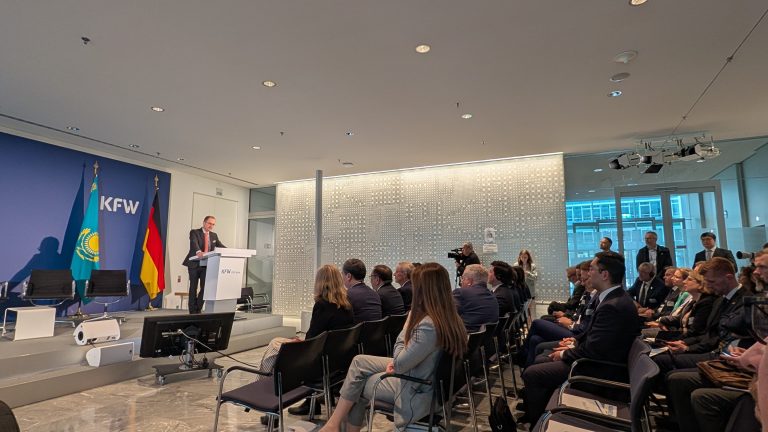
    The Kazakhstan Investment Day, held on 24 February 2026, at the KfW Bankengruppe headquarters in Frankfurt, highlighted a pivotal shift in Eurasian trade dynamics. The event centered on the deepening energy and mining alliance between Germany and Kazakhstan, a relationship that has gained strategic urgency as Kazakhstan effectively replaces Russian oil volumes and leverages deep-rooted cultural ties to strengthen bilateral cooperation.

    Financial and Strategic Framework

    The scale of this partnership is substantial, with bilateral trade recently seeing a 10% increase to reach €4 billion. Kazakhstan is currently positioned to supply 21 of the 34 critical raw materials (CRMs) identified on the EU’s strategic list.

    To facilitate this, several financial and logistical mechanisms have been established:

    • The Development Bank of Kazakhstan (DBK): A $1 billion financing program (2025–2030) has been launched, specifically dedicated to the extraction and processing of rare and critical materials.

    • Foreign Direct Investment (FDI): Kazakhstan aims to attract $400 billion in FDI by 2029, supported by Germany’s raw materials fund and backing from institutions like KfW IPEX and DEG.

    • The Middle Corridor: The Trans-Caspian International Transport Route is being developed as a highly efficient logistical artery connecting Central Asia to Europe, bypassing sanctioned territories.

    Operational Success vs. Bureaucratic Hurdles

    There is a notable contrast between engineering achievements and administrative delays. Industry leaders from Thyssen Schachtbau and Qazaq Kalium have demonstrated successful deep-shaft mining projects, proving that German technology is effectively unlocking Kazakh resources. Furthermore, the German development agency GIZ is pivoting its strategy by forming a dedicated in-country team focused exclusively on CRM partnerships.

    However, several impediments remain:

    • The “Bearocracy”: Despite the strategic need, Kazakh businesses face extreme delays and bureaucratic hurdles regarding German visa regimes, a point acknowledged by German officials.

    • Sanction Compliance: German leadership maintains a hard line, stating there will be zero support for any trade or logistics involving Russia or sanctioned companies.

    • Implementation Lag: While the financial architecture is in place, the actual development of new mining projects remains slowed by EU-wide bureaucratic processes.


    A Shifting Global Context

    The global competition for resources is accelerating. Coinciding with these discussions in Frankfurt, China introduced a supply ban of critical minerals to 40 major Japanese industrial firms over “remilitarisation” concerns. This geopolitical shift forces Japan to seek immediate alternative suppliers, placing Kazakhstan and the broader Central Asian region directly in their sights. The consensus is clear: while the foundations for a Euro-Kazakh partnership are solid, the slow pace of European administration may cause the EU to lose ground in an increasingly aggressive global race for resources.

  • Europe Scrambles for Rare Earth Alternatives as China Tightens Grip and Global Geopolitics Shift

    Europe Scrambles for Rare Earth Alternatives as China Tightens Grip and Global Geopolitics Shift

    Rare earth elements, once rarely discussed outside technical circles, have become central to geopolitical tensions as China continues to dominate both extraction and refining, as well as the manufacturing of rare earth magnets. Beijing’s decision on 8 October to intensify export controls—issued in response to tightened U.S. restrictions on AI chips—sent shockwaves across global industries that rely on these materials for electric vehicles, turbines, aircraft, semiconductors and advanced weaponry.

    Although the United States has some leverage in the rare earth space, given China’s dependence on imports of high-value American compounds, Washington ultimately agreed to Beijing’s terms during the first Trump–Xi bilateral meeting in Busan on 30 October. The deal secured a one-year truce under which China will continue supplying rare earths. In return, the U.S. will reduce tariffs on Chinese imports and lift export controls on AI chips.

    Europe, by contrast, finds itself with almost no bargaining power. As a heavy net importer with minimal domestic supply of valuable rare-earth compounds, the EU remains acutely vulnerable. Major employers such as Airbus, Vestas, Volkswagen and Europe’s EV manufacturers could face severe disruptions. The same applies to the continent’s re-emerging defence industry. Although Brussels secured the same one-year truce as Washington, European officials acknowledge that the underlying vulnerability remains unchanged.

    Meanwhile, the U.S. has aggressively accelerated efforts to diversify supply. The Trump administration is finalizing agreements with Australia, Malaysia, Vietnam, Brazil and Ukraine, while signing long-term contracts with Solvay’s La Rochelle plant in France — the world’s only refinery capable of producing all 17 rare earths at industrial scale.

    The EU’s progress has been far slower. The 2024 Critical Raw Materials Act set clear targets for 2030 — 10% domestic extraction, 40% domestic processing and 15% recycling — but these goals are widely considered unrealistic without significant investment. Funding remains scarce, and fast-track permitting systems for mining projects have yet to be established. Partnership agreements with Canada, Namibia and Chile exist only on paper, while domestic initiatives such as Sweden’s Norra Kärr, Portugal’s Mina do Barroso and German recycling efforts face regulatory delays and environmental hurdles.

    Japan’s experience offers a cautionary precedent. After China abruptly halted supplies in 2010, Tokyo invested heavily in diversification, striking deals with Australia, Vietnam and Kazakhstan, enhancing recycling and building strategic reserves. Despite this, Japan still imports 62% of its rare earths from China.

    Analysts warn that the EU cannot afford to let the one-year truce lapse without making rapid progress in reducing dependence on Beijing. One promising path lies in deeper cooperation with Japan, which is actively seeking partners to expand the scale of its emerging rare earth production and magnet manufacturing ecosystem. The EU could help by providing stable demand, even at prices higher than Chinese supply, in exchange for access to Japanese technologies and industrial know-how.

    Experts argue that only through joint development of production chains, shared R&D, and coordinated demand can Europe hope to build a viable rare earth ecosystem. Leveraging corporate capabilities on both sides may be essential for Europe to achieve supply resilience in one of the world’s most strategically important material sectors.

  • Ukraine’s Titanium Comeback: A Strategic Blueprint for Rebuilding Europe’s Titanium Industry

    Ukraine’s Titanium Comeback: A Strategic Blueprint for Rebuilding Europe’s Titanium Industry

    For decades, titanium has been a cornerstone of aerospace, defense, and high-tech manufacturing — prized for its strength, lightness, and resistance to corrosion. Yet behind this strategic metal lies a highly concentrated global industry, where only a handful of nations control production of titanium sponge, the raw metallic form of the element.

    Among them, Ukraine once stood as a global leader, the industrial backbone of the Soviet titanium complex and one of the few countries that mastered the Kroll process — the key technology for sponge production. Ukraine uniquely combined chemical, metallurgical, and scientific expertise, hosting its own Institute of Titanium and advanced hydrometallurgical facilities capable of extracting not only titanium but also zirconium and hafnium.

    Today, that legacy stands disrupted. The Russian invasion has fractured Ukraine’s heavy industry and halted sponge production since 2021. But it also opened a potential path forward: the chance for Ukraine to reclaim a central role in Western titanium supply chains, as the world scrambles to reduce dependence on Russia and China.


    Global Titanium Landscape

    According to the US Geological Survey, global titanium sponge capacity reached 410,000 tons in 2024, with production steady at around 320,000 tons. The market is heavily consolidated:

    • China accounts for nearly 69% of global output, producing mainly industrial-grade sponge for domestic use.

    • Japan, Saudi Arabia, and Kazakhstan supply almost all of the aerospace-grade sponge imported by the United States and the European Union.

    • Russia remains integrated in its own defense value chain, but sanctions have eroded margins and logistics competitiveness.

    • Ukraine, a former key player, has recorded zero production since 2021.

    While China dominates the midstream segment with state-backed clusters, low-cost energy, and full integration, it lacks certification pathways to access Western aerospace markets. By contrast, Japan and Saudi Arabia occupy the high-quality premium segment, selling sponge at $11,000–13,000 per ton, compared with China’s $7,000 average price.

    The United States and EU remain the largest consumers and stockpilers, offering the most stable and profitable end markets — but they are also the most supply-constrained.


    Why Ukraine Matters

    Ukraine is the only European nation with both a high-grade mineral base and the industrial legacy to re-enter titanium sponge production. Its ilmenite and rutile deposits can support chloride-route Kroll processing, the same route used for aerospace-quality sponge.

    Even a 10,000–15,000 tpa facility could anchor a new Titanium Cluster serving Western markets. The cluster could later expand into VAR smelting (Vacuum Arc Remelting) to produce ingots and billets, especially for Ti-6Al-4V alloys used in aviation and defense.

    Strategically, this would fill a critical gap in the non-Chinese, non-Russian titanium segment, providing Europe with a certified domestic source of titanium metal for the first time in decades.


    Key Enablers and Investment Model

    Rebuilding Ukraine’s titanium metallurgy requires three foundational pillars:

    1. Energy Efficiency and Security:
      Titanium sponge production is power-intensive, with electricity costs accounting for 20–30% of total cash costs. Stable, affordable power — ideally renewable or nuclear — is crucial.

    2. Integrated Clustering:
      A vertically integrated industrial cluster combining mining, sponge, smelting, and by-product recovery (zirconium, hafnium, germanium) would minimize costs and maximize value retention.

    3. Strategic Financing:
      A $400–700 million CAPEX is needed for a 10,000–15,000 tpa sponge facility, with an additional $350–400 million for smelting capacity. Financing could come through long-term offtake contracts with Western aerospace and defense OEMs, supported by instruments such as the U.S.–Ukraine Reconstruction Investment Fund.

    Advanced payments and consortium-based equity could unlock broader project financing, while ensuring certification alignment with Western standards.


    Outlook and Feasibility

    Global titanium sponge output is forecast to reach 400,000–440,000 tons by 2035, driven by:

    • Rising aerospace demand (notably from Airbus A320 and Boeing 737 MAX programs).

    • Global rearmament and stockpiling.

    • Ongoing supply diversification efforts by Western governments.

    Within this framework, Ukraine and India are viewed as the two most promising re-entry markets. Ukraine could restore 5,000–10,000 tons per year of production by 2035, scaling to 15,000 tons under favorable conditions.

    Even modest early-stage output would offer strategic returns: it would anchor a European titanium hub, reduce Western supply risk, and cement Ukraine’s industrial role in the critical minerals value chain.


    Conclusion

    Ukraine possesses the minerals, know-how, and geographic advantage to rebuild a titanium industry that serves Europe’s long-term strategic interests.

    If paired with targeted investment, certification partnerships, and energy reforms, Ukraine could re-establish itself as a core supplier of aerospace-grade titanium, bridging the gap between resource-rich producers and high-tech Western consumers.

    Far from a nostalgic revival, this would mark a new strategic chapter — positioning Ukraine not just as a raw material exporter, but as Europe’s titanium powerhouse.

  • Japan, Spain and South Korea Warn of Unsustainable Copper Market as Smelting Fees Collapse

    Japan, Spain and South Korea Warn of Unsustainable Copper Market as Smelting Fees Collapse

    Japan, Spain, and South Korea have issued a rare joint statement voicing alarm over the steep decline in copper treatment and refining charges (TC/RCs), warning that the current market conditions threaten the sustainability of both smelters and miners.

    The statement — released following an online meeting of the three countries’ industry ministries — comes amid mounting pressure on global copper smelters, who face shrinking profit margins due to tight concentrate supplies and growing smelting capacity in China.

    In June, several Chinese smelters agreed to process copper concentrate for Chilean miner Antofagasta at no charge, underscoring the severity of the downturn.

    “We are deeply concerned that this deterioration in TC/RCs is prompting a reassessment of copper smelting operations worldwide, with several companies already indicating intentions to scale down or withdraw from copper concentrate smelting,” the ministries said.

    TC/RCs — fees paid by miners to smelters for processing copper concentrate into refined metal — have traditionally been a key revenue stream for smelters. However, in some spot deals this year, TC/RCs have turned negative, forcing smelters to pay miners to secure feedstock.

    The ministries warned that this imbalance undermines the sustainable coexistence of smelting and mining industries and increases dependency on a narrow group of supplier countries, a scenario they described as “undesirable” for both producers and consumers.

    “We hope TC/RCs will return to sustainable levels for copper concentrate trading,” the statement said, adding that the three countries would continue engaging with stakeholders to establish a resilient and sustainable copper supply chain.

    Naoki Kobayashi, deputy director of Japan’s Ministry of Economy, Trade and Industry (METI), said the issue will be raised during LME Week in London, one of the global metals industry’s key gatherings.

    Japan’s leading copper smelters, including JX Advanced Metals and Mitsubishi Materials, have already announced plans to scale back concentrate processing due to eroding margins, reflecting a broader trend of contraction across the global smelting sector.

  • Kazakhstan and Japan Expand Cooperation in Critical Minerals Sector

    Kazakhstan and Japan Expand Cooperation in Critical Minerals Sector

    Kazakhstan’s Minister of Industry and Construction, Kanat Sharlapayev, met with representatives from the Japan International Cooperation Agency (JICA) and the Japan Organization for Metals and Energy Security (JOGMEC) to discuss further collaboration in the critical minerals sector. The meeting, reported by El.kz with reference to the Ministry of Industry and Construction, focused on strengthening ties between the two countries in resource exploration and processing.

    JICA, a Japanese government agency specializing in technical assistance programs for developing nations, has been working with Kazakhstan since 2011. Through this partnership, Kazakhstan implemented the State Energy Register (SER), a key tool for monitoring and controlling energy consumption, based on Japanese expertise.

    JOGMEC, which integrates Japan’s former National Oil Corporation and Metal Mining Agency, has been actively involved in geological exploration and mineral extraction in Kazakhstan. In August 2024, the Ministry of Industry and Construction signed a Memorandum of Cooperation with JOGMEC, outlining joint efforts in mineral exploration, mining, and processing.

    During the meeting, both parties explored the possibility of launching new projects in the critical minerals sector, crucial for industrial production and the energy sector. Strengthening partnerships in rare earth metal extraction is expected to enhance Kazakhstan’s investment appeal and introduce advanced technologies in geological exploration.

  • Navoiuran State Enterprise: Perspective Plans Discussed with Itochu Corporation

    Navoiuran State Enterprise: Perspective Plans Discussed with Itochu Corporation

    A high-level meeting took place in Uzbekistan at the state enterprise ‘Navoiuran’ with a delegation from the Japanese corporation Itochu Corporation, led by Daisuke Inoue, Executive Director and Chief Operating Officer of the Metals and Mineral Resources Department.

    The Japanese delegation was warmly received by the enterprise’s management, headed by Director General J. Faizullaev. During the discussions, the enterprise’s leadership emphasised the long-standing cooperation with Itochu Corporation, highlighting the relationship’s foundation of mutual trust and friendship.

    While the specific details of the perspective plans were not fully elaborated in the initial report, the meeting signals continued collaborative efforts between Navoiuran State Enterprise and the prominent Japanese corporation.

    The engagement underscores the ongoing international business relationships and strategic partnerships in the metals and mineral resources sector.

  • Kazakhstan and Japan Strengthen Cooperation on Critical Minerals

    Kazakhstan and Japan Strengthen Cooperation on Critical Minerals

    Kazakhstan’s Minister of Industry and Construction, Kanat Sharlapaev, met with representatives of Japan’s International Cooperation Agency (JICA) and the Japan Organization for Metals and Energy Security (JOGMEC) to discuss future collaboration on critical minerals.

    JICA has supported Kazakhstan since 2011, helping establish the country’s State Energy Registry based on Japanese expertise. Meanwhile, JOGMEC signed a memorandum with Kazakhstan in August 2024 on geological exploration, mining, and mineral processing.

    The meeting focused on expanding joint projects related to critical minerals essential for industrial and energy sectors. Kazakhstan aims to strengthen international partnerships in rare earth metals to boost investment appeal and integrate advanced geological exploration technologies.

  • A new report examines the strategic importance of titanium metal for the European Union (EU) economy

    A new report examines the strategic importance of titanium metal for the European Union (EU) economy

    The EU relies heavily on titanium imports, a critical metal used in aerospace, defense, and green technologies. A new European Commission Joint Research Centre (JRC) report highlights the risks of this dependence, exacerbated by global tensions and limited suppliers. The report analyzes the titanium supply chain and proposes strategies to increase circularity and reduce import reliance.

    The EU’s titanium consumption is substantial and expected to grow. Currently, it imports significantly more titanium than it exports, primarily in the form of products and unwrought titanium. Civil aerospace accounts for the majority of this demand, supporting a large number of jobs and contributing significantly to the EU’s GDP. However, the EU faces geopolitical challenges due to its import dependence, especially with the war in Ukraine and the concentration of titanium production in a few countries like China, Japan, Russia, and Kazakhstan.

    The JRC report suggests that increasing circularity, particularly by recycling titanium scrap from aircraft, could significantly reduce import needs and boost the EU’s titanium sector employment. The report recommends several policy actions:

    • Reshoring titanium processing: Re-establishing domestic production capacity.
    • Improving titanium recycling: Addressing barriers to large-scale recycling from decommissioned aircraft.
    • Strengthening international partnerships: Diversifying supply sources through collaborations.
    • Supporting Ukraine’s titanium industry: Integrating Ukraine into the EU’s titanium value chain post-conflict.

    These recommendations align with EU priorities like decarbonization, reshoring, and critical raw materials security, and support existing and upcoming policies such as the Critical Raw Materials Act and the Net Zero Industry Act. The JRC report emphasizes the urgent need for the EU to enhance its strategic autonomy in the titanium supply chain through circularity, reshoring, partnerships, and support for Ukraine. Initiatives like the European Defence Agency’s work on titanium circularity demonstrate practical steps towards achieving these goals.