Tag: investment opportunities

  • Kazakhstan at PDAC 2026: The Next Major Frontier for Mineral Discoveries?

    Kazakhstan at PDAC 2026: The Next Major Frontier for Mineral Discoveries?

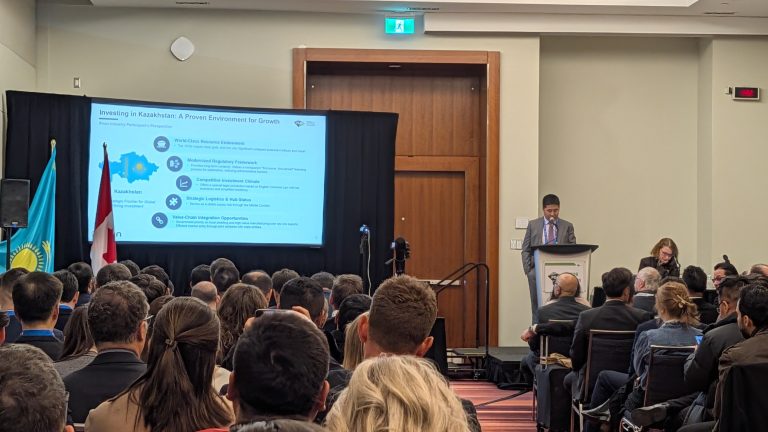
    This year marked a significant milestone as the Kazakhstan Chamber of Mines took the lead as the official organiser of Kazakhstan Day — and what a resounding success the debut turned out to be!

    Despite a packed PDAC schedule, the session drew an impressive crowd of over 130 industry leaders, investors, and exploration experts. The atmosphere in the room confirmed one thing: the global mining community is paying very close attention to Central Asia.

    MINEX Forum was proud to support the event as the Official Media Partner, capturing the insights that are shaping the next wave of exploration in the region.

    Key Highlights from the Plenary Session: The tone was set by Ruslan Baimishev, President of the Kazakhstan Chamber of Mines:

    “Kazakhstan is entering a new era of exploration — driven by robust reforms, international partnerships, and the soaring global demand for copper and critical metals.”

    We also heard high-level perspectives from H.E. Dauletbek Kussainov, Ambassador of Kazakhstan to Canada, and Iran Sharkhan, Vice-Minister of Industry and Construction.

    Expert Insights & Project Showcases: The technical session, “Unlocking New Discovery Potential in Kazakhstan,” featured a stellar line-up including Tim Barry (Arras Minerals), Charlie Liu (Zijin Mining), Simon Cooper (Pallas Resources), and world-renowned experts Anna Fonseca and Professor Jeffrey Hedenquist.

    The afternoon shifted to tangible opportunities, with project presentations from AMG Ltd, Kogadyr Gold, Taskora, and Muzbel. As Tim Barry aptly put it: “Kazakhstan offers unique opportunities for Canadian juniors to enter new jurisdictions — and the future looks bright.”

    Kazakhstan is no longer just a “prospective” jurisdiction; it is rapidly becoming the territory where the next big copper success stories are being written.

    Special thanks to the Kazakhstan Day partners:

    • General Sponsors: Aurora Minerals Group, NAC Kazatomprom, Pallas Resources.

    • Sponsors: Arras Minerals, TauGold Copper.

    Missed the session?  📺 Watch the session recordings and download expert presentations at:

  • Kazakhstan Showcases Its Geological Potential at PDAC 2025 in Toronto

    Kazakhstan Showcases Its Geological Potential at PDAC 2025 in Toronto

    The Prospectors & Developers Association of Canada (PDAC) 2025, the largest international mining convention, has officially opened in Toronto. The event brings together key industry leaders, investors, and government representatives from around the world.

    As part of the exhibition, Kazakhstan inaugurated its national pavilion, highlighting the country’s geological potential. The opening ceremony was attended by Deputy Minister of Industry and Construction Iran Sharkan, AIFC Governor Renat Bekturov, Kazakhstan’s Ambassador to Canada Dauletbek Kusainov, and PDAC Vice President Karen Rees.

    One of the key events on the first day was the international forum “Meet Kazakhstan: The Power of Geology in the Ninth Largest Nation.” Speaking at the session, Deputy Minister Iran Sharkan emphasized Kazakhstan’s rich geological heritage and mineral resources, including lithium, niobium, and tantalum.

    “Kazakhstan has a strong history in geological exploration and mining. We are committed to creating favorable conditions for investment and cooperation with both local and international partners. We actively adopt new exploration and mining technologies, while also prioritizing environmental sustainability in resource extraction and processing,” he stated.

    The panel featured leading global experts in the mining and metallurgy sector, including Canada’s Deputy Minister for Lands and Mineral Resources Rinaldo Genti, Cove Capital founding partner Pini Althaus, Neo Performance Materials VP of Corporate Development Vasileios Tsianos, Hatch Minerals Managing Director Konrad Blake, and European Commission Deputy Head of Mission Madalina Ivanica.

    PDAC 2025 will run until March 5, with the Kazakh delegation actively engaging in meetings with partners and representatives from major mining companies.

  • Experts Assess Future of US Relations with Central Asian Countries

    Experts Assess Future of US Relations with Central Asian Countries

    American experts have shared their assessments on how the relationship between the United States and Central Asian countries, which already collaborate in various formats, will develop. The opinions of these experts are detailed in a report by a correspondent of the Kazinform agency.

    A new impetus to strengthen political ties between the US and Central Asian countries was gained in September 2023 at the inaugural “C5+1” summit during the UN General Assembly in New York. During this summit, President Joe Biden met with the leaders of Kazakhstan, Kyrgyzstan, Tajikistan, Turkmenistan, and Uzbekistan. Further development occurred in the economic sphere with the involvement of both public and private sectors at the first “B5+1” Forum held in Almaty from March 13 to 15, aiming to improve the business environment between the US and Central Asia. Key experts from influential American analytical centers provided assessments on this event and the future prospects of US relations with Central Asian countries.

    Given Helf, a Senior Expert on Central Asia at the US Institute of Peace, positively evaluated the “B5+1” Forum as a result of a successful meeting between US presidents and Central Asian leaders in New York the previous year. The expert believes that all Central Asian countries are keen on attracting American investments. However, the question remains as to how Central Asian countries will create the conditions for this, what laws will be enacted to provide guarantees and stimulate American business interest in the region. According to Helf, the next stage in the development of the political “C5+1” and economic “B5+1” formats will involve expanding US cooperation with the five Central Asian countries in the security sphere, which includes a wide variety of cooperation forms ranging from protecting the interests of participant countries and companies to logistics and climate change.

    The transit corridor holds significant importance not only for sustainable economic growth in Central Asia but also for the transit of goods between Europe and China.

    Ralph Winnie, Vice President of the Eurasia Center, believes that the US and Central Asian countries are moving in the right direction. Developed American business will contribute to the development of small and medium-sized enterprises, job creation, and become an engine for economic growth in the region. “B5+1” serves as a unique platform for establishing contacts in the business environment, seeking partnerships between companies in Central Asia and the United States. According to the expert, professional contacts will develop from personal relationships.

    In Central Asia, there must be a strong security component for any kind of business in the region. In this regard, the rule of law, tax incentives, and other stimuli will be a key factor in advancing economic ties and attracting foreign investments.

    In these directions, the US will focus its attention as part of the development of multi-format cooperation with Central Asian countries.

    Ariel Cohen, Managing Director of the Energy, Economic Growth, and Security Program at the International Tax and Investment Center, noted that it is important to fill the relationship between the United States and Central Asia with substantial content and value. While the development of the economic aspect is crucial, doing business with Western companies may face some challenges. The expert reminded that the Central Asian region lacks access to the sea and is far from international markets. Consequently, this affects the cost of imported or exported goods and resources, making them less competitive. However, rare earth elements, abundant in the region, remain in demand as they do not require large volumes. Kazakhstan’s Geological Survey is highly advanced in digitizing information and ensuring its availability to potential Western investors. According to the expert, for the successful development of the “B5+1” format, measures should be taken to improve container transportation speed, reduce bureaucracy for transporting goods across multiple borders, and increase logistics capacity.

  • Kazakhstan cancels contracts for gold and titanium deposits development

    Kazakhstan cancels contracts for gold and titanium deposits development

    The Ministry of Industry and Infrastructure Development in Kazakhstan has recently shared information regarding the termination of 107 subsoil use contracts. The data, provided by LS in response to an editorial request, sheds light on the reasons behind these cancellations, with 29 contracts ending due to the expiration of subsoil use rights, four through mutual agreement, and 74 being terminated ahead of schedule due to non-compliance with obligations. It is worth noting that all these companies are residents of Kazakhstan.

    In the Akmola region, 15 contracts have been terminated, with seven expiring naturally and eight being terminated ahead of schedule. These contracts involved the exploration and extraction of various resources, including gold, iron, manganese, and solid mineral formations.

    The Karaganda region witnessed the premature termination of 16 contracts. Among them were deposits such as Koktenkol, Kaskyrkazgan, Itmurindy, Kozhattauskoye ore field, Mystobe, and others. Subsoil users in this region were engaged in the search for and extraction of resources such as tungsten, molybdenum, copper, gold, silver, coal, chrysoprase, jadeite, and more. Additionally, 11 contracts have expired in this region, including those related to deposits like Aktas-1 and 2, Tamdy-Sainbulak, Northern and Southern squares, Kyzyl Kazan-1, Borsheuken Akkens, Tesiktas, Borly, and Atbas.

    The document for the East Balkhash-1 deposit, located in the Karaganda and East Kazakhstan regions, has also expired.

    In the East Kazakhstan region, one contract for the Khamir square was mutually terminated, while 12 contracts were terminated ahead of schedule. These contracts pertained to the exploration and extraction of polymetals, gold, copper-molybdenum ores, coal, and other resources.

    The Kostanay region saw the premature termination of agreements for the Mayatas (gold, silver, platinum, copper, lead, zinc, yttrium, and rare metals), Eltay-4 (iron), Kutukhinskoye (gold), and Shevchenkovskoye (nickel, cobalt) deposits.

    In the Pavlodar region, three contracts were terminated ahead of schedule, involving coal and gold.

    The Aktobe region witnessed agreements with subsoil users on three documents, while another six contracts were terminated. These contracts were associated with the exploration and extraction of resources such as gold, bauxite, copper-porphyry ores, and phosphorites.

    The premature termination of the subsoil use contract for the Shugul deposit (potassium salts) occurred in the West Kazakhstan region. Similar actions were taken against subsoil users of four deposits (mineral salts) in the Mangystau region.

    In the Almaty region, the terms of three contracts for the Predgorny Ketmen, Dalabai, and Utegen-2 deposits have expired, and three more contracts were terminated ahead of schedule. Gold, silver, and copper were among the resources being searched for and extracted in this region.

    In the Zhambyl region, 12 contracts have been terminated, with five expiring naturally and seven being terminated ahead of schedule. These contracts involved the exploration and extraction of resources such as gold-bearing and barite ores, silver, gold, polymetals, iron, alluvial gold, coal, titanium, gold, and lead-zinc ores.

    Furthermore, four contracts were terminated ahead of schedule in the Kyzylorda region, where subsoil users were working on deposits such as Jaxi-Klychskoye 2 and 3 (sodium sulfate), Koskol (copper-gold-bearing ores), and Ak-Espe area (titanium-zirconium).

    In the Turkestan region, six subsoil use contracts have been terminated ahead of schedule since the beginning of 2022. Two of them expired naturally, and the remaining three were terminated prematurely. The resources being explored and extracted in these contracts included iron-copper ores, polymetals, barites, and iron.

    Additionally, two contracts were prematurely terminated in the Ulytau region.

    The Ministry of Energy has also shared that since 2022, 35 subsoil use contracts have been terminated across various regions, namely Aktobe, Atyrau, West Kazakhstan, Mangystau, Kyzylorda, Zhambyl, and Almaty. The main reasons behind these terminations were the expiration of subsoil use contracts and the failure of subsoil users to fulfill their contractual obligations.

    Minister of Energy Almasadam Satkaliyev has previously highlighted that, since 2022, 29 contracts have been terminated, with debts amounting to 1.9 billion tenge being repaid for nine of them. The returned subsoil plots areput up for auction to attract investments, and electronic auctions have proven successful in this regard. In fact, in July, 11 subsoil plots were sold, fetching a signature bonus of 3.4 billion tenge. These auctions encompassed both exploration and production contracts, as well as production contracts alone.

  • German Company Considers Producing Sodium Cyanide in Egypt for Gold Mining

    German Company Considers Producing Sodium Cyanide in Egypt for Gold Mining

    The Egyptian Ministry of Petroleum announced that Germany’s CyPlus is interested in establishing a new production plant for Sodium Cyanide in Egypt that is used as part of the gold mining and extraction process.

    CyPlus is a leading company with advanced technology services and innovative solutions. It ensures safe use of cyanide production, transportation, and disposal.

    The company utilizes new innovative technologies to develop gold extraction and mining procedures.

    The working group will decide on the necessary procedures and find a suitable location in the Eastern Desert for the new production plant and will also work on researching the required technologies and local market needs.

    Sodium cyanide is a colorless sodium salt. It is prepared from sodium amide by heating it with carbon at 800 degrees. It is used in the treatment and extraction of gold.

    A press statement released by the Egyptian Ministry of Petroleum and obtained by Asharq Al-Awsat, said the German company has a “desire to establish a plant for the production of sodium cyanide.”

    Minister of Petroleum and Mineral Resources Tarek El-Molla met with Chairman of CyPlus Stefan Welbers on Wednesday to discuss the investment opportunities available to the company in Egypt.

    During the meeting, Molla stressed the need to localize industries for products complementary to the mining activity, citing the remarkable development in gold mining, the successful gold bid, and the entry of several international companies into the promising field.

    He indicated that the authorities are studying the feasibility of establishing such factories. He added that the ministry is working on a strategic plan to enhance mining activity and establish more factories to boost it, especially those importing products in foreign currency.

    The minister highlighted the importance of developing the industry sustainably and implementing green mining requirements. He stressed the need for increasing mining capabilities while working towards reducing environmentally harmful emissions.

    For his part, Welbers confirmed that the company provides safe and responsible uses of cyanide, starting from production, through transportation and circulation processes, to application and exchange.

    He indicated that CyPlus dedicates its capabilities to providing new solutions that boost productivity and innovatively develop the gold mining process.

    He praised the remarkable developments in the mining field in Egypt, saying it holds promising opportunities for investment.